Greek Mythology
Theseus and the Minotaur — Greek Mythology
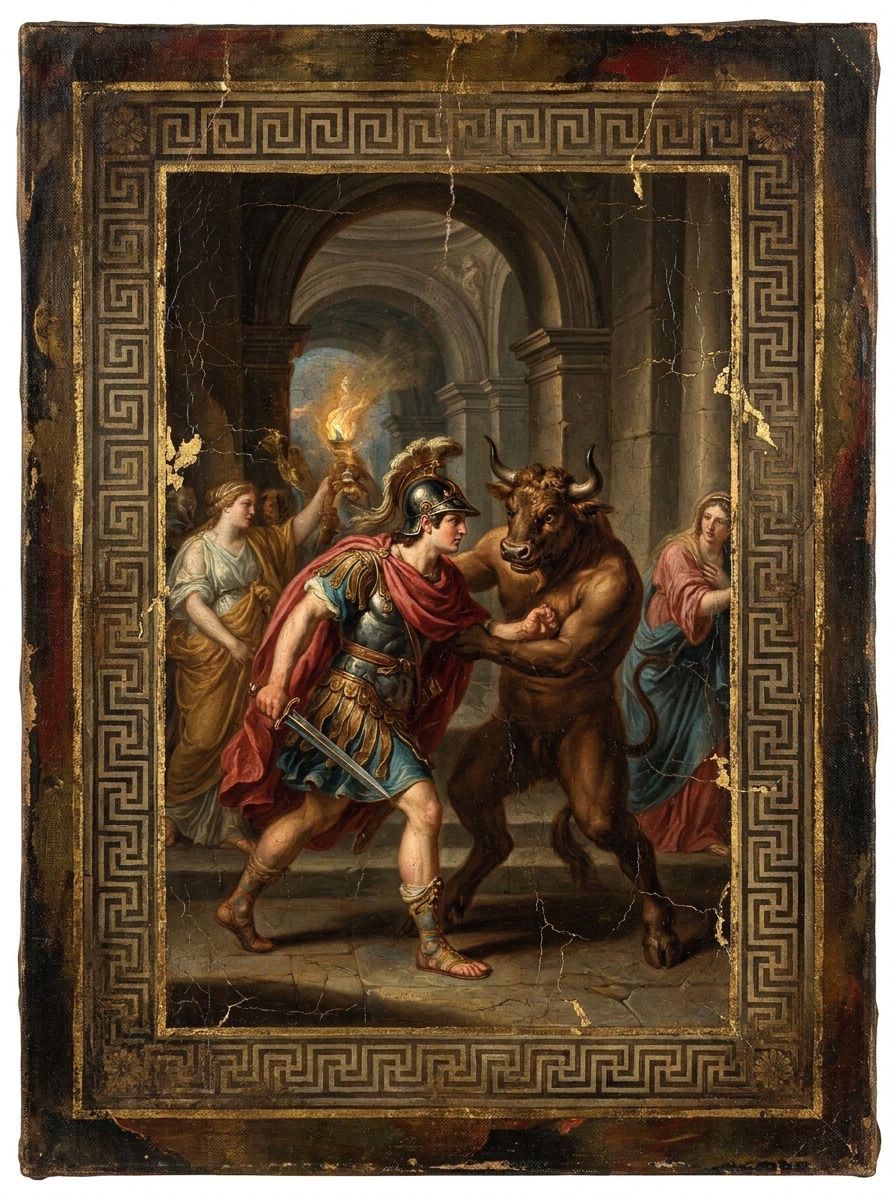
Every nine years, Athens was forced to send seven young men and seven young women across the sea to Crete as a tribute to the monster in the Labyrinth. Theseus volunteered to go. With Ariadne’s help, he slew the Minotaur and led his companions out, but in his joy he forgot to hoist the white sail, and his father, Aegeus, died in grief after throwing himself into the sea.
Article
Summary
King Minos of Crete, grieving and angered by the death of his son Androgeus in the region of Athens, forced the Athenians to send seven young men and seven young women at fixed intervals. These youths were carried to Crete and shut inside the Labyrinth built by Daedalus, where they became prey for the Minotaur, the creature with a man’s body and a bull’s head. When Theseus returned to Athens, he saw that his father Aegeus and the whole city still lived beneath the shadow of the black-sailed tribute ship. He chose to sail with the next group of victims and promised Aegeus that, if he came home alive, the ship would return with white sails instead of black. In Crete, Theseus drew the attention of Ariadne, the daughter of Minos. She knew that even a man who killed the monster could still die lost in the maze, so she secretly gave him a ball of thread and told him to fasten one end at the entrance. In return, she asked him to take her away from Crete if he survived. Theseus entered the Labyrinth, followed the thread into the dark passages, and faced the Minotaur where the stone corridors closed around them. After a brutal struggle, he killed the monster and led the Athenian youths back along Ariadne’s line until they reached the door and breathed the sea air again. That night Theseus fled Crete with Ariadne and the rescued Athenians, but Ariadne was left behind at Naxos according to the old traditions. On the way home, Theseus forgot to change the sail. Aegeus saw the black sail from the shore, believed his son dead, and threw himself into the sea. Theseus returned as the savior of Athens, but also as a son marked by grief.
The Black-Sailed Ship Comes to Athens
In Athens there was a custom that hung over the city like a curse.
Every nine years, the Athenians had to choose seven young men and seven young women and send them across the sea to the island of Crete. When the ship set out, it carried black sails. There was no singing aboard it, and no one on the shore could smile as it left. Parents walked beside the harbor, some reaching toward the rail, others weeping with their heads bowed. After the children were taken away, few ever heard of them again.
This cruel tribute began with Minos, king of Crete.
His son Androgeus had once come to the region around Athens to compete in athletic games, and by strength and skill he had beaten many opponents. Later he died there. The stories about his death differ: some said the Athenians were jealous of him; others said he was sent against the bull of Marathon and was killed. When Minos heard the news, he was furious. He brought his fleet against Athens, and then the city was struck by famine and plague. With no way out, the Athenians were forced to accept Crete’s terms: at fixed intervals they would send fourteen youths, seven boys and seven girls, as blood-price for the death of the prince.
The place where these children were taken was a dreadful Labyrinth near the palace of the Cretan king.
That Labyrinth had been built by the master craftsman Daedalus. It was no ordinary house. One door led into another, one corridor turned into the next, and the stone walls were cold and hard, so that every footstep seemed to strike back from somewhere else. Anyone who entered quickly lost all sense of direction. Deep within it was the Minotaur. It had a human body but the head of a bull, and when it breathed, its breath came rough and heavy. Its horns shone at the tips, and when hunger came on it, it stamped and roared in the dark. Those who were sent into the maze almost never came out alive.
That day, the black-sailed ship was once again ready to depart. Athens was filled with lamentation. King Aegeus was old now. He sat in the palace and listened to the crying outside, his face as gray as stone. It was then that his son Theseus stepped forward.
Theseus Boards the Tribute Ship
Theseus had only just returned to Athens.
He had not been raised in the royal palace, but in Troezen. When he came of age, he moved the sword and sandals his mother had hidden beneath a great stone in his youth and journeyed overland to Athens, clearing the road of robbers and ridding it of wicked men. Only after he reached the city did Aegeus recognize the young man as his own son. Father and son had been reunited for only a short while when the black-sailed ship was once more about to carry off the children of Athens.
Seeing the parents of the city weeping as they sent their sons and daughters away, Theseus could not remain silent. He went before Aegeus and offered to sail as one of the tribute.
Aegeus was nearly unable to stand when he heard it. He had already lost hope once before; now that he had finally found his son again, how could he watch him go to his death? He begged Theseus to stay and said that the Minotaur was no ordinary beast, and that the Labyrinth was no place from which courage alone could bring a man back.
But Theseus would not yield. If no one ever faced the horror, he said, Athens would remain forever beneath the black sails and the sound of mourning. He would enter the maze, kill the monster, and bring back the young men and women who had gone with him.
Aegeus could not stop him. At last he ordered a white sail to be prepared and handed it to the helmsman. Then he took Theseus’s hand tightly and said, “When the ship sets out, it must still carry the black sail. If you come home alive, remember to hoist the white one instead. Then I will know from far off, standing by the sea, that you are safe.”
Theseus promised he would.
When the ship left the harbor of Athens, the black sail swelled in the sea wind. Those on the shore watched it shrink until it was only a dark speck. Theseus stood at the prow, looking out across the water as wave after wave broke and fell away. Beside him, the young men and women were pale with fear. Some hugged their knees in silence; others wept in whispers. Theseus told them that so long as he still breathed, he would not let them die uselessly in the maze.
The Princess in the Palace of Crete
When the ship reached Crete, the young men and women were led into the palace of Minos.
The Cretan halls were broad and bright, their columns painted in vivid colors, their walls alive with figures of bull-leapers and flowers in bloom. Yet to the children of Athens, the stone beneath their feet felt cold. They knew that once the ritual was done, they would be taken into the Labyrinth.
Minos sat high above them and studied the tribute. When he saw that Theseus did not cower, he paused and let his gaze rest on him. This Athenian youth did not look like a man dragged there to die. He looked instead as if he had come into enemy land with a purpose of his own.
There was also a princess in the palace, Minos’s daughter Ariadne. She too saw Theseus. He stood among the captives with no rich ornaments on him, yet he carried himself with his back straight. While the others looked down, he gazed toward the Labyrinth, as though in his mind he had already walked that dark road.
Ariadne’s heart stirred.
She knew what lay inside the maze. She knew that once a person entered it, he seldom found his way out again. That night she came secretly to Theseus and said, “If you go in with nothing but courage, you may kill the beast, but you will die there yourself. The paths of the Labyrinth will trap you.”
Theseus asked her what he should do.
Ariadne produced a ball of thread, strong enough to be let out for a long distance. In some versions of the story she also gave him a weapon; in others, Theseus fought the creature by his own strength. But whatever the case, the thread was the most important thing of all. She told him to tie the end to the entrance, then unwind it as he went deeper in. When the deed was done, he would need only follow the thread back to the door.
She placed it in his hand and lowered her voice. “If you come out alive, take me away from Crete.”
Theseus promised that he would.
The Thread Leads into Darkness
The next day, the young men and women of Athens were brought before the entrance to the Labyrinth.
When the gate opened, a chill breath came rushing from within. The torches could light only the nearest stone walls; beyond them the corridors bent away into darkness. From somewhere farther in came a low, heavy breathing, like a bull stamping underground, or a man groaning in pain.
Theseus tied the end of the thread firmly to a stone pillar beside the door. He looked back once at his companions and told them to stay close and not to run. Then, with the thread in one hand and his weapon in the other, he entered the maze.
The paths split at once. To the left was a low passage; to the right, another door turned around a stone wall. On the floor lay old bones, torn scraps of cloth, and marks where bodies had been dragged. As the torchlight flickered, the shadows on the walls seemed to move like living things. The youths held their breath and followed Theseus closely. Thread slipped little by little from his hand and fell at his feet, leaving behind them a slender trail.
The deeper they went, the nearer the monster’s voice became.
Then, suddenly, a roar burst out ahead of them. The Minotaur came charging from the darkness, its bull’s head lowered and its horns aimed straight at them. Its hooves struck the stone floor with a weighty thunder. The young men and women cried out and stumbled back, and one torch nearly fell.
Theseus did not retreat. He slipped aside from the creature’s first rush, and its horns slammed into the wall, making the stone ring. The Minotaur wheeled and lunged again, hot breath streaming from its nostrils. Theseus moved close along its flank, avoided the horns, and seized his chance to strike back. Deep in the maze, the sounds of battle echoed everywhere: breathing, footsteps, blows, and roars, each louder than the last.
This was no combat beneath the sun, with onlookers and cheers. There was only stone, torchlight, and the frightened youths trembling nearby. Theseus fought with all his strength, grappling with the beast until at last he brought the Minotaur down and ended its roaring in the Labyrinth.
The darkness fell suddenly silent.
For a moment the youths could scarcely believe it. Only when they saw that the creature no longer moved did they slowly gather near. Some wept; some sank to their knees, panting. Theseus did not let them linger. He picked up the thread and said quietly, “Follow me. We go out at once.”
They went back along the thread. Every path that had seemed ready to swallow them on the way in now opened before them like a narrow shining road. At last the light of the entrance appeared ahead. When they emerged from the maze, the air outside carried the smell of the sea, and many of them felt for the first time how precious simple breathing could be.
The Night Escape
Theseus did not remain in Crete.
Once Minos learned that the Minotaur was dead and that Ariadne had helped the Athenians, he would never have spared them. So Theseus took the rescued youths and Ariadne as well, and under cover of night they hurried to the shore. The ropes were cast off, the rowers kept their voices low, and the ship slipped away from Crete into the dark.
Night lay deep over the sea, and the lights of the palace were left far behind. Ariadne stood on the deck and watched her homeland fade into darkness. For Theseus’s sake she had turned her back on her father and left her own palace behind. Theseus comforted her and said that the ship would carry them to a new place.
Later the ship put in at an island near Naxos. The ancient stories do not agree on what happened to Ariadne there. The common version says that Theseus abandoned her; another tradition says that Dionysus later made her his bride. Whichever tale one follows, Ariadne did not sail back to Athens with Theseus. The wind moved over the island’s rocks, and her figure remained behind on that shore.
Theseus went on, bringing the Athenian youths home. Relief at escaping the maze, the silence after leaving Ariadne, and the long winds of the sea all mingled together. The company had survived, yet the ship was not filled only with rejoicing.
And along that journey, Theseus forgot the most important thing of all.
He forgot to change the black sail to white.
Aegeus Sees the Black Sail
Back in Athens, Aegeus had been waiting all this time.
Ever since the tribute ship had gone out, he had often gone to the shore and looked toward the horizon. The old man stood on the heights and watched the ships come and go across the water. Whenever a white wave lifted in the distance, he hoped it might be his son’s return. Whenever he was mistaken, he would fall back into silence and go home again.
At last, one day, a familiar ship appeared far off.
It came closer and closer. Aegeus narrowed his eyes and saw that the sail still hanging from the mast was black. That black cloth stood out sharply in the sunlight, as though it were blotting out the last trace of hope.
The old man did not wait for the ship to dock. He believed Theseus was dead in Crete, swallowed up like the countless children who had never come home. Grief overwhelmed him at once. He threw himself from the heights into the sea. From then on, that water was called the Aegean Sea.
Only when the ship entered the harbor did Theseus learn what had happened.
He had saved the youths of Athens, killed the Minotaur, and brought an end to the terror that had come each year with the black-sailed ship. But what met him was not his father’s embrace, only the news that the king was dead. Theseus stood at the harbor and looked at the still-unfurled black sail, and his heart grew so heavy that he could not speak.
From that time on, Athens no longer had to send its children to the maze in Crete. Theseus became king of Athens. His name was remembered together with the thread that saved them, the Minotaur that fell in the depths, and the black sail that brought death to Aegeus on the shore.