Greek Mythology
Theseus and the Amazons — Greek Mythology
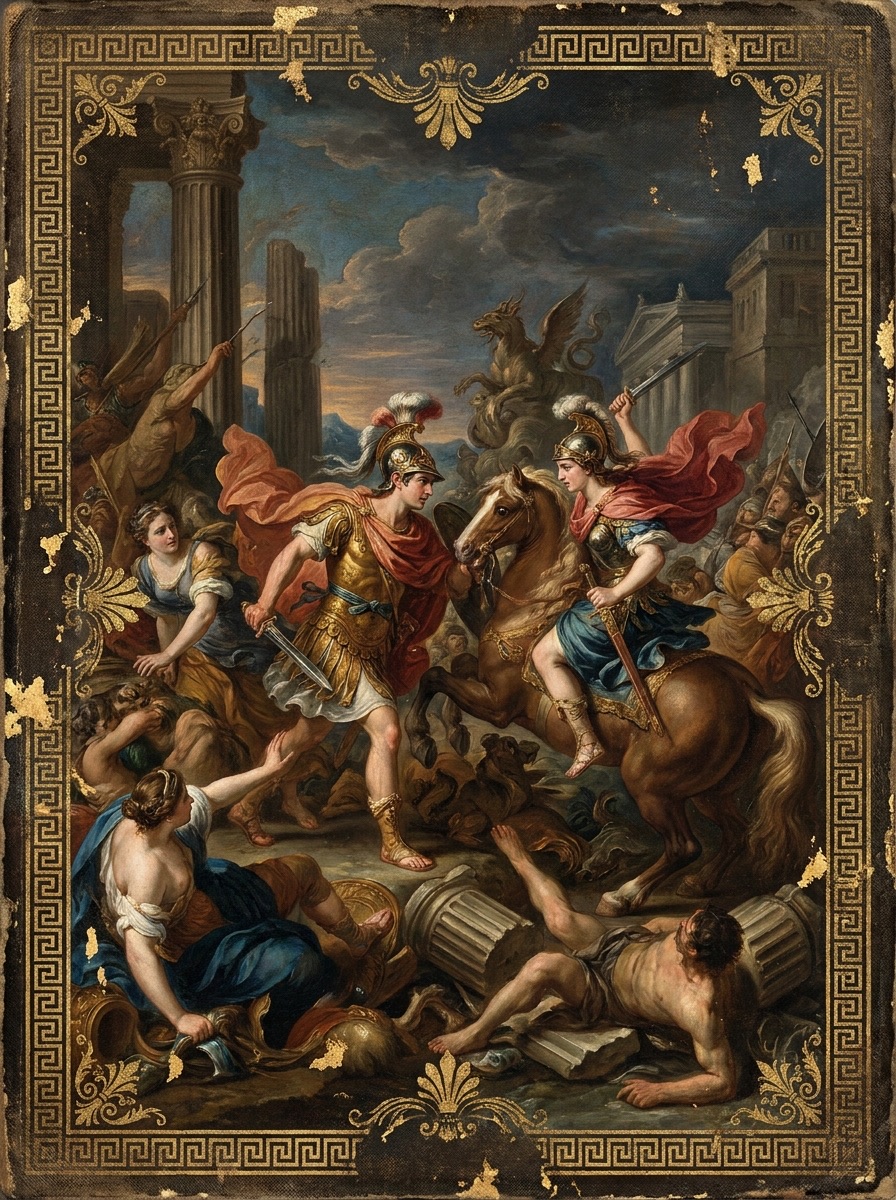
Theseus sailed far across the sea to the land of the Amazons and carried away Hippolyta, one of their royal women. The Amazons pursued him all the way to Athens. After a bitter battle beneath the city, Hippolyta died; Theseus saved Athens, but he was left with a motherless son, Hippolytus.
Article
Summary
After Theseus had secured his place in Athens, he was still drawn toward distant ventures. He joined other heroes across the sea and came to the lands of the Amazons near the Black Sea. There lived women warriors who rode horses, drew bows, commanded armies, and followed queens whose names stirred both curiosity and fear among the Greeks. The old stories do not agree on how Theseus carried off Hippolyta. Some say she was seized in battle; others say she stepped aboard his ship to greet the visitors, only for the vessel to pull suddenly away from shore. In every version, she left her own people, came with Theseus to Athens, and bore him a son, Hippolytus. The Amazons did not forget the shame of her loss. They gathered horsemen, bows, and spears, crossed a great distance, and came against Athens itself to recover Hippolyta and punish Theseus. The Athenians rushed to arms, and the fighting reached the gates, streets, and sacred places of the city. Hippolyta stood on Theseus’s side, which made the war more painful than an ordinary siege. She faced the people of her birth while defending the home and child she had gained in Athens. Amazon riders struck at the Athenian lines, the Athenians closed ranks behind their shields, and in the confusion Hippolyta fell. The Amazons were finally driven away, and Athens survived. Yet the victory was bitter: graves and old place-names remained in the city, Theseus lost the woman he had brought from across the sea, and Hippolytus grew up without his mother. The war made the wounds of Theseus’s heroic life enter his own household.
The Women Warriors Beyond the Sea
After Theseus killed the Minotaur and returned from Crete, the Athenians already looked to him as one of the great pillars of their city. Yet the young king was not a man made only for a throne. In the palace there were stone columns, altars, and orderly feasts; beyond the city lay mountain roads, sea winds, and rumors from distant lands. Whenever news of a heroic expedition reached Athens, his heart stirred toward it.
In those days the Greeks often spoke of a strange people living beyond the sea, along the shores of the Black Sea and in the wide lands farther on. They were women unlike the women of ordinary households. They did not sit beside the loom; they rode horses, wore hides or short armor, carried curved bows at their waists, and held long spears in their hands. From childhood they learned to shoot and hurl the javelin, and they could turn in the saddle at full gallop and send an arrow behind them. People called them the Amazons.
The Amazons had cities of their own, and queens to rule them. They honored Ares, the god of war, and when they rode out to battle they swept across the plain like wind. Many Greek heroes had heard their name with both wonder and caution. Theseus heard those tales too. Later, when an expedition set out against the Amazons, he was among the heroes who sailed with it; another version says that he went on a separate voyage with ships of his own. Whichever tale is told, Theseus’ vessel came at last to that unfamiliar shore.
As the ship drew near land, the water darkened, and the wind carried the smell of grassland and damp earth. The Greeks shipped their oars and watched the shore. Far off, dust rose into the air. A troop of mounted women appeared on the slope. They did not flee in fear. They reined in their horses and studied the men who had come from the sea.
Theseus stood at the prow and looked back at them. He had seen robbers, wild beasts, and the monster in the Labyrinth of Crete, but seldom had he seen an army like this: no clamor, no disorder, horses held in close formation, quivers slanting across shoulders, bright spearheads trembling slightly in the sun.
Hippolyta Comes Aboard
Among the Amazons, one woman stood out above the rest. She was young, brave, and those around her obeyed her command. Most old stories call her Hippolyta; other traditions call her Antiope, or divide the names among different Amazon queens. Here we follow one widely told version and call her Hippolyta.
The ancients did not tell the same story about how Theseus obtained her.
Some said that after the Greek heroes landed, fighting broke out between them and the Amazons. Spears struck shields, horses pounded over the sand, the women drew their bows, and the Greeks advanced behind their shields. In the confusion, Theseus seized his chance and carried Hippolyta away. Others said it did not happen in the midst of battle. At first the Amazons did not attack. They came to the ship with gifts, wishing to look at these strangers from far away. Hippolyta stepped onto Theseus’ vessel, perhaps to speak with him, perhaps to offer gifts. But as soon as her feet touched the deck, Theseus ordered the mooring ropes loosed. The sailors thrust their oars into the water, and the great ship slid away from shore. On land the Amazons cried out and urged their horses after it, but the sea stood between them.
Whichever version one follows, the result was the same: Hippolyta left her people and went with Theseus to Athens.
The voyage home was long, and the ship rose and fell among the waves. Hippolyta watched her homeland sink farther and farther behind her, and her heart could not have been at peace. She was no ordinary captive. She had once given orders from horseback; she had been honored by her own people. Now she stood on the ship of a foreign hero, with the endless sea behind her and unknown Athens ahead.
Theseus brought her into the city. The Athenians looked with amazement at this woman from a distant land. She did not live like the women of their own households. She knew the bowstring, the saddle, and the order of battle. In time she bore Theseus a son, named Hippolytus. In that child ran the blood of the royal house of Athens and the blood of the Amazons. Theseus loved his son, and he knew the boy was unlike other children in the city. His mother’s homeland lay beyond the sea, and her people would not easily forget what had happened.
The Ships of the Amazons
After Hippolyta was taken, the Amazons did not let the matter rest.
To them this was no small private wrong. A woman of their people had been carried off by a Greek hero, and not just any woman, but one of high rank. Such an insult had to be answered. So the Amazons gathered. They readied their horses, put their armor in order, and took up bows, arrows, and spears. They crossed long roads, passed over land and inlets of the sea, and came toward Greece.
One day people near Athens saw dust rolling in the distance. At first they thought it was some ordinary company of travelers. Then they understood that it was an army. Horses trampled the fields, quivers knocked against leather armor, and the banners of the Amazons shook in the wind. They had not come to ask for peace. They had come to reclaim Hippolyta and to make Theseus pay for what he had done.
Athens grew tense at once. Men took shields down from the walls and sharpened their spearpoints; old men hurried to the altars to pray; women brought children indoors. Stones were piled beside the gates, and guards climbed onto the walls. Theseus stood within the city and knew that this enemy was not a robber from the mountain road, nor a lone beast hidden in a maze, but an entire army come for one of its own.
The Amazons did not merely challenge the city from outside the walls. They pressed deep into Athenian ground and came near the heart of the city. Old tradition said that they once camped near the Hill of Ares. In later times, places there still bore names connected with the Amazons, as though even the stones of Athens remembered the war.
Theseus summoned the Athenians to meet them. As the soldiers formed their ranks, they could hear the shaking of hooves beyond the city. The Amazons were skilled mounted archers. They would not stand still and wait for men to charge them. Instead they swept past the flanks, and arrows fell like rain. The Athenians raised their shields, and the shield-faces rang with sharp, rapid blows. Some men fell pierced by arrows; others, groaning, pulled the shafts from their flesh and gripped their spears again.
Blood Beneath the City
The battle dragged on bitterly.
The Amazons had come from far away with anger in their hearts; the Athenians were defending their own city and would not give ground. Fighting could break out suddenly at a street mouth, on a slope, or near an altar. The whinnying of horses, the cries of combat, and the clash of bronze armor mingled together, and even the steps of temples that were usually quiet were coated with dust.
Hippolyta stood on Theseus’ side.
That is the most painful part of the story. Her own people had ridden from a far country to take her back; but she had become Theseus’ wife and had borne him a child. When she saw the Amazon horsemen, she must have known their banners, their ways of fighting, perhaps even some of their faces. Yet she also saw the houses and altars of Athens, where her home now stood, and where her son was.
When the battle began, she did not hide in the palace. She took up her weapons and stood beside Theseus. She knew where the Amazon arrows would come from, and when their cavalry would turn. Her presence astonished the Athenians and enraged the Amazons. To the women who had come so far to rescue her, it was harder to endure than defeat itself that the one they sought should fight shoulder to shoulder with the enemy.
Arrows flew past her shoulder; spearpoints flashed beside the bellies of horses. In the confusion Theseus commanded his men to block the street entrances and force the Amazon cavalry away from open ground. The Athenians advanced slowly behind a wall of shields, while the Amazons struck again and again from the sides. Dust rose until men could barely tell friend from foe, except by the devices on shields, the voices shouting, and the direction of the horses’ charge.
In that turmoil, Hippolyta fell.
Some stories say she was killed by an Amazon woman named Molpadia. Others say she died in the general battle, and that the killer’s name was lost. What people remembered was this: she did not return to the Amazon ranks, and she did not enter Athens after the war at Theseus’ side. Her blood fell on Athenian soil, and both the women warriors from afar and the men of the city saw her death.
When Theseus reached her, the fighting had not yet stopped. Shields still crashed behind him; arrows still passed overhead. But he no longer cared for those things. Hippolyta’s weapon lay beside her, and dust clung to her fingers. She had come from beyond the sea to Athens, and beneath the walls of Athens she died. For Theseus, the war was no longer only a battle to save the city. It had become his own grief.
Athens After the War
After Hippolyta’s death, the Amazons’ strength began to falter. They were far from home, supplies were difficult, and they had failed to recover the woman they had come for. The Athenians held the gates and the roads, and kept forcing them outward. At last the Amazons retreated.
Some traditions say that the two sides finally made a treaty and the Amazons departed from Athens. Others say that after their defeat they scattered and fled, carrying the sorrow of their dead back toward the distant land. In any case, the army of women warriors that had once pressed close to the heart of Athens did not bring Hippolyta home.
The sounds of daily life returned to the city. The gates opened again, people moved through the marketplace, ashes were cleared from the altars, and damaged shields were hung back on the walls. Yet many places still bore the marks of war: cracked stone steps, arrow holes in house walls, and new mounds of earth beside the road. The people remembered, too, that the Amazons had come; they were not mere shadows from travelers’ tales, but enemies who had truly entered Athens.
Theseus buried Hippolyta. In the story she is both a daughter of the Amazons and the wife of the Athenian king. Because of Theseus she left her homeland, and for Theseus she died in battle. Her fate lay between two sides, and there was no easy road between them.
Her child Hippolytus grew up after her. When people looked at him, they remembered that his mother had come from a world of horses and bowstrings. Later, Hippolytus would have his own tragic story; but at this moment, he was only a child who had lost his mother.
The hoofbeats of the Amazons faded away, and the homeland beyond the sea became distant once more. Theseus remained king of Athens, and the city had been saved. Yet this victory was not a light one. It left behind old place-names in the city, graves of the dead, and the memory of a woman whose life began far from Athens and ended on an Athenian battlefield.