Greek Mythology
Theseus and Pirithous — Greek Mythology
After Pirithous drove off Theseus’ cattle, he expected a clash, but instead the two men became sworn companions. Their bond later led them into a reckless attempt at marriage by force and then into a descent to the underworld, where Pirithous was left forever in darkness and Theseus returned to the world bearing shame and grief.
Article
Summary
When Pirithous heard of Theseus’s fame, he deliberately drove off the Athenian hero’s cattle to test him. Theseus pursued him into the land of the Lapiths, and the two men nearly drew swords. Yet each recognized courage in the other, and anger turned into respect; instead of enemies, they became friends. Later, at Pirithous’s wedding to Hippodamia, the Centaurs drank too much and tried to seize the bride and the women among the guests. The feast became a battlefield in a moment. Theseus fought beside Pirithous and helped the Lapiths drive the Centaurs away, strengthening the bond between the two heroes. That friendship, however, also led them into arrogance. Neither wished to marry an ordinary woman, so they swore to take only daughters of Zeus as brides. First they carried off the young Helen and hid her at Aphidna in Attica, leaving her under the care of Theseus’s mother, Aethra, until she should be old enough to marry. When Pirithous’s turn came, he desired no mortal woman but Persephone, queen of the Underworld. Theseus would not abandon his friend, so he descended with him into the realm of Hades. The lord of the dead did not rage at once; he merely invited them to sit. As soon as they touched the stone seats, they were held fast and could not rise. Much later, when Heracles came down to the Underworld, he managed to free Theseus, but he could not tear Pirithous from the seat. Theseus returned to the upper world to find Helen rescued by her brothers, Aethra carried away, and Athens unsettled. Pirithous remained forever in the dark, the heaviest end of a friendship born from heroic daring.
The Cattle That Were Driven Away
By the time Theseus had settled securely on the throne of Athens, his fame had already spread far and wide. People said that he had walked dangerous roads, slain robbers, entered the Labyrinth in Crete, and returned alive after facing the Minotaur. Many admired him, and many more wanted to test him.
In Thessaly, Pirithous, king of the Lapiths, heard these stories and was not impressed. He was no man to sit in a palace and listen to tales. Young and fierce, he rode like the wind, and he thought: if Theseus is truly one of the greatest heroes in the world, let him come and prove it.
So Pirithous led his men into Theseus’ pasture and drove off his cattle. Hooves beat up the dust, the herdsmen cried out and scattered, and the great bullocks were whipped northward. When the news reached Theseus, he did not send an envoy to complain, nor did he wait on his throne for an apology. He wrapped himself in his cloak, seized his weapons, and set off at once in pursuit.
He followed the trail all the way to the land of the Lapiths. Pirithous did not hide. He stood in the open ground and waited for the Athenian hero to arrive. When the two men met, both had their hands on their sword hilts, and those around them held their breath, certain that blood would be spilled before long.
But when Theseus looked into Pirithous’ eyes, he saw no coward’s slyness there, only the courage to meet force with force. Pirithous, for his part, saw that Theseus had come hard and fast in pursuit, with neither fear nor arrogance on his face. For a while they stood in silence, and anger slowly gave way.
Pirithous spoke first. He admitted that he had driven off the cattle, not for the sake of cattle at all, but to test Theseus. Since Theseus had come in person, he was ready to make restitution and submit to punishment. Theseus looked at him and did not draw his sword. A man like that, he said, should not be made an enemy; he should be made a friend.
And so a fight that should have ended in blood came to a halt before a single blade was drawn. The two heroes clasped hands and swore friendship, promising aid to one another in every danger. The stolen cattle mattered little after that. What mattered was that Pirithous had found the man he sought to test, and Theseus had won a friend who would trust him with his life.
The Centaurs at the Wedding Feast
Later, Pirithous married Hippodamia. He gave a splendid wedding feast in his house and invited many heroes and neighbors to attend. Theseus was among the guests.
The hall was filled with roasted meat, bread, and wine. Firelight shone on bronze cups, and song and laughter rose again and again. The bride sat in her wedding robe among the guests, while Pirithous beamed with joy and lifted his cup to those around him.
Among the company were the Centaurs. They lived in the hills and woods and were rough by nature, with the upper body of a man and the lower body of a horse. They knew little restraint. At first they too sat at table and drank. The wine was strong, and the cups were filled again and again. But once the drink had gone down their throats, their wildness overcame what little reason they had.
One Centaur suddenly sprang up and reached for the bride. Others shouted after him and hurled themselves upon the women at the feast. Cups were overturned, long tables were shoved askew, meat rolled to the floor, and in an instant the wedding hall became a battlefield.
Pirithous saw his bride insulted and burned with rage. He drew his sword and charged. Theseus leapt from his seat as well and placed himself between the women and the Centaurs. Those who could not seize shields tore up table legs; those who could not find spears lifted cups and torches instead. The hall rang with hoofbeats, cries, and the splintering of wood.
The Centaurs were strong, and their heavy arms sent men tumbling. Yet the Lapiths did not yield. They defended their bride and their kin beneath their own roof. Theseus waited for the instant when one Centaur lunged at him, then slipped aside and struck back with his sword across the man’s shoulder and back. Pirithous rushed at the first of the intruders to raise his hand against the guests and drove him back across a floor slick with blood and wine.
The fighting was savage. The wedding songs had long since fallen silent. Torches flickered on the walls, and the women hid behind the pillars. At last the Centaurs could not hold out. Driven by the Lapiths and the heroes who came to their aid, they fled from the hall and ran back to the hills.
The feast had been stained with blood, but Pirithous now understood all the more clearly that Theseus was not merely a hero of distant rumor. He drew his sword when a friend was in danger, and in the midst of chaos he stood at the front. From that day on, the bond between the two men was stronger than before.
Only the Daughter of Zeus
Time passed, and both Theseus and Pirithous endured their own griefs. One had lost his wife; the other had become a widower as well. Though no longer young, both still kept the stubborn spirit of their youth. Sitting together, they began to speak of marriage, and as they talked, their words grew bolder and bolder.
They agreed that, since they believed themselves to be men of rare birth and strength, they ought not to marry ordinary women. They would take wives who were daughters of Zeus. Once such a vow had been spoken aloud, danger already clung to it. The daughters of gods were not spoils of war, and mortal hands should not reach so far. But pride was driving them then, and neither man stopped to consider the road ahead.
First they thought of Helen. She was still very young, yet already famous for her beauty. She was a daughter of Zeus and lived in the region of Sparta. Theseus and Pirithous went there, seized their chance, and carried her off. The child left home without an escort of soldiers and was taken away by the two powerful heroes.
They brought Helen to Attica and hid her at Aphidnae, leaving her in the care of Theseus’ mother, Aethra. Few in the city knew what had happened. Theseus meant to wait until Helen was grown before marrying her. To him it was a wedding bond won by daring; to Helen’s family it was theft and humiliation.
Helen’s brothers, Castor and Polydeuces, would not remain silent forever. Yet before they could arrive, Pirithous proposed something even more terrible.
He said that Theseus had chosen a daughter of Zeus, and now it was his own turn to seek a bride worthy of their vow. What he desired was not a mortal woman, but Persephone, queen of the underworld. She too was a daughter of Zeus, yet she was already the wife of Hades, seated beside him on the dark throne below the earth.
When Theseus heard this name, he should have known that this was no mere raid on a city to steal away a woman. Once one had gone down the road to the underworld, it was not a path from which every man returned. But he had already promised to stand by his friend. Pirithous had stood beside him in danger before, and he would not shrink now from the most reckless wish Pirithous had ever spoken.
So the two heroes left the sunlight of the world above and took the road leading down to the underworld.
The Stone Seats in the Dark
The road beneath the earth had none of the firelight of a wedding feast or the shouting of a battlefield. The farther they went, the colder the air became, and the soil underfoot seemed to drain the strength from their limbs. Rivers moved through the darkness, and the shades of the dead wandered silently. This was no place for a hero to win glory, nor a place where sword and spear could solve everything.
Theseus and Pirithous came before Hades. He knew why they had come. If such a request were made in the upper world, it would already have been outrageous; spoken in the underworld, it was a direct insult to its lord and his queen.
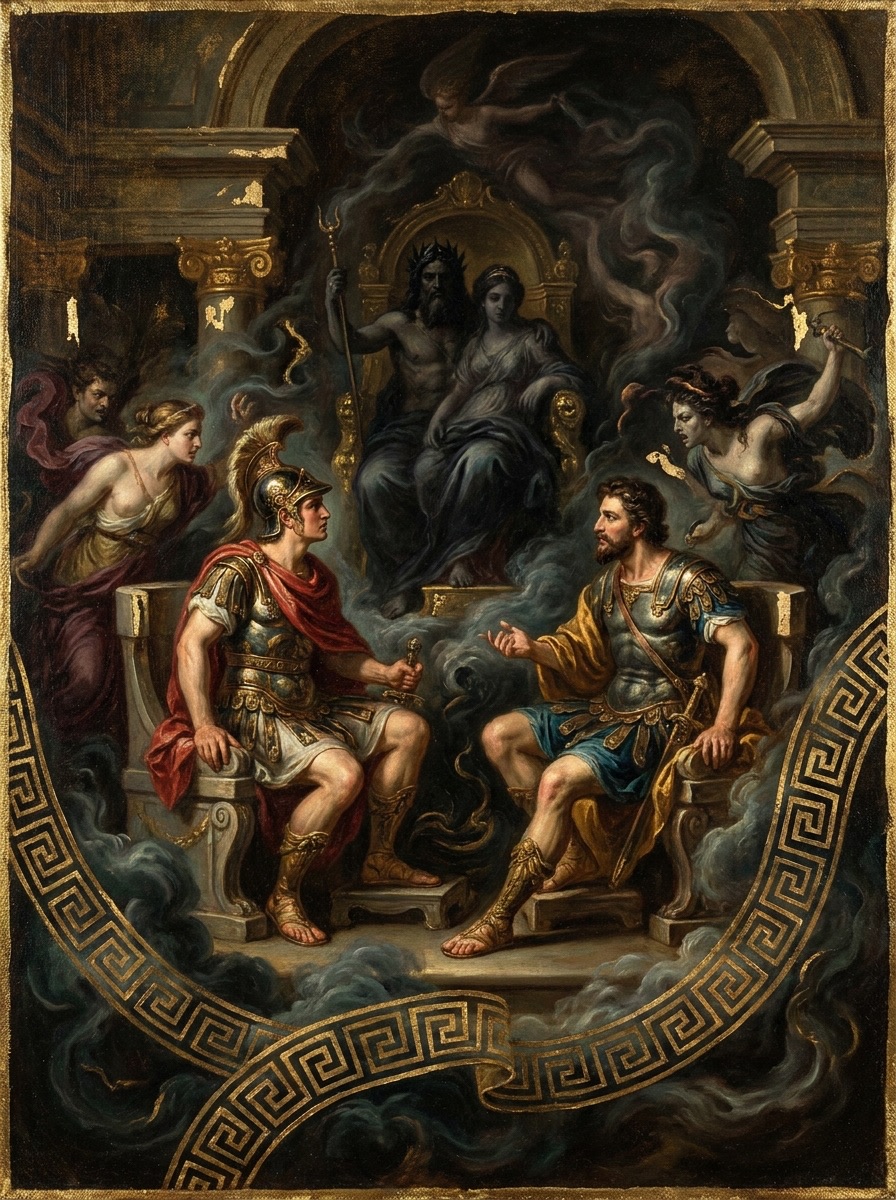
Yet Hades did not at once command the shadows to tear them apart, nor did he call for a duel. Instead he received them as guests and invited them to sit. Before them stood stone seats, cold and heavy, looking no more than a place to rest.
Pirithous sat down, and Theseus followed. The moment their bodies touched the stone, they discovered that they could no longer rise. Their legs felt as though the rock had swallowed them, and the darkness pressed against their backs. Their arms could still struggle, but they could not break free of the unseen force that held them. They tried to stand, and the seat did not move. They tried to cry out, and the silence of the underworld swallowed their voices.
Hades did not need to draw a sword. For mortals who had invaded his realm and sought to steal away his queen, such punishment was enough. There they sat, trapped, unable to return to the light or to carry out their reckless vow. Time in the underworld lost all clear shape, and Theseus and Pirithous remained in darkness while the dead drifted past them.
Meanwhile, the world above did not stand still. Helen’s brothers at last came to Attica to search for their stolen sister. They captured Aphidnae, rescued Helen, and carried Aethra away with her. Theseus was not there to defend his own house, nor to answer for the wrong he had done.
The One Who Was Saved and the One Who Stayed
Much later, Heracles descended into the underworld to complete one of his great labors. In the darkness he came upon Theseus and Pirithous. The Athenian hero, once famed for having traveled the world and overcome mighty foes, was now fixed to the stone seat like a man nailed to the earth.
Heracles reached out and took hold of Theseus. He was a man of prodigious strength, able to lift what no ordinary mortal could budge. This time the stone gave way, and he pulled Theseus free from the binding force. But when he tried to raise Pirithous, the underworld would not release him. The seat seemed fused to him, and the power below held him fast.
Heracles could not save them both. Theseus returned to the upper world, but Pirithous remained in Hades. They had first met over a herd of cattle, then fought side by side at a wedding feast, and finally walked together into darkness because of a vow that should never have been made. In the end, only one of them saw the sun again.
When Theseus came back to Athens, much had changed. Helen had been rescued, Aethra had been taken away, and the city’s peace was no longer what it had been. He carried the shadow of the underworld with him, along with the pain of a friend who would never return.
Pirithous’ name was afterward bound to that stone seat. The Lapith king had won Theseus’ friendship through boldness, and he had once stood firm to defend his bride at the wedding feast. But in the end he reached after Persephone and crossed a boundary no mortal should ever have crossed. Darkness did not erase that friendship; it left it divided forever, one half in the world above and the other in the underworld.