Greek Mythology
Theseus and Helen — Greek Mythology
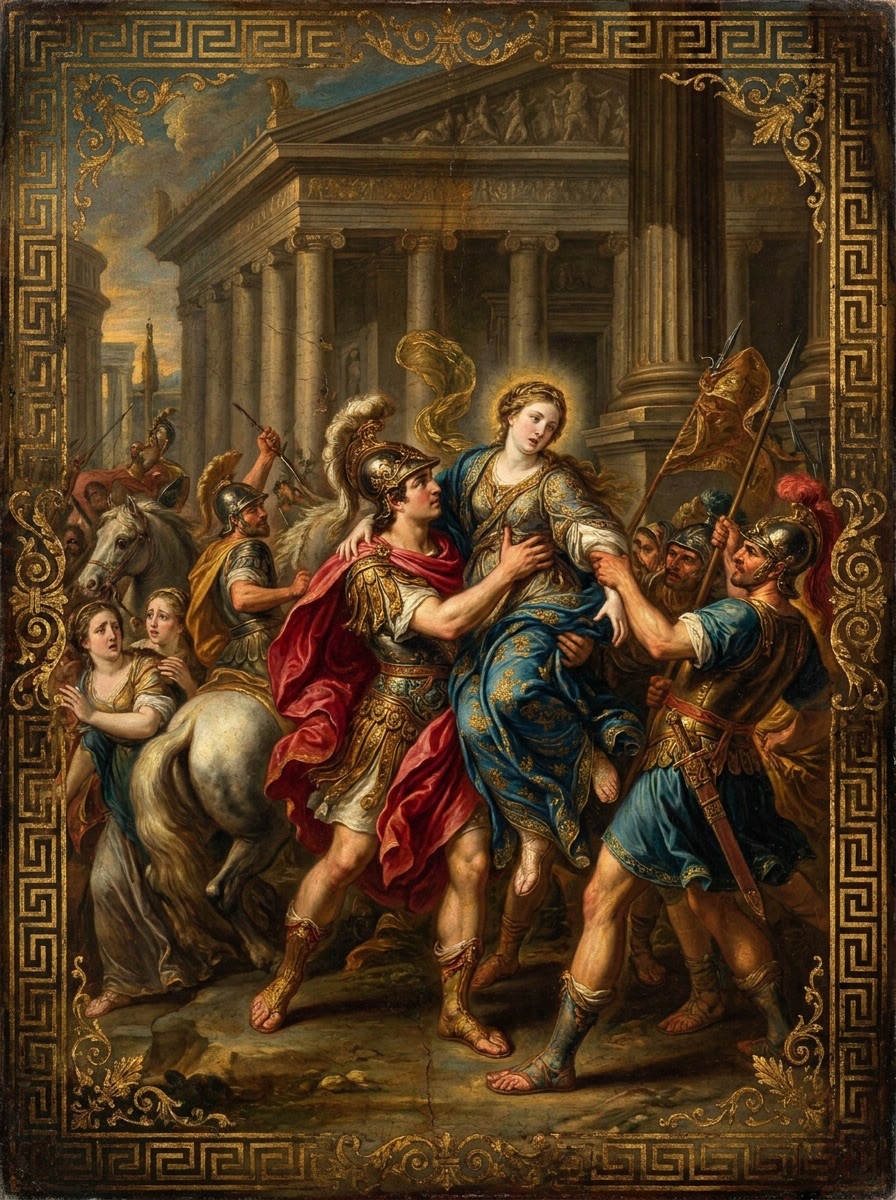
Even in old age, Theseus could not settle into peace. With his friend Pirithous, he swore to wed a daughter of Zeus, and so they seized the young Helen from Sparta. They hid her in Attica, while Theseus himself later went down to the Underworld to win Persephone. In the end Helen was rescued by her brothers, and Theseus’s own house paid the price.
Article
Summary
In his later years, Theseus still could not rest quietly. He formed a close friendship with Pirithous, the hero of the Lapiths, and both men were proud of their strength. They decided that ordinary marriages were beneath them and swore to marry only daughters of Zeus. Their first choice was Helen of Sparta, still young, but already famous throughout Greece for her beauty. They did not ask the Spartan royal house for marriage, nor did they wait for Helen to grow up. Instead, they seized her when she was away from the palace or taking part in a sacred gathering. The girl was carried off from her familiar home and turned into proof of two heroes’ daring. From the beginning, the deed was not love but overreaching ambition. Theseus and Pirithous brought Helen to Attica and drew lots; she fell to Theseus. Knowing he could not keep her openly in Athens, he hid her at Aphidna and placed her under the care of his mother, Aethra. He acted as if a closed door could keep Sparta’s anger away for a little while. But Pirithous still demanded his own bride under their oath. He wanted no woman of the upper world, but Persephone, queen of the dead. Theseus followed his friend into the Underworld, where Hades trapped both men on the stone seats. Unable to return, Theseus could not protect Helen, his mother, or his city. Helen’s brothers, Castor and Polydeuces, eventually found Aphidna, stormed the hiding place, rescued Helen, and carried Aethra away. When Theseus returned, Helen was back in Sparta, his mother was a captive, and the Athenians had begun to resent his recklessness. The story shows that the hero who once saved the children of Athens could, through pride, drag another household’s child into disaster.
Two Heroes Who Would Not Stay Idle
In his youth, Theseus had already walked through many dangerous roads. He had slain robbers along the way, entered the Labyrinth of Crete, killed the Minotaur, and brought the young men and maidens of Athens safely home by sea. By the time he became king of Athens, his fame had spread everywhere. Yet a hero’s heart does not always grow calm with age.
In the northern hills and plains there lived another hero, Pirithous, among the Lapiths. He had heard of Theseus, but he did not want to praise him from afar; he wanted to test the man himself and see how great the Athenian king truly was. Some said that he drove away Theseus’s cattle on purpose, hoping to draw him after him. Theseus came armed, and the two men met in the open country, each measuring the other. Theseus saw at once that this was no common bandit, and Pirithous understood that the king of Athens was not a man to be mocked lightly.
They ought to have drawn swords, but once they spoke, their anger melted away. Heroes are often like that: when they meet a worthy opponent, respect rises before hatred does. Pirithous explained the cattle raid as a test, and Theseus did not press the matter. From then on, the two became close friends. Later, when Pirithous married Hippodamia, the Centaurs grew drunk at the wedding feast and caused a riot; Theseus stood beside him then as well, fighting at his side.
Friendship only made them bolder, and it also made them forget caution more easily. By the wine-cups and the firelight, they often boasted of their deeds. No ordinary woman seemed worthy of them. Since they were the most renowned heroes in Greece, they said, they ought to marry the highest-born women. Mortal kings’ daughters were not enough; they would take wives who were daughters of Zeus.
It may have sounded like drunken boasting to others. But Theseus and Pirithous turned the boast into an oath.
The Maiden of Sparta
At that time, in the palace of Sparta in Laconia, there was a girl named Helen. She was a daughter of the house of King Tyndareus, and her mother was Leda. Greek men told many strange stories about her birth, but one thing many of them agreed on was this: even while she was still very young, her beauty already shone like the first light of morning.
She was not yet of marriageable age. She played with other girls near the shrines and took part in the dances of the festivals. She had attendants, kinsfolk, and Spartan guards around her. But fame travels faster than horses. Helen’s name crossed hills and seas and reached the ears of heroes far away.
When Theseus and Pirithous heard of her, they made her their first target. They said to one another, “She is a daughter of Zeus, and the most beautiful maiden among mortals. Let us take her first, and then cast lots to decide who shall have her. The one who loses will help the other win yet another daughter of Zeus.”
What sounded like boldness was really theft. They did not go to Sparta to ask for her hand, nor did they wait for Helen to come of age. They came with armed men into Laconia and watched for their chance.
One day Helen left the palace and went out beyond the city, perhaps to a shrine or an open place with her companions. The sun shone on her dress, and her attendants’ laughter had not yet faded when unfamiliar horses and chariots suddenly drew near. Theseus and Pirithous led their men forward. The girls screamed and scattered; the servants had no time to stop them. Helen was lifted into a chariot, the reins snapped tight, and the wheels tore up the dust as they raced north.
The cries of Sparta were left far behind. Helen was still too young to understand why she had been torn from home; she only wept in the chariot, with no father, no mother, no brother beside her—only the clang of strangers’ armor and the rush of hooves.
The Hiding Place at Aphidnae
The two men carried Helen away from Laconia and returned to Attica. According to the agreement they had made, they cast lots to decide who should have her. The lot fell to Theseus, and Pirithous did not contest it. Though Theseus had won Helen, he knew he could not bring the matter openly into Athens. Helen was a princess of Sparta, and her brothers, Castor and Polydeuces, were fierce and warlike; the Spartans would not let the matter rest.
So Theseus sent Helen to Aphidnae in northern Attica and placed her under the care of his mother, Aethra. There, away from the noise of the city, there were walls and houses and places where someone might be hidden. Helen lived there with the people Theseus had assigned to watch over her. Aethra was old now. She should have spent her later years in peace, honored by her son’s renown; instead, she was drawn into this unjust deed and turned into a keeper of the girl.
Theseus may still have meant to wait. He could not marry Helen at once, since she was still a child; yet he could not send her back either, for that would be to admit his wrongdoing. So he hid the stolen maiden away, as if closing a door could keep Sparta’s anger from reaching Attica.
But Pirithous had not forgotten the other half of the oath. If Helen belonged to Theseus, then Theseus must help him seek another daughter of Zeus. Pirithous aimed even higher than his friend. He did not want a woman from a mortal palace. He wanted Persephone, wife of Hades and queen of the Underworld.
Persephone was the daughter of Zeus and Demeter, and the queen of the dead. To the living, her name meant darkness, silent rivers, and the souls from which there is no return. Yet Pirithous let his own ambition drive him on, and Theseus did not refuse his friend. As they had once set out together for feasts and battles, so now they prepared to descend into the Underworld.
The Road to the Underworld
They left Attica, leaving Helen at Aphidnae and Theseus’s mother behind as well. The two heroes made for the entrance to the lower world. The farther they went, the more desolate the land became, until even the daylight seemed to fall away. In the old stories, the entrance to Hades lies deep in the earth, in wet stone and shadowed caverns, where the road to the dead begins.
Theseus and Pirithous descended and came to the country of Hades. There was no shouting of battle there, no firelight of human feasts. The souls of the dead moved like shadows, the waters were black, and the ferryman’s landing was cold. For living men to enter such a place was already an offense; to come there while nursing the thought of stealing the queen of the dead was worse still.
Hades was not a god easy to deceive. He knew why they had come, but he did not at once draw his weapon. Instead, he welcomed them as a host receives guests and invited them to sit. The two heroes thought they might yet find a chance, so they sat down. But the seats were no ordinary stone stools. Once they settled themselves, they found their bodies fixed as if by invisible bonds, and they could not rise again.
There Pirithous’s wild boasting came to an end. Theseus too could no longer swing a sword, mount a chariot, or fight his way out. They sat in the Underworld on their fatal seats, surrounded by the shadows of the dead, with no blue sky overhead and no road home beneath their feet. The world above kept going. Helen waited at Aphidnae, and Athens was left in turmoil. But Theseus could not return to set any of it right.
The Brothers from Sparta Come Seeking Their Sister
When Helen disappeared, Sparta did not stay silent. Her brothers, Castor and Polydeuces, began searching everywhere. Later people called them the Dioscuri, the sons of Zeus. They were master horsemen and mighty warriors, and they could not bear the loss of their sister.
They questioned travelers and followed tracks and rumors. Some had seen strange heroes carrying off a girl to the north; others heard that somewhere in Attica an outsider girl was being hidden. But Attica had many towns, hills, and villages, and without a sure guide it was hard to search by force alone.
Then a man named Academus revealed the hiding place to them. Later Athenians remembered this and said that because of it the Spartan brothers did not lay waste to the place where Academus lived. However the tale changed over time, the secret of Helen’s hiding place at Aphidnae was finally betrayed.
Castor and Polydeuces came into Attica with their men. Theseus was not in the city; he was trapped below, unable to arm himself and meet them in battle. The Athenians were divided in mind as well. Some had long resented Theseus, feeling that he had brought foreign trouble into the city; others took the chance to support Menestheus and turn the people away from him.
The Spartan brothers did not merely shout at the gates. They attacked Aphidnae and searched for their sister. The guards could not hold them off, and the stronghold was taken. Helen was at last led out of hiding. She had gone from home as a frightened girl, and now her brothers took her back along the road to Sparta. They also carried off Aethra. Theseus’s mother, once the keeper of the captive girl, became a captive herself and was forced to follow Helen to Sparta.
The Mother Taken Away
For Theseus, the blow was not only the loss of Helen. Helen had never truly been his wife, only a girl he had stolen. But Aethra was his mother. She should have spent her old age honored in Athens; instead, because of her son’s reckless act, she was dragged into a foreign land and later made to wait upon Helen.
When Aphidnae was taken and Helen returned to Sparta, Castor and Polydeuces had completed their task. Athens, however, was left in confusion. Theseus’s prestige wavered, and people in the city began to feel that the hero who had once saved them could now drag them into needless disaster.
As for Theseus himself, he was still in the Underworld. He sat fixed on the seat that would not let him rise, unable to save his mother, unable to recover his name, unable even to defend himself against the consequences of his own folly. Only later, when another hero came down to Hades, did Theseus finally have a chance to escape; Pirithous, however, was not so fortunate. He had come to seize the queen of the dead, and so he remained in the darkness.
By the time Theseus returned to the upper world, many things had already changed. Helen was no longer in Attica, and Aethra was no longer at home. The Spartan brothers had gone back with their sister, and the people of Athens no longer looked on Theseus as they once had. He had once torn disaster apart with his sword, but this time he had not been able to cut his way free. He and his friend made a foolish oath, stole what should not have been taken, and left their mother and their city exposed to danger.
Helen returned to Sparta and continued to grow up. Her later fate would draw kings and ships into still greater troubles, but in this story she is only a young girl carried off by the ambition of heroes. Theseus had once saved other men’s children from the Labyrinth; now he had brought another man’s child into his own ruin. And so the tale ends not with a song of victory, but with a city that was taken, a mother led away, and a hero unable to wash the stain from his deed.