Greek Mythology
The Trojan Horse — Greek Mythology
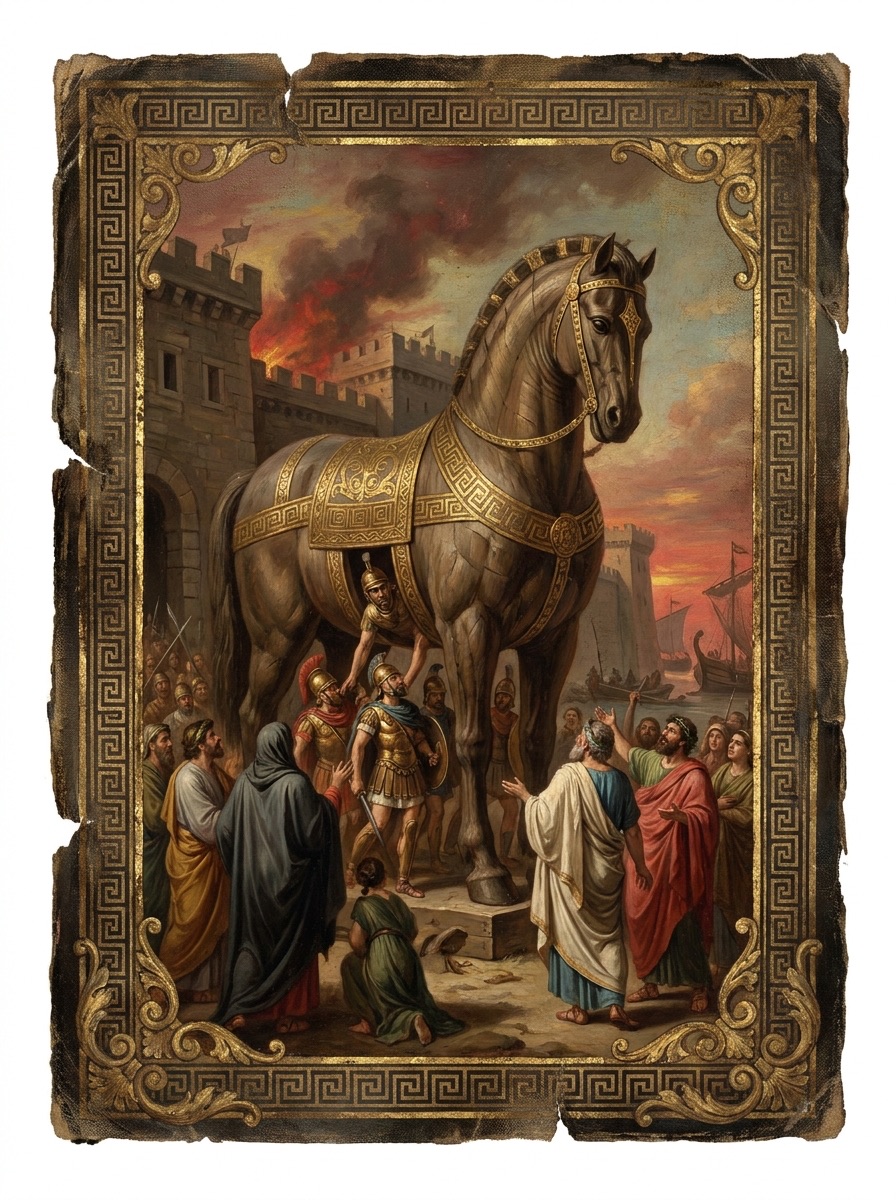
For ten years the Greeks besieged Troy and could not break its walls. At last they built an enormous wooden horse, hid warriors inside it, and pretended to sail away. The Trojans dragged the horse into their city; that night the gates were opened from within, and Troy fell in fire.
Article
Summary
By the tenth year of the Trojan War, Hector, Achilles, Ajax the Greater, and many other heroes had fallen, yet the walls of Troy still stood. The Greeks understood that if they kept attacking with spear and shield alone, they would only spend more lives beside the sea. Odysseus therefore proposed a trick: build a giant wooden horse, hide chosen warriors inside it, and make the rest of the army pretend to sail away. The craftsman Epeius built the hollow Trojan Horse, and Odysseus, Menelaus, Diomedes, Neoptolemus, and other armed men entered its belly. Then the Greeks burned their camp and launched their ships, but in truth they hid behind the island of Tenedos and waited for night. They also left Sinon behind, so that his lies could complete the stratagem. At dawn the Trojans saw the shore empty and believed the ten-year siege had finally ended, so they gathered around the horse and debated what to do. Sinon pretended to be a man abandoned by the Greeks and claimed the horse was an offering to Athena; if it entered Troy, he said, the goddess would turn her favor toward the city. His lie answered exactly the people’s longing for victory and divine protection. The priest Laocoon did not trust a Greek gift and hurled his spear into the horse, making its hollow belly give a dull sound. But two great serpents rose from the sea and strangled Laocoon and his sons, and the Trojans took this as a sign that the goddess had punished him. Cassandra also foretold the danger hidden inside the horse, but as always, no one believed her. The Trojans dragged the horse into the city, drank in celebration, and fell asleep as night deepened. Sinon gave the signal, the hidden Greek warriors slipped out of the belly, and the fleet concealed behind the island returned under cover of darkness. The walls had resisted ten years of assault, but not the piece of wood mistaken for a gift, and Troy’s final night began.
The Shore After Ten Years
For ten years the sea wind had blown outside the walls of Troy.
The Greek ships no longer shone in ordered rows as they had when they first arrived. Salt had whitened their hulls; ropes had frayed and split; the stakes of the camp had been driven in, reinforced, and pulled up again and again. The ground was scarred with wheel ruts, ashes, and old trenches. Many of the young men who had crossed the sea with Agamemnon now lay in the dust beside the river Scamander.
Yet Troy still stood.
Its high walls had turned back assault after assault. Hector was dead; Achilles was dead; Ajax the Greater was gone; many famous warriors had become names beneath burial mounds. But the gates remained shut. In the city of King Priam, people still lit their hearths, still made offerings before the temples, still climbed the towers and looked toward the shore, wondering when the Greeks would finally give up and sail away.
The Greek commanders understood the truth as well. If they went on fighting in the same way, victory might never come; the suffering of ten years would only stretch into a longer suffering.
It was then that Odysseus proposed a plan.
He was not the strongest man in the Greek army, nor the brightest figure in the rush of battle. But he knew how to wait, how to hide, how to speak, and how to take the enemy’s desires into account. He told the leaders that Troy’s walls were hard to break from the outside. Then let the Trojans themselves invite danger into the city.
When the others heard him, silence fell first. Then some nodded, some frowned, and some thought the scheme too perilous. But they had few choices left.
The Wooden Horse Rises in the Camp
The Greeks gathered timber and set the craftsman Epeius to work. Wood was sawn, planed, fitted, and nailed together. For many days the camp rang with the sound of axes and chisels. Soldiers hauled heavy beams into place, as if they were building a small house—or a ship that would never touch the water.
Before long, a huge wooden horse stood in the middle of the camp.
Its four legs were tall and massive, and its hollow belly was broad enough to hide men. Planks closed over the secret darkness within. From the outside it looked only like an immense offering to a god. Some said it was meant for Athena: if the Trojans left the horse outside the walls, the Greeks might one day regain the goddess’s favor; but if they dragged it into the city, then they would drag ruin through their own gates.
There was no laughter in the camp when the men were chosen to enter the horse.
This was no ordinary ambush. If those hidden inside were discovered, they would have nowhere to run. They would be burned alive within the planks, or pierced one by one with spears. Even so, men stepped forward. Odysseus, Menelaus, Diomedes, Neoptolemus, and other warriors climbed into the horse’s belly with short swords and spears. Some pressed their shields close beside them; others tried to slow their breathing. When the planks were sealed, darkness closed in at once, leaving only thin threads of light through the cracks.
Outside, the Greeks began the next part of the plan.
They burned their huts, pulled up the stakes, and dragged their ships down to the sea. Smoke rose from the shore like the smoke of an abandoned town. By evening, sail after sail opened, and the Greek fleet left the beach of Troy. In truth they had not gone far. They only sailed behind the nearby island of Tenedos and hid there, waiting for night and flame to give them their chance to return.
They left one man behind.
His name was Sinon. His clothes were torn, his hands and feet looked as if they had been bound, and his face showed fear and exhaustion. He had to do something more dangerous than swinging a sword: he had to walk among the enemy and tell a lie powerful enough to open the gates.
Cheers from the Walls
The next morning, the Trojans looked toward the shore and stared in astonishment.
The crowded ships were gone. The Greek camp lay empty, with only blackened stakes, warm ashes, and the towering wooden horse left behind. The sea was calm; no sail showed in the distance. Inside the city that had endured ten years of siege, shouting suddenly broke out. People pushed open the gates and ran onto the old battlefield. Some kicked aside the Greeks’ broken pots; some laughed as they tramped over the mounds of the deserted camp; others knelt and thanked the gods, believing at last that their long misery had ended.
They gathered around the wooden horse and looked up at it.
It was immense, and the fresh marks of cutting still showed along its wooden ribs. Some touched the planks; some walked around its legs; some said it should be split open to see whether anything was hidden inside. Others argued that it was an offering to the goddess, and that to damage it would bring divine anger.
While they were still disputing, the Trojans captured Sinon.
He had not fled far, as though his own companions had abandoned him on the shore. The soldiers dragged him before King Priam and the assembled crowd. Spear-points were leveled at him, and they demanded to know why he had remained behind.
Sinon wept and begged for mercy. He said that he too had once belonged to the Greek army, but had angered Odysseus. The Greeks wished to return home, he said, but the winds were against them, and the seers had declared that the wrath of the gods must be appeased with the life of a Greek. Odysseus had put him forward as the victim. During the night, Sinon said, he had slipped his bonds and hidden among reeds and mud, escaping death by chance.
As the Trojans listened, their anger slowly turned into curiosity.
Priam was old and tender-hearted, and when he heard that this man too claimed to have suffered at the hands of Odysseus, he ordered his bonds loosened. Then he asked what the wooden horse meant.
That was the question Sinon had been waiting for.
With his head bowed, he said that the Greeks had once stolen a sacred image from Troy and had angered Athena. To win back the goddess’s favor, they had built the wooden horse as an offering of atonement. They had made it so tall and vast on purpose, he said, because they feared the Trojans might drag it into the city. If the horse remained outside the walls, the Greeks could return one day; but if it entered Troy, the goddess’s protection would pass to the Trojans, and the Greeks would never be able to take the city.
His words flowed through the crowd like water.
Ten years of weariness, the joy of victory, and reverence for the gods all gathered together in that moment. Many began to believe that the wooden horse was not a danger but a prize, not a trap but a sign sent by heaven.
Laocoon’s Spear
Yet not everyone believed.
The priest Laocoon came hurrying from the city. When he saw the crowd around the wooden horse and heard Sinon’s story, his face changed at once. He cried out to the Trojans not to trust Greek gifts. Those men, even if they had sailed away, would never leave something good behind so easily. They were masters of trickery—especially while Odysseus was among them—and disaster might be hidden even inside wood.
To wake the crowd from its excitement, Laocoon lifted his spear and hurled it with all his strength at the horse.
The spear struck the wooden belly. The planks shuddered, and a deep sound echoed from within. Inside the horse, the Greek warriors were so frightened they did not dare move. Some tightened their hands around their sword-hilts; others held their breath, swallowing even the urge to cough.
For one instant, the crowd fell still.
Had they listened a little longer, they might have heard the strange sound behind the planks. But fate did not give them such clarity.
Soon cries rose from the shore. Two great serpents came swimming from the waves, their heads lifted high, their scales gleaming in the light on the water. They rushed onto land and made straight for Laocoon and his two sons. The boys tried to flee, but the serpents were already coiling around their bodies. Laocoon seized his weapons to save them, and the serpents wrapped themselves around him as well. Father and sons struggled beside the altar; their cries grew weaker and weaker. At last the serpents left their bodies and slipped away toward the image of Athena.
The Trojans watched in terror.
They no longer remembered Laocoon’s warning. They saw only a god’s punishment for insulting the wooden horse. Sinon’s words now seemed truer than ever. People cried that the horse must be brought into the city and not left outside in dishonor.
Still, one person refused to believe.
Cassandra stood among the crowd, pale-faced. She had long carried a dreadful fate: she could speak the truth, but no one would believe her. She looked at the wooden horse as if she could already see the flames that would rise in the night. She shouted for them to stop. Men with swords were hidden in the horse’s belly, she said; once the gates were opened, Troy would be lost.
But the cheering drowned her out.
Some said she always spoke of misfortune. Some pulled her aside. Others simply stopped listening. Victory seemed to be standing before them—who, at such a moment, wanted to hear of ruin?
The Horse Enters Troy
The Trojans broke open a section of the wall, or widened the gate, so that the enormous thing could pass through. Ropes were fastened to the horse, and many people pulled together. Its wheels and beams groaned over the ground. The horse was so tall that it caught more than once, and the crowd shouted and shoved as if they were moving a shrine that would bring good fortune.
The streets inside the city filled with people.
Women came out carrying children; old men stood in doorways leaning on their staffs; young men hung garlands on the wooden horse. Some sang, some raised cups, some made sacrifices before the temples. When ten years of fear suddenly loosened its grip, joy came fierce and swift. The Trojans set the horse in the city and treated it as a sign of victory.
When night fell, the city was still noisy.
Jar after jar of wine was opened. Torches burned from the streets to the temple doors. Many drank until they fell asleep against pillars. Even the guards on the walls let down their watchfulness. Who would fear an enemy that had already fled? The shore was empty, the ships were gone, and the city possessed the goddess’s wooden horse.
Inside the belly of the horse, the Greek warriors waited until their limbs were stiff.
During the day, when the Trojans had hauled the horse, the planks had rocked and the ropes had tightened, and every shout outside had seemed about to betray them. By night, heat and the smell of sawdust pressed around them. They heard the songs in the city sink little by little; they heard drunken laughter turn to snoring; they heard, far off, dogs barking and torches crackling.
At last Sinon crept to the horse and gave the agreed signal.
The planks opened, and night air rushed in. Odysseus emerged first and looked around to make sure no one was near. Then, one by one, the Greek warriors slipped down from the horse’s belly, their feet touching the ground of Troy. They did not cheer. They only gripped their weapons and hurried through the dark streets toward the gates.
The gate-bars were lifted.
The heavy doors slowly opened in the night, and from the darkness outside came the sound of oars and footsteps. The Greek fleet, which had been hiding behind Tenedos, had returned under cover of night. Soldiers leapt from the ships, crossed the old camp, and rushed toward the open gates.
Troy’s last night had begun.
Troy in Flames
When the Greeks poured into the city, many Trojans were still asleep.
First came the sound of running feet and weapons; then came screams. Torches were thrown onto rooftops, and dry timber and hanging cloth quickly caught fire. The night wind drove the flames along the streets, reddening the stone walls. People rushed out of their houses. Some had not even seized a sword; some carried children and searched for their kin; some fled toward the temples, thinking the altars might save them.
Menelaus searched the city for Helen. Agamemnon’s men drove toward the palace. Odysseus, Diomedes, and others led soldiers to seize the main ways through the city. Neoptolemus burst into the palace of Priam, where there had once been feasts, weddings, and the footsteps of princes; now there were only firelight, blood, and cries.
Old King Priam saw that the city had fallen and knew there was nowhere left to flee. He went to the altar of Zeus, wrapped in an old man’s cloak, as if in that final moment he were asking a god to look upon his city. But the swords did not stop. The king who had once ruled Troy died in his own palace.
Everywhere there was confusion.
Some Trojans fought desperately in the narrow lanes. Some tried to escape through small gates. Some were overcome by smoke inside their houses. Cassandra was dragged from a temple. The truth she had spoken had come to pass at last, but it could no longer save anyone. Laocoon’s warning, the sound of his spear striking the wooden horse, Cassandra’s cries—all were swallowed by the fire of that night.
The wooden horse still stood in the city.
By day, people had hung garlands on it and treated it as victory and divine favor. By night, it became the doorway through which Troy’s destruction entered. It had not run by itself; it had not swung a sword. It had only stood there in silence, waiting for people to drag it through the gates with their own hands.
By dawn, Troy was no longer the Troy it had been.
Palaces had fallen, roofs smoked, and the streets were strewn with shields, cups, broken spears, and charred beams. The Greeks had finally taken the city they had besieged for ten years. Helen was brought back into Greek hands; many Trojan women became captives; the survivors stared at the ashes as if at a nightmare from which they could not wake.
From that time on, the tale of the wooden horse was remembered.
People remembered not only the cunning of the Greeks, but also the moment when the Trojans, wavering at the edge of victory, lowered their guard. High walls had held off ten years of weapons. They could not hold out against a piece of wood mistaken for a gift. On such a night, Troy fell.