Greek Mythology
The Calydonian Boar Hunt — Greek Mythology
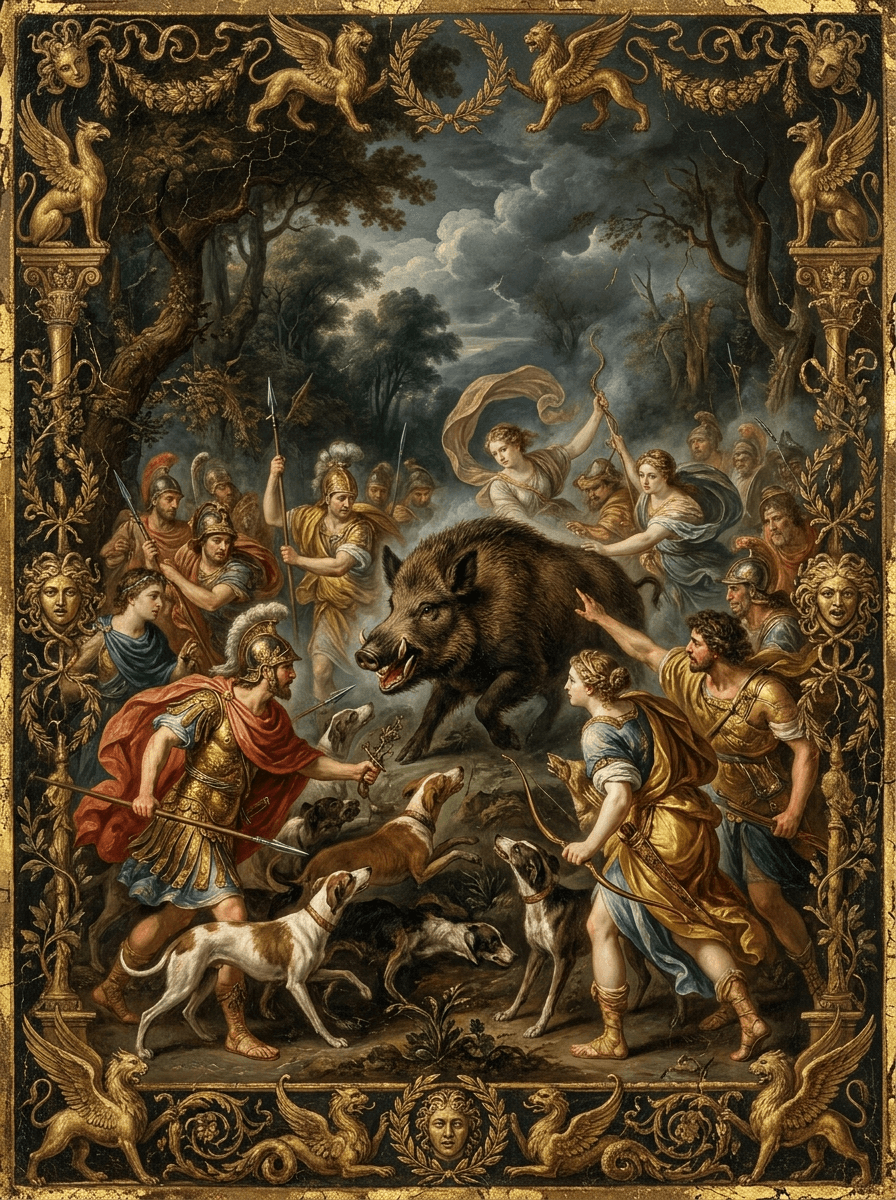
King Oeneus of Calydon forgot to sacrifice to Artemis, and the goddess sent a monstrous boar to ravage his fields. Meleager gathered the heroes of Greece for the hunt; Atalanta was the first to wound the beast, but the prize of victory stirred a quarrel that turned triumph into disaster for the royal house.
Article
Summary
After a rich harvest in Calydon, King Oeneus offered grain, grapes, and oil to the gods, but he left out Artemis, goddess of the hunt. Angered by the slight, she drove a savage boar into the Calydonian countryside. It trampled the wheat, tore down vines and olive trees, and frightened shepherds and hounds alike from coming near.
The Forgotten Altar
The land of Calydon had always been fertile. When harvest came, the wheat bowed heavy on its stalks, grapes hung in thick clusters from the vines, and the leaves of the olive trees flashed gray-green in the wind. King Oeneus watched his storehouses fill and, according to the old custom, made offerings to the gods above.
Grain was given to Demeter, grapes to Dionysus, olive oil to Athena. Flames rose before the altars, fragrant smoke drifted into the sky, and the people laid out the first fruits of the year, thanking the gods for guarding their fields.
But among the rows of altars, one stood cold and empty. It was the altar of Artemis.
There was no fresh venison, no garland, no oil, no smoke. Perhaps Oeneus had simply been too busy and careless; perhaps, with so many gods to thank that year, he had overlooked the goddess of the hunt. Yet to the gods, being forgotten was no small matter. Artemis saw that no gift had been placed before her altar. Her heart hardened, and anger rose in her.
She did not at once hurl down thunderbolts. She did not tear the palace from its foundations. Instead, she loosed disaster into the fields.
Before long, the people of Calydon heard a heavy pounding from deep within the woods. Branches snapped, earth flew, and a boar unlike any they had ever seen burst out from the forest. Its body was as huge as a bull’s; stiff bristles stood upright along its back; its eyes were red, its tusks long and white. With one thrust of its snout, it could rip tree roots from the ground.
It charged into the wheat fields, flattening whole stretches of grain. It bit through the grapevines, tearing tender shoots and fruit together. It rushed into the olive groves and scored the bark with its tusks. Shepherds fled with their flocks, and even hunting dogs, catching its scent, slunk away with their tails tucked low. Those who watched it pass from behind stone walls hardly dared to breathe.
The ruin grew worse with every day. The fields of Calydon looked as though war chariots had rolled across them. Farmers were afraid to go out to their land; children dared not leave their doors. Only then did King Oeneus understand that the altar he had forgotten had drawn the whole city into fear.
The Heroes Come to Calydon
Oeneus’ son Meleager was young and strong. His arms could bend a stubborn bow, and when he cast a spear, it flew swift and true. Seeing the countryside so laid waste by the boar, he knew he could wait no longer. He sent word far and wide, calling the famous warriors of Greece to Calydon for a great hunt.
When the summons spread, many came with weapons in hand. Some carried spears, some bore bows and arrows, and some led hunting dogs. In later tradition, heroes as renowned as Jason, Theseus, Pirithous, Castor, and Polydeuces were counted among those who joined the hunt. For days the roads rang with hoofbeats, and men kept arriving at the city gates. The square of Calydon filled with hunters wearing skins, carrying swords, and slinging quivers over their shoulders.
Among them was a huntress from Arcadia named Atalanta.
She had not been raised gently in a palace. It was said that when she was a child she had been abandoned in the wild, and that a she-bear had suckled her until hunters found and reared her. As she grew, she learned to run through the forest with a light step and a keen eye; when her bowstring sang, few birds or beasts escaped her. With her hair bound back, a quiver on her shoulder, and a bow in her hand, she entered the gathering at Calydon, and many heroes turned to look at her.
Some did not want a woman to take part in the hunt. They thought it would shame the men. But Meleager saw Atalanta calmly testing the points of her arrows, and he saw how steadily she stood among the hunters. He paid no heed to their muttering. Respect for her rose in him, and with it affection, though the hunt was near and he had no time to say much.
The next day, they set out for the woods with their hounds.
They crossed the ruined wheat fields and passed through low scrub. The nearer they came to the place where the boar had its lair, the damper the air grew. Everywhere the ground was torn up, pitted with muddy holes and strewn with broken branches. The hunters stretched nets along the edge of the wood; some circled round to guard the mouth of a ravine, while others led the dogs in search of tracks. Suddenly the hounds caught a rank scent and broke into wild barking, rushing toward a valley thick with reeds and poplars.
The hollow was dark and wet, and the reeds stood dense as a wall. There the boar was lying hidden.
The Roar in the Reeds
The barking drew nearer and nearer. Then the reeds shuddered violently. In the next instant the great boar burst out.
It flung up mud and water as it came. Grass roots hung from its tusks, white foam sprayed from its mouth, and it rolled toward the men like a black boulder torn loose from a hillside.
The hunters in front cast their spears in haste. Several flew at the beast, but some glanced off its tough hide, while others slid along the bristles. The boar, maddened, lowered its head and crashed into their ranks. One hunter, too slow to leap aside, was tossed by the tusks; another had barely lifted his axe before the beast knocked him to the ground. Hounds sprang at its ears and legs, but with one toss of its head it flung them away, and they tumbled yelping near the roots of the trees.
The line broke. Some men scrambled up the stony slope; others ducked behind trunks. Meleager shouted for them to hold firm, but the boar had already torn through the nets and was wheeling toward the far side of the ravine.
At that moment, Atalanta raised her bow.
She did not shoot in haste. She stepped with the turning of the boar, waited until its shoulder and neck showed between two trees, and then released the string. The arrow flew and sank into the beast’s flesh. It did not strike a mortal place, but for the first time the boar bled.
Red blood dripped down through the stiff bristles. The boar roared in pain. When the hunters saw that arrow, their courage returned. Meleager cried out in praise of Atalanta, then tightened his grip on his spear and rushed forward.
The boar smashed through the trees. More spears were thrown; some missed, some struck only shallowly. Suddenly it turned back, and its tusks swept across a hunter’s leg, scattering blood over the dead leaves. Several heroes moved in to surround it, only to be forced back again. The forest filled with the barking of dogs, the shouting of men, and the cracking of branches.
Meleager watched for the heaviness that came after the wound. When the boar turned its head once more, he stepped straight into danger and drove his spear deep into its flank. The beast heaved so violently that it nearly snapped the shaft. Meleager drew his sword and, as the boar staggered, struck again at a vital place. At last the huge creature lost its footing and crashed down in the mud. Its hooves scraped the earth a few times, and then it lay still.
Suddenly the woods were quiet, except for the low whimpering of wounded dogs and the rough breathing of the hunters.
Calydon’s plague was over.
The Hide and the Tusks
The hunters gathered around the fallen boar. Its body lay across the forest floor like a black tree trunk cut down. Mud and blood clung to its tusks; its hide was thick and hard, and Atalanta’s arrow still stood in its flesh.
By right, Meleager had dealt the killing blow. Yet he knew that without Atalanta’s first shot, the boar might never have exposed its weakness. So he cut off the hide and removed the tusks, and gave those most visible trophies to Atalanta.
He said the honor belonged to her.
Atalanta did not answer with many words. She reached out and took the hide and tusks. But the faces of some men nearby changed at once—above all those of Meleager’s two uncles, who were themselves warriors in the hunt. They were the brothers of the queen, and they were men; how, they thought, could they stand by and watch a woman carry off the prize?
In anger they said that Atalanta had done no more than shoot the first arrow. Meleager had truly killed the boar, and the trophies should not pass into her hands. Their words grew harsher and harsher, until at last they stepped forward and tried to seize the hide from Atalanta.
Meleager barred their way.
The blood of the hunt had not yet dried, and weapons were still in every hand. The quarrel soon turned to violence. The uncles would not yield, and Meleager would not allow Atalanta to be insulted. Once swords were drawn, there was no more gentle speech between kin. In the confusion, Meleager killed his own uncles.
The forest that had just been freed from the boar was stained again, this time with human blood.
The Brand in the Queen’s Hands
When the news reached the palace, Queen Althaea was waiting for her son’s return in triumph.
First she heard that the boar was dead, and relief came over her. Then, almost at once, someone told her that her two brothers were dead as well—and that the man who had killed them was her son Meleager. Althaea stood as if struck by a heavy blow, unable for a time to speak.
She was a mother, but she was also a sister. One voice within her pleaded for her son: the fight had broken out suddenly during the hunt; perhaps he had been driven to that terrible act. Another voice kept reminding her that the dead men were her own brothers, and that their blood could not go unanswered.
Then she remembered something she had hidden long ago.
Soon after Meleager was born, the Fates had come into the palace. Looking at a piece of wood burning on the hearth, they declared that the child’s life was bound to that brand: when the wood was consumed, he too would die. Althaea, terrified, had snatched the brand from the fire, smothered the sparks, and hidden it carefully away. For years she had guarded that piece of wood as though she were guarding her son’s life.
Now she brought it out.
The brand was long since dry, darkened with age. Althaea held it in trembling hands. She paced the room, now pressing it to her breast, now turning her eyes toward the fire. She remembered her son’s face as a child and the first time he had lifted a little spear; then she saw again, in her mind, the bodies of her brothers lying in the wood and heard the cries of her mother’s house.
At last hatred overcame a mother’s love.
She threw the brand into the flames.
The fire licked the dry wood. First there was a small crackle; then the flame leapt up. Far away, in the city or in the camp, Meleager suddenly felt as though fire were burning inside him. He had received no new wound, and no flame touched his skin, yet pain rose from the marrow of his bones. He clutched his chest, and the color drained swiftly from his face. Those beside him caught him in alarm, but none of them knew what had happened.
On the hearth, the wood blackened and split little by little. Meleager’s strength ebbed little by little with it.
When the last piece of the brand fell into ash, he too stopped breathing.
Cries After Victory
The fields of Calydon had been saved. The boar that had ruined the crops, terrified the shepherds, and robbed the whole city of peace lay dead in the forest. Yet the hunt brought no feast of celebration.
Cries rose from the palace. When Althaea saw her son dead and came fully back to herself, remorse overwhelmed her like a flood. It was said that she later took her own life. Meleager’s sisters gathered around their brother and mourned him, their cries lingering long; in some tellings, their grief moved the gods to pity, and they were changed into birds and flew away from the palace filled with the pain of blood kin.
Atalanta carried away the fame she had earned. People remembered that her arrow was the first to make the boar bleed. They remembered, too, that Meleager had drawn steel against his own kin in order to give her the honor.
So the Calydonian Boar Hunt was told again and again. At first it was a tale of a goddess’s anger; then it became a tale of heroes gathered together; but in the end it came to rest upon a piece of wood burned to ash. The boar was slain, and the fields were safe, yet the house of Meleager could never return to what it had been.