Greek Mythology
Telemachus Seeks His Father — Greek Mythology
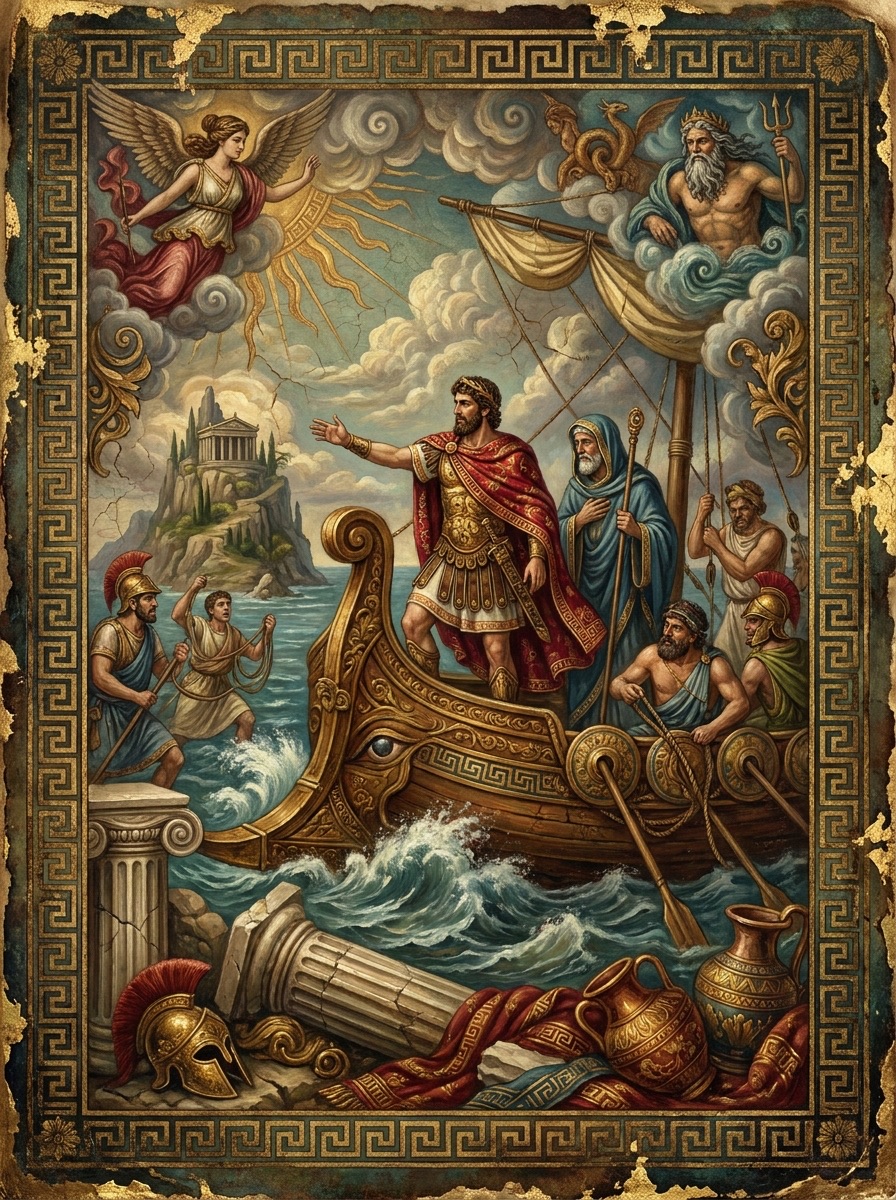
The suitors have overrun the house of Odysseus on Ithaca. Encouraged by Athena, young Telemachus leaves the island for the first time, sailing to Pylos and Sparta to ask for news of his father. He does not find Odysseus, but from Nestor and Menelaus he hears old tales of the return from Troy—and learns that his father may still be alive somewhere in the world.
Article
Summary
Odysseus has been gone for many years, and his palace on Ithaca is occupied by suitors. Telemachus watches them devour his household’s wealth, angry yet powerless. Then Athena comes to him in the form of a guest and urges him to stand before the people, call an assembly, and sail to Pylos and Sparta in search of news of his father. For the first time, Telemachus rebukes the suitors in front of the Ithacans, but Antinous and the others refuse to yield. That night, with Athena’s help, he readies a ship and provisions, keeps the voyage hidden from his mother, and sails for Pylos to visit the old king Nestor. Nestor is sacrificing to Poseidon beside the sea when Telemachus arrives, and he receives the young man warmly. He recalls the scattered homecomings from Troy and the fates of many heroes, but he cannot say where Odysseus went afterward. So he sends his son with Telemachus by chariot to Sparta, to ask Menelaus. In Sparta, Menelaus and Helen recognize in Telemachus the likeness of Odysseus, and they speak of Odysseus’ cunning and endurance inside the walls of Troy. Then Menelaus tells him what he once learned from the sea-old man Proteus: Odysseus is still alive, held on a far-off island by the nymph Calypso, unable to return home. At last Telemachus receives word that his father is not dead. Meanwhile, on Ithaca, the suitors discover that he has left the island and secretly prepare an ambush at sea to kill him. Penelope weeps and prays when she hears of it, but Athena comforts her with a dream, while Telemachus, through this journey, begins truly to grow into manhood.
The Noise in the Hall
Odysseus had been gone from Ithaca for many years.
When he first sailed with his fleet to Troy, the people of the island had believed he would return once the war was over. But after Troy was taken, the other heroes came home one by one. Some brought treasure, some brought wounds, and some vanished forever. Only Odysseus did not appear.
His house, however, had not fallen silent.
In the great hall of the palace, young noblemen sat day after day on the benches. They slaughtered the cattle and sheep of Odysseus’ household, drank the wine from his storerooms, ordered the singer to play and sing, and had the servants bring bread and meat before them. They said they had come to court Penelope, but in their hearts they already treated the house as their own.
Penelope refused them all. By day she endured as best she could in the upper rooms; by night she often wept for her husband. Her son Telemachus had grown to manhood, but he had never truly ruled his house. He watched the suitors feasting, ashamed and furious, yet he was young, and he did not have men enough at his side. For the moment, he did not know how to drive them out.
One day Athena came down from Olympus to Ithaca. She took the form of a foreign guest and stood at the doorway of Odysseus’ house, holding a spear in her hand like a friend from far away.
Telemachus saw her from the hall and rose at once to welcome her. He did not want a guest left standing outside where those insolent suitors could stare. He went to her, took her spear, brought her into the house, seated her in a carved chair, and ordered a maid to bring water for washing. Then he set a table and food before her.
The suitors went on making noise nearby, throwing dice, calling for wine, as though the master of the house had not received a guest at all.
Athena spoke softly to Telemachus. “What are these men doing in your house? Is this a wedding feast, or an ordinary banquet? Why do they behave so outrageously?”
Telemachus sighed. He said that if his father were truly dead, that would at least be clear: men would have raised a tomb for him, and Telemachus could have inherited the household. But as it was, Odysseus’ life or death was unknown; his mother was being pressed to marry; the estate was being eaten away each day; and he himself could do nothing.
When Athena had heard him, she stirred him with firm words. He was no longer a child, she said. He must summon the people of Ithaca and publicly rebuke the suitors. Then he must ready a ship, take twenty oarsmen, and seek news of his father. First he should go to Pylos and ask Nestor; then to Sparta and ask Menelaus. Both were old heroes returned from Troy, and perhaps they knew what had become of Odysseus.
“If you hear that he is alive,” she said, “endure another year. If you learn that he is dead, raise a mound for him, hold his funeral rites, and then let your mother marry. As for these suitors, you must find a way to deal with them.”
With that, Athena vanished like a bird.
Telemachus stood stunned where he was. He knew that the visitor had been no ordinary guest, and suddenly a courage he had never felt before rose within him.
Standing Forth for the First Time
At dawn the next day, Telemachus ordered the heralds to summon the Ithacans to assembly.
No such gathering had been held for many years. Old men came leaning on their staffs, and the men of the island made their way one by one to the stone seats. When they saw the son of Odysseus rise, they were astonished. Telemachus held the staff of speech in his hand. At first he fought back tears; then he began to speak.
He reproached the suitors. Odysseus was not at home, but that did not give them the right to gather in crowds and consume his wealth. If they truly wished to marry Penelope, they should return to their own houses and prepare bride-gifts, not linger in another man’s hall slaughtering his animals and draining his wine and grain.
Some who heard him were ashamed; others kept silent. But among the suitors there was one named Antinous, the most arrogant of them all. He would admit no fault. Instead he blamed Penelope, saying she had delayed the marriage by her weaving: by day she wove a burial shroud for her father-in-law Laertes, and by night she undid the work, deceiving them for years.
Telemachus refused to drive his mother from the house. If he forced her to remarry, he said, men would hate him, and the gods would be offended. He asked only that the suitors leave—but they would not listen.
Then two eagles appeared in the sky. They swept down from the direction of the mountains, circled above the assembly, and suddenly clawed at each other until feathers scattered through the air. Then they flew away beyond the town. An old man skilled in bird omens declared that this was a sign sent by the gods: perhaps Odysseus would yet return, and the suitors would meet disaster.
The suitors laughed. They did not believe the omen, and they did not fear Telemachus.
When the assembly broke up, Telemachus went to the shore and prayed to Athena for help. Athena came again, this time in the likeness of Mentor, comforted him, and arranged both ship and crew. She also cast a heaviness over the suitors, so that they did not notice the preparations for the voyage.
When night fell, Telemachus slipped back into the house. He did not tell his mother the truth. He only asked the old nurse Eurycleia to prepare meal, wine, and travel gear. When the old woman heard that he meant to sail, she burst into tears and begged him not to risk his life. Telemachus gently urged her to keep the secret and not tell Penelope, lest his mother spend the night in anguish.
At midnight the ship lay ready in the harbor. The rowers were aboard, and jars of wine and sacks of grain had been placed in the hold. Telemachus stepped onto the vessel; Athena sat beside him. The sea-wind rose, the white sail bellied full, and the dark ship left Ithaca behind, bound for Pylos.
It was the first time Telemachus had truly left his home.
Sacrificial Fires by the Sea at Pylos
At daybreak the ship reached Pylos.
The shore was full of voices. The Pylians were sacrificing to Poseidon, god of the sea. Rows of black bulls had been led down to the sand; flames were rising; the smell of roasting meat drifted on the wind. Old men, young men, and children sat in groups along the shore, offering prayers to the god.
When Telemachus saw it all, he felt afraid. He was not yet used to walking among strangers, still less to questioning an aged king whose fame was known throughout Greece. Athena, still in the form of Mentor, said to him, “You came here for news of your father. Do not be shy. The gods will give you courage, and you yourself must speak.”
They went up onto the beach. Nestor’s son was the first to greet them and led the guests to his father. Nestor was old, but his mind was still clear and strong. He seated them, gave them roasted portions and wine, and first invited them to pray to Poseidon. Only when the sacrifice was finished and the food had been shared did the old king ask where they had come from and why they had sailed to Pylos.
Telemachus rose and gave his name. He said he was the son of Odysseus. He had not come to seize wealth or inquire into some lesser matter; he wished only to learn his father’s fate after Troy.
When Nestor heard the name of Odysseus, he gave a long sigh.
He remembered the years beneath the walls of Troy. Many heroes had suffered there, and many had died in battle. Odysseus had been clever, patient, and rich in counsel—one of the rarest men among the Greeks. Yet after Troy fell, the kings’ return was troubled. Some angered the gods; some quarreled and divided the fleet; some sailed by different routes; some perished.
Nestor said that he himself and part of the army had set sail quickly and returned safely to Pylos. Menelaus and other ships had become separated and endured long wandering before reaching home. As for Odysseus, Nestor had not seen with his own eyes what happened afterward. He could say only that around the time of departure from Troy, Odysseus and Agamemnon had disagreed about the voyage home, and after that the Greeks had scattered.
Telemachus heard this with disappointment and stubborn hope together. He had wanted the old king to speak one certain word, but Nestor had no such news.
The old king also told of Agamemnon’s homecoming. That commander had returned to Mycenae only to be murdered by Aegisthus and by his own wife, Clytemnestra. Later his son Orestes grew up and avenged his father. Nestor told this so that Telemachus would understand: a son cannot remain silent forever. If evil men are in his house, he must have the courage to face them.
As evening came on, Nestor kept the guests for the night. Then Athena revealed a sign of her divinity, flying away like a sea-eagle. When the people saw it, they understood that the companion had been the goddess herself. Nestor was filled with greater reverence and at once offered sacrifice to Athena, praying that she would protect the son of Odysseus.
The next day the Pylians harnessed a chariot. Nestor sent his son Peisistratus to accompany Telemachus to Sparta. The chariot rolled out through the city gates, its wheels striking the road, the horses’ manes tossing in the wind. Telemachus left the shore behind and set out for the palace of Menelaus.
The Golden House of Sparta
After two days on the road, they came to Sparta in Lacedaemon.
A wedding feast was underway in the palace of Menelaus. The halls were bright; vessels of gold and silver gleamed; the tables were crowded with bread, meat, and wine. Wealth brought back from distant lands filled the house, and the walls seemed lit by sunlight. When the servants saw the two young strangers, they went to tell their lord.
Menelaus did not leave them waiting at the door. He said that he himself had wandered in foreign lands and had received hospitality from many people. How, then, could he fail to welcome guests who came to his threshold? So the servants washed their hands, wrapped them in cloaks, and seated them beside the feast.
Telemachus looked at the splendor of the house and whispered to Peisistratus that it was almost like the dwelling of the gods. Menelaus heard him, but he was not proud. He said that though he had brought home many treasures after years of wandering, he had lost his brother, his companions, and the peace of his life. No amount of wealth could outweigh the dead.
At this he spoke of Odysseus, and grief came over him. Of all the friends who had suffered for his sake, he said, Odysseus was the one he most longed for. That man had done great deeds for the Greeks, yet still had not come home; surely his wife and son were waiting for him in sorrow.
When Telemachus heard his father’s name, he could not stop himself. He drew his cloak over his eyes, and tears fell.
Menelaus saw his face and began to wonder. Just then Helen came out from the inner rooms. She looked once at Telemachus and said the young man was strikingly like Odysseus. Menelaus questioned further, and Peisistratus revealed who the guest was.
For a moment the hall fell silent. Hosts and guests alike thought of Troy, of the dead, and of Odysseus, who had not returned.
To still their sorrow for a while, Helen mixed a drug into the wine—an herb that could make men forget pain for a time. When calm returned to the feast, Helen told an old story. Odysseus had once disguised himself as a beggar, marking his body with wounds, and slipped secretly into the city of Troy. No one recognized him, but Helen perceived the truth. Odysseus did not lose his nerve. He observed the streets and guards within the city, killed enemies, and returned to the Greek camp with news.
Menelaus told another tale. When the Greeks were hidden in the belly of the Wooden Horse, Helen had walked beside it and imitated the voices of the heroes’ wives, calling to them by name. Inside, some of the men almost answered when they heard voices so familiar. But Odysseus clamped his strong hands over his comrades’ mouths and forced them to remain silent until the stratagem succeeded.
Telemachus listened quietly. Before this, he had known his father only as the missing king, the man for whom his mother waited day after day. Now he heard how Odysseus had endured, how he had risked himself, how at the most dangerous moment he had saved his companions. His heart ached and burned at once, yet he still needed to know where his father was.
The News Spoken by the Old Man of the Sea
The next day Menelaus feasted Telemachus and asked why he had come so far.
Telemachus no longer concealed anything. He said the suitors had taken over his house, consuming his wealth day after day and forcing his mother toward marriage. He had come to Sparta only to learn whether Odysseus was still alive.
Menelaus was deeply angered when he heard this. He compared the suitors to fawns wandering into a lion’s den: a doe leaves her young in the lair of a powerful lion while she goes out to graze, but when the lion returns, the fawns will meet a terrible end. If Odysseus came home, he said, those men would soon learn whom they had offended.
Then he told of the strange adventure he had met on his own voyage home.
Years before, when Menelaus was returning from Troy, winds and seas trapped him near Egypt, on the island of Pharos. The food was nearly gone, and the fleet could not sail. At last the sea-nymph Eidothea took pity on him and told him what to do. Her father, Proteus, the old man of the sea, knew many hidden things. If Menelaus could seize him and hold fast no matter what shape he took, he could learn the way home and the news he sought.
Menelaus did as she said. He and his companions wrapped themselves in sealskins and lay on the shore, enduring the stench, until Proteus came up from the waves, counted his herd of seals, and lay down to rest. Then they sprang upon him and held him tight. Proteus became a lion, then a serpent, then a leopard, a boar, running water, and a great tree. The men gritted their teeth and would not let go. At last the old sea-god’s strength failed, and he returned to his own form. He told Menelaus how to sacrifice to the gods and make his way home.
Menelaus also asked him about the fates of other heroes. In this way he learned that Agamemnon had been brutally killed, and that Oilean Ajax had been swallowed by the waves after offending the gods. Finally he asked about Odysseus.
Proteus said that Odysseus was alive, but trapped on a far-off island. The nymph Calypso was keeping him there. He had no ship and no companions, and could only grieve upon the island, longing for home.
At these words Telemachus felt a shock pass through him.
This was not the news that his father was dead. Odysseus still lived somewhere under the sun, still looked out over the sea. But that place was distant, and Telemachus could not sail at once to rescue him. He could only fasten the words in his memory.
Menelaus wished to keep him longer and give him gifts. Telemachus thanked his host, but he did not want to delay. He thought of his home on Ithaca, of his mother, and of the suitors still feasting in the hall, and he asked to return as soon as he could.
The Ambush Hidden off Ithaca
While Telemachus was abroad seeking word of his father, the suitors on Ithaca finally learned that he had sailed away from the island.
They were startled and angry. A young man they had once dismissed had deceived them, gathered a ship, and gone to sea with a crew. To them this was no small matter. If Telemachus brought news back from abroad, or won the favor of the people, their days in the house of Odysseus would no longer be so secure.
Antinous was the first to propose a murderous plan. He ordered a swift ship made ready, with weapons aboard, to lie in wait in the strait between Ithaca and Same. When Telemachus sailed home through those waters, they would kill him at sea and divide the estate.
The news later reached Penelope. Only then did she learn that her son had gone far from home; and when she heard that the suitors meant to murder him, she nearly collapsed where she stood. She went back upstairs, weeping without cease, and prayed to Athena to protect her only son.
That night Athena took pity on her and sent a dream-shape to comfort her, saying that Telemachus had an escort and would not easily be slain. Penelope’s crying quieted a little, but her heart remained suspended in fear.
In Sparta, meanwhile, Telemachus had received the most important word he could hope to gain. He had not seen his father. He had not brought back Odysseus’ staff, or cloak, or message written by his own hand. But he knew his father was not dead. He knew there were still men in the world who remembered Odysseus’ courage and cunning. And he knew that he himself could no longer hide like a child in the corner of the hall and sigh.
This voyage was only the beginning of his search for his father. When he set foot again on the soil of Ithaca, the feasting in his house, the knives in the dark, and his mother’s tears would all still be waiting for him.