Greek Mythology
Telemachus and the Suitors — Greek Mythology
When Odysseus fails to return for many years, the suitors crowd into his palace on Ithaca, feasting day after day and pressing Penelope to marry again. Young Telemachus rises out of silence: he calls an assembly, denounces the suitors, and, with Athena’s help, sails in search of news of his father. From that moment he is no longer merely the boy mocked in his own house.
Article
Summary
Odysseus has been gone from Ithaca for many years, and the suitors have taken up residence in his palace, urging Penelope to choose a new husband. Every day they slaughter livestock, drink wine, and waste the king’s wealth little by little. Telemachus sees it all, but he is young and alone, and for a long time he can only endure their insults. Athena comes to the palace in the shape of a guest and urges Telemachus to stand up for himself. First he speaks firmly to his mother in the hall; then he announces that he will summon the people of Ithaca to assembly. The next day he accuses the suitors before the citizens, asking them to witness the wrong done to his house. But the suitors turn the blame upon Penelope and refuse to leave. The assembly does not drive the suitors out, yet it changes Telemachus. He is silent no longer. Athena continues to help him, secretly gathering a crew and preparing a ship. Telemachus orders his old nurse to keep the plan hidden, takes food and wine aboard, and leaves Ithaca under cover of night, bound for Pylos and Sparta to seek news of his father. When the suitors learn that he has sailed, they fear he may bring back word of Odysseus—or help from abroad—and they plot to ambush him at sea. Penelope hears that her son is in danger and prays in grief; Athena comforts her with a dream. The story rests at the moment Telemachus leaves home: he has not yet defeated the suitors, but he has already become more than the bullied boy in the palace. He has begun to act as the son of Odysseus.
The Palace Under Siege
After the Trojan War ended, many heroes had already found their way home. Some returned with wounds, some with plunder, and some had left their ships and comrades behind in the sea. But Odysseus, king of Ithaca, did not return.
His palace still stood on the hillside. In the yard were pens for cattle and sheep; in the storerooms lay bronze vessels, woven cloth, and jars of wine. Yet the master of the house was absent, and another company came and went across his threshold.
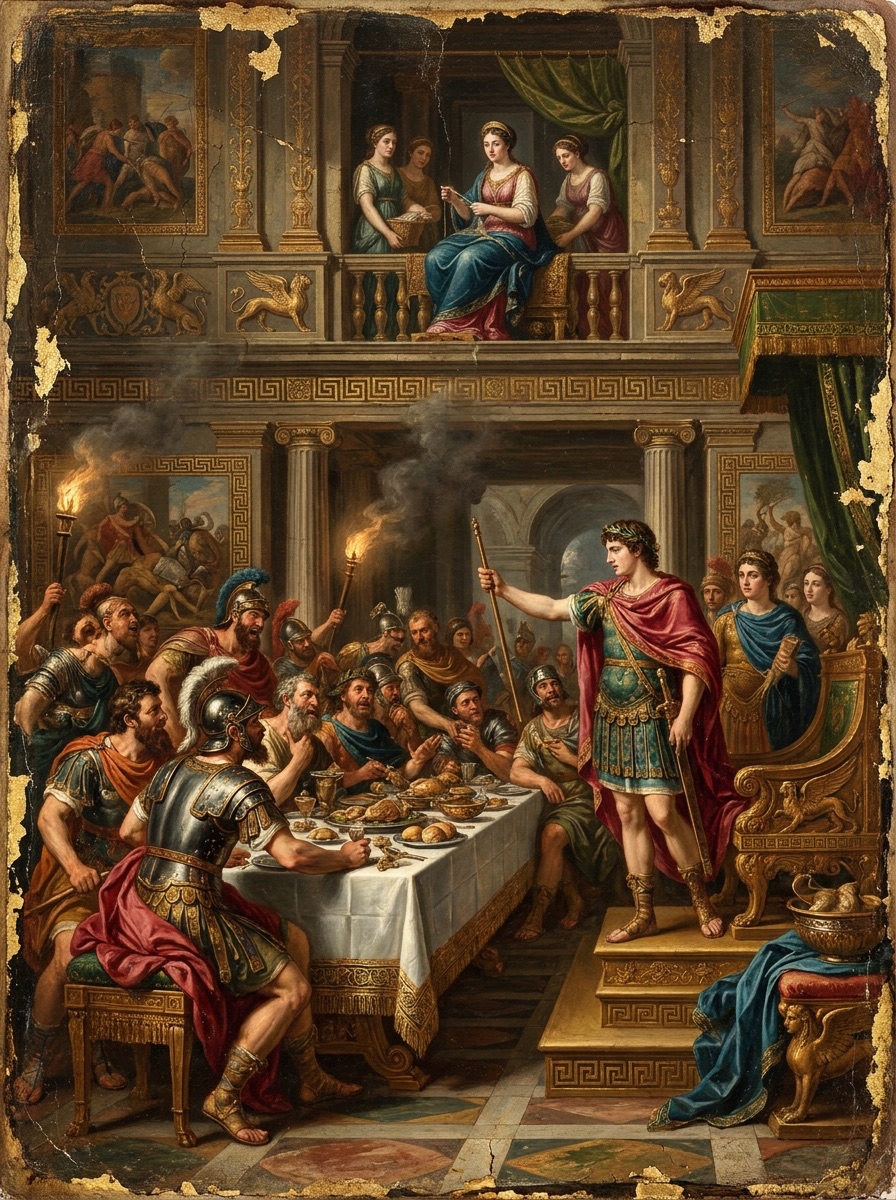
They were noble young men from Ithaca and the islands nearby. Each wore a fine cloak and brought attendants with him. They claimed they had come to court Queen Penelope, but in truth they had turned Odysseus’ house into their own feasting hall. In the morning they ordered servants to bring in fat sheep and dark cattle; by afternoon the tables were spread in the great room, meat hissed over the fire and dripped with fat, and wine cups passed from hand to hand. The singer was forced to perform, but the sound of the lyre could hardly rise above their laughter and shouting.
Penelope lived upstairs. She would not believe her husband was dead, nor would she lightly marry any one of these men. The suitors pressed her day after day, saying that Odysseus had been gone too long and that a woman could not keep watch forever over an empty house. Penelope had no strength to drive them out, so she delayed them by cunning. Once she said she must first finish weaving a funeral shroud for old Laertes, Odysseus’ father, and that when the cloth was done she would choose a husband. By day she sat at the loom, passing the shuttle back and forth; by night she lit a lamp and secretly undid the work she had woven. For a long time the trick held. Then a maidservant betrayed her, and the suitors grew bolder than before.
In that occupied palace, Odysseus’ son Telemachus had grown toward manhood. As a child he had never seen his father’s authority. He knew Odysseus only from the words of his mother and the old servants: how he had sailed to Troy, how shrewd he was in counsel, how he spoke among kings. Now Telemachus watched the suitors divide up the cattle and sheep in his own hall; he heard them spilling wine on the floor; shame and anger burned in him together. But he was still young. He had no army in his hands and no name like his father’s. When the suitors saw him pass, they only laughed at him as a boy.
The Stranger at the Door
One day the suitors were making their usual uproar in the hall. Telemachus sat apart, imagining how his father might suddenly come home and drive these men out through the doors. Just then a stranger appeared at the entrance.
The newcomer held a bronze spear and looked like a traveler from far away, yet his bearing was calm and strong. Telemachus saw him first. Unlike the suitors, who cared only for meat and wine, he rose at once to greet him, took the spear from his hand, led him inside, and told the maids to bring water for washing. Then he set food and wine before him.
The stranger was in fact the goddess Athena. She had come to Telemachus in the likeness of Mentes. After the guest had eaten, the suitors began their noise again and called on the singer to perform a sorrowful song of the return from Troy. Penelope heard the music from her rooms above. Thinking of her husband, she could not bear it and came down, asking the singer to choose another song.
Then Telemachus spoke. He told his mother that the singer was not to blame; many men had suffered on the way home. She should return upstairs, he said, and attend to the loom and her women, while speech in the hall belonged to men. Penelope was astonished to hear her son speak so. She did not argue, but went back upstairs with her maids and wept in secret for Odysseus.
The suitors heard him too. Some were displeased; others laughed, thinking the young man had suddenly begun to imitate a master of the house. But Telemachus did not draw back. He told them that at dawn he would summon the men of Ithaca to an assembly, so that all might hear what was being done in this palace.
That night Telemachus led the stranger aside to speak in quiet. Athena urged him not to sit any longer under insult. If he wished to learn news of his father, she said, he must prepare a ship and sail first to Pylos, to visit Nestor, and then to Sparta, to ask Menelaus. Before departing, the goddess told him to remember this: if he heard that his father was alive, he should endure a year longer; but if he heard that Odysseus was dead, he should raise a mound for him, perform the funeral rites, and then arrange his mother’s marriage. When she had spoken, the stranger vanished suddenly like a bird.
Telemachus looked after her and understood that no ordinary mortal had visited him. That night, for the first time, he felt that his duty was not merely to endure.
The Assembly of Ithaca
At dawn Telemachus ordered the heralds to call the people together. Ithaca had not held such an assembly for many years. Old men came leaning on their staffs; younger men came wrapped in their cloaks; the suitors came as well. They stood at the edge of the gathering with careless smiles on their faces.
Telemachus took the staff of speech and stood among them. He did not begin with distant wars, but with the wrong at his own door. His father was missing, he said, and his house had no master. The suitors would not properly seek Penelope from her father, yet day after day they crowded into Odysseus’ home, slaughtered his cattle and sheep, drank his wine, and destroyed his estate. He asked the people to bear witness, and he asked the suitors to leave the palace and hold their feasts in their own houses.
As he spoke, he could no longer hold back. He dashed the staff to the ground, and tears fell from his eyes. For a moment the assembly was silent. Many of the elders looked at the young man who had grown up without a father’s protection and pitied him, but none dared at once to stand against that band of noble youths.
Among the suitors, Antinous spoke first. He admitted no fault of his own. Instead he blamed Penelope, saying she had deceived them for years with her weaving. Eurymachus added that they would not leave unless Penelope chose a husband. The words sounded orderly enough, but their meaning was plain: they meant to stay in the palace, eating and drinking until the house was stripped bare.
Then two eagles flew down from the mountain and circled above the assembly. Suddenly they tore at each other with their talons, scattering feathers through the air, and then they flew away toward the town. Halitherses, an old man skilled in reading signs, saw it and warned the people: Odysseus would yet return, and if the suitors did not stop, ruin would come upon them.
The suitors only mocked him. They said the old man was merely speaking on Telemachus’ behalf. The assembly won no justice for Telemachus, but he had set the shame of his house before everyone. All Ithaca had heard it now: Odysseus’ home was not unwatched. Its defender was only still young.
The Ship Prepared by Night
When the assembly broke up, Telemachus went down to the shore and prayed to Athena. The goddess came to him again, this time in the likeness of Mentor, and comforted him, saying she would arrange a ship and companions.
The suitors could not be allowed to learn of it. If they discovered that Telemachus meant to sail, they would surely stop him—and might even kill him. So the goddess moved through the town, gathering young men willing to go with him, and borrowed a swift ship. Telemachus returned to the palace and told his faithful nurse Eurycleia to prepare food and wine.
The old nurse had watched him grow from infancy, and when she heard that he meant to leave home, she nearly wept aloud. She begged him not to risk it. The suitors were fierce enough already, she said, and the sea held winds and dangers of its own. Telemachus asked her to keep the matter secret and not tell his mother, lest Penelope spend the whole night weeping. He had wine poured into two-handled jars, barley meal packed into leather sacks, and clothes and gifts made ready.
Deep in the night, the suitors, full of wine, sank one by one into sleep. Athena made their drowsiness heavier. Telemachus slipped quietly out of the palace and went down to the shore. The ship had already been launched; the mast stood upright, the rigging was ready, and his companions sat waiting beside the oars.
A sea wind blew, and the dark water struck against the hull. Telemachus stepped aboard, afraid and eager at once. Never before had he left his island in this way; never before had he truly gone in search of his father. Athena sat in the stern and urged the men to cast off. The sailors raised the sail, and the ship ran with the night wind away from Ithaca, bound for Pylos.
The Suitors’ Plot
After Telemachus had gone, the feasting in the palace continued. At first the suitors paid no attention. Then word came that he had sailed away to seek news of Odysseus.
Their faces changed. The young man they had despised had deceived them all and put out to sea. If he returned with news that his father lived, or with help from another king, they would no longer be able to act as boldly in Ithaca as before. Antinous was the first to propose a cruel plan: they should send a ship to watch the sea road between Ithaca and Samos, and when Telemachus came back, ambush him so that he would never reach home.
The suitors approved the scheme. They chose men, made ready a ship, and set their trap. Penelope later heard whispers of it and almost fainted. She had not even known that her son had sailed; now she heard that the suitors meant to kill him. Her heart felt as if it had been cut with a blade. She went back upstairs, sat on the floor weeping, and prayed to Athena to protect her child.
The goddess did not let her suffer through the whole night. She sent a dream in the likeness of Penelope’s sister, telling her that Telemachus would not suffer alone, for a god was guiding him. When Penelope woke, the fear in her heart had eased a little. Still she looked toward the dark doorway, waiting for some safe word from the sea.
The Boy Leaves the Threshold
Telemachus’ voyage did not at once drive out the suitors, nor did it restore peace to Ithaca. In the palace those men still sat at the tables, cutting meat, drinking wine, and mocking the absent master. In the strait, the ship meant to ambush him waited in the dark.
Yet something had changed.
Before, the suitors had treated him as a child fit only to sit in a corner. Penelope had seen him as a son to be protected. The people of Ithaca had grown used to thinking that no one ruled in the house of Odysseus. Now he had spoken in the assembly and accused the men who were devouring his inheritance before the eyes of all. He had stepped aboard a ship at night and gone to seek news of his father from the old heroes. He had made the suitors uneasy for the first time.
The palace of Ithaca was still filled with noise, and in the ashes beside the hearth the fat from roasted meat still smoldered. But the son of Odysseus had crossed the threshold and taken to the sea. When he came home again, he would no longer be only the boy the suitors laughed at.