Greek Mythology
The Clashing Rocks — Greek Mythology
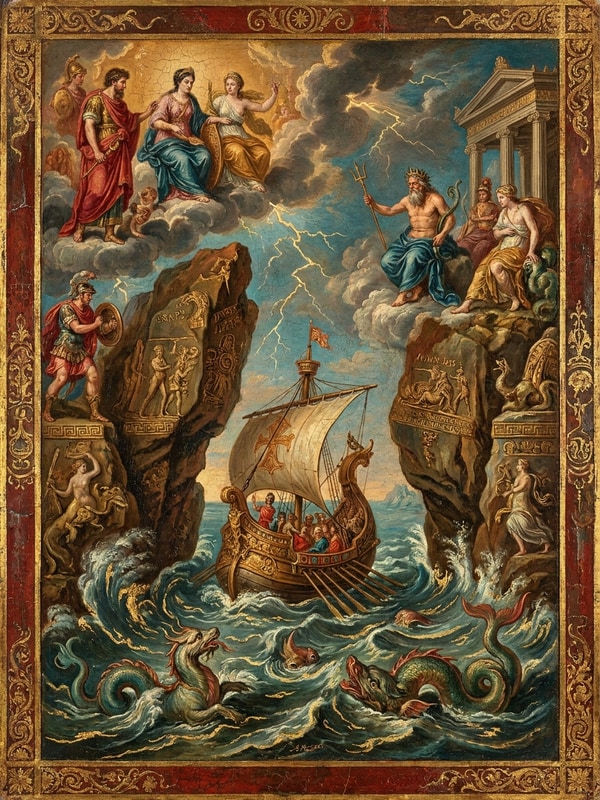
After leaving Phineus, the Argonauts came to the most dreaded passage before the entrance to the Black Sea: two great rocks that crashed together. Following the old seer’s warning, they released a dove to test the strait, then rowed with all their strength under Athena’s aid, until the Argo at last slipped through the Clashing Rocks.
Article
Summary
Once Phineus had been freed from the torment of the Harpies, he thanked the Argonauts by warning them of the dangers ahead. On the sea-road to Colchis, he said, stood two wandering mountains of rock. When the surge drove them together, they crushed anything between them, splintering ships to pieces. He told the heroes to release a dove first. If the bird passed safely between the rocks, they were to seize the brief moment when the cliffs opened again and row with every hand at once. If the dove died beneath the stones, they must not force the passage. The heroes listened with heavy hearts, yet they made their ship ready and sailed toward the roaring mouth of the sea. When the Argo reached the Clashing Rocks, the water was full of whirlpools and white foam. The two rocky heights opened and closed by turns, thundering like a storm in the mountains. Euphemus released the dove. It skimmed low over the waves and flew into the gap; when the rocks slammed shut, they tore only a few feathers from its tail. Tiphys at once shouted for the men to row. The heroes bent over their oars, the blades struck the water together, and the Argo rushed between the rocks as if driven by the wind. The stones closed again and almost caught the stern, but Athena reached out and helped the ship through. From that time on, the Clashing Rocks no longer drifted over the sea. They stood fixed in place, forming a strait through which later ships could pass.
Phineus’ Warning
After the Harpies had been driven away, Phineus’ house was quiet for the first time.
The old king had been starved until he was little more than skin and bone. He sat at the table, his hands still trembling, yet at last he could lift clean food to his mouth. Bread, wine, and roasted meat lay before him. No clawed monsters swooped down from the air; no foul wind swept across the table. He ate slowly, as if afraid it might all be a dream, and now and then his blind face turned toward the doorway.
The Argonauts did not hurry him. Jason sat nearby. Tiphys leaned on an oar. The two sons of Boreas had just returned from far away, still carrying in their bodies the rush of the chase after the Harpies. When Phineus had caught his breath, he raised his head and spoke to the men who had saved him.
“You are sailing to Colchis,” he said, “but do not think only of the Golden Fleece. Before you reach it, there is a peril on the sea where many ships have been crushed before their crews ever saw the farther shore.”
The room fell silent.
Phineus told them that before the narrow waterway leading into the Black Sea stood two terrible rocks. They were not reefs rooted quietly in the seabed, but great masses like beasts driven about by the sea. When the tide pressed them, the two rocky mountains moved toward one another; and when only a thread of water remained between them, they struck together with sudden violence. White spray leapt into the air, and the noise was like a mountainside collapsing. Any ship caught there would have its mast, planks, and oars shattered. Not even driftwood would escape.
The heroes listened, their faces darkening.
Then Phineus said, “When you come there, do not rush in at once. First release a dove and watch whether it can fly between the rocks. If it passes through and loses only the feathers of its tail, then seize the instant when the rocks draw apart and row with all your strength. No one must look back; no one must stop. But if the dove is crushed, do not try to prove yourselves. Turn away, for that is not a road mortals can force open.”
Jason asked, “If we catch that instant, can we truly pass?”
Phineus was silent for a while, as though in his darkness he saw the distant surf. His eyes could no longer see, but his mind knew the prophecies the gods had given him.
“You have the Argo,” he said, “and you have a goddess’ favor. But the ship will not fly through by itself. When the moment comes, everything will depend on the arms of each man among you.”
They remembered his words. At dawn the next day, the Argo left the shore of Phineus. Her sail filled with wind, and her prow cut through the gray-blue water. The old man stood on the shore, listening to the beat of the oars as it faded, until he could hear it no more.
Black Water Before the Strait
At first, the sea was calm enough.
The Argo sailed along the coast. The shadow of the hills slowly fell behind on the left, and seabirds wheeled above the mast. Each man kept to his place. Some tended the ropes, some checked the oarlocks, and some silently sharpened their spear-points. All of them knew that ahead lay no ordinary strait, but a stone mouth that could close upon them.
The farther they went, the wilder the wind became.
The sea no longer rose in clean, steady waves. It rolled in from several directions at once. One moment the ship was lifted high; the next she seemed to drop into a pit. White foam raced along the sides, and from far ahead came a deep, dull roar, as though boulders were striking one another inside the mist.
Tiphys, the helmsman, narrowed his eyes and looked forward. No man aboard understood the sea better than he did, yet even he tightened his grip on the steering oar. When the mist opened for a moment, the heroes finally saw the two rocks.
They stood on either side of the sea-mouth, so high they seemed to prop up the sky. No trees grew on them, only wet black stone and cracks hung with foam. Worse still, they were not still. The rock on the left slowly moved to the right, and the rock on the right was driven inward by some unseen force. Between them the water churned and boiled like a cauldron.
“Back a little!” Tiphys shouted.
The rowers pulled in reverse, and the Argo held off at a distance. Just then the two rocky mountains crashed together. The thunder of it overwhelmed the wind. A wave burst from the cleft and rose high, and the spray fell over the Argo like cold rain. The ship lurched violently, and many men caught at the planks without thinking.
When the rocks slowly drew apart again, a black lane of water appeared between them. Yet the passage was narrow, whirlpools twisted within it, and broken waves struck the stone walls with a sound like beasts gasping for breath.
Jason looked toward the prow.
There lay the dove Phineus had told them to bring. Euphemus held it in his hands. The bird had kept its wings folded quietly before, but now it too felt the terror of the sea and clenched its claws around his fingers.
“Is it time?” someone asked under his breath.
Tiphys did not answer at once. He watched the rocks, saw them open to their widest point, and saw the current surge out between them. He knew the next collision would come quickly.
“Wait for my call,” he said. “The dove goes first. If it passes, we follow.”
The Dove Enters the Cleft
For one breath, the wind before the strait fell still.
Tiphys cried, “Release it!”
Euphemus lifted both hands, and the dove sprang from his palms. It beat its gray-white wings. At first the crosswind forced it low, almost down to the wave-crests; then it rose and flew straight toward the gap between the two rocks.
Every man aboard watched it.
That small pale shape looked terribly light among the black stone and white foam, light enough to be swallowed at any moment. It did not turn back. Its wings beat fast as it drove forward along the narrow lane of water. The rocks began to move. The shadow on the left pressed inward; the wall on the right came after it. The strip of light between them grew thinner and thinner.
“Fly…” someone murmured, unable to stop himself.
The dove suddenly darted upward, escaping a burst of spray. In the next instant the two rocks slammed shut. The sound cracked across the sea like thunder, and the rising mist hid everything from sight.
When the spray cleared, the heroes stared ahead.
The dove had flown through.
It wavered over the far water, then steadied its wings again. Only a few feathers were missing from its tail. The rocks had clipped them away, and they spun now in the foam.
For a moment there was silence on the ship. Then men began to shout—not with easy joy, but as though a stone had shifted from their chests.
Tiphys did not smile. He knew that since the dove had passed, the Argo must enter at once. The rocks had already closed once and were drawing apart again. The time left to them was no longer than a breath.
“Rowers to your places!” he roared. “All of you—use every ounce of strength! No one stops!”
The heroes sprang to their benches. Heracles was no longer aboard for this stretch of the voyage, and the ship lacked her mightiest oarsman; yet none of those who remained drew back. Jason gripped the ship’s side. Euphemus returned to his oar. The two sons of Boreas gathered in their wing-like cloaks and took hold of the oars with the rest.
The water heaved before the prow. The rocks slowly opened, and the dangerous channel appeared again.
Tiphys judged the current, then thrust the steering oar hard.
“Row!”
The Argo Rushes Through the Stone Gate
Dozens of oars struck the water at once.
The Argo leapt forward, her prow cutting the waves like a blade. The rowers bent their backs. Shoulders rose and fell together, and the veins stood out along their arms. One stroke, then another, then a third—the current caught the hull, but the strength of the men drove her on. Spray broke into the ship and struck their faces, bitter with salt.
Tiphys stood at the stern, never taking his eyes from the passage ahead. He pressed the steering oar and called the rhythm. The rock walls drew nearer and nearer. Their vast shadows covered the ship, and sunlight shrank to a narrow thread. Seaweed and shells clung to the stone on either side, and water ran down through the cracks as though the mountains themselves were sweating.
When the Argo entered the gap, every sound changed.
The wind outside was cut off. Only the furious water roared beneath the hull. The inner faces of the rocks were rough and wet, only a few feet from the oar-blades. If a blade strayed even a little, it would strike the stone and shatter. The rowers did not dare look to either side. They fixed their eyes on the back of the man before them and drove their oars into the water again and again.
But the Clashing Rocks began to close once more.
First the sound of the water sharpened. Then the black walls on either side pressed toward the ship. Some heard the heavy grinding of stone against stone, like a great beast gnashing its teeth. The stern had not yet cleared the cleft, and already the rocks were coming after it.
“Faster!” Tiphys shouted, his voice raw.
The men nearly threw their whole bodies onto the oar-handles. The Argo surged ahead, then a returning wave dragged her back. The stern swung hard, and the timbers gave a groan that chilled the heart.
At that moment, Athena came.
Not all the heroes saw her clearly. Some felt only a bright rush of wind pass overhead. Others glimpsed the goddess beside the rock wall. With one hand she held back one of the rocks, delaying its crash for a single instant; with the other she thrust against the stern of the Argo and sent the ship, built for heroes, onward.
Suddenly the hull grew light.
The Argo burst out of the rock-mouth.
Almost at the same time, the two rocks closed behind her. A small piece of ornament from the stern was snapped away, flung up with the spray, and swallowed by the foam. It was like the dove’s tail-feathers torn off before them: only a little more, and the whole ship would have been left between the stones.
The heroes kept rowing for several strokes more. Only when Tiphys called for them to stop did they seem to wake from a dream. Some collapsed over their oars, gasping. Others turned to look back at the sea-mouth, their faces still wet and startled.
Jason rose and saw that the water ahead had widened. The wind filled the sail again, and sunlight shone across the dripping deck. The Argo had been lightly wounded, but she still floated steady on the sea.
The Rocks That Drifted No More
Behind them, the Clashing Rocks did not pursue.
After they closed, their thunder slowly died away. The two rocky mountains seemed to have spent the ancient savagery that had driven them for so long. They no longer drifted with the tide, but stood fixed on either side of the strait. Waves still struck their walls, and white foam still flew; yet the terrible power that had opened and shut and devoured ships had come to an end.
Only then did the heroes dare to cheer.
They lifted their wet arms, beat the planks, and called one another’s names. Euphemus looked into the distance, but the dove that had tested the way was already out of sight; only a few feathers still turned in the circling water. Tiphys loosened his grip on the steering oar, his palms rubbed red. Jason bowed his head toward the place where the goddess had aided them, though on the sea there remained only wind and light.
The Argo sailed on.
She had passed through the stone gate no one before had safely mastered, and behind her she left a new sea-road. In later days, when ships came to that place, they found only silent cliffs on either side of the strait. The current was still swift, and the reefs were still dangerous, but the Clashing Rocks no longer leapt like living things upon the vessels that approached.
What the Argonauts remembered most clearly was the moment itself: the dove, the torn tail-feathers, the black stone closing behind the stern, and the sound of every man driving his oar into the waves.