Greek Mythology
The Suitors’ Plot — Greek Mythology
When word reaches the suitors that Telemachus has left Ithaca to search for his father, Antinous immediately plots to ambush him at sea. Penelope learns of the scheme and prays in anguish, while Athena sends a dream-phantom to comfort her and calm her terror for a little while.
Article
Summary
The herald Medon overhears the plot. Unwilling to see Odysseus’ son murdered, he hurries to the women’s quarters and tells Penelope what he has heard. At the news, Penelope can scarcely stand. Her husband has been gone for years, and now her son may die at sea as well; grief leaves her nearly speechless. Only then does the old nurse Eurycleia confess that before Telemachus sailed, he had asked her to prepare food and wine for him and to keep the matter from his mother for a time. She urges Penelope not to alarm the aged Laertes, but to pray instead to Athena. Penelope follows her counsel, washes the tears from her face, and calls upon the goddess for help. Athena hears the prayer and sends a dream-phantom to Penelope’s bedside. It comforts her, saying that Telemachus is under divine protection and will not be left alone to be destroyed. Meanwhile Antinous sails with his men toward the strait between Ithaca and Same. The plot has begun, but in Penelope’s heart a small measure of calm returns.
News in the Palace
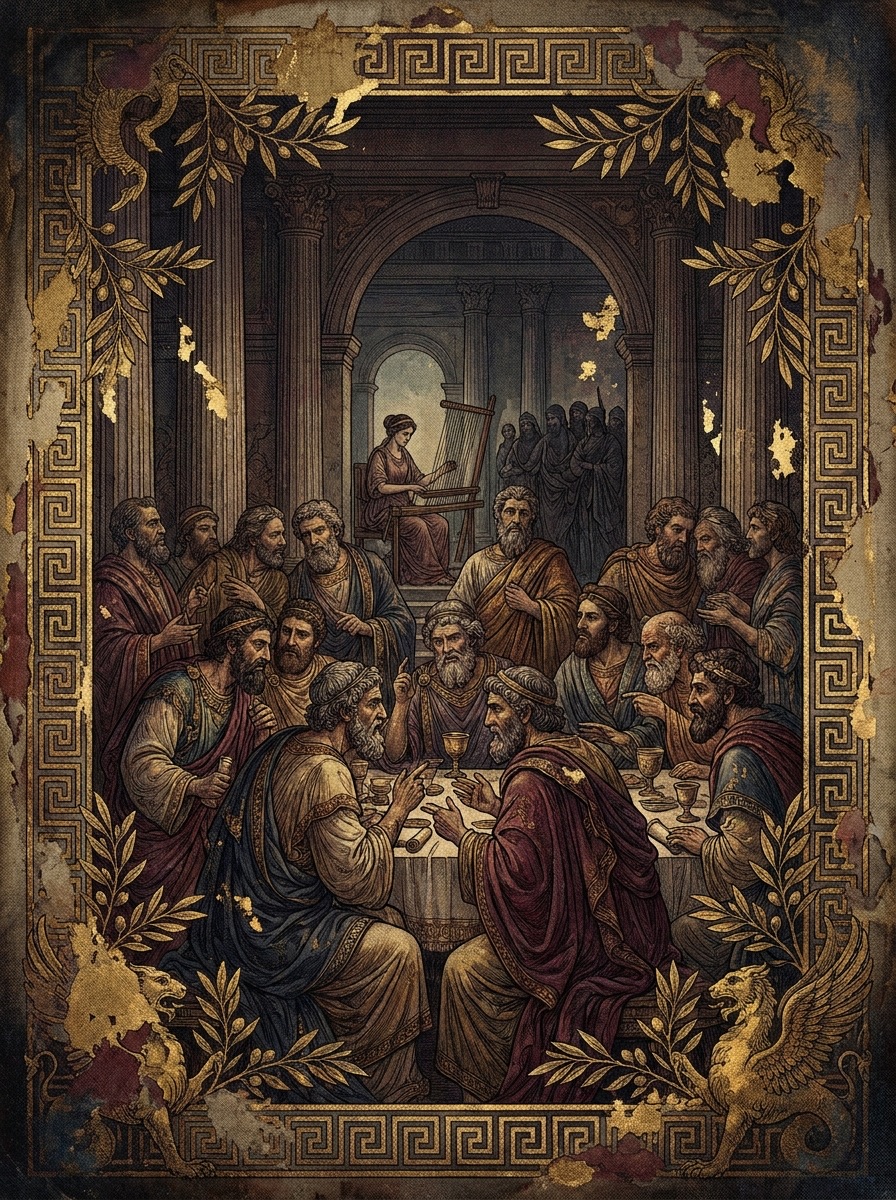
Odysseus had been gone for many years, and the palace of Ithaca looked less and less like a royal house. It had become more like a banquet hall seized by strangers.
In the morning, servants set out the long tables, opened the jars of wine, and led sheep and swine into the courtyard for slaughter. By evening the lyre would be sounding again. The suitors leaned back in their chairs, heaped their plates with cut meat, and passed cup after cup from hand to hand. They were waiting for Penelope to agree to another marriage, and they were waiting, just as patiently, for the wealth of Odysseus’ house to be eaten away.
Among them, Antinous was the most violent, and Eurymachus the smoothest in speech. Often the two sat aside from the noise of the others, watching the revelry while they spoke in low voices about how to force Penelope to choose a husband quickly.
That day a man named Noemon came into the palace. He had not come to feast, and there was no cheer in his face. He crossed through the smell of wine and the clamorous hall until he stood before Antinous and Eurymachus.
“Do you know when Telemachus will return?” he asked. “He borrowed a ship from me. I have business now in Elis, and I need the ship back.”
The words fell like a stone into a wine cup.
Antinous lifted his head. Eurymachus stopped what he was doing. They had thought Telemachus had merely hidden himself somewhere in the countryside, perhaps at one of the farms, perhaps with his old grandfather Laertes. None of them had imagined that the young man they had long despised had already left Ithaca and gone to sea with a crew.
Antinous asked, “When did he sail? Who went with him? Were they young men from the island?”
Noemon said only that Telemachus had borrowed the ship and sailed away with sailors. Whom he had asked for help, and where he meant to go, Noemon did not know.
He did not stay long after that, but the news he had brought remained behind in the palace, and it could not be called back.
Antinous’ Plan
Antinous rose to his feet, his face dark. He went among the suitors and motioned for them to be silent.
“Friends,” he said, “this is no small matter. Telemachus has dared to sail away without our knowledge. If the gods bring him home again—if he returns with news, or brings others back to aid him—shall we still be safe here as we are now?”
Some frowned. Others set down their cups. Until then they had treated Telemachus as a boy not yet grown, laughing when he spoke in the hall as if he had only suddenly found a little courage. But now he had sailed in search of his father. This was no empty outburst.
Antinous went on: “We must not wait for him to return. Give me a swift ship and twenty good men. I will lie in wait in the strait between Ithaca and Same. When his ship passes, we will catch him there, and his journey will end at sea.”
A low murmur moved through the hall. Some feared the deed was too cruel; others feared what Telemachus might do to them if he lived. In the end, more of them nodded in agreement. They had feasted too long in Odysseus’ house, and their hands had reached too deep into what was not theirs. By this point, killing the master’s son seemed easier than going home.
So they began arranging for a ship and sailors. Antinous already saw the scene in his mind: night, the strait, men lying in ambush, the young man’s ship coming on from the distance—then surrounded, overcome, and sunk beneath the waves.
Medon at the Door
The suitors thought their words had gone no farther than the feasting hall. But someone had heard them.
The herald Medon was standing near the door. He often moved through the palace on errands and carried messages for these men, yet he had no love for them. He had seen how they wasted Odysseus’ wealth, and he had heard how they mocked Telemachus. Now, hearing Antinous plan an ambush at sea for the young master of the house, his heart tightened. He did not dare linger.
Quietly he slipped away from the crowd, crossed the courtyard in haste, and ran down the passage that led toward the inner rooms. The sounds there were different from those in the hall: fewer clashing cups, less men’s laughter. Penelope was in her chamber with her maidservants and her loom. For years she had woven by day and undone the threads by night, using that craft to delay the suitors—and to hold fast to the last thread of hope within herself.
Medon came to the doorway and spoke urgently: “My queen, I bring evil news. The suitors have learned that Telemachus has sailed, and now Antinous means to lead men into ambush in the channel between Ithaca and Same. They will wait for him there and kill him when he returns.”
When Penelope heard this, it was as if her strength had been taken from her at once. She stood motionless for a long while, unable to speak. She had endured the absence of her husband year after year; now she heard that her son too was in danger, and the room seemed to darken before her eyes.
At last she said softly, “Why did he go? Why did he board a ship? Was it not enough that I lost my husband? Must I lose my son as well?”
The maidservants gathered around her. Some wept; others held her up. Medon bowed his head. He could tell her what he had heard, but he could not bring Telemachus back from the sea.
The Old Nurse’s Secret
Then Penelope thought of Laertes. The old man lived in the countryside, aged and sorrowful, and seldom came to the town anymore. She ordered her servants:
“Go and summon Dolius. Let him hurry to the farm and tell Laertes. Perhaps the old man can still think of some help. Perhaps he will cry out before the people and make them know that these suitors mean to murder the son of Odysseus.”
At this, the old nurse Eurycleia stepped forward. She had cared for Telemachus since he was a little child; now her hair was white, but her loyalty had not failed. She knew she could keep silent no longer, and so she said to Penelope:
“My queen, if you must blame someone, blame me. I knew before now that the young master had gone to sea. Before he left, he asked me to prepare food and wine for him, and he made me swear that for ten or twelve days after his departure I would not tell you—unless you first discovered he was no longer in the palace.”
Penelope turned and stared at her in astonishment.
With tears in her eyes, Eurycleia said, “I did not mean to bring you pain. I feared you would weep day and night and harm yourself, and I feared you would stop him. His whole heart was set on seeking news of his father, and I could not turn him back. Now that things have come to this, my queen, do not summon Laertes into danger. The old man is too frail; if he hears this, his grief will only grow heavier. Bathe, put on fresh garments, and pray with your maidservants to Athena. She loved Odysseus and will watch over his son.”
Penelope listened, and the tears fell. She did not strike the old nurse, nor did she send anyone to trouble Laertes. She knew that the palace was in the hands of the suitors, and that men lay in wait at sea. Human help had become a thin thing.
A Prayer to Athena
Penelope told the maidservants to bring clean water. She washed the tear-stains from her face, put on fresh clothing, and had grain placed in a basket as an offering to the gods. Then she went to the upper room, lifted her hands, and cried out to Athena.
“Daughter of Zeus, bright-eyed goddess,” she said, “if Odysseus ever offered you rich sacrifices of cattle and sheep in this house, if you still remember his reverence, save my son. Do not let those arrogant men kill him on the sea.”
As she prayed, the maidservants wept with her. Outside the palace the suitors still shouted and feasted; inside, a mother entrusted her last hope to the goddess.
Athena heard.
She would not allow Penelope to be tormented by fear until dawn, and so she shaped a dream-phantom. The phantom took the likeness of Penelope’s sister and came by night to her bedside like a familiar kinswoman. Penelope had at last fallen into an exhausted sleep, though tear-marks still lay upon her face.
The phantom stood beside her and said gently, “Penelope, do not weep so. Your son does not travel alone. Athena pities you and has already sent one to guard him.”
In her sleep Penelope asked, “Why have you come here? You know how much sorrow is in my heart. My husband is far from home, and I do not know whether he lives or is dead. Now my son too has been trapped by men who plan to destroy him at sea.”
The phantom answered, “Take courage. A god protects him, and he will escape this danger.”
Penelope wished to ask more about Odysseus. She longed to know whether her husband still lived or had already died. But the dream-phantom gave no answer to that. Like a thin drift of smoke, it left the room and vanished into the darkness by the door.
The Ambush in the Strait
That same night, the suitors’ ship left the shore.
Antinous boarded with the sailors he had chosen. They lowered the oars and, under cover of darkness, rowed toward the channel between Ithaca and Same. Ships passing through those waters had to come that way; the sea seemed open enough, but it offered hiding places to those who knew where to wait. That was why Antinous had chosen it.
They brought the ship to a place from which they could watch the route and waited for Telemachus to return. The sea wind blew along the hull. The oars lay drawn in, and the sailors spoke in hushed voices. Antinous stared out over the dark water. His thoughts were not on feasting, nor on Penelope, but on how to remove the son of Odysseus amid the sound of the waves.
Yet in the palace, Penelope had awakened from her dream. She remembered the gentle voice, and she remembered what the phantom had said: Telemachus was under the care of a god. Her fear had not wholly left her, but her heart was no longer as wild as before. She lay quietly on her bed and waited as the darkness slowly thinned toward dawn.
The suitors’ plot had been laid, and a ship lay hidden in the strait. But that night their murderous intent did not reach Telemachus. It remained out on the black water, rising and falling with the tide, waiting for a homeward traveler who had not yet come.