Greek Mythology
The Siege of Thebes and Menoeceus — Greek Mythology
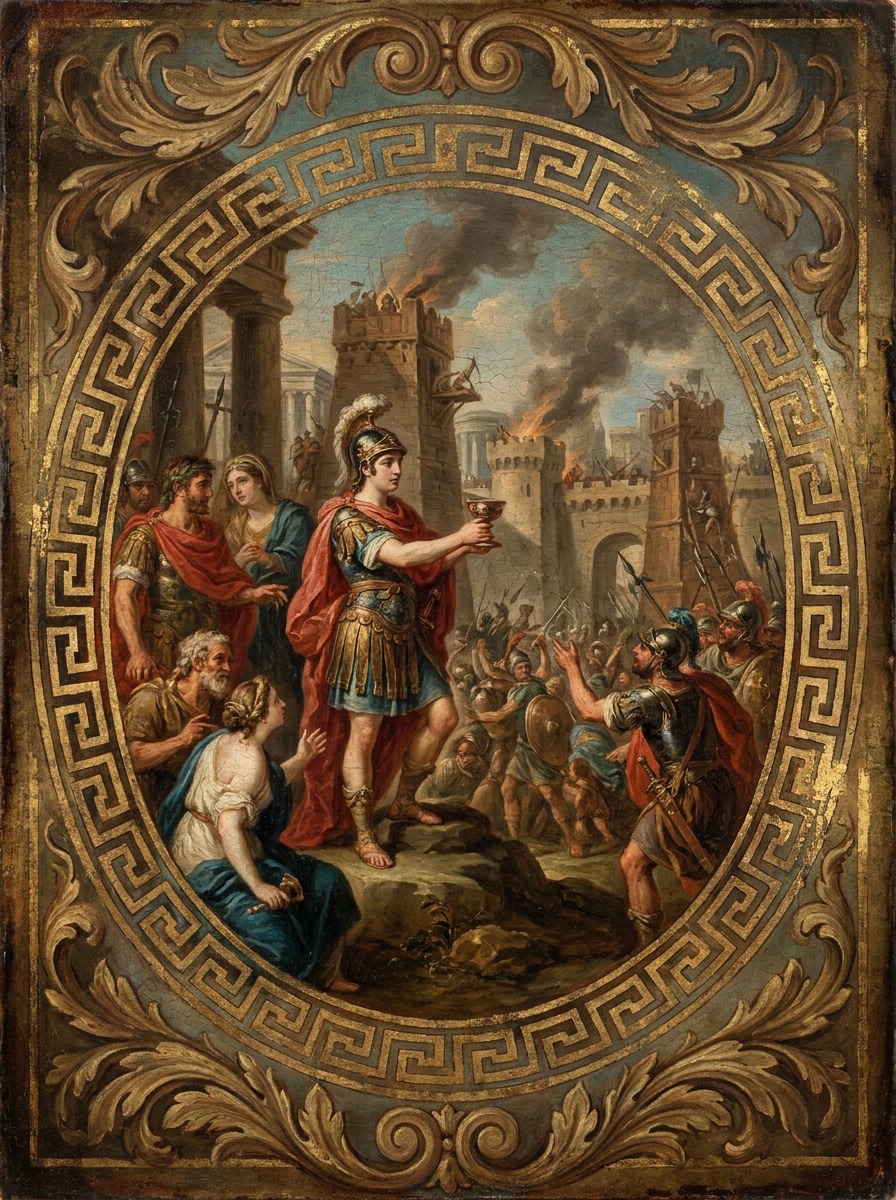
As the Argive army presses against Thebes, fear spreads inside the city. Tiresias declares that Menoeceus, son of Creon, must die willingly if Thebes is to be saved.
Article
Summary
This story stays inside Thebes while the Argive army closes around the seven gates. Eteocles and the elders argue over defense, Tiresias names the price of salvation, and Creon tries to spare his son Menoeceus. The youth chooses the city over his own life, and his death becomes the hidden cost behind Thebes’ survival.
Fear Inside the Walls
The Argive army was already before Thebes. The question here was no longer how Polynices found allies or how the Seven set out, but what the city felt once war pressed against its gates. Inside the walls, Eteocles had to defend the city while old guilt, prophecy, and fear moved through the palace.
The Quarrel Within the City
Meanwhile, Eteocles had gathered the leaders in the palace. He would not hear the old promise repeated. All he said was that the enemy was already outside the walls and Thebes must be held. Some urged him to seek peace with Polynices and spare the city the shame of brother fighting brother; others said that once a man had brought an army against his own city, he could no longer be treated as kin.
Their mother, Jocasta, still lived. She was old and worn with grief, yet she still tried to save her sons. She had Polynices brought into the city, hoping to make the brothers speak face to face. Polynices walked through the palace gates in foreign armor, but his eyes kept turning to the familiar columns, the altars, and his mother’s face. He said he had been driven out unjustly, and that was why he had been forced to seek help from outsiders. Eteocles answered coldly that the throne was already in his hands and he would not surrender it.
Their mother stood between them, reaching first for one and then for the other. She begged them to think of the father they shared, the womb that had borne them both, the people of the city, and the women who were already weeping before the battle had even begun. But the brothers’ words grew harder with every exchange. Polynices said that if justice was denied him, he would take what was his by spear. Eteocles answered that if he had come with an army, then he should not expect to leave alive.
The meeting broke apart. Polynices went back out through the gates to the Argive camp, and Eteocles armed himself and set about arranging the defense. His mother’s tears could not stop the war, and the clouds above Thebes seemed only to sink lower.
Tiresias Speaks
While the city was busy assigning troops, the blind seer Tiresias was led up to the palace. He was very old, and though he could not see, he seemed to hear the gods speaking in the dark. He leaned on his staff, with a child to guide him, and his robe brushed softly over the stone steps.
Creon was there as well. Since the disasters of Oedipus’ house had never ceased, he had long handled much of the city’s business. When Tiresias appeared, everyone fell silent, for few paid less heed to common guesses than that old man.
At first Tiresias would not speak. He knew that what he was about to say would fall like a knife into the hearts of those who heard it. Creon pressed him, asking how Thebes could be saved and how the enemy at the gates might be driven back. The old man was silent for a long time before he answered that Thebes’ suffering came not only from the army before its walls, but from an older debt that had never been paid.
Long ago, Cadmus had come to that land, killed the dragon of Ares, and sown the dragon’s teeth in the earth. From those teeth sprang armed men, warriors who rose from the soil and slaughtered one another until only a few remained. They became the ancestors of the Theban nobility. But the dragon had belonged to Ares, and the blood-guilt had never truly gone away. Now, with the city under siege, if Thebes was to be saved, one youth descended from those first “sowers” had to offer his life to Ares.
That youth was Creon’s son Menoeceus.
When Creon heard this, it was as though someone had struck him in the chest. He was no enemy of Thebes, nor did he despise the gods, but this was his own son, a young man who had not yet truly lived. There were so many warriors in the city, so many old men—why should it be his child who died?
When Tiresias finished, he said no more. The prophecy had been given; what remained was not for him to choose.
A Father’s Plea
Creon hurried to summon Menoeceus. When the young man arrived, he knew nothing of what had been said. He saw his father’s pale face and asked whether the gates had already fallen. Creon drew him aside and, in a low voice, told him the seer’s words: if he died, Thebes could be saved.
Menoeceus listened, first in shock and then in silence. The drums from outside could already be heard faintly; people were running in the courtyards, shouting in the streets, and the smoke of sacrifice was drifting in from the shrines. He knew this was no jest, and no words to be forgotten lightly.
But Creon seized his hand and pleaded with him not to believe it. Perhaps the gods had another way. Perhaps the prophecy could still be escaped. He ordered his son to leave Thebes at once, before the gates were fully sealed, and to take his servants and horses and flee to some distant place. Creon was even willing to give him money so he could live elsewhere, so long as he stayed alive.
Menoeceus looked at his father. He saw not the stern man he had known, but a father terrified of losing his son. The faster Creon spoke, the more clearly the young man understood: if he ran away, his father might save a son, but what would happen to Thebes? What of the children, the women, the old people, and the warriors who stood behind the gates?
He did not openly defy his father. Not wanting Creon to seize him by force, Menoeceus nodded and said he would leave and do as his father commanded. Creon finally breathed easier and urged him to make ready at once.
Yet once Menoeceus left his father’s side, he did not go to the stables or gather his baggage. He climbed the stone steps toward the walls. The wind blew in from outside the city, carrying dust and the smell of horses. Far away, the Argive banners moved over the plain, and before every gate the clash of weapons on shields could already be heard.
The Young Man on the Wall
Menoeceus came to the high ground and looked out over all Thebes. He saw the palace roofs, the colonnades of the shrines, and the narrow streets with their doors. He saw people bringing water jars to the walls in case of fire; he saw boys slinging bowcases over their shoulders, their hands trembling; he saw women raising their arms before the image of Athena and begging for help.
His heart was not light. No young man walks toward death without fear. Perhaps he, too, had once dreamed of feasts to come, of chariots, of marriage, of the day when, after his father had grown old, he would have to carry the house on his own shoulders. But the army was already outside, and the oracle had already spoken. If every man thought only of keeping his own life, Thebes would be swallowed by spear and fire.
So he drew his sword. The bronze flashed once in the sunlight. Menoeceus did not turn back to seek his father, and he did not call down to the city below. He gave his life over to the city and to the gods, and from the height of the walls he killed himself. His blood fell upon the stones and onto the land tied to the ancient tale of the dragon.
By the time anyone discovered what had happened, Creon was too late to stop it. The father reached the wall and saw his son’s body, and grief nearly broke him. But the fighting did not pause for one man’s tears. Outside the gates, the Argive army still advanced; within the walls, the Thebans knew that one young man had already gone ahead of them into death.
The Fighting at the Gates
Then the seven Argive champions pressed one by one against the seven gates. On the walls, the defenders heaved great stones into place and fitted arrows to their bows. Eteocles himself oversaw the defense, sending warriors to meet the enemy wherever the danger was greatest.
Capaneus was the most arrogant of the attackers. Standing on his ladder with torch and shield, he boasted that even if Zeus himself stood in his way, he would burn Thebes to the ground. The words were barely out of his mouth when the sky split open. Thunder and white fire struck down from above. He plunged from the ladder, his armor smoking, and crashed at the foot of the wall. The sight chilled many of the besiegers.
The other champions also met fierce resistance at the gates. Spearpoints shattered on shields, chariot wheels crashed over bodies, and frightened horses reared screaming. Parthenopaeus fell in the battle; Tydeus was carried off grievously wounded. Amphiaraus, who had known all along that the expedition would end badly, fled in his chariot, but the earth opened before him and swallowed both him and his car into the depths. Adrastus, though he had led the expedition, could only watch his companions die one after another.
In the end, the worst encounter fell, as it had to, upon the two brothers. Eteocles chose to meet Polynices himself. Both wore armor and carried spears as they stood on the ground near the gate. One guarded the throne; the other demanded it. One said he was defending Thebes, and the other said he was claiming his rightful due. By then words were useless. Only weapons could answer.
They rushed at each other. First the spears broke, then the shields buckled under the force of the blows, and then each brother drew his sword. Those gathered nearby dared not come close. They heard only the shriek of bronze striking bronze. In the end, the brothers struck one another almost at the same instant with mortal blows. Eteocles fell, and Polynices fell with him. What their mother had tried to prevent happened at last before the city gate.
Thebes Is Saved
The Argive army, now bereft of its leaders, broke apart. Those who remained alive began to retreat; the chariots turned, and once again dust rose over the plain. But this time it was no advance—it was a flight. Outside the seven gates there were shattered shields, broken spears, dead horses, and countless bodies. Thebes had not been taken.
Yet there was no true rejoicing inside the city. The price of saving the walls had been far too high. Creon had lost Menoeceus, Jocasta had lost both sons, and the Thebans saw that the curse on Oedipus’ house had not ended simply because the old king was gone.
Menoeceus’ death was not like the noise and confusion of battle. He did not charge forward with an army, nor did he boast of his courage before a crowd. He only heard that the city required one man’s life, and he went alone to the wall and gave up the life his father had wanted to keep. The gates of Thebes still stood, and the fires in the city were still burning. His name, too, remained, bound forever to the heaviest memory of that siege.