Greek Mythology
The Expedition of the Seven Against Thebes — Greek Mythology
The Seven leave Argos and march against Thebes. This story follows the expedition on the road, the arrival before the seven gates, the collapse of the attack, and Adrastus’ escape.
Article
Summary
With the leaders gathered, the Seven set out from Argos and move toward Thebes. The road gives them ominous signs, the seven gates await them, and the assault breaks against the city. Capaneus falls, Amphiaraus is swallowed by the earth, the brothers meet in a fatal duel, and Adrastus alone rides away from the ruined expedition.
The Army Leaves Argos
Adrastus had already sheltered Polynices and gathered the leaders who would be remembered as the Seven. Now the matter passed from palace promises into movement. Chariots, horses, shields, and omens all began to point one way: toward the walls and seven gates of Thebes.
The Seven Captains Set Out
The army of Argos began to gather.
The wheels of chariots were greased, horses were harnessed, spears leaned beside the cars, and shield after shield was carried out. At dawn the soldiers set off. Bronze armor flashed in the sun, and dust rose behind the wheels. Polynices marched among them, and the nearer he came to Thebes, the heavier his resentment grew.
On the road they came to Nemea. The army lacked water, and both men and horses were tormented by thirst. A woman named Hypsipyle was caring for the infant Opheltes. She showed them the way to a spring, but for a little while she laid the child down in the grass. When the others returned with water, the child had been bitten by a serpent and was dead.
The event fell over the army like an evil shadow. Amphiaraus said that the child’s death foretold the fate of the expedition. They held funeral games in the child’s honor, and later people would regard this as one origin of the Nemean Games. Yet grief did not turn the army back. The libations were poured, the flames went out, and the chariots rolled on toward Thebes.
Among the heroes on the march, Capaneus was the proudest. He was strong, and his speech was as great as his strength. He often said that even if Zeus himself hurled thunder, he could not keep him from climbing the walls of Thebes. Some who heard him frowned; others warned him not to show contempt for the gods. Capaneus treated such warnings as cowardice.
Amphiaraus grew still more silent. He looked at the army, at the sky, at the dust under the horses’ hooves, as if he already saw many men lying dead before the gates.
Before the Walls of Thebes
At last Thebes appeared in the distance.
Its walls rose high above the plain, and its seven gates stood like seven closed mouths. Inside the city, the people heard that the enemy had come and hurried up to the battlements. Women took their children to the temples and prayed to Athena, Ares, and the guardians of the city. Old men stood at the street corners and gazed toward the gates. Young warriors lifted their shields and waited for the orders of Eteocles.
Eteocles did not give way. He knew that the one approaching was no ordinary enemy, but his own brother returning with a foreign army. Yet upon the walls he no longer thought of Polynices as a brother. He saw him only as a besieger.
The Thebans sent men to observe the enemy’s array. They brought back word that the seven captains were advancing against the seven gates, each with a striking device upon his shield. Some bore torches, some beasts, some arrogant images, as if Thebes had already been trampled underfoot.
Eteocles assigned defenders to meet them one by one. Each gate would have a Theban champion; each shield would be opposed by another shield. At last only one gate remained, and the man attacking it was Polynices.
Some urged Eteocles not to go himself. They said that brother killing brother would bring the curse of the house of Oedipus to fulfillment. But Eteocles would no longer listen. Since Polynices had brought an army to the walls, he would meet him in person.
He took up his shield and spear and went toward that gate.
Blood Beneath the Gates
The battle began.
Trumpets sounded. The Argives pushed forward behind their shields, while the Theban defenders hurled stones and javelins from the walls. Wheels crushed loose stones, frightened horses screamed, and spearheads rang against bronze shields in flashes of sparks.
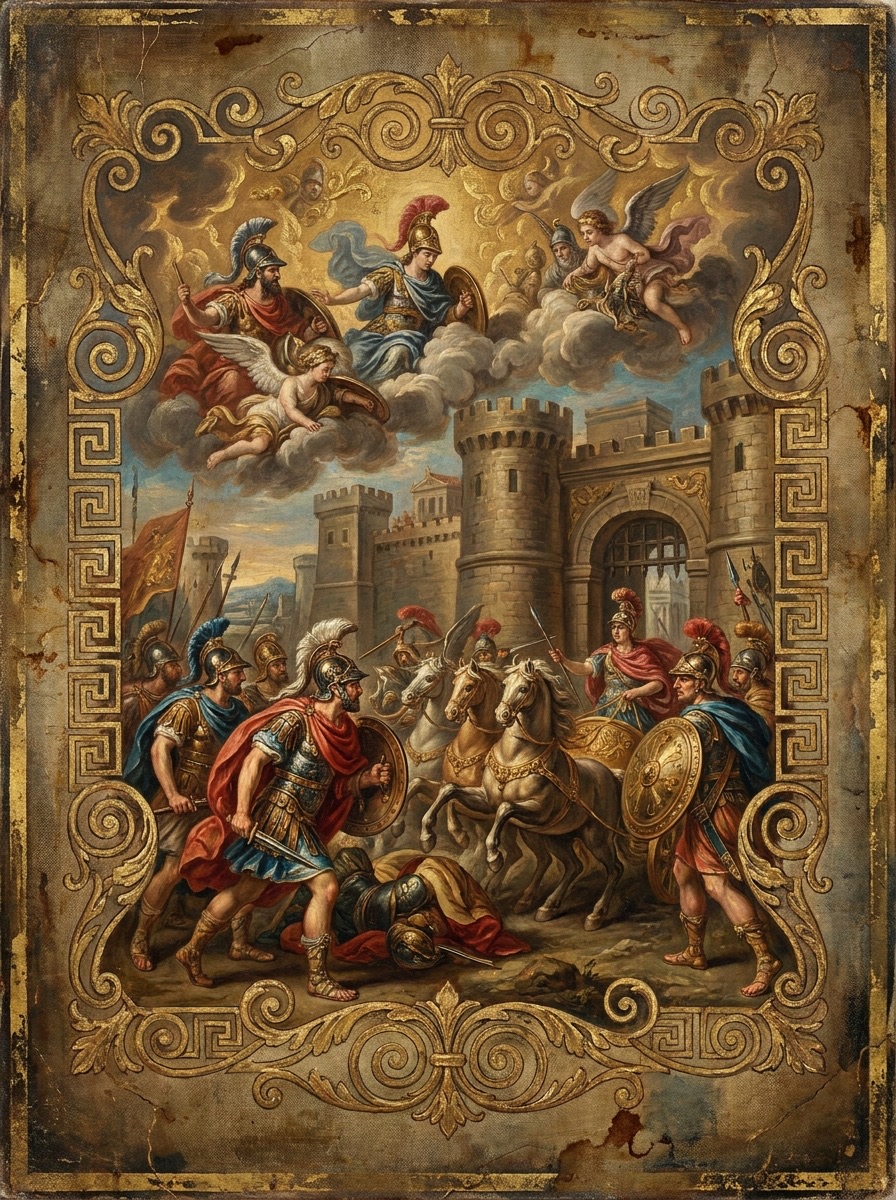
Capaneus rushed to the foot of the wall. He set up a ladder and climbed as if he were scaling a mountain, shouting as he went that not even a god could drive him down. Just as he was about to pass over the battlements, the sky flared. Thunder split the battlefield, and the bolt of Zeus struck him. Capaneus fell from the height, armor and all, his body wrapped in flame and black smoke. Those who had heard his boasting did not dare speak then.
Parthenopaeus also died before the gates. This young hero had come from Arcadia to Argos, hoping to win a name in war, but his fate ended beneath the walls of Thebes. Hippomedon fought with all his strength, yet he too could not force the gates open. Tydeus was fiercely brave and struck down many enemies, but at last he received a mortal wound. Athena had pitied his courage and meant to win immortality for him, but in his final moments he committed a dreadful act, and the goddess turned away in disgust.
Amphiaraus drove his chariot through the battle. He knew he could not escape, yet he fought like a true warrior. When his pursuers pressed close, Zeus caused the earth to split open. The chariot, the horses, and Amphiaraus sank together into the ground. Dust closed over them, and only cries of terror remained on the battlefield. The seer did not fall in blood like an ordinary man; the earth itself received him.
One after another, the seven captains went down. The banners of the Argive army were torn apart, and the shouts of assault slowly became cries of anguish.
The Brothers’ Duel
At last Eteocles and Polynices met before the gate.
Both wore armor. Helmets covered their brows, and shields guarded their breasts. Yet however heavily they were armed, each still recognized the other’s eyes. Once they had grown up in the same palace; now they faced each other across the points of their spears.
Polynices said he had come to reclaim the throne that was his. Eteocles said that a man who brought a foreign army against his fatherland was no longer fit to be king of Thebes. Argument was useless now. The warriors around them drew back, leaving a space of trampled dust.
The brothers raised their shields and crashed together. Their spears thrust in turn. Bronze points scraped across shield faces with a harsh sound. They circled each other, searching for the gaps between the plates of armor. Eteocles was wounded first, and blood ran from beneath his mail; Polynices did not escape the answering blow. In the end, almost at the same moment, each drove his spear into the other’s body.
They fell upon the same ground.
The throne of Thebes belonged to neither brother now. Polynices had not entered the city as king; Eteocles had not kept the throne for long. The old hatred in the house of Oedipus was paid for once at that gate with two lives, but it was not truly ended.
Adrastus Rides Back
The Argive army was defeated.
Of the seven captains, only Adrastus survived. His divine horse Arion was swift, and it carried him out of the chaos of the battlefield. Behind him lay fallen companions, shattered wheels, and the gates recovered by the Thebans. He did not dare look back for long; he could only let the horse bear him away.
Thebes had held the city. Yet its people did not rejoice for long, for victory had come soaked in blood. Eteocles was dead, Polynices was dead, and many young defenders had died as well. Cries of mourning rose from the palace. The incense before the temples had not yet dispersed when a new command came from the royal house.
Creon took control of Thebes. He ordered that Eteocles, who had fought for the city, be buried with honor, but forbade the burial of Polynices, who had led an army against it. His body was to be left outside the walls for birds and beasts to tear. To the Thebans, this was the punishment of a traitor; but to Antigone, daughter of Oedipus, he was still her brother.
So ended the expedition of the Seven against Thebes. The heroes of Argos did not take the city, and Thebes found no peace in victory. The seven gates still stood, scarred by weapons, while the earth outside had drunk the blood of the two brothers and many heroes. In later days, when people spoke of that expedition, they would always remember its terrible end: seven captains came to the walls, and only Adrastus returned alive.