Greek Mythology
Semele and the Birth of Dionysus — Greek Mythology
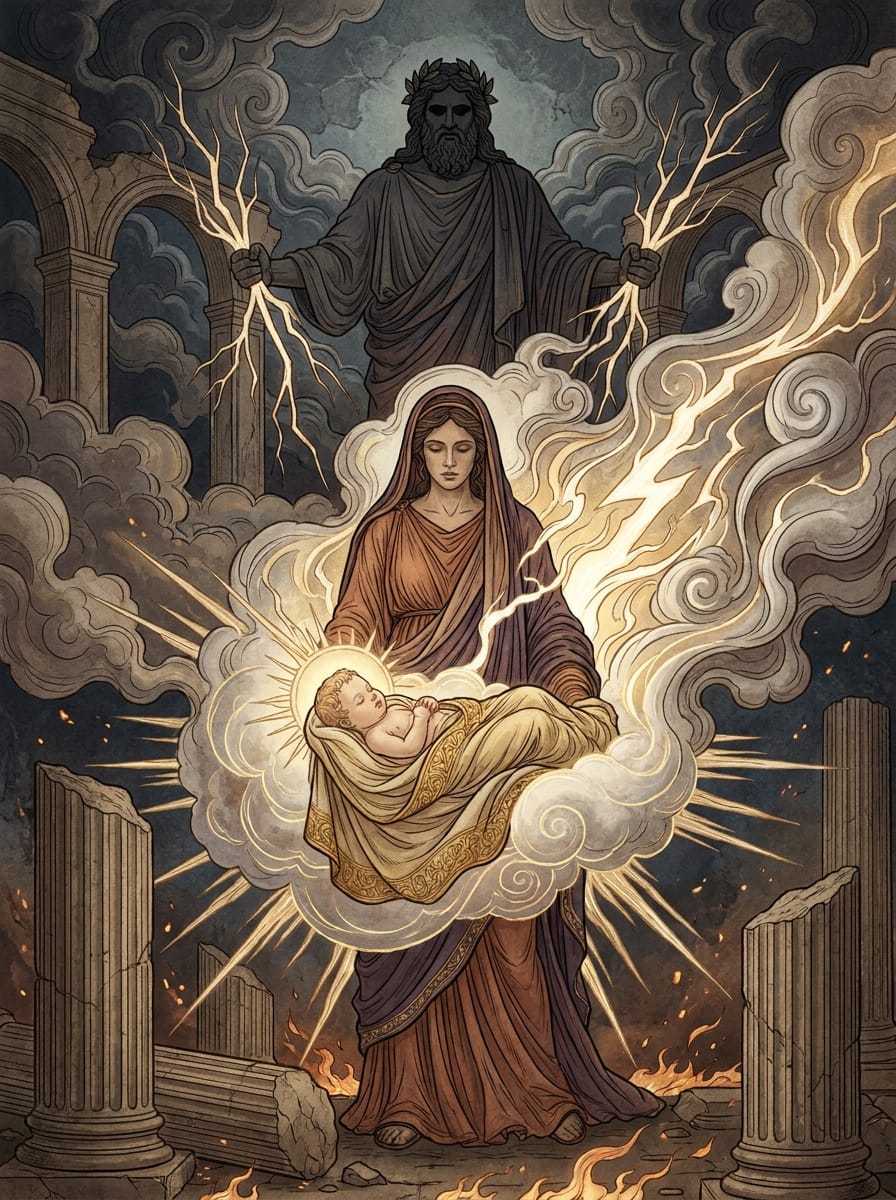
Semele, princess of Thebes, was loved by Zeus, but Hera led her to demand that she see Zeus in his true divine splendor. Bound by an oath he could not take back, Zeus appeared with thunder and fire; Semele was consumed, but from the flames he saved the unborn child, Dionysus.
Article
Summary
Semele was the daughter of Cadmus, king of Thebes, and Harmonia. Zeus fell in love with her and often came to her secretly at night. When Semele conceived a child, whispers spread through the palace, and Hera soon heard the news and grew jealous. Hera did not strike Semele down at once. Instead she took the shape of an old woman and went to visit her. Pretending concern, she sowed suspicion in Semele’s heart and urged her to make Zeus swear an oath, then ask him to appear before her in his true majesty. Persuaded, Semele waited until Zeus came and first made him promise that he would grant her wish. When Zeus heard what she asked, he was horrified, for he knew no mortal could endure the thunder and radiance of a god. He begged Semele to choose another gift, but the oath had already been sworn, and she would not withdraw her request. At last Zeus appeared with lightning, the palace caught fire, and Semele died in the blaze. The child was not yet ready to be born. Zeus rescued him from the flames and sewed him into his own thigh, where he continued to grow. When the proper time had passed, the child was born from Zeus’s body: Dionysus. Later he was hidden and raised in secret to escape Hera’s anger, and so the tale remembered him as the god who was born twice.
The Girl in the Palace of Thebes
After Thebes was founded, its walls stood white and strong beneath the sun. The people of the city often said that Thebes had not come easily into being: Cadmus had searched for his lost sister, killed the serpent beside the spring, and sown the dragon’s teeth in the soil, watching armed men rise out of the earth. In time he became king of Thebes and took Harmonia as his wife.
The gods themselves had attended the wedding of Cadmus and Harmonia, bringing rare gifts for the bride and groom. Yet the gifts of gods are not always simple blessings. Sometimes they gleam like gold; sometimes ruin lies hidden inside the gold. After the marriage, Harmonia bore several daughters, and Semele was one of them.
When Semele grew up, she often moved through the palace courts. Her dress trailed over the stone steps, and her attendants followed with folded cloth and little boxes of perfume. She was no goddess, but there was a brightness in her beauty. When the people of Thebes saw her, they would murmur that the daughter of Cadmus was like a flower just opened in spring.
Zeus saw her too.
He did not descend in a chariot of thunderclouds, nor did he send an eagle circling above her roof. He often came to Semele when night had deepened, like a lover from far away, with a gentle voice and warm hands. Semele did not know what divine power stood before her. She only knew that this visitor loved her, listened to her, and was willing to remain by her side.
Before long, she was carrying his child.
No palace keeps secrets perfectly. Servant girls noticed the change in the princess’s face; they saw her smile to herself, then sit lost in thought with a hand pressed to her breast. Low talk slipped past the columns, reached the women’s chambers, and traveled farther still. At last the news came to Hera.
Hera Takes the Shape of an Old Woman
When Hera heard Semele’s name, anger was already burning in her heart. She was the wife of Zeus, and what she least endured was that mortal women should receive his love. But she did not at once send down a storm or topple the palace walls. Hera knew how to make a person walk toward disaster by her own steps.
She put on the appearance of an old woman: white hair hanging by her temples, fine wrinkles across her face, her gait made slow and careful. She entered the place where Semele lived, pretending to be an aged nurse, as though she had cared for the girl since childhood. The attendants suspected nothing and let her into the inner room.
Semele was sitting by her bed, holding a piece of half-woven cloth. She looked up, saw the old woman, and invited her to sit. The old woman sighed, asked first about her appetite, then about whether she slept well at night. Her words were tender, but her eyes watched every change in Semele’s expression.
At last Semele spoke of her secret. She said the one who came to her so often was no mortal man; he had told her he was Zeus. As she spoke, there was shyness in her face, but pride as well. For a mortal woman to be loved by the father of gods was enough to quicken the heart.
Hera pretended to be startled, then frowned.
“My child,” she said slowly, “men’s words can be as light as the wind. If someone says he is a god, does that make him one? If he truly is Zeus, why does he always come in darkness? Why has he never let you see him as he really is?”
Semele tightened her fingers around the cloth.
The old woman leaned closer and lowered her voice. “You carry his child. You have more reason than anyone to know who he is. Make him swear an oath that he will grant you one request. Once he cannot draw back, ask him to come before you as he goes to Hera, with his thunder and his divine majesty. Then the truth will be plain.”
The words were like small thorns driven into Semele’s heart. She had trusted Zeus, but once she remembered that she had never seen his true form, doubt began to grow. After the old woman left, Semele sat for a long time, not even noticing when the weaving slipped down into her lap.
The Oath That Could Not Be Recalled
That night, Zeus came again.
Semele did not go to him at once as she usually did. She looked at him with an unease she could not hide. Zeus saw that something troubled her and asked, “What do you want? If it is in my power to give it, I will give it.”
This was the very sentence Semele had been waiting for. She drew near and asked him first to swear an oath he could not break. Zeus loved her, and he did not imagine that she would ask for anything terrible, so he swore by the River Styx. For the gods, that oath was heavy beyond measure; once spoken, even Zeus could not easily cast it aside.
Only then did Semele say, “Come to me in your true form, as you come to Hera, with all your radiance and thunder.”
Zeus’s face changed at once.
He understood. This was not a request Semele could have devised alone; Hera’s hand must be behind it. But the oath had been spoken, and it could not be swallowed back. He urged her to choose another wish: gold, silver, palaces, long life, glory for her son—anything. Semele thought he was evading her, and her suspicion only deepened. Again and again she begged him to keep his oath.
Zeus was silent for a long time.
Mortal eyes cannot endure the full light of a god. Mortal houses cannot withstand thunder. Zeus knew that if he did as she asked, Semele would die. Yet the oath by the Styx lay upon him, and he could not break it.
So he left her for a little while.
High in the depths of the sky, clouds gathered. Thunder first rolled in the distance, like enormous wheels grinding over the valleys. Wind swept through the courts of Thebes, and the lamps shook one by one. Semele stood inside her chamber with cold fingers, still waiting. She wanted to see who her lover truly was, and to silence her doubt with her own eyes.
The Child in the Thunderfire
Zeus returned.
This time he was no gentle visitor of the night. White lightning flashed around him, cloud wreathed his shoulders, and thunder roared in his hand. Even though he had done all he could to restrain his power, it was still more than any mortal body could bear.
First the room blazed with a dreadful whiteness; then the beams cracked apart. Curtains caught fire. Perfume boxes, woven cloth, and the bed itself were swallowed by tongues of flame. Semele had only time to see the dazzling light before she fell in the fire. The child in her womb was not yet full-grown, but he stirred amid the blaze.
Zeus rushed into the flames and saved the unborn child.
The child was too small to live outside his mother’s body. Zeus did not hand him over to any mortal, nor did he expose him to Hera’s anger. He cut open his own thigh, hid the child inside it, and sewed it closed. In this way Semele’s son continued to grow within his father’s body.
The fire in the palace of Thebes slowly died away. People saw only charred beams and collapsed rooms. They saw that Semele was dead, but no one could clearly say what had happened in the night. Some whispered fearfully that she had loved a god; others said cruelly that she had boasted of lying with Zeus and had been punished by lightning.
Semele could no longer hear them.
But her child had not died. Zeus hid him deep from Hera’s eyes until the time was fulfilled, and then brought the child forth from his own thigh. Because he had first taken shape in his mother’s womb and then come to completion in his father’s body, later stories said that he had passed through two births.
This child was Dionysus.
The Hidden Infant God
When Dionysus was born, he did not come into the world bearing weapons like Ares, nor did he, like Apollo, reveal a shining godhead with his first words. He was simply an infant in need of protection. Zeus knew that Hera would not easily spare Semele’s son, so he entrusted the child to Semele’s sister Ino and her husband Athamas to raise.
Ino held him in her arms and cared for him as though he were her own son. The baby slept indoors, with soft cloth beside him, a little basin of clear water, and a nurse humming quiet songs. But the queen of the gods did not let go of her resentment. Later, disaster came upon the house of Athamas as well, and Ino was forced to flee with her own child. Semele’s son was never destined to grow up peacefully beneath a safe roof.
Other traditions say that Zeus sent Hermes to carry Dionysus away and place him in the care of nymphs in the mountains and woods. The nymphs hid him among tree-shadows, springs, and vine leaves. Mountain wind blew across the mouth of the cave, grapevines climbed the stone, and the child grew far from the courts of kings. To escape Hera, some tales even say that he was once changed into a young goat, so those searching for him would not know him.
Whichever version is told, one thing remains: from the moment Dionysus was born, he bore the memory of his mother’s death and his father’s protection. He was not a god who grew serenely in a bright temple, but a child rescued amid fire, fear, and concealment.
The Name Semele Left Behind
After Semele’s death, the people of Thebes still spoke of her. Some pitied her and said she had trusted another’s words too easily. Some defended her and asked how any mortal could know how terrible a god’s true form would be. Hera’s scheme left no open mark, yet the ruin had fallen, and Semele would never again return to the stone steps of the palace.
Dionysus later grew up to become the god of wine, revelry, and ecstatic celebration. His train would pass through forests and cities, carrying staffs wreathed with vine leaves, with crying maenads behind him and the wild voices of the hills. Yet behind his glorious name, the first scene remained the thunderfire in the palace of Thebes: a young mother giving her life because she wished to see a god with her own eyes.
This story also remembers that the love of gods does not always bring mortals peace. Zeus saved the child, but he could not save Semele. Hera did not light the fire with her own hands, yet with a few words she led it to Semele’s side. From then on, Dionysus was called the twice-born god, and Semele’s name, too, endured in Greek legend with the story of his birth.