Greek Mythology
The Return of the Argonauts — Greek Mythology
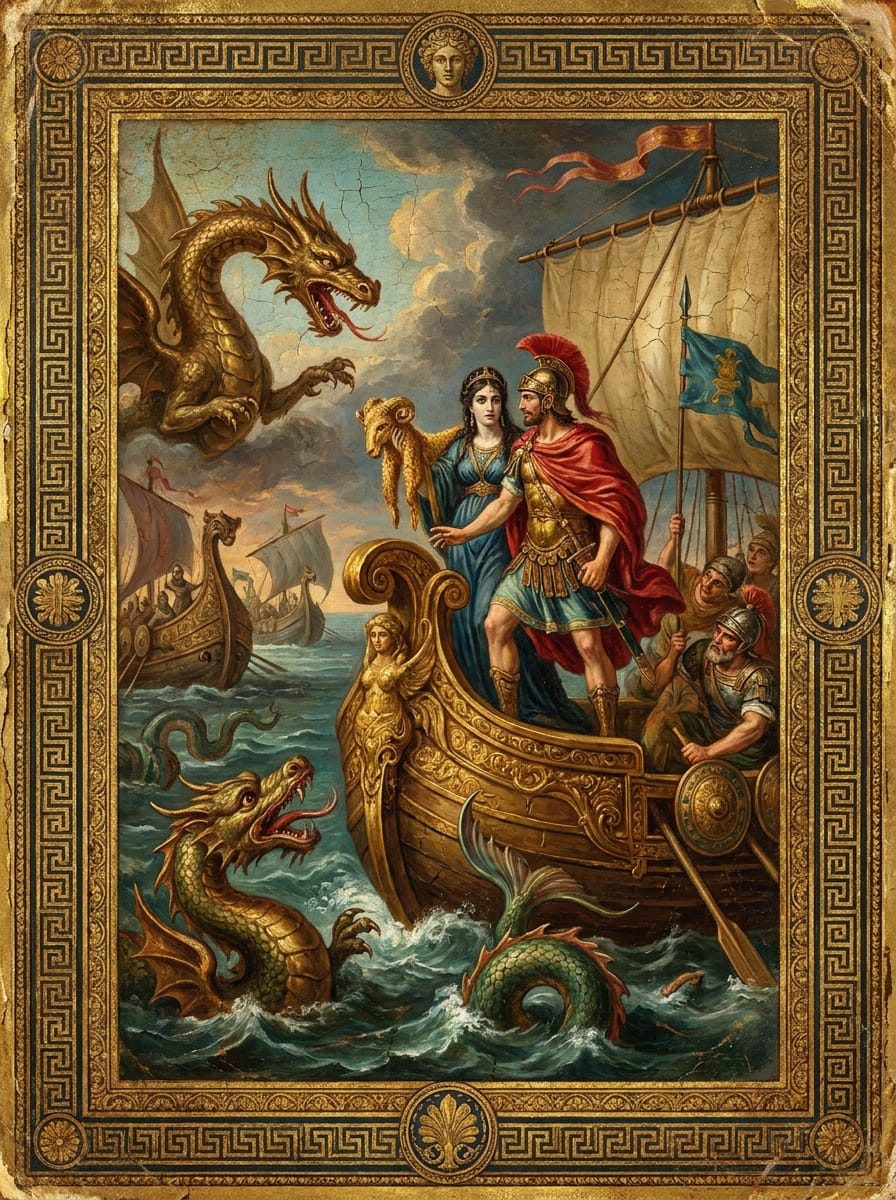
After Jason wins the Golden Fleece, he flees Colchis with Medea and the Argonauts, while pursuing ships, divine anger, and monsters close in one after another. Through blood-guilt, purification, song, monstrous seas, and the bronze giant Talos, they at last bring the Argo back to Greece.
Article
Summary
Jason, Medea, and the Argonauts slip away from Colchis under cover of night, but Aeetes soon sends a fleet after them. Apsyrtus leads the pursuit and cuts them off; Medea contrives to meet him in secret, and Jason kills him. The Argonauts escape, but the deed leaves a heavy stain of blood upon them. The Argo wanders to the island of Circe, where Jason and Medea seek purification. Circe performs the rites for them, but when she learns that they have killed a kinsman, she orders them to leave. Their voyage continues, and soon they meet the song of the Sirens. Orpheus answers with his lyre, drowning out the enchantment and saving most of his companions. They pass the dreadful strait between Scylla and Charybdis, escaping whirlpool and monster with the help of sea-goddesses. When they reach the land of the Phaeacians, Colchian pursuers again demand Medea’s return. King Alcinous sets a condition, and Queen Arete secretly helps Jason and Medea marry that very night, so that the pursuers are forced to depart. Later, the Argo comes to Crete, where the bronze man Talos blocks the shore with hurled stones. Medea uses her arts to loosen the bronze peg in his ankle; the life-fluid drains from him, and the giant falls. At last, lost on a dark sea, the Argonauts pray to Apollo and receive a guiding light, bringing the Golden Fleece home to Greece.
The Ship That Left by Night
The darkness had not yet lifted from Colchis when the Argo slipped quietly out from the river mouth.
No one on board spoke loudly. The oars dipped again and again into the black water, and the sound slid backward along the hull. Jason stood in the prow, his breath still quick in his chest. He had just taken the Golden Fleece from the grove of Ares. Even wrapped and laid within the ship, that ram’s skin seemed to hold a hidden fire. Medea was on board too. She had left her father’s palace, the walls and altars she had known all her life, carrying herbs, spells, and a heart that could never return to what it had been.
She knew that when daylight came, all Colchis would discover what had happened.
And so it was. When Aeetes learned that the Golden Fleece had been stolen and that his daughter had fled with strangers, rage swept through the palace like a storm. He ordered ships made ready, sent men in pursuit, and placed his son Apsyrtus at the head of a squadron. The Colchian warships drove out along the waterways, their rowers straining at the oars, their bronze spears and shields flashing in the sun.
The Argo fled ahead; the pursuers pressed on behind. The heroes had thought that once they left the coast of Colchis, the road home would open before them. Soon they understood that seizing the Golden Fleece had been only the first step. The harder task was to carry it away and live.
The Pursuit of Apsyrtus
The pursuers came swiftly.
Apsyrtus was not a young man easily shaken off. He knew the local channels, and he knew how terrible his father’s anger could be. Leading the Colchians by a different route, he moved to cut off the Argo, and at last drew near beside an island. On the sea, the ships sighted one another, and the air tightened at once. The Argonauts gripped sword-hilts and spears. The rowers paused, and the ship rose and fell softly on the swell.
The Colchians demanded Medea and the Golden Fleece. Jason could surrender neither. If open battle came, the Argo was only one ship, and could hardly endure a long encirclement by the pursuers.
Then Medea spoke.
She knew her brother better than any of them, and she knew the customs of the Colchians. She sent word that she was willing to meet Apsyrtus privately and discuss how the quarrel might be ended. Apsyrtus trusted the chance. Perhaps he thought his sister had grown afraid; perhaps he thought that if only he brought her back, their father’s fury would be appeased.
By night he came to the appointed place.
It was not a brightly lit palace, nor a hall where people might speak at ease. Around him were only dim sea-wind, rocks, and shadows. Medea waited there, and Jason lay hidden nearby. When Apsyrtus approached, he did not yet know he had stepped into a snare.
A blade flashed suddenly from the dark.
Jason killed Apsyrtus. The young man’s blood fell upon the ground, and upon the very beginning of the homeward voyage. Medea stood by and saw her brother fall with her own eyes. She had no road back; Jason had none either. To delay the pursuers, they cut Apsyrtus’ body apart and scattered the pieces, forcing the Colchians to stop and gather the prince’s remains.
The chase across the sea fell into confusion. The Colchians were torn between grief and fury, but they could not at once abandon the body of the king’s son. The Argo used that disorder to draw away again.
Yet a person may escape pursuers and still not escape the debt of blood.
Bound by Blood-Guilt
After the Argo left those waters, the winds did not carry them smoothly home.
The ship turned and wandered through unfamiliar seas. Often the heroes looked up at the sky or toward the shadow of a coast, yet could not tell how far they were from Greece. Sometimes the sea lay flat as cold iron; sometimes white waves rose without warning. The rowers’ shoulders and backs ached with weariness, and no one in the ship was quick to laugh anymore.
Jason bore the blood of Apsyrtus upon him, and Medea bore it too. Killing the pursuer had saved the ship for a time, but it had not washed away the pollution of kindred blood. By ancient law, if such blood-guilt was not cleansed, the anger of the gods would follow them, and the sea-road itself would turn dangerous.
They came to the island of Aeaea, where the goddess Circe dwelt. She was a mighty enchantress and a kinswoman of Medea. Thick woods covered the island; smoke rose slowly from the roof of her house, and strange beasts moved before her door. When the Argonauts landed, they were still wary; but Medea knew that if they wished to go on, they must seek purification here.
When Circe saw them, she did not at first ask many questions. She saw Jason and Medea sitting with lowered heads beside the hearth; she saw that they dared not look straight into the firelight; she saw on their hands a shadow that seemed impossible to wash away. She brought victims for sacrifice and performed the ancient rites, slaughtering, sprinkling water, and burning offerings. Smoke rose, and fat crackled in the flames. Through the ritual she cleansed the two of them from the blood of the slain kinsman.
Only when all this was done did Circe ask what they had committed.
Medea told her of Apsyrtus’ death. Circe’s face darkened as she listened. Though she had purified them, she could not love such a crime. She ordered them to leave and would not allow them to remain long on her island.
So the Argo went down to the water once more. The heroes had gained a path onward, but not an easy heart. They knew now that the homeward ship carried not only glory, but a grave and secret burden.
The Song of the Sirens
After leaving Circe’s island, another danger waited for them on the sea.
Ahead lay an island where the Sirens dwelt. Their song was sweeter than anything of mortal making. It made passing sailors forget the oars in their hands, forget their homes, forget even life itself, until they wished only to draw nearer to that voice. Then the ship would strike the rocks, and human bones would remain beside the shore, drying in the sea-wind.
As the Argo drew near, a thread of song first drifted through the air. It was light, as if falling from a far-off cloud, and yet it seemed to whisper each man’s name close to his ear. One by one the heroes raised their heads; their eyes grew fixed. Some loosened their hold on the oars. Some began to move toward the side of the ship without knowing it, as though if they came just a little closer, they would hear the most beautiful words in the world.
Then Orpheus stood up.
He did not stop his companions’ ears, nor did he shout over them. He lifted his lyre, and as his fingers touched the strings, a clear music rang out from the ship. At first it was like a mountain spring; then it grew swifter and stronger, overcoming the sea-wind and the Sirens’ song alike. Orpheus sang of the road home, of oars and sails, and of those who waited for them.
The heroes woke as if from a dream and took up the oars again. The Argo did not turn toward the Sirens’ shore, but drove onward.
Only Butes could not wholly break free. Drawn by the song, he suddenly leapt into the sea and swam toward the island. The waves closed over his shoulders. His comrades cried out, but it was too late to pull him back. Fortunately Aphrodite pitied him and carried him away from the danger, so that he did not die beside the Sirens’ rocks.
The Sirens’ song faded behind them, and Orpheus’ lyre slowly fell silent. For a long while the men on board said nothing, as if they had only just torn themselves out of an invisible net.
Death on Either Side
But not every danger of the sea sings.
The Argo next came to a dreadful channel. On one side was Charybdis, who swallowed and spewed up enormous waves; there the sea spun downward as if the ocean had opened a bottomless mouth. On the other side lurked Scylla, hidden beneath high rocks, thrusting out her terrible heads and necks to seize men from passing ships. The water thundered between the cliffs, and the waves shattered into white foam. Even the bravest heroes clutched the sides of the ship.
If they tried to force the passage by human strength alone, the Argo might be smashed in the whirlpool or torn open by the monster. The heroes stared at the dangers on both sides and knew that no oar could outrun a vortex that swallowed the sea, and no spear, however well aimed, could easily reach a creature hiding in the rock.
Then the goddesses of the sea came to their aid.
They upheld the Argo among the waves so that it was not swept away like a leaf in the current. The hull was lifted, then guided toward a safer course. The heroes worked with all the strength left in them, dipping and raising their oars together. Spray drenched their hair and clothes; salt water filled their mouths, bitter and harsh.
The Argo passed along the very edge of destruction. Behind them Charybdis still churned, and the shadow of Scylla’s rocks fell farther and farther away. No one cheered. There was only hard breathing. When they had finally escaped the channel, many found that their fingers had gone white and stiff from gripping the oars too tightly.
The Island of Alcinous
In time the Argo reached the land of the Phaeacians. It was not like the perilous places they had just passed. There was a harbor by the shore, a palace in the city, and King Alcinous and Queen Arete were famed for kindness to strangers.
At last the heroes could come ashore and rest. The ship was drawn up into the shallows. Exhausted men sat on the sand, stripped off their soaked clothing, and examined planks and oar-handles. Medea too thought she might breathe for a little while.
But the pursuers had not vanished entirely. The Colchians arrived there as well and demanded that Alcinous return Medea to them. They said Medea was the daughter of Aeetes and must go back with them to Colchis. Jason and the heroes, of course, refused. If the king surrendered her, the Golden Fleece could not be kept either, and the whole expedition would be ruined on the way home.
Alcinous did not judge in haste. He listened to both sides and decided the matter by one condition: if Medea was still an unmarried maiden, she should be restored to her father; if she had already become Jason’s wife, then she would not be handed over to the Colchians.
The words reached Queen Arete. She pitied Medea and saw that the young woman had staked her whole fate upon Jason. By night, Arete secretly told Jason and Medea what the king intended.
So they did not wait for dawn.
There in the land of the Phaeacians, amid hurried and hidden preparations, Jason and Medea were married. There was no grand procession and no long feast—only urgent night, companions as witnesses, and vows that had to be completed at once. From then on Medea was not only the princess who had fled her father’s house; she was Jason’s wife.
The next day, Alcinous gave judgment according to his own condition: Medea was married and would not be returned to the Colchians. The pursuers could do nothing but depart. Some of them, afraid to go back empty-handed before Aeetes, remained in foreign lands and never returned to Colchis.
Once more the Argo had escaped.
The Bronze Man Talos
The homeward voyage continued southward, and the Argonauts came near the island of Crete.
From a distance the shore looked like a place where they might land. The ship’s water was almost gone, and the men needed to rest and make repairs. But as the Argo drew near, a gigantic bronze man appeared on the coast.
His name was Talos, and he guarded Crete. It was said that his whole body was cast in bronze, and that every day he circled the island, allowing no strange ship to land at will. Within his body there ran only one vein, filled with a life-fluid like the ichor of the gods, and the end of that vein was sealed with a bronze peg.
When Talos saw the Argo, he at once lifted great stones. They flew from his hands and crashed into the sea, throwing up high columns of water. The heroes strained to keep the ship clear. One stone fell beside the hull, shaking the vessel violently. Had it struck nearer, the Argo would have been split open beside the shore.
They could not land, yet they could not linger there long. Jason looked to Medea. Many dangers had been met with swords and oars, but this bronze man was no ordinary enemy, and arrows or spears would hardly wound him.
Medea went to the prow and fixed her eyes on Talos. She did not raise a spear or go ashore to fight. Instead she began to murmur spells, calling upon powers that bewilder the mind and loosen life from the body. With words and gaze she caught the bronze man’s spirit and made him lose his balance. Talos swayed upon the shore, his heavy feet crushing stones beneath him.
Then the bronze peg in his ankle came loose.
The little seal was opened, and the life-fluid poured from his body, running down his bronze leg like something molten and bright. The more Talos struggled, the faster it drained away. At last his huge frame could bear him no longer, and he crashed down upon the shore. The sound of his bronze body striking the ground carried far, and the birds of the island rose startled into the air.
Only then could the Argonauts land. They took on water, rested, and repaired their gear. Talos lay by the shore and could no longer circle the island. The wind of Crete blew across his bronze body with a low sound.
A Cry for Help in the Darkness
After leaving Crete, the Argo met a terrible darkness.
It was no ordinary night. There were no stars in the sky, no outline of land upon the sea, and even the foam of the waves seemed swallowed into ink. The ship drifted in the dark. The rowers could not see one another’s faces and did not know whether rocks lay ahead. The wind sounded now near, now far away, like someone whispering from an unseen place.
Fear rose in the heroes’ hearts. After so many perils, they were still afraid of this boundless blackness. A monster could be seen; storm-waves could be resisted. But in that darkness there was nothing—only the waiting, and the uncertainty of what they might strike in the next moment.
Jason prayed to Apollo.
Standing aboard the ship, he turned toward the unseen sky, promised sacrifice, and begged the god of light to give them some sign to steer by. Not long after the prayer was spoken, a gleam appeared far off. It was not dawn, but it shone like a bright arrow sent by a god, revealing a stretch of shore where they could land.
The heroes rowed toward it at once. The oars had a direction again; the prow cut through the black water, and at last they came near a safe place. There they moored the ship and gave thanks to Apollo for his help. In later memory, people kept the story of the light that appeared in the darkness, and of how the Argo had almost been lost in a starless night.
Back to Greece
At last the Argo reached the shores of Greece.
When the ship had set out, it had carried heroes eager for fame. When it returned, its hull was crusted with salt and scarred by the sea; the rowers’ palms were thick with calluses, and many of their faces had grown quieter. The Golden Fleece was still on board. Once it had hung in the grove of Colchis under the guard of a sleepless dragon; now it had crossed the Black Sea, river mouths, islands, monstrous waters, and night, and had been brought back with Jason.
They passed through the final waters and returned to the place from which they had begun. Someone on shore recognized the Argo, and the news spread quickly. When the heroes stepped down from the ship onto dry land, the ground beneath their feet still seemed to sway with the sea. Some kissed the earth. Some held the ship’s side for a long time without speaking.
Jason had brought back the Golden Fleece, and he had brought back Medea. He had fulfilled the task Pelias had set him, but the cost of the journey had been cut deep into all of them: the blood of Apsyrtus, the purification beside Circe’s hearth, the song of the Sirens, the hurried marriage on the Phaeacian island, the crash of Talos shaking the shore—all of these had returned with them.
The Argo rested beside the land, and the far seas that had beaten against its sides at last fell behind them. The heroes’ homeward voyage was over. The light of the Golden Fleece had not gone out; but the glory around it was no longer a weightless tale. It had become a road home edged with sea-wind, blood, and weariness.