Greek Mythology
The Return of Perseus — Greek Mythology
After rescuing Andromeda, Perseus does not remain long in Ethiopia. He returns to Seriphos with his wife and finds that Polydectes has driven his mother Danae to seek refuge beside an altar. Perseus punishes the king with Medusa’s head, sets Dictys on the throne, returns the divine gifts, gives the head to Athena, and later unknowingly fulfills the old oracle when a discus he throws at games near Larissa strikes his grandfather Acrisius.
Article
Summary
After saving Andromeda in Ethiopia and ending the violence at the wedding feast, Perseus continues toward Seriphos. Medusa’s head is still hidden in the divine pouch, the winged sandals and curved blade are still with him, but the person he most urgently wants to see is not a king. It is his mother, Danae. When Perseus left Seriphos, Polydectes had used the pretense of wedding gifts to push him into a reckless promise: he would bring back Medusa’s head. Only after returning does Perseus learn that his mother refused the king’s pressure and fled to the altar of a temple for protection. Perseus enters the palace, tells the innocent to turn away, uses Medusa’s head to turn Polydectes and his companions into stone, and gives the kingdom to Dictys, the man who once rescued mother and child from the sea. Perseus then refuses to keep the divine aids as trophies. He returns the winged sandals, the pouch, the cap of invisibility, and the curved blade, and presents Medusa’s head to Athena. The goddess fixes it on her shield or breastplate, so that the terrible face becomes a warning carried by her own armor. With Danae safe, Perseus turns toward Argos and the grandfather who once feared an oracle. Acrisius flees, still trying to avoid the prophecy that he will die by his daughter’s son. Later, at athletic games near Larissa, a discus thrown by Perseus flies astray and strikes an old man in the crowd. The man is Acrisius. Perseus has not meant revenge, yet fate is fulfilled; unwilling to rule the city whose old king died by his hand, he exchanges territories and leaves Argos behind.
Leaving Ethiopia
The sound of the waves on the Ethiopian shore slowly fell behind them.
Perseus had killed the sea monster, unlocked Andromeda’s chains, and put down Phineus’ armed violence in the palace of Cepheus. The stone figures still stood under the torches, frozen in gestures of shouting, running, and begging. The people by the sea were still speaking of the young hero who had descended from the sky.
But Perseus could not remain there.
Andromeda was now his wife and was willing to leave her parents and follow him far away. She knew that this man carried gifts given by the gods, and also a head that could not be shown carelessly. Perseus kept Medusa’s head inside the divine pouch, its mouth bound tight. The winged sandals carried them away from the shore, over cloud shadows and open sea, toward Seriphos.
On that journey, Perseus was not thinking first of glory or of the wedding feast. He was thinking of his mother, Danae.
Long ago, when Acrisius shut mother and child in a wooden chest and cast them into the sea, it was Dictys, a fisherman of Seriphos, who drew them out and saved them. Danae had lived on that island for many years, and Perseus had grown up there. Yet the island’s king, Polydectes, had long desired to force Danae into marriage. Before Perseus left, the king had used that very desire to set a trap and send him toward the deadly task of taking Medusa’s head.
Now Perseus was returning.
His Mother Beside the Altar
When the coast of Seriphos appeared beneath the clouds, Perseus did not first go to the palace, nor did he show off his prize. He looked for his mother.
Danae was not at home. The neighbors were stunned to see him alive, and at first they could hardly speak. Then someone told him quietly that after he had gone, Polydectes had grown more shameless. Believing Perseus dead, he no longer hid his desire and tried to force Danae to submit to him.
Danae refused. She had no army and no power. Her only refuge was the temple, where she sat beside the altar and begged for protection. Good Dictys still guarded her as best he could, but though his heart was just, he had no strength to resist a king.
When Perseus reached the temple, he saw his mother seated by the altar. Her face was worn, and ash clung to her robe. The fire on the altar had burned low, and suppliant branches lay nearby. Danae lifted her head and saw her son. For a moment she stared as though at a dream; then she rose and embraced him.
She had thought him dead at the far end of the sea, lost among monsters no mortal should approach.
Perseus held his mother and asked where Polydectes was. Someone told him that the king and his companions were feasting in the palace, laughing at the young man who would never return with Medusa’s head.
Perseus did not shout in anger. He simply tightened the divine pouch and turned toward the palace.
Statues in the Palace
A feast was underway in the hall.
Polydectes sat in the high place, surrounded by flatterers. They drank wine and mocked Perseus. When the young man entered, the laughter paused, then rose again. None of them believed he had truly reached the Gorgons, still less that he had returned alive with Medusa’s head.
Polydectes looked at him with contempt and said, “Since you have come back, bring out the gift you promised. Let us see where that head is.”
Perseus looked at him and remembered the darkness of the chest drifting over the sea. He remembered his mother living as a stranger in another land. He remembered her tired face beside the altar only moments before. He did not turn the matter into an argument. He gave one warning to the few innocent people in the hall: “Turn your faces away. Do not look.”
Some heard him and bowed their heads at once. Others were still laughing.
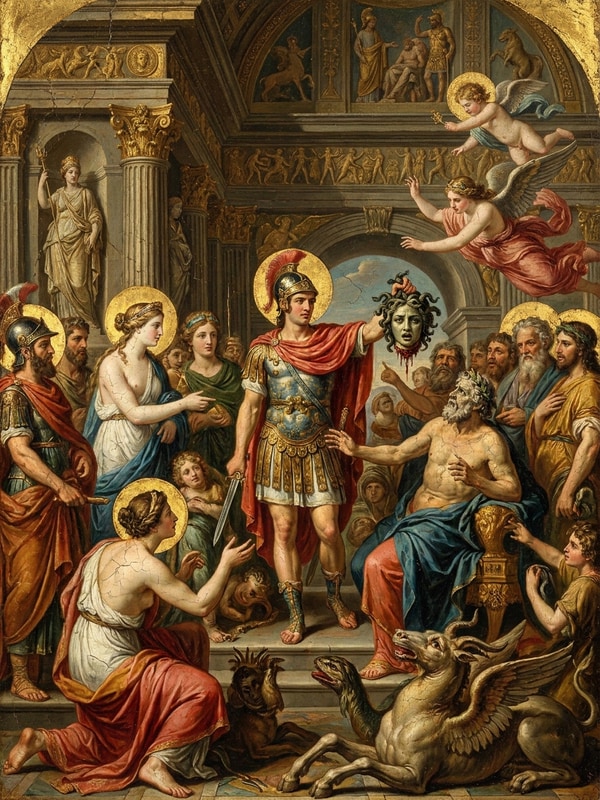
Perseus opened the divine pouch. When Medusa’s head was lifted, the laughter stopped as if cut by a blade. Polydectes remained seated on his throne, the sneer not yet gone from his mouth, while the color drained from his skin and gray stone took its place. His companions stiffened one by one around him: one still holding a cup, one half risen from his seat, one with disbelief still in his eyes.
In moments, the palace had gained a company of cold, hard statues.
Perseus put the head back into the pouch and tied it shut. He did not seize Seriphos for himself. Instead, he gave the kingdom to Dictys, the man who had once pulled the chest from the sea and saved Danae with the infant Perseus. Now Dictys became the man better suited to rule the island.
Danae no longer had to hide beside the altar.
Returning the Divine Gifts
Once the punishment was done, Perseus did not treat the gifts of the gods and nymphs as his own trophies.
The winged sandals had carried him over the sea. The cap of invisibility had hidden him from the Gorgons’ pursuit. The divine pouch had held Medusa’s head, and Hermes’ curved blade had cut it from her body. Without those aids, mortal courage, however great, could not have carried him through such a journey.
So Perseus returned the winged sandals, the pouch, and the cap of invisibility to the nymphs who had helped him, and he gave the curved blade back to Hermes. Last of all, he presented Medusa’s head to Athena.
Athena accepted the head and set it upon her shield or breastplate. From then on, the Gorgon’s face belonged to the goddess’ armor. It was no longer only the weapon of Perseus’ private revenge, but a terror carried by Athena into battle. Enemies who saw it would still feel a chill rising in their hearts.
At Perseus’ side remained Andromeda and Danae, and also an old oracle not yet finished.
The Road Back to Argos
Perseus had been born under the shadow of the Argive royal house.
His grandfather Acrisius had once consulted an oracle because he had no son and was tormented by the question of succession. The oracle told him that he would die at the hands of the child born to his daughter Danae. To escape those words, he shut Danae in a bronze chamber; when she gave birth to Perseus, he placed mother and child in a wooden chest and pushed it out to sea.
Acrisius believed that if the child died, fate would lose its place to stand.
But the chest did not sink. Danae and the infant were saved. The child whom Acrisius had sent into the sea had grown into the man who cut off Medusa’s head, rescued Andromeda, and punished the tyrant of Seriphos.
Perseus wished to return to Argos. He was not going there with a blade in his hand to hunt down his grandfather. He wanted to set his long-scattered family back upon the earth, and he wanted his mother to see the land that should have been hers.
When Acrisius heard that his grandson had returned, he felt only fear. He did not believe the oracle had passed away, and he did not dare face the child grown to manhood. So he left Argos and fled elsewhere, trying to put distance between himself and the ancient sentence.
But fate does not need to wait in one place.
The Flying Discus
Later, athletic games were held near Larissa. People came from all around to watch the footraces, boxing, and discus throwing. Shouts rose and fell around the field. Young men showed their strength in the dust, while older men watched from the side.
Perseus also entered the games.
He stood in the field with a heavy discus in his hand. It was not a battlefield blade, nor the head of a Gorgon that could turn men to stone. It was only an implement of sport. The rules of the field were clear, and the spectators stood aside; no one thought danger would come from there.
Perseus lifted the discus, turned, gathered his strength, and threw.
Perhaps the wind shifted. Perhaps his motion went slightly astray. The discus did not fall where it was meant to fall, but flew toward the side where the spectators stood. A cry rose from the crowd. An old man had been struck and fell to the ground.
Only when the people gathered around him did they discover that the old man was Acrisius.
He had left Argos to avoid his grandson, and in another place he met the discus thrown by that grandson’s hand. Perseus had not recognized him. He had not meant to kill him. Yet the words of the oracle fell all the same, at the moment no one expected.
Perseus stood in the field with no pleasure of revenge in his hand, only a sudden weight. The man who once cast mother and child into the sea had at last died by his hand; but the blow had not come from hatred. It was the result fate left after passing around every attempt to escape it.
The Throne He Would Not Take
Perseus gave Acrisius the rites of burial.
By blood, he could have returned to Argos and inherited the throne. But when he thought that the city’s former king had died by his hand, even by accident, he could not bring himself to sit on that seat. The old king had once wronged him and his mother, yet the dead man was still his grandfather and had once ruled Argos.
So Perseus exchanged territory with the ruler of Tiryns and left Argos to rule another land. In this way, he did not have to sit upon a throne left open by a death he had caused, and Argos did not have to look each day upon the man whose hand had killed its former king.
Andromeda followed him, and Danae at last found rest after many years of fear. The return of Perseus brought his mother safety, brought punishment to a tyrant, and brought back the oracle that had hung above his family before he was born.
Later people told of Medusa’s head when they told of Perseus. They told of Andromeda rescued from the rock. And they also told of the discus that flew astray, because this hero’s return was not only a return in victory. It was also the moment when fate finally arrived.