Greek Mythology
Pygmalion — Greek Mythology
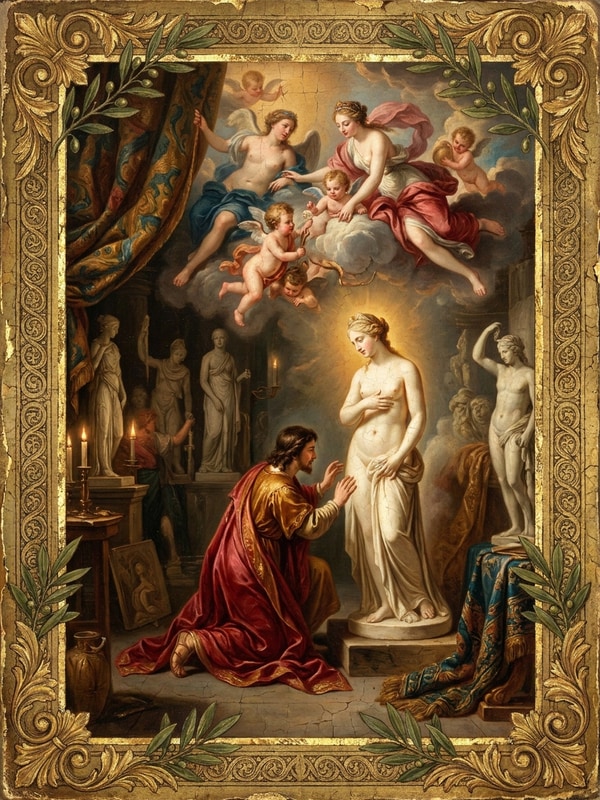
Pygmalion, a sculptor of Cyprus, recoils from the shamelessness he sees in the women around him and lives alone, carving a maiden from ivory. Aphrodite hears his prayer and gives warmth and breath to the cold statue.
Article
Summary
Pygmalion lived on Cyprus, a craftsman so skilled that he could make hard ivory seem as soft as skin. Yet when he saw people around him treating the gods and marriage vows lightly, his heart drew away from marriage. He chose the quiet company of his tools and workshop, giving his care to material that could not deceive him. One day he obtained a splendid piece of white ivory, meaning only to carve a work finer than any he had made before. As the chisel moved, it seemed that a maiden had been hidden inside the ivory all along. Her face showed neither insolence nor falsehood; she stood as if untouched by the stains of the world. Pygmalion could no longer leave her easily. He clothed her, adorned her with beads and flowers, and spoke to her as though she might answer. When Aphrodite's festival came, Pygmalion stood before the altar and did not dare ask directly for the statue to live. He prayed only for a wife like the ivory maiden in his house. The altar flame brightened and leapt three times, as if in answer. Hurrying home, he touched the statue's lips and wrist and found the cold ivory softening, warming, taking on color, breath, and open eyes. Afterward Pygmalion married the woman who had once been ivory, with Aphrodite herself as the unseen witness of the union. She was no longer a work standing beneath the lamp to be looked at, but a living person with her own gaze and life. Ancient tradition said that their descendants included Paphos, whose name was remembered in a Cypriot city and in the island's worship of Aphrodite.
The Solitary Sculptor
On the island of Cyprus there lived a sculptor of extraordinary skill, named Pygmalion. Year after year he kept to his workshop, where wood shavings, stone dust, and fine polishing sand lay near the door, and saws, chisels, files, and unfinished blocks of material leaned against the walls.
When the sea wind swept over the island, it carried the taste of salt. Other people spoke in the marketplace of weddings and feasts, but Pygmalion often bent his head over a piece of ivory, studying the grain. His eye was steady, and so was his hand. In his keeping, rough matter slowly revealed brows, folds of cloth, and delicate fingertips.
Yet he would not marry.
To him, some of the women around him seemed to have cast modesty aside. They treated the gods lightly, and marriage vows lightly too, making a jest of things that ought to be held in reverence. The longer Pygmalion watched, the colder his heart became. Human hearts, he thought, were too hard to trust, and so he preferred to live alone. At night, when lamplight burned and he heard laughter and singing in the distance, he shut his door and took up his chisel again.
He told himself that it was better to give his heart to the work in his hands than to a person who might deceive him or grow corrupt. Ivory did not lie. Chisel marks did not lie. If only he worked with care, the white material would little by little obey his hand.
The Maiden in the Ivory
One day Pygmalion obtained a splendid piece of ivory. It was white and smooth, like fresh moonlight, and cool beneath his touch. He carried it into the workshop, set it where the light fell best, and walked around it for a long while.
At first, he meant only to carve a work finer than any he had made before. But once the chisel began to fall, the work itself seemed to change. It was as though a maiden had already been hidden inside the ivory, and all Pygmalion had to do was cut away what was unnecessary until she appeared.
He carved the forehead and the bridge of the nose, then slowly shaped the lips. The mouth must not be too cold, nor too playful; the eyes, though they could not open, had to seem as if they might at any moment turn toward the world. The neck had to be slender yet strong, the shoulders just emerging from their garment. The fingers were hardest of all: a touch too heavy made them stiff, a touch too light made them weak. Again and again he held his breath and guided the small blade forward by the smallest degrees.
Day passed, and night came on. Pygmalion forgot to eat and forgot to rest. He smoothed away the marks of the blade with fine sand and wiped off the dust with cloth. As the statue took shape, he found he could not bring himself to leave it at once. He stood beneath the lamp and looked at her, and she no longer seemed like a lifeless thing.
She was too beautiful.
It was not the bright, painted beauty of cosmetics, nor the arranged pose of someone at a banquet. She stood quietly, as if no stain of the world had ever touched her. There was no insolence in her face, no falsehood, no mockery. As Pygmalion gazed at her, a tenderness he had never known before stirred within him.
He reached out and touched her arm. The ivory was cold, and yet he could not help thinking that if he waited a little longer, perhaps some warmth would come into it.
From then on, Pygmalion became like a man caught fast in love. He no longer treated the statue merely as a work of art. He draped her in soft garments, placed necklaces, shells, and little beads upon her, and laid fresh flowers at her feet. Sometimes he slipped a ring onto one of her slender fingers; sometimes he took it off again, afraid it might harm her.
He spoke to her, too.
In the morning, when he opened the window and let in the sea wind, he would say, “The light is beautiful today.” In the evening he lit the lamp and moved his chair nearer, as though he feared she might be lonely. He knew she would not answer, yet each time he turned away, it seemed he was waiting for her to move, just a little.
He understood that this was folly. How could a living man love a piece of ivory? But the more he told himself so, the less he could bear to leave her. Living women had disappointed him; this silent maiden made him feel that perhaps pure love might still exist in the world.
The Prayer at the Festival
Before long, the people of Cyprus celebrated the festival of Aphrodite.
On that day, the altars of the goddess were crowded. People led in snow-white cattle and hung garlands on their horns; spices and firewood were heaped together, and when the flames rose, sweet smoke drifted into the air. Maidens wore festival robes, women carried offerings, and men poured wine upon the ground, praying that the goddess of love and marriage would grant them favor.
Pygmalion came as well.
He stood before the altar with his offering in his hands, but his heart beat hard. He wanted to speak his true desire, yet the words faltered before they left his mouth. To ask the goddess to turn a statue into a living woman was too bold a prayer, too far beyond what mortals ought to request.
The sacrificial fire crackled. Fat melted in the flames, and fragrant smoke coiled upward layer upon layer. Pygmalion lowered his head and at last said softly, “Great goddess, if you are willing to grant me marriage, give me a wife like the ivory maiden in my house.”
He said “like her,” for he did not dare say, “Let her come alive.” But Aphrodite rules over love. How could she fail to hear what was truly hidden in a human heart?
Suddenly the flame upon the altar brightened, and the tongues of fire leapt upward three times, as if answering his prayer. Others may have taken it for a lucky festival sign, but Pygmalion stood transfixed. He looked into the fire, afraid and joyful at once, not knowing whether the goddess would truly pity him.
When the rites were over, he hurried home almost at a run.
The Cold Hand Grows Warm
The workshop was very quiet. The flowers still lay at the statue’s feet; the garments still fell about her; the ivory face looked gentle in the dim light of the room.
Pygmalion approached slowly, as though he feared to startle her. For a long time he looked at her. Then he stretched out his hand and lightly touched her lips.
They were still white.
His heart sank, and he nearly laughed at his own madness. But just as he drew back his hand, he suddenly felt that the place his fingertips had touched was not entirely cold. The sensation was faint and uncertain, like the first trace of warmth beneath a stone when winter is almost past.
He could not believe it. He put his hand on her wrist.
This time he felt it clearly: the ivory was softening.
The hard surface grew gentle, like wax warming in the sun, yet it did not melt or lose its form. The hand remained a maiden’s hand, but it was no longer a dead thing; it had become soft skin. Pygmalion held his breath. His palm rested against her arm, and from within he felt a delicate warmth rise toward him.
Then he lowered his eyes to her face.
The motionless lips had taken on the color of blood. Her cheeks were no longer cold white. Her breast rose slightly, as if learning to breathe for the first time. Her eyelashes trembled, and then she opened her eyes.
The first person she saw was Pygmalion, standing before her in wonder and joy.
Pygmalion could scarcely speak. He held her hand, afraid that if he let go, everything would turn back into a cold dream. But the hand remained warm in his palm and did not vanish. The maiden looked back at him, her gaze clouded with the bewilderment of first waking, like one newly arrived in the world, not yet understanding the lamplight in the room, the jewels on her clothes, or why the man before her had tears in his eyes.
Pygmalion gave thanks to Aphrodite. He knew this was not the work of his chisel. However skilled a craftsman may be, he can carve only a shape; the breath, the warmth, the heartbeat—these were the goddess’s gift.
A Marriage Witnessed by the Goddess
Afterward, Pygmalion married the woman who had once been ivory. At the wedding, the people offered flowers and incense and gave thanks to Aphrodite. The goddess was not far from them. Since she had heard the prayer before the altar that day, she was willing also to see the marriage truly fulfilled.
From then on, Pygmalion’s house was no longer only a workshop. The tools remained, and so did the ivory dust and fine sand, but now the house held footsteps, voices, and the sound of breathing at dawn. The woman no longer stood beneath the lamp to be looked at by others. She had her own gaze now, and her own life.
In time, they had descendants. Ancient tradition says their child was named Paphos, and a city on Cyprus was remembered by that name. On that land, people continued to worship Aphrodite, and when they told the story of Pygmalion, they remembered the white ivory, and how a lonely man carved all his longing into his work, and how, through the goddess’s mercy, he saw a cold hand slowly grow warm.
Here the story comes to rest. Pygmalion, who had once distrusted earthly love, received at last a living wife in the maiden he had carved with his own hands. The statue was no longer merely his creation, but a person who lived with him, laughed with him, and bore children beside him.