Greek Mythology
Prometheus Creates Humankind — Greek Mythology
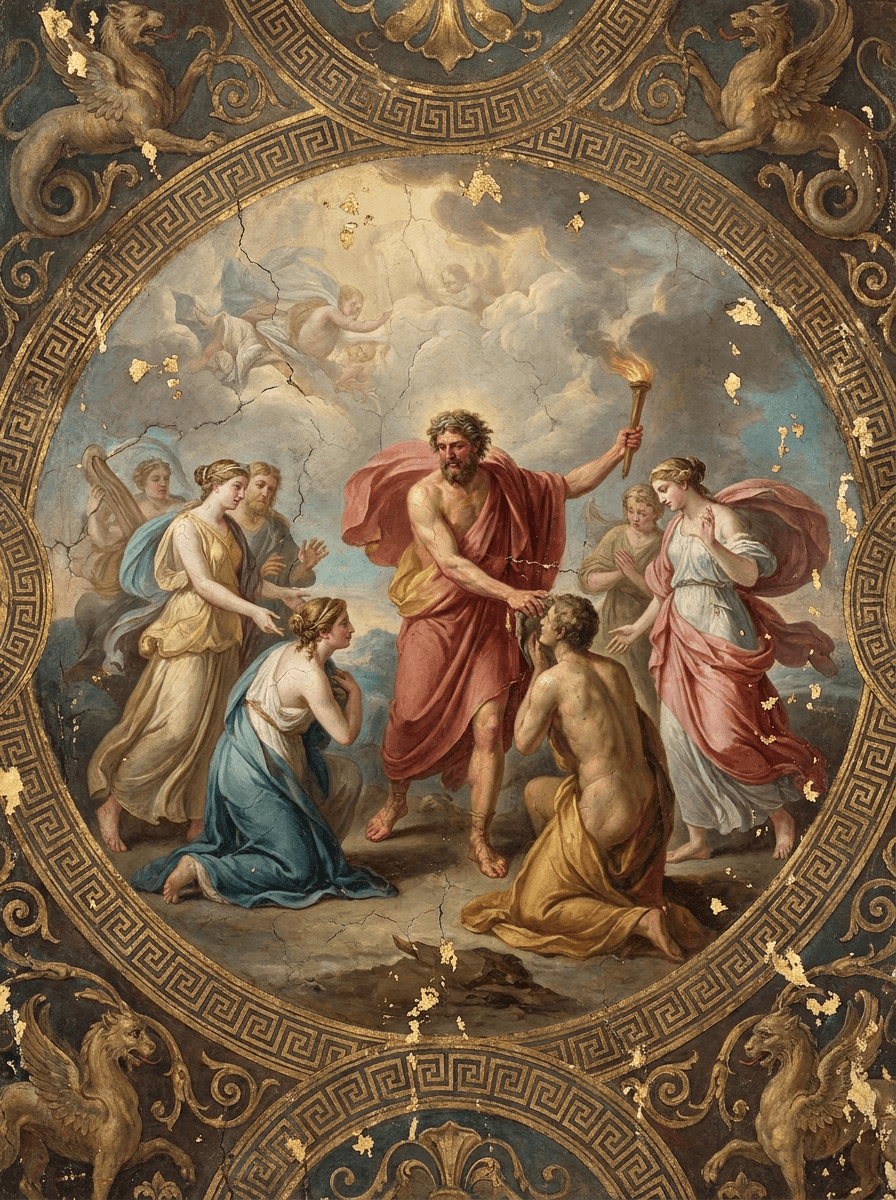
The earth already had seas, forests, birds, and beasts, but no creature yet stood upright to gaze at the sky and think. Prometheus shaped human forms from clay and river water, then asked Athena to breathe divine spirit into them. So humankind came into the world, and under his teaching learned how to live.
Article
Summary
From that time on, human beings were no longer mere shadows moving over the earth. They learned to lift their eyes to heaven, and they learned to change the world around them with their hands. Prometheus brought to mortals many arts that had not belonged to them before, and human life began.
Clay by the River
In the earliest ages, the sky already arched high above, and the earth had spread itself wide beneath it. The sea heaved in the low places; wave after wave struck the shore and drew back again into the deep blue water. Woods covered the hillsides, small creatures ran through the grass, fish flicked their tails beneath the surface, and birds rose crying from the rocks into the open air.
Yet one kind of life was still missing from the earth.
The beasts bent their heads to search for food. The birds busied themselves with nests. The fish moved only with the current. They had strength, claws, teeth, and wings, but none of them paused to look up at the sky and wonder why the stars rose and why they sank. None picked up a stone and shaped it into a tool. None, before wind and rain arrived, built a shelter against the cold.
Then Prometheus came down upon the earth.
He was not one of the newly risen Olympian gods, but a descendant of the ancient race of Titans. His father was Iapetos, and his line reached back to Gaia, the earth goddess, and Ouranos, the sky. Many Titans had lost their power in the struggles among the gods, but Prometheus still possessed a clear and cunning mind. He often walked among mountains and riverbanks, and when he looked upon the abundance of the earth, it seemed to him that it lacked a speaking watcher.
One day he stopped beside a river. Water ran between the stones, carrying wet silt in its current. He bent down, gathered a lump of clay, drew up clear water, and slowly worked the two together. In his hands the clay grew soft, as if it understood his will.
Prometheus did not shape it in the likeness of a beast. He looked up toward the region where the gods dwelt and, after the form of the immortals, molded a head, a chest, arms, and legs. He made this creature not to go on all fours with its face to the ground, but to stand upright. He gave it eyes that would not only stare at roots beneath its feet, but could look toward distant mountains and the stars overhead.
A clay figure stood beside the river, not yet truly awake. Then a second and a third came forth from his hands. Patiently Prometheus shaped their shoulders, hands, finger joints, and faces. Into the breasts of these new beings he placed, little by little, what he had seen among living things: courage and fear, gentleness and anger, desire and pity. So they were not empty shells of clay, but creatures with hearts that would one day be restless within them.
Still, the clay figures remained as if sunk in deep sleep. They had eyes, but did not truly see. They had lips, but could not speak. They had chests, but no bright breath of life moved within them.
Athena Breathes in Divine Spirit
Prometheus knew that clay alone was not enough.
Among the gods he had a friend: Athena, goddess of wisdom. Her eyes were keen, her mind swift, and she delighted in every skillful craft and every act of clear judgment. Prometheus brought the beings he had shaped from clay for her to see.
Athena bent over them. Their faces were not yet alive, but already they bore the form of the gods. Their fingers were slender, as if one day they might grasp tools. Their brows seemed to hold an empty space, waiting for thought to kindle there. The goddess looked at them for a long while and saw that these were no ordinary figures of earth.
So she leaned down and breathed sacred spirit into their faces.
At that moment the clay figures’ chests seemed to rise and fall for the first time. Wind moved over the grass along the riverbank, and their eyes slowly opened. At first they did not understand where they were. They only gazed at the shining water, the sky, and the face of Prometheus. One lifted a hand and stared in wonder at his own fingers. Another heard a bird call and turned to find where the sound had come from. Another looked down, saw his reflection in the river, and stepped back in fright.
Prometheus stood among them like a father watching newly awakened children.
From that day, humankind appeared upon the earth. Human beings were not the strongest of creatures. They had no lion’s claws or teeth, no eagle’s wings, no heavy horns like a wild bull. Yet they could stand upright. They could speak. They could remember what had happened yesterday, and they could make plans for tomorrow.
But these new arrivals in the world still did not know how to live.
Walking Like Dreamers
The first human beings wandered over the earth like people only half awakened from a dream.
They saw the sun rise and watched it set, but did not understand that a day had passed. When the cold wind cut into them, they crouched behind rocks; when spring warmth returned, they did not know why grass and trees began to grow again. Summer came, and they suffered from heat. Winter came, and they froze. When clouds filled the sky, they could only flee in terror from thunder, not knowing how a roof might keep off the rain.
At night they crawled into dark holes in the ground or huddled beneath tree roots. The caves were damp, earth clung to their feet, and wind poured through every crack. They had no beams, no doors, no secure place beside a hearth. By day they searched the wasteland for fruits and roots that could be eaten, and often wild beasts chased them. If someone broke a leg, he could only lie on the ground and groan. If someone burned with fever, no one knew herbs, and no one knew how pain might be eased.
They had hands, but did not know what hands could do. They had eyes, but had not learned to observe. They had hearts, but fear often crushed them.
Prometheus saw all this and pitied them. Since he had brought humankind into being, he would not let them suffer on the earth like helpless shadows. He went among them and began to teach them, one skill after another.
Stars, Numbers, and Writing
First Prometheus taught human beings to lift their eyes to the sky.
He showed them how the east grew pale, how the sun rose from beyond the mountains. Then he had them wait for night and count the stars as they appeared one by one. The stars were not scattered fires hanging at random in the dark; they had their own paths. Some appeared in one season, others rose in another. The moon, too, grew from a thin curve into a round disk, then slowly diminished again.
Humans learned to remember these changes. In time they understood when cold would come, when the ground could be sown, and when fruit should be gathered. The days were no longer a shapeless confusion. They could distinguish yesterday, today, and tomorrow.
Next Prometheus taught them to count.
One sheep, two sheep; one bundle of wood, two bundles of wood. At first people counted on their fingers. Later they used pebbles, notches, and knotted cords to record numbers. Once they knew how to reckon, they could divide food, keep account of game and livestock, and organize many people to work together.
He also taught them how to leave signs in writing. The earliest marks may have been cut into wood, or drawn in wet clay. People set down what they thought, what they had seen, and what they had agreed upon. In this way, even when one person was not present, another could still know his meaning. When an old person died, what he had known could still be read by children who came after him.
The human voice no longer vanished entirely into the wind.
Timber Houses, Tame Beasts, and Sails
Then Prometheus led them into the woods.
He taught them how to choose trees, cut branches and trunks, smooth the timber, and raise it into beams and posts. Stones could be piled into walls, clay could seal the gaps, and thatch or bark could be laid over the roof. The first houses may have been rough, and the wind may still have blown in at the doorway, but they were far better than cold, damp caves. For the first time, people passed a rainy night beneath a roof of their own, listening to drops strike overhead without trembling in the dark.
He brought them also to the edge of the wild fields and taught them to watch the strong animals that could be tamed. Oxen could drag heavy loads. Horses could be fitted with bridles to draw carts or carry riders over long roads. Humans learned to feed their animals, to guide them with ropes and wooden yokes. Heavy labor no longer rested entirely on human shoulders.
At the seashore, Prometheus looked out over the waves and taught them to join timber into boats and hang sails from masts. When the wind blew, the sail swelled, and the boat left the shore, gliding out over the farther water. Surely the first people to sit in such a vessel were afraid: the planks shifted beneath their feet with the waves, and deep water lay on every side. Yet before long they discovered that the sea was not only a barrier. It was also a broad road.
From then on, rivers and seas bound distant places together.
Healing Herbs and the Treasures Underground
Human beings still suffered wounds, and they still fell ill. So Prometheus led them among the plants and taught them their uses.
He showed them which leaves could be laid upon a wound, which roots could be boiled into a drink to ease pain, and which bright-colored things were poisonous and must not be eaten carelessly. Before, people could only wait in sickness and pain for whatever fate might bring. Now they knew that their own hands could search out some small means of surviving.
He also taught them to look for what the earth hid in its depths.
In cracks of stone there were the colors of metal; beneath the soil lay ores that could be used. Humans learned to dig and to recognize copper, iron, silver, and gold. With the help of fire, hard ore could become knives, axes, plowshares, vessels, and ornaments. Axes split tree trunks, plowshares turned the soil, vessels held water and grain, and life grew steadier little by little.
None of these arts was learned in a single day. People failed. They burned wood they meant to shape. They overturned boats in the shallows. They mistook one herb for another. They scorched their hands while hammering metal. Yet Prometheus did not leave them. Like a patient teacher, and like a father standing beside his children, he gave them skill after skill.
The Beginning of Humankind
As time passed, the human beings upon the earth gradually changed.
They no longer spent their lives curled in dark caves, but built houses in the sunlight. They no longer searched for food only when hunger drove them, but counted the seasons and stored grain. They no longer stood helpless before sickness and injury, but gathered healing herbs. They no longer gazed in despair at rivers and seas, but raised sails and set out toward distant shores.
At night they sat before their houses and watched the starlight appear one point after another. Those stars had once been nothing but far-off flames; now they were signs by which people knew the seasons. Children gathered around elders and listened to stories of the first clay, the river water, and the breath the goddess had given. People knew that they came from the earth, yet they could lift their eyes to heaven. Their bodies were frail, yet they had minds that could learn and hands that could make.
Prometheus brought humankind into the world, and then opened for them, one by one, the doors of living. From that time onward, the earth belonged not only to beasts, birds, and forests, but also to creatures who remembered, built, and told stories beside the fire.