Greek Mythology
Procne and Philomela — Greek Mythology
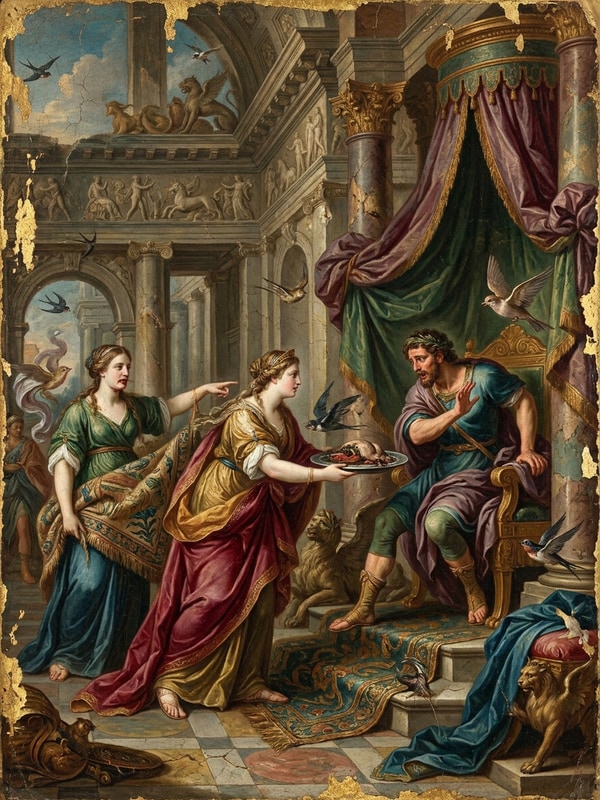
Procne, princess of Athens, was married to Tereus, king of Thrace. Longing for her sister Philomela, she asked her husband to bring her from home. On the journey Tereus committed a brutal crime and cut out Philomela’s tongue. When the sisters were reunited, they answered him with a dreadful revenge that destroyed his house, and in the end all three were changed into birds.
Article
Summary
Pandion, king of Athens, once received help from Tereus, king of Thrace, and gave him his elder daughter Procne in marriage. Procne left Athens, became queen in distant Thrace, and bore a son named Itys, yet she never stopped longing for her sister Philomela. After many years, she asked her husband to return to Athens and bring Philomela to her. When Tereus saw Philomela, desire took hold of him. He led her away from Athens, but instead of bringing her to the palace, he took her into a lonely Thracian wood, assaulted her, cut out her tongue, and imprisoned her. Back beside Procne, he lied that Philomela had died on the journey, leaving his wife to mourn a sister who was still alive. Philomela, unable to speak, did not surrender the truth. She wove her suffering into a cloth and found a way to send it to Procne. Once Procne understood the message in the threads, she used the disorder of Dionysus’ rites to rescue her sister; when the two were reunited, grief quickly hardened into revenge against Tereus. Procne finally turned her rage toward her own son, Itys. With Philomela, she killed the child, prepared his flesh as a meal, and served it to Tereus. When the truth was revealed, Tereus drew his sword and pursued the sisters, but all three were changed into birds in the chase; from then on the story bound voicelessness, weaving, revenge, and birdsong together.
The Sister Married Away to Thrace
Pandion, king of Athens, had two daughters. One was named Procne, the other Philomela. The sisters grew up together in the palace, often sitting side by side at the loom, often whispering beneath the colonnades. Later, when war came upon Athens, Tereus, king of Thrace, led his men to Pandion’s aid. He was fierce in battle, and his soldiers, wrapped in heavy cloaks, seemed to bring with them the breath of the northern mountains. After he helped Athens drive back its enemies, Pandion gave him his elder daughter Procne in marriage, both in gratitude and to bind the two houses together.
The wedding was splendid. Torches burned through the night, wine cups passed from hand to hand, and the Athenians watched the foreign king lead the princess away. Yet some tellings say that the marriage was ill-omened from the start: the gods who should have blessed the bridal bed did not linger gladly there, and a shadow seemed to fall beside the wedding fire. Procne mounted the chariot, left her father’s palace, left her sister Philomela, and went with Tereus to far-off Thrace.
Thrace was not like Athens. The winds were colder there, the ridges darker, and the forests were full of the cries of birds and beasts. Procne became queen, and in time she gave birth to a son, Itys. When the child learned to walk, he would clutch at his mother’s robe and run through the palace after her. Procne loved him dearly, but there remained an empty place in her heart. She missed the sunlight of Athens, missed her father, and most of all missed Philomela.
Year after year passed, until at last she said to Tereus, “If you truly love me, go to Athens for my sake. Bring my sister here, so that I may see her. Let her stay only a little while, if that is all my father will allow.”
Tereus agreed. He readied a ship and set out with his attendants. The sail swelled in the wind, the prow cut through the waves, and the vessel made for Athens.
The Plea Beside the Ship
Tereus came to the palace of Athens. Pandion was old by then, and when he saw his son-in-law arrive from afar, he welcomed him with a feast. Tereus said that Procne longed for home day and night in Thrace and wished her sister might come to keep her company for a season. The old king listened, pitying his elder daughter, yet reluctant to let the younger one leave him.
Then Philomela herself entered. She was young and beautiful, her dress light about her, her hair falling over her shoulders like new leaves in spring. When she heard that her sister wanted her, she went at once to her father’s side, took his hand, and pleaded, “Father, let me go. I want to see my sister too. Do not be afraid; I shall come back soon.”
Pandion looked at her, then at Tereus. When he entrusted Philomela to his son-in-law, he charged him again and again: “She is my daughter, and your wife’s sister. Guard her as you would guard your own blood. Let her go safely, and bring her safely home.”
Tereus promised with his mouth and gave the old man every assurance. But from the moment Philomela entered the hall, a wicked desire had taken root in him. He watched her speaking, watched her lift her hands, watched her lower her head beside her father, and the longer he looked, the more he was dragged down by his own lust.
The next day the ship left Athens. Pandion stood on the shore and watched his daughter board. Philomela turned back and waved, and the white sail dwindled across the sea. The old man did not know that this farewell would nearly hurl his whole family into ruin.
The Crime in the Woods
The ship reached the coast of Thrace. Tereus did not take Philomela straight to the palace. Pretending they must rest on the way, he led her into a lonely stretch of mountain forest. The trees were thick there; sunlight broke into shards among the leaves; damp fallen foliage covered the ground, and no human voice could be heard.
At first Philomela thought it was only a stop along the road. By the time she understood that something was wrong and tried to flee, it was too late. Tereus threw off his disguise and showed the cruelty beneath. He ignored her cries and struggles and committed an unforgivable outrage.
Philomela lay on the ground, her dress torn, her face wet with tears. But she did not fall silent as Tereus expected. She lifted her head, fixed him with a fierce stare, and cried, “You have done this, and you think you can hide it? I will tell my sister, tell my father, tell everyone. Even if I must stand in the marketplace and shout, I will make your crime known!”
Tereus was afraid—not from remorse, but from fear of discovery. He drew his sword, first threatening her into submission, and then did something still more savage: he cut out Philomela’s tongue.
From that time on, she could no longer speak the truth aloud. Tereus shut her in a hidden hut in the woods, set guards over her, and returned to the palace. To Procne he lied, saying that Philomela had fallen ill and died on the journey.
When Procne heard the news, she wept without end. She put on mourning clothes and made empty rites for the sister she believed dead. Little Itys did not understand why his mother cried; he only tugged at her sleeve beside her. Procne thought Philomela had gone down into the grave, not knowing that she was still alive, suffering in silence on the same land.
The Words on the Loom
Philomela was shut in the hut, and no one heard her call, for she could no longer call at all. She wanted to escape, but the door was locked. She wanted to beg for help, but the guards would not listen. Day after day passed; light slipped through cracks in the wall, slanted across the room, and slowly withdrew. She could not speak, but she still had her hands.
She found thread for weaving. On a pale cloth stretched across the loom, she worked purple-red strands into the fabric, thread by thread, shaping a design. It was no ordinary pattern, but a silent accusation. She wove the whole story into the cloth: how she had been led into the woods, how Tereus had violated her, how he had cut out her tongue and imprisoned her. Every strand was like a sentence she could not utter.
When the work was finished, she managed to give the cloth to a trusted servant and have it carried to the queen. Perhaps the servant did not understand the full meaning of the woven figures; he simply did as he was told and went to the palace.
When Procne received the cloth, she first thought it was some piece of handiwork left by her sister. She unfolded it and looked, and little by little her face changed. The threads had no voice, yet they spoke more clearly than any cry. She saw the woods, saw Tereus, saw the tongue stolen from her sister’s mouth, saw her shut away in darkness.
Procne did not burst into tears at once. Her tears seemed to freeze inside her. She pressed the cloth against her breast and stood for a long time. Then, after a while, she said in a low voice, “Such a deed cannot be answered with weeping alone.”
It was the season of Dionysus’ rites. Women clothed themselves in fawnskins, carried thyrsus-staves, and went out into the hills with cries and songs and dancing. Under cover of the festival’s confusion, Procne pretended to join the holy rites, left the palace, and brought others with her to the place where Philomela was held. When the door was opened, Philomela lifted her head out of the dimness. The sisters saw each other: one could not speak, and the other, for a moment, could not speak either. Procne clasped her sister in her arms, touched the ruined mouth, and at last her eyes filled not with tears but with fire.
The Shadow of Itys
Procne brought Philomela back to the palace and hid her there. Nothing remained in her heart but revenge. Yet how could she punish Tereus so that he would feel true pain? She paced the room, and then she heard a child’s footsteps outside.
Itys ran in and called her mother. The child had his father’s brow and eyes, and at times his gestures too were like Tereus’. When Procne saw him, her heart convulsed. A mother’s love held her back; hatred dragged her on. The child knew nothing. He only looked up at her.
Philomela stood nearby, unable to speak. Her silence was like a cold blade. Procne thought of all her sister had suffered, of Tereus’ lies, of how she herself had worn mourning for one who had never died, and her heart hardened.
She made the most terrible decision.
Procne killed Itys. Philomela helped her. The sisters cut up the child’s body, put the pieces into a pot to boil, and roasted part of them over the fire. Smoke rose from the palace hearth, and the smell of meat mingled with the heat; the servants thought only that the queen was preparing a feast.
When mealtime came, Procne had Tereus sit down alone and allowed no one else to share the table. Tereus knew nothing of what had happened. He sat, ate, and drank. He asked where his son was, and Procne answered, “The one you are looking for is here.”
Tereus did not understand. He kept asking. Then Philomela stepped out from where she had been waiting and hurled the child’s head before him. Tereus saw the familiar little face and understood what he had just eaten.
He overturned the table. Wine and blood-colored broth spilled across the floor. Retched with horror, he drew his sword and rushed madly after the sisters. Procne and Philomela turned and fled, their dresses sweeping over the threshold, their footsteps clattering through the palace.
Wings in the Chase
Tereus came after them with sword in hand. His roar rang through the halls like a beast’s cry from the mountains. The sisters fled through the palace gates, and the wind struck their faces. There was nowhere left to go: behind them was Tereus with his blade; before them lay the open sky and the wild land.
Just as the pursuit was about to end, the gods would not let this blood-debt continue in human form. Procne’s body grew light, and her arms became wings. Philomela too was covered in feathers, her feet lifting from the ground. They no longer ran. They beat their wings and rose, flying over the rooftops toward the trees and fields.
Tereus lunged and caught nothing. He himself began to change. The hand that gripped the sword became a bird’s claw; feathers sprang from his body; a long sharp crest rose upon his head. He became a bird with a crested crown and a beak like a blade, still seeming to pursue, still carrying an anger without end.
From then on, people said that Procne and Philomela had become birds of lamentation. As for which became the nightingale and which the swallow, different traditions do not always agree. But the story remembers this: the sister who lost her voice found another voice in the world, and the sister married far from home left forever the bloodstained palace.
When spring comes, birdsong rises from hedges and beneath the eaves. Some voices sound like weeping; others like a hurried tale being told. Those who hear them remember the two daughters of Pandion, the cloth that wove the truth, and the house of Tereus, which in the end was left with only pursuit, lament, and a crime beyond repair.