Greek Mythology
Priam Ransoms Hector — Greek Mythology
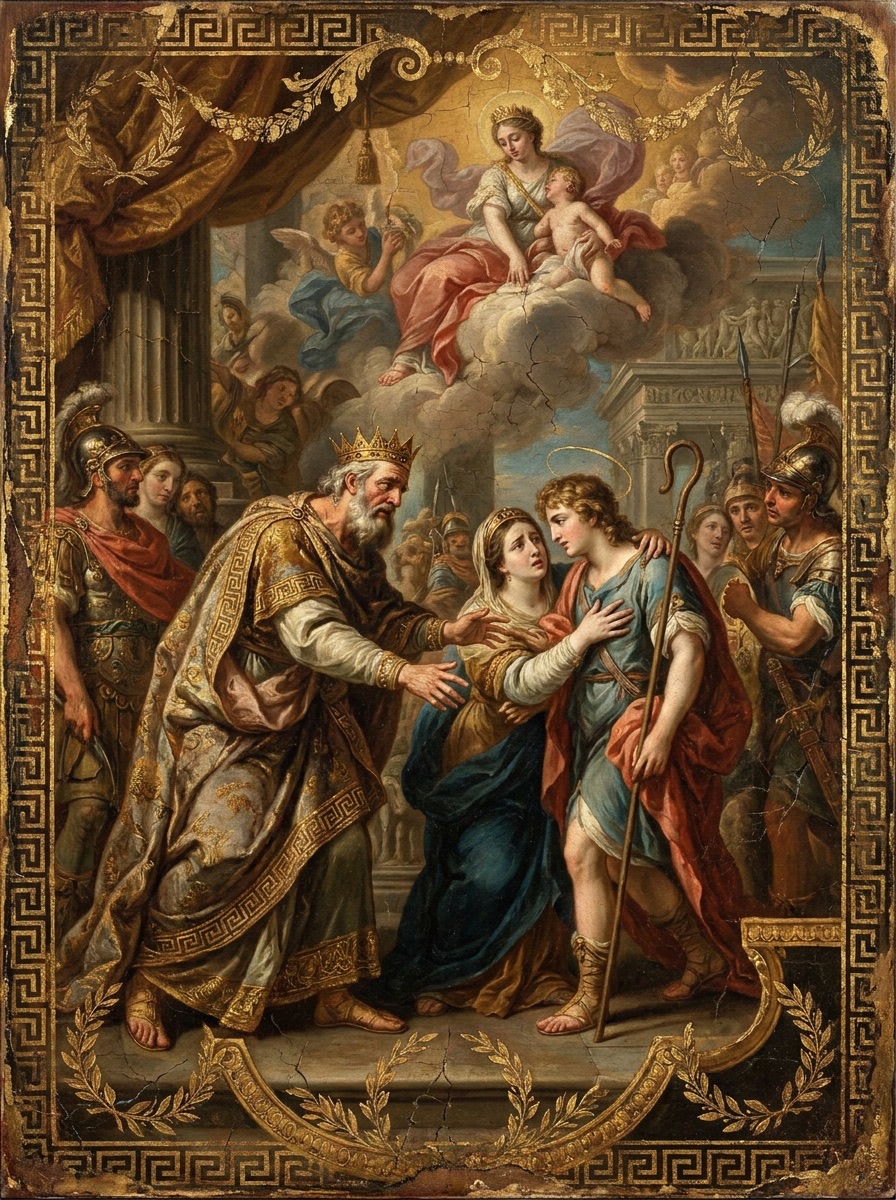
After Hector falls in battle, Achilles, grieving for his beloved companion Patroclus, refuses to give back the body. Guided by the gods, aged Priam enters the Greek camp by night, kneels before the man who killed his son, and ransoms Hector, so that the Trojans may at last bury their defender.
Article
Summary
After Achilles kills Hector, he drags the body back to the Greek ships. His anger has not cooled: each day he fastens Hector behind his chariot and drags him around the tomb-mound of Patroclus. Yet the gods cannot bear to see Troy’s bravest guardian so dishonored, and Apollo secretly protects the body from decay. On Olympus, the gods finally decide that the outrage must end. Zeus sends Thetis to tell her son to accept ransom and return Hector, and he sends Iris to Troy with a message for aged Priam: the king must go himself to the Greek camp. Priam knows he is being asked to face the man who killed his son, but he opens the storerooms, loads robes, gold, tripods, and bronze cauldrons onto the wagons, and prepares to ransom Hector with a father's own hands. Hecuba is terrified that her husband will die among the Greeks and begs him not to go, but Priam has made his choice. After pouring wine to Zeus, he sees a great eagle pass over the city and takes it as a sign. Under cover of night, Priam and the old herald Idaeus drive out from Troy with the ransom gifts. Hermes appears in the form of a young man, leads them past the sentries and the ditch, casts sleep over the guards, and brings the king safely to Achilles' shelter. Priam enters the shelter, clasps Achilles' knees, and kisses the hands that killed Hector, asking Achilles to remember his own aged father, Peleus. The appeal breaks through Achilles' rage. He thinks of his father, of Patroclus, and of the grief that binds enemies together. The two men weep in the same tent; then Achilles raises Priam up, accepts the ransom, and orders Hector's body washed, anointed, wrapped in robes, and placed on the wagon. Achilles also grants the Trojans twelve days of truce for Hector's funeral. Before dawn, Hermes warns Priam to leave, and the old king returns to Troy with his son's body. Cassandra first sees the wagon from the wall, and the city pours out in grief. Hecuba, Andromache, and Helen each lament Hector, and the Trojans gather wood, burn the body, collect the bones, and raise a tomb. At last Hector is no longer a dishonored corpse in the enemy camp, but the guardian of Troy restored to his people, his earth, and their memory.
The Body Beside the Ships
When Hector fell, it was as though the strongest beam in Troy had been cut away.
On the walls, Andromache had fainted; Hecuba had torn at her white hair; Priam had stretched out his old hands as if he would fling himself down from the battlements. But out in the dust beyond the gates, Hector could answer no one. His armor had been stripped from him, and Achilles had dragged his body behind the chariot back to the ships of the Greeks.
Killing his enemy did not bring Achilles peace.
Patroclus had died at Hector’s hands, and that grief burned in Achilles like a red-hot iron driven deep into the heart. His friend’s body had hardly been laid to rest; the cries of mourning still echoed through the camp. Whenever Achilles looked at Hector, he saw again Patroclus wearing his armor, falling on the battlefield.
He cast Hector’s body down beside the ships and would not allow the Trojans to claim it. Later, even after Patroclus’ funeral had been held and his mound raised, Achilles would not relent. Every morning he yoked his horses, bound Hector’s body behind the chariot, and dragged him around Patroclus’ tomb. The wheels stirred up pale dust; the horses’ hooves beat the ground; the Greeks watched in silence.
Yet Hector’s body did not rot as mortal bodies do. Apollo pitied him and secretly guarded him, keeping dust and wounds from destroying his beauty. The gods saw this, and little by little their hearts were moved.
On Olympus, the gods spoke of the matter. Some pitied Hector; others remembered the anguish of Achilles. At last Zeus gave his command: Hector must be returned to his father, and Achilles must accept the ransom, so that the dead man might receive burial.
So Thetis was summoned to Olympus. She was Achilles’ mother, and she knew how deep her son’s rage ran. Zeus ordered her to go to the Greek ships and tell Achilles that the gods were displeased: he must accept the ransom and give Hector back.
At the same time, Zeus sent Iris, the rainbow goddess, flying toward Troy.
The Old King’s Decision
When Iris came to Priam’s palace, the halls were still full of lamentation.
Hector’s brothers, sisters, wife, and mother were sunk in grief. Priam was very old, his hair white as snow, his robes stained with ash. He had other sons, but in the hearts of those who defended the city, Hector had been Troy’s strongest shield. Now that shield was broken. The city still stood, but its people felt as though daylight had gone from them.
Iris came quietly to the old king’s side and gave him the word of Zeus: he was to take ransom-gifts and go in person to the ships of the Greeks, asking Achilles to return Hector. He was not to be afraid. Hermes would guide him until he reached Achilles’ shelter.
Priam was shaken to the heart.
Whom was he to meet? The man who had killed Hector. The man who had dragged his son’s body around a tomb. This was no ordinary enemy, but the most terrible warrior in the Greek army. Yet if Priam did not go, Hector would remain in the enemy camp, far from his parents, his wife and child, and the people of Troy.
The old king rose and ordered the storerooms opened.
Servants brought out finely woven robes, heavy cloaks, gleaming vessels of gold, tripods, and bronze cauldrons. They harnessed a mule-cart and loaded the ransom piece by piece. Gold shone in the torchlight; folded cloth was stacked neatly. Priam hardly looked at any of it. He only urged them to hurry.
When Queen Hecuba heard that her husband meant to go alone to the Greek camp, she was terrified and tried to stop him. Weeping, she begged him not to go, saying that Achilles’ heart was hard as iron and that, if he saw Priam, he might not spare him. But Priam had made up his mind. He told Hecuba that if this was Zeus’ command, he would take the risk; and if fate required him to die beside the Greek ships, he would be willing to die near his son.
Hecuba could not hold him back. She ordered a cup of wine to be brought, so that the old king might first pray to Zeus and ask for an omen.
Priam washed his hands, stood in the courtyard, lifted the cup, and poured wine upon the ground. He prayed to Zeus on high: if this road was truly permitted by the gods, let a bird be sent for him to see.
Before long, a great eagle flew over the city, spreading broad, powerful wings. The Trojans saw it and felt a little steadier in their hearts. Priam climbed into the wagon. His old herald Idaeus sat beside him and took the reins. The gates were opened, and the night lay outside them like dark water.
With the ransom-gifts behind him, the old king left Troy.
The Guide on the Night Road
By day, the plain outside Troy was filled with the noise of battle; by night, it was more dreadful still.
There lay fallen weapons, unburied bodies, and earth churned by chariot wheels. Far off, the Greek campfires burned in clusters, and near the sea the black ships rested. Priam sat in the wagon, listening to the soft sound of the wheels, and thought of Hector as a child, and of the wall Hector had looked back toward when he went out in armor.
Halfway along the road, a young man suddenly appeared before them.
He looked like an attendant from the Greek camp. There was no cruelty in his face; his step was light, his voice gentle. Old Idaeus grew tense, fearing they had met an enemy night patrol. Priam too felt a shock of fear. But the young man asked who they were, where they were going, and said he would guide them through the camp.
The young man was Hermes, though he had hidden his divine form.
He told Priam that Hector’s body was still with Achilles, but had not decayed and had not been torn by wild dogs. Apollo had guarded him all along. When Priam heard this, tears nearly fell from his eyes. For a father, the knowledge that his son still kept a human face was like a small flame burning in the darkness.
Hermes walked before the wagon and led them past the sentries. He cast the guards into heavy sleep, so that the sound of wheels and mule-hooves did not wake the Greeks. Through gate, ditch, and wooden palisade they passed, one after another, under cover of night. Priam saw sleeping soldiers, shields laid on the ground, and spears leaning against the ships. Without a god to guide him, he could never have reached this place alive.
At last they came to the shelter of Achilles.
Only then did Hermes reveal who he was. He told Priam: go in now, clasp Achilles’ knees, and ask him to remember his own father, Peleus. With that, the god left him and returned to Olympus.
Priam stood outside the shelter, the night wind stirring his robes. He knew that the next step had to be taken alone.
Kissing the Hands That Killed His Son
Achilles had just finished eating and was sitting inside. Since the death of Patroclus, true sleep had rarely come to him. There was firelight in the shelter, vessels, spoils of war, and a heavy silence.
Suddenly, Priam entered.
Everyone inside was astonished. No one could imagine that the old king of Troy had passed through the camp and appeared before Achilles. Priam carried no sword and raised no cry. He went to Achilles, bent his aged body, clasped the warrior’s knees, and kissed the hands that had killed Hector.
For a moment, the shelter was terribly still.
Then Priam spoke. He did not begin with gold, nor with kingship. He asked Achilles to think of his own father, Peleus. Peleus too was old, far away in his homeland, longing for his son’s return; yet at least he knew Achilles was alive. Priam’s lot was different. He had many sons, and many had already died in battle; now the best of them had been taken too. He said that he had done what no mortal man could bear to do: he had kissed the hands of the man who killed his child.
Achilles listened, and the fire of his anger slowly loosened.
He thought of Peleus. His old father might even now be waiting at home for news, not knowing that his son was fated not to live long. He thought again of Patroclus and of the days when they had grown up together. Priam wept at his feet for Hector, and Achilles wept for his father and his friend.
For a long time the two enemies wept in the same shelter: one the victorious killer, the other the old king who had lost his son.
After a while, Achilles rose and gently lifted Priam to his feet. He said that the gods distribute suffering among human households, and no one receives only joy. He also warned the old king not to stir his anger again, for Hector would be returned—that was the command of Zeus.
Priam begged him to accept the ransom and let him see his son quickly. Achilles ordered his servants to go out and prepare the body where Priam could not see it being moved, lest the sight overwhelm him with grief and provoke new conflict. The servants washed Hector’s body, anointed it with oil, wrapped it in robes, and laid it on the wagon.
Achilles himself went near the body and, in his heart, spoke to Patroclus. He asked his friend not to blame him for accepting ransom, for this was the will of the gods, and he would set aside for Patroclus the offerings that were due.
Then Achilles invited Priam back inside and had food set before him.
Priam had not eaten properly for a long time. Neither had Achilles. Grief is not banished by one meal, but the living must still take a little bread and wine if they are to endure the next day. The two men sat at the same table and, for a brief span, laid their weapons aside.
After the meal, Priam looked at Achilles with both fear and wonder. He saw that the man who had killed Hector was young, tall, and radiant as a god. Achilles looked at Priam too and saw the dignity of his face and white hair, and respect rose in him.
The old king made one final request: give the Trojans time to bury Hector. The city needed to bring in wood, to mourn, and to raise a tomb. During those days, let there be no fighting.
Achilles agreed. He asked how many days were needed. Priam said twelve. Achilles promised that, for that span, the Greeks would not attack the city.
The night was now deep. Achilles had beds laid outside the shelter for Priam and Idaeus, so that if other Greek leaders came unexpectedly, they would not find the Trojan king within and cause trouble.
Hector Returns to Troy
Priam did not sleep peacefully.
Before dawn, Hermes came to him again and warned him to leave quickly. If Agamemnon and the other Greeks learned that the old king of Troy was in the camp, the matter might end badly. Priam at once woke Idaeus, and they harnessed the mule-cart and chariot.
Hector’s body lay on the wagon, covered with robes. The ransom had been left behind, and the sound of the wheels passed once more through the Greek camp. Hermes escorted them out until they had crossed the ditch and reached the road that led back to Troy.
Slowly, the light of dawn rose.
On the wall, Cassandra was the first to see the wagon in the distance. She recognized her father and saw the body lying upon the cart, and she cried aloud. Her voice carried through the city, and the Trojans poured toward the gates. Men, women, old people, and children all came to welcome Hector home.
When the wagon reached the city, grief came over them like a wave.
Hecuba flung herself beside the cart and touched her son’s head. Andromache clasped Hector’s head and neck, lamenting that he had died too soon and left behind a little son and a widowed wife. Helen too came to mourn him. She said that in all her years in Troy, Hector had never spoken a harsh word to her; instead, when others reproached her, he had often defended her.
The Trojans carried Hector into the city and laid him on a bed. The women gathered around him and sang their laments, and cries of mourning filled every street. Yet now, at last, he no longer lay beside the enemy ships, nor was he dragged through the dust behind a chariot. He had returned to his own house, to his parents, his wife, and his child.
In the days that followed, the Trojans kept away from battle as agreed, and the Greeks held back.
The people went up into the hills to cut wood, brought it down into the city, and built a high funeral pyre. When the appointed day came, Hector’s body was placed upon the wood. Flames rose, and smoke climbed straight into the sky. The Trojans stood around and watched the fire consume the bravest defender of their city.
When the fire had died, they quenched the embers with wine, gathered the white bones, and placed them in a golden chest, covering it with soft purple cloth. They buried the chest in the earth, raised a mound above it, and set guards nearby in case the Greeks made a sudden attack.
At last, the Trojans held the funeral feast in the city.
So Hector’s burial was completed. The war beyond the walls was not over. The Greek ships still lay by the sea, and Achilles’ wrath had not brought the dead back to life. But for those twelve days, at least, a father had ransomed his son, and Troy had wept for its guardian, burned him, and laid him in the ground. Hector was no longer a dishonored body in the enemy camp, but a hero kept in the memory of the Trojans.