Greek Mythology
Priam, Hecuba, and Paris — Greek Mythology
Queen Hecuba dreams that she gives birth not to a child, but to a blazing torch, and the seer warns that the baby will bring ruin upon Troy. The infant Paris is cast out on Mount Ida, yet he survives, grows up among shepherds, and at last comes home through a contest.
Article
Summary
When Priam and Hecuba ruled Troy, the queen conceived a child. Before the birth, she dreamed that she did not bear a baby at all, but a burning torch. The flame spread higher and higher until it seemed ready to consume the roofs, walls, and temples of Troy itself. When the dream was explained, the warning was grim: if the child lived, he would one day destroy the city. Priam could not bear to kill his own son, but he dared not dismiss the prophecy either. So when the boy was born, he handed the infant to a servant and ordered him to abandon him on Mount Ida. The servant obeyed, yet when he returned days later, he found the child still alive. A mother bear had fed him, and neither beasts nor cold had taken his life. Moved with pity, the servant carried him home and raised him in secret. The boy grew up in the hills and was called Paris, though some called him Alexander. He kept cattle and sheep, drove off thieves, and guarded the herds with a shepherd’s hardiness and a prince’s grace, though he knew nothing of his birth. At last, Priam held games in memory of the son he had lost and sent to Mount Ida for a prize bull. The very bull Paris loved was chosen. Paris followed it to Troy, entered the contest, and defeated the king’s sons one after another. When the others grew angry and set upon him, Cassandra recognized him as the child long ago exposed on the mountain. Priam and Hecuba finally welcomed him back to the palace, but the dream of the torch came home with him as well.
The Queen Dreams of a Firebrand
Troy stood high above the plain, with roads running down toward the sea and walls that looked out across the land. In Priam’s day the city had stables, temples, palaces, and busy streets. Queen Hecuba lived deep within the royal house. She had already borne children for the royal line, and now she was carrying another.
Before this child was born, Hecuba had a troubling dream.
She saw herself in labor, but the thing she brought forth was not a soft, helpless infant. It was a burning torch. As soon as it fell into her arms, the flame shot up. It crept over her hands, over the curtains beside the bed, and rushed through Troy like fire driven across dry grass. The rooftops glowed red, the gates shone like molten bronze, and even the pillars and high walls of the temples trembled in the blaze. When Hecuba woke, she was covered in cold sweat.
She told Priam what she had seen. The king’s heart sank too. He summoned those skilled in signs and omens and asked them to explain the dream. They did not soften their answer. The child inside the queen, they said, would bring great ruin on Troy. If he were allowed to live, the flames would one day reach the city.
The palace grew very still. Outside, horses still neighed and servants still moved through the corridors, but Priam and Hecuba knew that the dream now hung over them like a weight.
The Child Taken to Mount Ida
When the child was born, he was a boy. At birth he cried like any other infant, with tiny fingers curled and his face wrinkled in his swaddling cloth. Hecuba looked at him and could not make the torch of her dream fit this fragile little life.
But the seer’s words still echoed in the royal chamber. Priam was both father and king. He feared that pity might destroy the city, yet he could not bring himself to kill his newborn son. At last he called a servant he trusted and gave him the baby, commanding him to carry the child to Mount Ida and leave him there.
The servant took the infant from the palace. Behind him, Troy’s gates closed, and he went up the road toward the hills. Pine trees bent in the wind, and the slopes were marked with narrow paths left by sheep. In a lonely place, he set the baby down among the rocks. He dared not look long. He only pulled the cloth closer around the little body and turned away.
The nights in the hills were cold, and by day wild beasts roamed there. By any reckoning, such a small child should not have survived for long. Yet after some days the servant returned, uneasy in his heart, to see what had become of him. He expected to find an empty swaddling cloth, or nothing at all.
Instead, as he drew near, he heard the faint sound of crying.
The child was alive.
The tale says that a mother bear came to him in the hills and fed him with her milk. The infant cast out by Troy was neither swallowed by the dark nor torn apart by beasts. The servant stood there a long while, and his heart could no longer stay hard. He picked up the child, carried him to his own home, and raised him in secret.
The Shepherd of the Hills
That child was later called Paris. Another name for him was Alexander, because as he grew older he often protected the herds and drove off men who came to steal cattle and sheep.
He knew nothing of his true parentage. He only knew that he lived below Mount Ida. At dawn he drove the cattle and sheep up to grass wet with dew. At midday he lay in the shade and played his pipe while the bells on the animals rang softly in the breeze. At evening he gathered the strays and sent them back into their pens. Springs ran from the rocks, pine needles fell across the paths, and though the shepherd’s life was hard, it was plain and steady.
Paris grew handsome and quick of hand and foot. He could throw a spear, chase wild beasts, and stand at night beside the sheepfold with a staff in his hand. If thieves came down from the mountain roads to drive off the herd, he and his companions would run them down and win the cattle back. Little by little, the people of the hills learned that this young shepherd was not one to be trifled with.
He also had a strong bull, broad in the neck and hard of horn, that stamped so heavily on the dirt road you could hear it from far away. Paris loved it as a man loves a precious thing. Among the herd, the bull stood out above all the rest, and anyone who saw it knew it would make a fine prize in a contest.
A Bull Leads to Troy
Years passed, and Priam still remembered the son who had been cast away. Everyone believed the child had died in the hills. To honor him, the king ordered games, where young men wrestled, raced, and tested their strength, and a fine bull would be given to the victor.
Messengers were sent up to Mount Ida to choose the prize. Among the herd, they singled out the bull Paris loved. When they came to take it, Paris could not bear to lose it, so he followed them down from the mountain. He did not know he was walking back toward the place where he was born. He only knew that no one should take his bull from him without a struggle.
When Troy’s gates came into view, he was still only a shepherd from the hills. The walls were towering, the streets were noisy, and the roofs of the palace shone in the sun. By then the contest had already gathered a crowd, and the princes and noble youths were preparing to compete.
When Paris saw that his bull was to be handed out as a prize, he was angered. He asked to enter the games himself. Some laughed at his rough dress and shepherd’s look, and some dismissed him at once. But he did not step back.
Once the contests began, the laughter slowly faded.
He ran faster than the others, held firm in wrestling, and would not easily be thrown in strength contests either. One by one, the young men trained from childhood in the palace were beaten by him. People began to whisper along the edge of the field: who was this shepherd from Ida, and where had he learned such strength and daring?
The princes were humiliated. Priam’s sons, in particular, were furious to see a stranger rob them of their glory. To them he was only a man from the hills, unworthy to outshine the royal house at its own games. In their anger, they decided to kill him.
Recognition at the Altar
Paris sensed the danger and fled. He pushed through the crowd and ran toward an altar near the palace. That was the place where families and gods were honored, and in danger a man who reached the altar had grasped the last hope left to him. Paris threw himself beside it and clung to the sacred stone, refusing to leave.
His pursuers stopped short, not daring to strike down a man at the altar. Then, in the midst of the turmoil, Cassandra appeared.
She was the daughter of Priam and Hecuba, and she was known for speaking dreadful truths no one wanted to hear. Again and again people had ignored her warnings, but this time she looked at the young man by the altar and recognized him at once. She said that this fugitive shepherd was no stranger: he was the child once abandoned on Mount Ida, the torch from Hecuba’s dream, the son Priam had lost.
The words fell like a stone into water, and there was an outcry all around. Priam heard her and was shaken to the core. He had believed his son long dead, and now that son stood alive before him, a handsome and fearless young man. Hecuba came too, and when she saw Paris’s face and the frightened stubbornness in his eyes, no mother could mistake him for a stranger.
Perhaps the servant who had exposed him also told the truth: that the baby had been left in the hills, yet had not died, and had been secretly raised. Piece by piece, the story fitted itself together. The dream, the infant, the parting, all of it came back before the royal house.
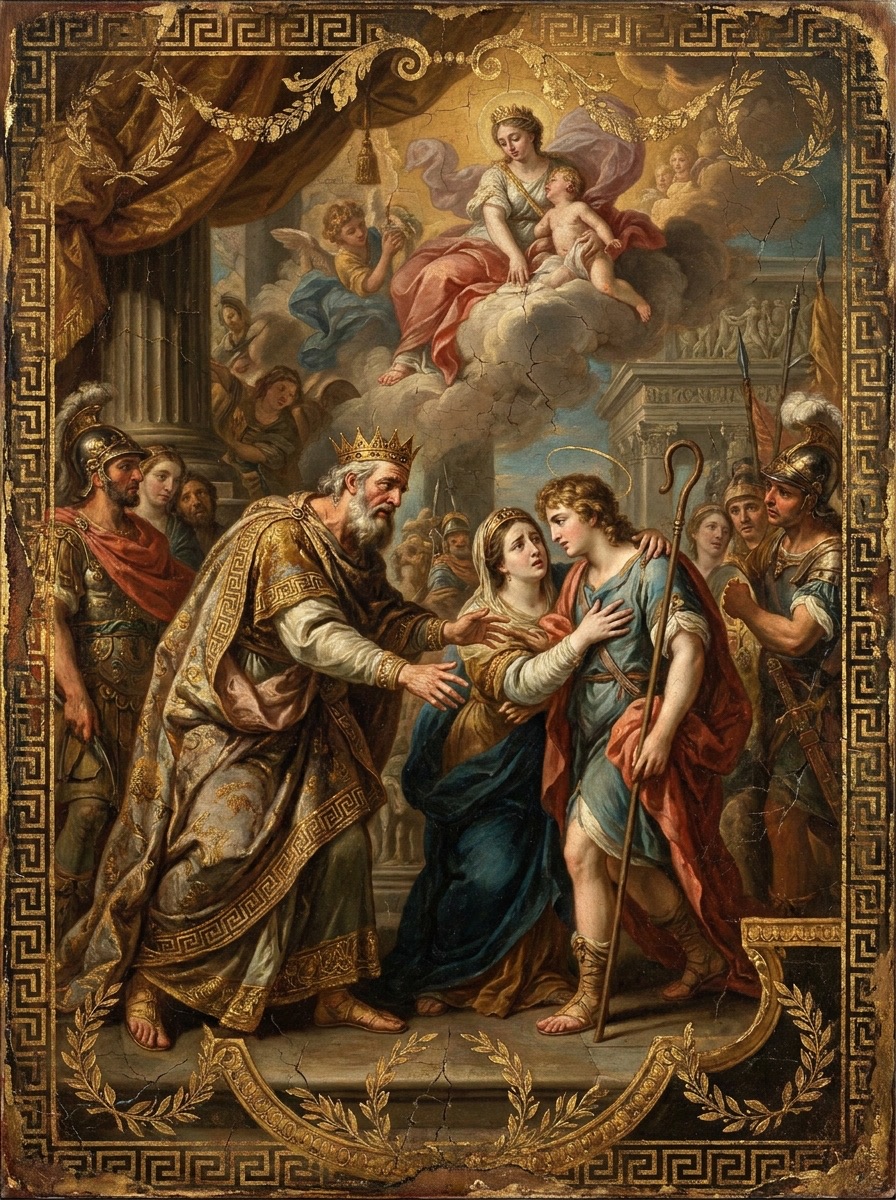
Priam did not order the youth killed. He brought Paris into the family and acknowledged him as a prince of Troy. Hecuba, who had lost him and found him again, was overjoyed. The palace dressed him in royal garments and gave him back his place. From a shepherd in the hills, Paris became the son of the king, watched now by all Troy.
Yet Cassandra’s warning did not vanish. Many were busy celebrating and willing to treat the old prophecy as a nightmare that had already passed. But the torch from the dream had only been hidden for a time within the palace. Paris had returned to his parents, and Troy had welcomed back into the city the very fate it once tried to cast away.