Greek Mythology
Polynices and Eteocles — Greek Mythology
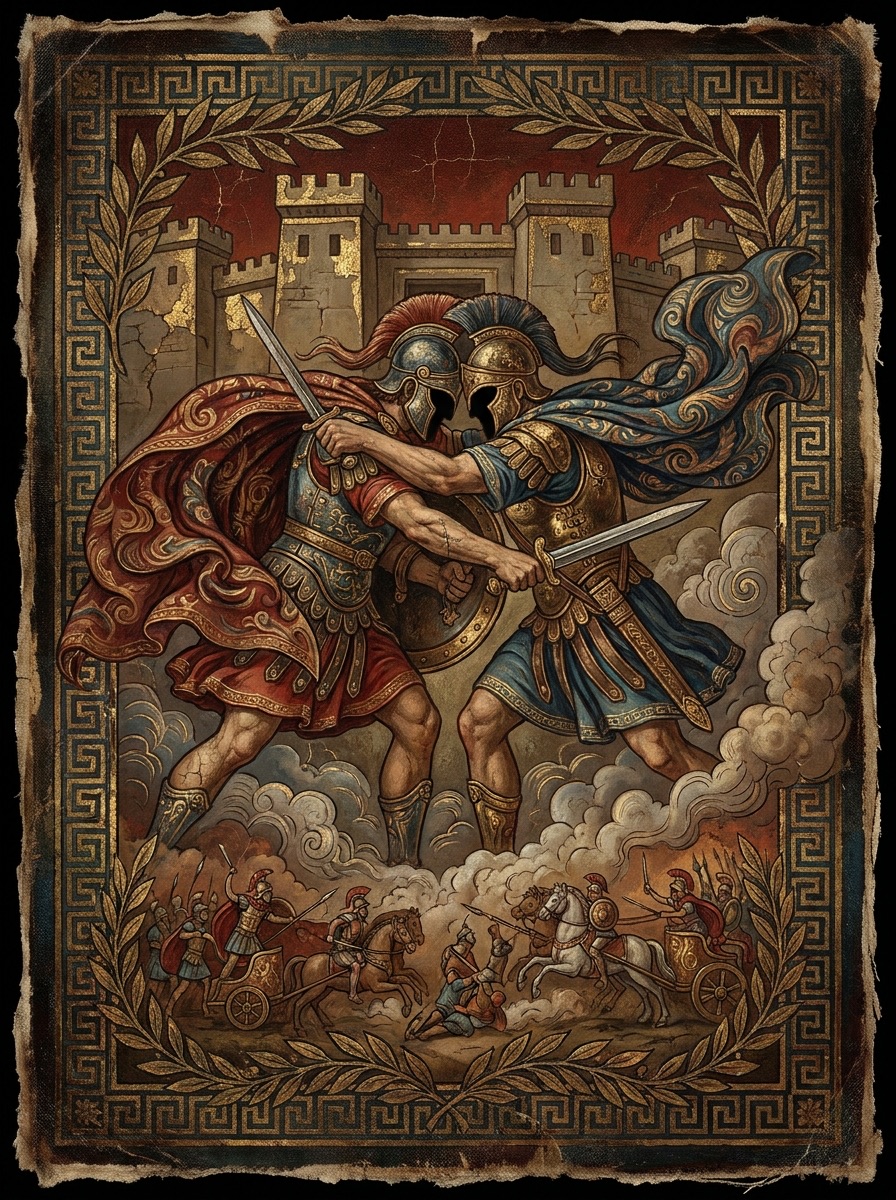
After Oedipus leaves Thebes, his sons try to share the throne by ruling in turn. Eteocles breaks the bargain, and Polynices is driven from the city.
Article
Summary
After Oedipus is gone, Polynices and Eteocles inherit a damaged house and a single throne. They agree to rule Thebes in turn, but Eteocles grows used to power and refuses to surrender it. Polynices leaves the city in anger, turning a family quarrel into the seed of a larger war.
The Two Sons in the Palace
The royal palace of Thebes had once been a lively place. Behind its high walls stood altars, stone steps, guards at the gate, and cattle and wine brought in from the countryside. But after Oedipus’ shame was brought to light, the whole house seemed to fall beneath a shadow.
Oedipus had discovered that he had unknowingly killed his own father and married his own mother, Jocasta. Jocasta took her own life in the chamber, and Oedipus, in despair, blinded himself and could no longer bear to look upon Thebes in the sunlight. In time he left the city, with only his daughter Antigone to guide his steps. Behind him remained his two sons, Polynices and Eteocles.
Both brothers were of royal blood, and both knew they had a claim to the throne. Yet there was only one seat, and it could not be shared by two men at once. The elders of Thebes wanted the city to remain steady, and the people only wanted the palace gates to stay quiet. So the brothers reached an agreement: they would rule in turn, one after the other, each for a single year. Eteocles would remain in Thebes first, while Polynices would leave for the time being and return when the year had passed.
It sounded fair enough. The oath was spoken before the altars, and the words were clear. But once the crown is on a man’s head, his heart can change.
The Exiled Brother
After Eteocles took the throne, he moved into the chambers his father had once occupied. He heard the gates open each morning, watched officials climb the stone steps to report to him, and received the salute of soldiers bowing their heads. The walls, the granaries, the stables, and the temples of Thebes all passed under his hand.
When the year was nearly done, Polynices sent messengers to remind his brother of the old bargain. They entered the palace and said that it was now Polynices’ turn to return and rule. Eteocles refused to step aside. He said Thebes needed a firm ruler and could not change masters every year. He also claimed that Polynices had been gone too long and had no right to come back and unsettle the city.
When these words reached Polynices, he understood that his brother had betrayed him. By their agreement he should have returned to Thebes and taken the year that was his; instead the gates were shut to him, the palace denied his claim, and his own brother stood in the way.
He could not force his way back alone. So he left Thebes and went to Argos. There, in the darkness, he stood before a foreign palace wearing the dust of exile. He was not the only displaced man in the city. Tydeus, another exile, was there as well. The two quarreled, like beasts driven too far, and came to blows at the palace doors.
Adrastus, king of Argos, heard the uproar and came out to see what had happened. He looked upon the two young men, one fierce as a lion, the other stubborn as a boar, and remembered an oracle that had told him to marry his daughters to a lion and a boar. So he sheltered the exiles, gave his daughters to them in marriage, and promised to help them win back what they had lost.
From that moment Polynices was no longer merely a prince cast out of his city. He had a father-in-law, allies, and an army.
The Quarrel Becomes a Road
Polynices left Thebes with no crown and no trust left for his brother. The city gates closed behind him, and the quarrel did not yet have armies, champions, or the noise of battle. It was still a broken promise inside one family. But the road away from Thebes led toward Argos, and there the private wound would begin to draw other heroes into its orbit.