Greek Mythology
Polydeuces and Amycus — Greek Mythology
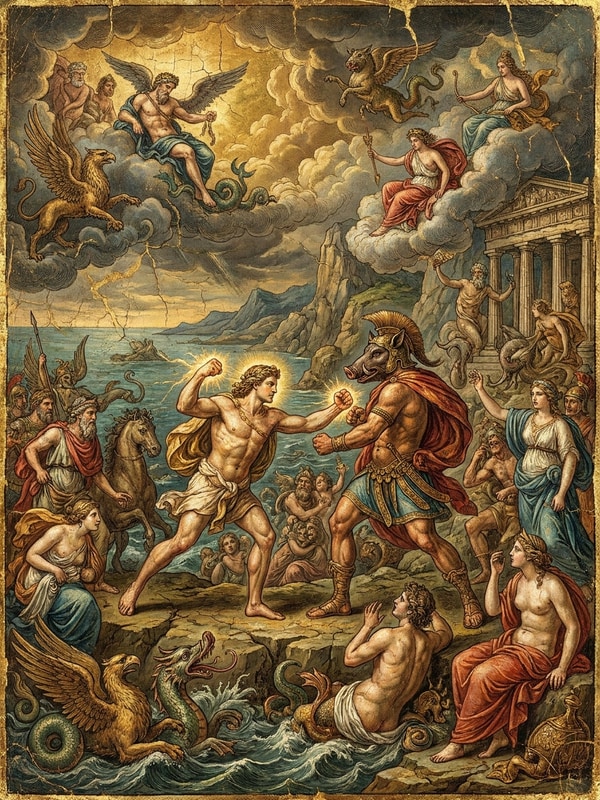
The Argo came to the Bithynian shore, where the brutal boxer Amycus forced strangers to fight him before they could draw water. Polydeuces stepped forward, met him beside the spring, and defeated him, so that the Bebryces no longer dared to abuse travelers in that way.
Article
Summary
The Argo sailed to the coast of the Bebryces, and the heroes went ashore in search of fresh water. There they found a spring, but it was held by the local king, Amycus. He was a son of Poseidon, immensely strong, and he made it his custom to force passing strangers into boxing matches. Many had died because of him. Amycus barred the Argonauts’ way and declared that anyone who wished to take water must first fight him. While the heroes bristled with anger, Polydeuces, skilled above all in boxing, stepped forward. He stripped off his cloak, bound the ox-hide thongs around his hands, and agreed to meet Amycus by his own rules. They fought beside the spring. Amycus struck with heavy blows, like a maddened beast relying on brute force alone; Polydeuces moved lightly, kept his head, slipped aside, and answered whenever an opening appeared. After several exchanges Amycus was wounded, and his anger only made him more careless. At last Polydeuces evaded one of Amycus’ crushing blows, closed in, and struck him on the side of the head. Amycus fell into the dust. The Bebryces rushed forward in alarm, but the Argonauts drove them back. From that day on, the spring was no longer merely a place where Amycus preyed upon strangers.
The Spring on the Strange Shore
For many days the Argo had been at sea, rising and falling under the force of the waves, while the oars grew heavier in the hands of the rowers. Then, one clear day, the heroes saw a coast ahead: trees, low hills, and a place near the shore where fresh water ran down toward the sea. Jason ordered the men to ship their oars and bring the vessel in toward land.
One by one the heroes leapt from the ship. Some held the mooring ropes; others carried jars up onto the shore. The sea wind was mixed with the scent of leaves, and from among the grasses came the sound of running water. To men long weary of salt water and spray, that sound was more tempting than wine.
But before they reached the spring, a tall man came out from the trees.
His shoulders were broad as a doorway, his neck thick, his face hard and savage. He wore none of the rich robes one might expect from a king. He looked rather like a beast guarding the mouth of its cave, arms hanging at his sides, fists heavy as stones. This was Amycus, king of the Bebryces, son of Poseidon the sea-god.
He saw the Argonauts landing, but he did not ask where they had come from or what they needed. He simply stood before the spring and blocked the way.
“Strangers,” Amycus said in a rough voice, “this water is not free for any man to drink. Whoever comes here must first box with me. If he wins, he may take as much water as he likes. If he loses, he leaves his life behind.”
The heroes’ faces darkened when they heard him. They had come only to draw water and rest their limbs after the voyage, and now they had met this insolent host. Some laid hands on their sword hilts; others looked to Jason, waiting for his word.
Amycus cared nothing for their anger. He was long accustomed to treating travelers in this way. Many ships had put in at this shore; many men had been forced by him to put on the boxing thongs and had fallen at last in the dust beside the spring. He counted that cruelty as proof of his strength, and as the law he set for all foreigners.
Polydeuces Steps Forward
From among the Argonauts a young man came forward. He was not the tallest of them, nor did he, like Heracles, make men think at once of overwhelming strength. Yet his shoulders and back were firm, his eyes bright, and his step light and steady. This was Polydeuces, son of Zeus, brother of Castor, and the finest boxer among the heroes.
When he had heard Amycus’ challenge, he did not burst into rage. He only took off his outer garment and handed it to one of his companions. In the sunlight the muscles of his arms stood taut, like a bow already drawn.
“If that is the custom here,” said Polydeuces, “then I will fight you.”
Amycus looked him up and down, and a contemptuous smile came to his mouth. Polydeuces was young, and he was not built like a mountain; the king thought he was merely another stranger who would soon be lying on the ground.
“You have courage,” said Amycus. “But courage will not save you.”
The two men went to an open place. The spring flowed from a cleft in the rock and gathered nearby in a shallow pool. The Argonauts stood on one side, while the Bebryces came out from the woods and down from the slopes, gathering in a ring. They knew their king rarely spared an opponent, and they waited to see the foreigner beaten down.
The boxing thongs were brought. They were not soft bands of cloth, but hard strips of ox-hide, wound around the hands so that every blow struck heavier. Polydeuces wrapped the leather carefully over the backs of his hands and around his wrists, then flexed his fingers to test their freedom. Amycus bound his own hands as well, but roughly, as if he were tying leather straps around two stones.
The match had not yet begun, but already the air had tightened.
The Boxing Match Beside the Spring
Amycus moved first. With a roar, he charged forward on heavy feet, driving his right fist straight at Polydeuces’ head. Had the blow landed, it would have felled a man where he stood.
Polydeuces did not meet it head-on. He turned aside, and the fist cut through the air past his ear. Amycus’ strength spent itself on emptiness, and dust rose under his feet. As the king turned, Polydeuces struck him on the side of the shoulder, with a sound like a wooden mallet hitting thick hide.
Amycus frowned. He had not expected the young man to be quick not only with his hands, but with his feet as well. He grew more serious and launched a fierce rush of blows. His left fist swept toward the chest; his right crashed toward the face. Blow followed blow, and even the onlookers drew back.
Polydeuces kept his eyes on Amycus’ shoulders and gaze. He did not retreat in panic, nor did he strike greedily. He answered only when the other man’s fists missed their mark. Amycus’ blows were heavy, but too hasty; Polydeuces’ fists were less ponderous, yet each one found a vulnerable place. Soon blood showed at Amycus’ temple, and swelling rose across his face.
At first the Bebryces had shouted encouragement, but little by little their voices fell away. The Argonauts, however, watched with growing excitement. Castor stood among them, his eyes fixed on his brother’s movements, his fingers tightening and loosening without his noticing.
Amycus was now enraged. Like a maddened bull, he lowered his head and rushed in, trying to crush Polydeuces by sheer force. That was the very moment Polydeuces had been waiting for. He stepped back, let the violence pass, then turned to the side and struck Amycus near the ear and along the neck.
Amycus staggered, but he did not yet fall. Gritting his teeth, he swung again. This blow came down from above, as if meant to smash his opponent’s skull. Polydeuces bent beneath it, rose suddenly at close quarters, and drove in a heavy punch.
The blow landed near Amycus’ temple.
The huge body lost its strength at once. Amycus’ knees buckled; he swayed, then fell heavily to the ground. Dust rose beneath him, and for a moment the spring was silent except for the water still sounding in the rock.
The Panic of the Bebryces
When the Bebryces saw their king fall, confusion broke over them. Some cried out; others snatched up spears and clubs and rushed toward Polydeuces. The Argonauts were ready. They took up their weapons at once and stood before their companion.
A skirmish broke out beside the spring.
The Bebryces were many, but the sudden turn had shaken them. They had thought Amycus certain to win; instead, it was their own king who lay in the dust. The Argonauts were chosen warriors from many lands, and when the enemy came on, they met them with force. In the woods rang the clash of shields; spears struck into wooden guards; stones rolled down the slopes and startled birds from the grass.
Polydeuces did not withdraw behind the others. Though he had only just finished the boxing match and the ox-hide thongs were still wound about his hands, he stood with his brother and his companions and helped drive the attackers back. When the Bebryces saw the heroes’ strength, and saw Amycus lying helpless on the ground, unable to command them any longer, their courage failed. They scattered into the woods and over the hillsides.
Quiet returned to the spring. The Argonauts filled their jars and washed the sweat and dust from their bodies. Some looked at Amycus where he lay and thought of all the unknown travelers who had been forced to die there; they felt no pity for him.
In one telling, Amycus died under the fists of Polydeuces. Another tradition says that Polydeuces spared his life, but made him swear that from then on he would never again force strangers to box, nor use the spring as a snare. In either version, the savagery of Amycus was broken that day.
Leaving the Shore Again
When the jars were full, the heroes returned to the Argo. The tide beat softly against the hull, and the oars reached once more toward the water. Jason saw that all his companions were aboard and ordered the mooring ropes loosed.
Polydeuces looked back one last time at the shore. The spring was still clear, flowing from the rock, through the grass roots, and down toward the sea. It had been only water for thirsty travelers, but Amycus had turned it into an excuse for murder. Now the great boxer had fallen, and the Bebryces no longer dared to stop every ship that touched their coast.
The Argo left the land behind, her white sail swelling in the wind. The heroes sailed onward, and the story of how Polydeuces defeated Amycus beside the spring spread over the sea: in some places, laws made by brute force stand only until they meet a steadier and braver pair of hands.