Greek Mythology
Philoctetes Abandoned on Lemnos — Greek Mythology
As the Greek army sailed toward Troy, the archer Philoctetes was bitten by a venomous snake. His wound festered, and his cries of pain would not cease. Fearing that he would burden the whole expedition, the commanders left him behind on Lemnos, with only a little food and the divine bow of Heracles.
Article
Summary
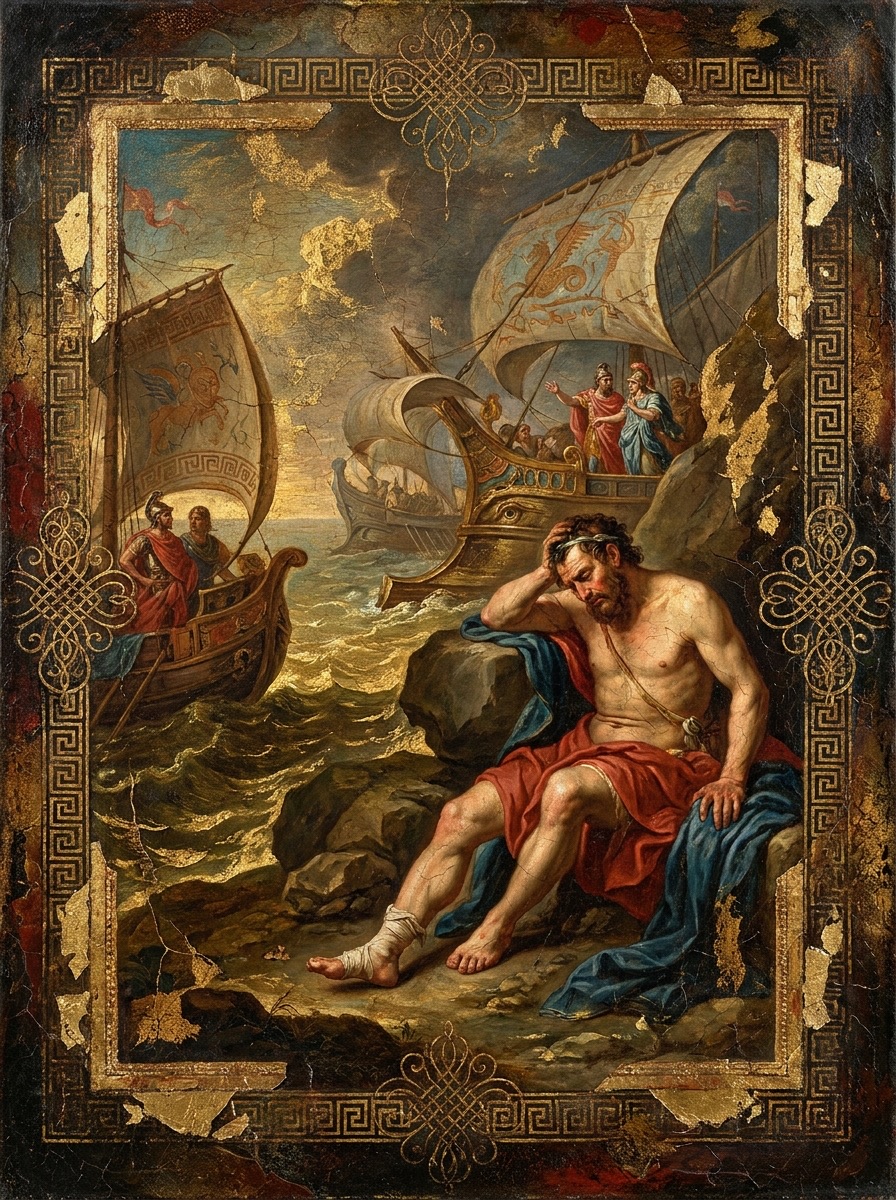
The Greek fleet was making its way toward Troy when it stopped at a small island to draw water and offer sacrifice. Philoctetes found an old altar and was preparing the sacred offering when a venomous snake, hidden in the grass, struck him in the foot. At first his companions carried him back to the ship, washed the wound, bandaged it, and laid herbs upon it. But the poison soon grew worse. The flesh festered and stank, and the pain drove him to cry out day and night. The warriors on the ships gradually could bear it no longer, and they began to fear that the wound might bring disaster upon the whole army. Agamemnon, Menelaus, and Odysseus secretly conferred and resolved to leave Philoctetes on Lemnos. While he slept, they lifted him into a small boat, carried him to a sea cave, left him clothing, food, and his bow and arrows, and then hurried away. When Philoctetes woke and saw the fleet vanishing across the sea, he understood that his comrades had abandoned him. Dragging his wounded leg, he cried out along the shore, but no one turned back. With the divine bow of Heracles beside him, he was left to endure long years of suffering alone on the desolate island.
A Fair Wind toward Troy
At last the Greek warships left the coast and sailed for Troy.
That day the wind was with them. White sails bellied high above the decks, and ship after ship cut through the waves like seabirds hurrying toward a far horizon. Warriors from many cities crowded the vessels. Some polished the points of their spears; some leaned their shields against the rail; others looked back in silence at the shore of their homeland as it sank farther and farther away.
Among them was a hero named Philoctetes. He was the son of Poeas, king of Meliboea. His fame did not ring out like that of Agamemnon or Achilles, yet many in the army knew that he carried a treasure beyond price: the bow and arrows once owned by Heracles.
In earlier days Heracles had suffered beyond measure and at last ended his mortal life upon a funeral pyre. Philoctetes had helped him then. As he was leaving the world, Heracles gave Philoctetes his own bow and arrows. The bow was powerful and hard to draw, and the arrows were no ordinary shafts of iron. When the string was truly pulled and the arrow flew, it seldom missed its mark. Philoctetes brought these weapons aboard the Greek ships, and everyone believed that with such an archer in their ranks, the Trojans would one day pay dearly.
But before the army had even glimpsed the walls of Troy, disaster was already waiting for him on the way.
The Old Altar on the Island
After the fleet had sailed for some time, it came near a small island. Some traditions call the place Chryse; others set the event at another sacred shore. The Greeks landed to take on water and to sacrifice to the gods, asking for a safe passage over the sea that still lay before them.
The stones along the beach were pale, the grass grew low, and the wind came through the cracks in the rock with the taste of salt upon it. Philoctetes went ahead, carrying the offerings. On the island he found an old altar. Its stones had tilted with age, and weeds grew from the seams. It was said that the altar had been left there long ago by the Argonauts during their voyage, dedicated to the goddess who watched over heroes.
Philoctetes was glad when he saw it. He was a man who honored the gods, and he thought that to find an ancient altar before a great expedition was a sign that sacrifice should be made. He called to his companions, cleared the tangled grass from the front of the altar, shifted broken stones aside, and prepared to lay the offerings there.
Just as he drew near, something moved deep in the grass.
A venomous snake, guarding that place, shot out of the shadow, swift as a dark line. Before Philoctetes could step back, it had fastened on his foot. Its fangs sank into his heel, and then it slipped away into the grass and vanished.
Philoctetes cried out and caught himself against the stones of the altar. He drew his short sword, wanting to strike the snake, but his leg suddenly weakened beneath him, and the wound began to burn as if fire had been poured into it. Blood seeped from the fang marks; soon it darkened, and the flesh around it began to swell.
His companions rushed to support him and carried him back to the ship. Some washed the wound with fresh water, some brought cloth to bind his foot, and others crushed herbs and laid them on the bite. At first they thought a hero’s wound was no great matter. In a few days, they said, the pain would ease, and he would draw the divine bow of Heracles again.
But it was not so simple.
The Poisoned Wound Worsens
After the fleet set sail again, Philoctetes’ wound grew worse day by day.
His foot swelled terribly. Whenever the bandages were changed, the wound showed a frightening color beneath them. Pus and blood clung to the skin, and a foul smell spread through the cramped space of the ship. The sea wind should have cleared away the heat and closeness of the hold, but it could not drive off that odor of corruption.
Worse still was the pain.
By day, while the warriors rowed, sorted ropes, and mended gear, Philoctetes lay in a corner with his teeth clenched and cold sweat on his brow. But when the poison flared through him, he could not hold back. He would clutch his wounded leg and cry aloud. At night, just as the others began to sleep, his cries startled them awake again. The planks rocked softly in the dark, the waves struck the hull, and his groans passed from stern to prow, leaving no man in peace.
At first many pitied him. He was their comrade on the expedition, and he was the keeper of Heracles’ bow. Some gave him water; some changed his bandages; some urged him to endure, saying that once they reached Troy they would surely find better treatment.
But as the days passed, complaints began to spread.
“How can anyone bear this smell?” one man muttered.
“How are we to fight when he goes on crying like that?” said another.
Others feared the wound might bring plague, first upon his own ship and then upon the whole fleet. The army was already tense. They were sailing to attack a mighty city, and no man knew whether he would return alive. Philoctetes’ suffering lay on all their hearts like a heavy stone.
Word reached the commanders. Agamemnon and Menelaus heard the soldiers’ complaints and were troubled. Philoctetes was a hero; he could not simply be killed. Yet to carry him onward meant that the whole army would be disturbed by his cries and by the stench of his wound.
Then Odysseus was called in to advise them.
Odysseus was always subtle in counsel, and he looked first to the outcome of a deed. He knew that abandoning a wounded comrade would be an ugly thing to tell. But he also knew that the commanders had already turned the thought over in their minds and lacked only someone to carry it out.
In secret they agreed: when the fleet came near Lemnos, they would leave Philoctetes there. They would give him clothing and some food, so that he would not die at once. But the army could no longer take him to Troy.
They thought only of escaping the trouble before them. They forgot that Heracles’ bow would remain with its master. Without Philoctetes, the Greeks would lose the archer whose arrows did not miss.
The Small Boat in the Hour of Sleep
The fleet came near Lemnos. The island lay far from crowded towns; its shore was rocky, the wind sounded hollow over it, and few signs of human life could be seen.
They waited for their chance.
Philoctetes, worn down by many days of pain, at last sank into a heavy sleep. His face was gray-white, his injured foot wrapped in old cloth. Heracles’ bow lay beside him, and the quiver rested near his arm. Even in sleep, his brow tightened now and then, as though another wave of pain had found him.
Odysseus came quietly with several men. They dared not make much noise, fearing that he would wake and accuse them aloud, or seize his bow and arrows. Together they lifted him, bedding and all, carried him down from the ship, and laid him in a small boat. As the boat left the larger vessel, the oars dipped lightly, keeping even the splash of water low.
On the shore of Lemnos there was a cave in the rock, its mouth turned toward the sea. Nearby were fresh water and stone walls that could shelter a man from the wind. Odysseus ordered the men to carry Philoctetes into the cave. They set down a few garments, some dry food, and the necessary things for survival. They did not take the bow and arrows of Heracles; these remained beside him.
When it was done, they did not linger.
The small boat quickly rowed back out to sea. The men climbed aboard the larger ships, the ropes were drawn in, and the sails opened again. The wind filled the canvas, and the Greek fleet moved on as if nothing had happened. Waves rolled up the shore and drew back again, washing away the marks the boat had left behind.
Waking in the Cave
After some time, Philoctetes woke.
The first thing he heard was the sea. Waves struck the rocks with a hollow echo, unlike the dull sound of water against a ship’s hull. He opened his eyes and saw, above him, not sailcloth and wooden beams, but a dim wall of stone. Light showed at the mouth of the cave. Far out on the sea, white sails had already grown small, like a few bird feathers about to disappear.
For a moment he did not understand what had happened. He struggled to sit up. As soon as his wounded foot touched the ground, pain shot fiercely through him. He drew in his breath and caught at a nearby stone to keep from falling.
Then he saw what had been left in the cave: a few pieces of clothing, a little food, marks near the water, and his own bow and arrows.
At last he understood.
The Greeks had gone. His companions had gone. The men who had sailed with him, drunk from the same water jar, and prayed beside him to the gods had left him alone on this desolate island.
Philoctetes dragged his wounded leg to the mouth of the cave and cried out after the departing fleet. He called the names of Agamemnon and Menelaus, and he called the name of Odysseus. He asked why they had treated a fellow soldier so cruelly, why they had not let him die aboard the ship, at least before the eyes of his comrades.
The sea wind tore his voice apart and carried it into the waves. The ships in the distance did not turn back.
In pain and rage, he cried until his strength was gone. At last he could only lean against the stone at the cave mouth and gasp for breath. The wound in his foot still oozed, and flies circled the blood. He reached out and touched the bow beside him. Its curve was cold and hard beneath his hand. It was the gift Heracles had left him, and on that lonely island it was the one thing he could truly depend on.
From then on, Philoctetes remained alone on Lemnos. With his bow he shot down birds; with his poisoned wound tormenting him, he searched for water; in the cave he endured the passing of day and night. The Greek army sailed on toward Troy, freed for the moment from his groans and the stench of his wound, but it had left a vital archer behind on an island beaten by the sea wind.
Years later, the Greeks would remember the man they had abandoned. But on that day, on the shore of Lemnos, there remained only the cries of Philoctetes, the pain of the poisoned wound, and the divine bow that had not lost its power.