Greek Mythology
Phaedra and Hippolytus — Greek Mythology
Hippolytus honors Artemis but despises Aphrodite, and so draws down the goddess’s vengeance. Phaedra is tortured by a forbidden love, and in the end leaves behind a false accusation that brings about the death of the innocent Hippolytus under his father Theseus’s curse.
Article
Summary
Hippolytus, the son of Theseus, loves the hills and the hunt. He gives his whole devotion to Artemis, yet treats Aphrodite with cold disdain. The goddess of love takes offense and plants a destructive desire in Phaedra, who becomes hopelessly enamored of her stepson. Phaedra knows the passion is shameful and tries to keep it buried in silence, even as it consumes her. Her nurse, desperate to save her, tells Hippolytus the secret. He reacts with fury and denounces the matter harshly. Hearing of this, Phaedra is overwhelmed by shame and despair and decides to die. Before her death, she leaves a tablet accusing Hippolytus of dishonoring her. When Theseus returns and finds his wife dead and the accusation before him, he calls on Poseidon to curse his son. Hippolytus, bound by his oath and unable to tell the whole truth, can only leave in innocence and disgrace. The sea god answers Theseus’s prayer. A monstrous bull rises from the waves and frightens Hippolytus’s horses; the chariot runs wild and drags him to a shattered, grievous death. At the end, Artemis appears and reveals the truth. Theseus is struck with bitter regret, and Hippolytus forgives his father before dying. The story closes on this irreparable ruin within one household.
The young man of the wilds
After Theseus became king of Athens, peace did not settle on his house.
He had a son named Hippolytus. The boy was not born to an Athenian queen; his mother had come from the race of the Amazon women. When he grew up, he seemed to carry something of that distant country within him. He disliked feasts, the noise of the city, and the glance of women. He preferred to lead out his horse at dawn, take his hunting dogs, and ride through the grass while the dew was still fresh, toward the hills and forests.
There, among the prints of deer and the torn webs hanging from the shrubs, Hippolytus hunted wild beasts and brought fresh garlands to Artemis. He regarded the goddess as his nearest protector. Each time he returned from the hunt, he carried flowers, tender branches, and the spoils of the chase to her altar, praising her purity and the freedom of the wild country.
But in the city there was another goddess’s altar.
That was Aphrodite, mistress of love and desire. People called on her at weddings, in longing, and even in the midst of revelry. Hippolytus, however, would pass her altar without so much as lifting his eyes. He thought the fever of love could only ruin the mind, and he treated the power of the goddess with contempt.
Aphrodite saw it.
The gods may endure weakness in mortals, but they are seldom patient with scorn. She did not hurl lightning at once, nor did she appear in anger in the marketplace. Instead, she kept the young man in mind and resolved that he should learn what it means to be struck by desire beyond one’s control.
The queen who kept silent
Theseus later took Phaedra as his wife.
Phaedra came from Crete. She was the daughter of Minos and the sister of Ariadne. She came to Athens as Theseus’s queen and became Hippolytus’s stepmother. The palace was broad enough, with its columns, courtyards, looms, and attendants moving to and fro. One might have thought that life would settle in time. But Aphrodite had already reached into that house.
One day Phaedra saw Hippolytus return from outside.
The young man was covered in the dust of the hills. The sweat of his horse had not yet dried, and in his hand he carried the garland meant for Artemis. He did not look at the queen for long; he merely passed as he always had. Yet at that moment Phaedra’s heart was suddenly thrown into confusion. It was no ordinary liking, no gentle tenderness a stepmother might feel for a boy under her care. It was a fire she feared, rising in her breast and burning so hard that she could scarcely breathe.
At once she understood that this desire must not exist.
She was Theseus’s wife. Hippolytus was Theseus’s son. The walls of the palace, the curtain of the marriage bed, the vows before the altars—all reminded her that if she spoke this thought aloud, it would mean shame and disaster.
So she forced the feeling down.
She would not eat properly, and at night she could not sleep. When attendants brought her water, she would only dip her fingers into it and draw them back. The loom stood before her, yet the shuttle slipped from her hands. When people asked what troubled her, she shook her head. When they urged her to pray to the gods, she lowered her eyes. Day by day her face grew paler, as though some invisible sickness were hollowing her out.
It was her nurse who first noticed.
This old woman had cared for Phaedra since she was young and knew the signs of true illness as well as the signs of a heart in torment. She sat by the bed, held Phaedra’s hand, and kept asking, “Child, what are you afraid of? Has the king wronged you? Has someone in the city harmed you? If you do not speak, how am I to save you?”
At first Phaedra refused to say anything. She buried her face in her clothes and seemed almost willing to die rather than let that name pass her lips. But the nurse would not leave. She wept, she pleaded, and she said that if this went on, the queen had only one road left.
At last Phaedra spoke Hippolytus’s name.
The room fell silent.
The nurse understood at once and was first horrified, then frantic for a way to help. Phaedra, however, turned around and begged her. “Do not tell anyone. Let me keep even this shame to myself. If I cannot live, at least do not let my name be trampled.”
The nurse said yes, but in her heart she thought: if only I can save her, there may still be another way.
Words that should never have been spoken
Hippolytus happened to be near the palace, and the nurse found him.
She first made him swear not to reveal what he was about to hear. The young man, not knowing why, agreed. But when she began to speak haltingly of Phaedra’s suffering and the love the goddess had planted in her heart, Hippolytus’s face changed at once.
He recoiled as though bitten by a serpent.
To him, this was not merely a terrible passion. It was a stain on his father, on the household, and on the gods themselves. He burst into anger and lashed out at the nurse, then at all the evils he believed women could bring. His voice rang through the colonnades and struck deep into the palace like a blade.
Phaedra heard him.
She had already been driven nearly beyond endurance by shame; now, hearing Hippolytus despise her so fiercely, she knew there was no life left for her. She blamed the nurse for speaking out of turn, but nothing could be undone. If Hippolytus kept his oath and said nothing, others might still guess the truth from his rage; if he later lost patience and told the secret, her name, her children, and the last shred of dignity she had left in the palace would all be dragged into the mud.
Shame and fear closed in together.
Phaedra went into her chamber and loosened her belt. Before she died, she left behind a tablet. It did not contain the truth, but another story entirely: Hippolytus had violated her, and she had no choice but to die in order to preserve her honor.
Soon the cries of the servants rose from the house.
Phaedra had hanged herself.
Theseus’s curse
When Theseus returned, he found not the family that should have greeted him, but servants in tears and his wife lying dead in the room.
Phaedra no longer breathed. Her robe hung loose beside the couch, and her face still held the pallor of death. Theseus rushed to her side, as though all strength had left him at once. He asked who had killed her, but no one dared answer. At last the tablet was placed in his hands.
When Theseus opened it, rage swallowed him whole.
He did not question, and he did not wait for Hippolytus to explain. In that moment he saw only his wife’s body and believed only the accusation left by the dead. Then he remembered that Poseidon had once granted him three wishes, to be used when he most needed the sea god’s help. So he lifted his hands and cried out to the god of the sea, begging Poseidon to punish Hippolytus and bring his son to a miserable end.
By the time Hippolytus arrived, he could already read the doom in his father’s eyes.
Theseus pointed at him and accused him of dishonoring the marriage bed and driving Phaedra to death. Hippolytus was so stunned that he could hardly speak. He had indeed sworn to the nurse that he would not reveal Phaedra’s secret; yet if he stayed silent now, he would carry the most terrible guilt of all.
So he could only swear to his father that he had done no such thing. He said he had always hated such unclean desire and had never touched Phaedra. But Theseus would not listen. His fury let him believe only the tablet. He ordered Hippolytus driven from the land and forbidden ever to remain in Athens.
Hippolytus looked at his father in grief and helplessness.
He could not lay Phaedra’s secret bare, because the oath still bound him. So he left the palace and had his chariot prepared. The horses stamped in the courtyard, and dust rose around the wheels. The young man climbed aboard, looked back one last time at the gate, and drove away along the road by the sea.
The monster rising from the sea
On one side of the road lay the rocks; on the other, the heaving sea.
Hippolytus gripped the reins, and the chariot sped forward. The wind tugged at his cloak, the wheels crushed over the stones, and the sound came sharp and urgent. Then the water suddenly changed.
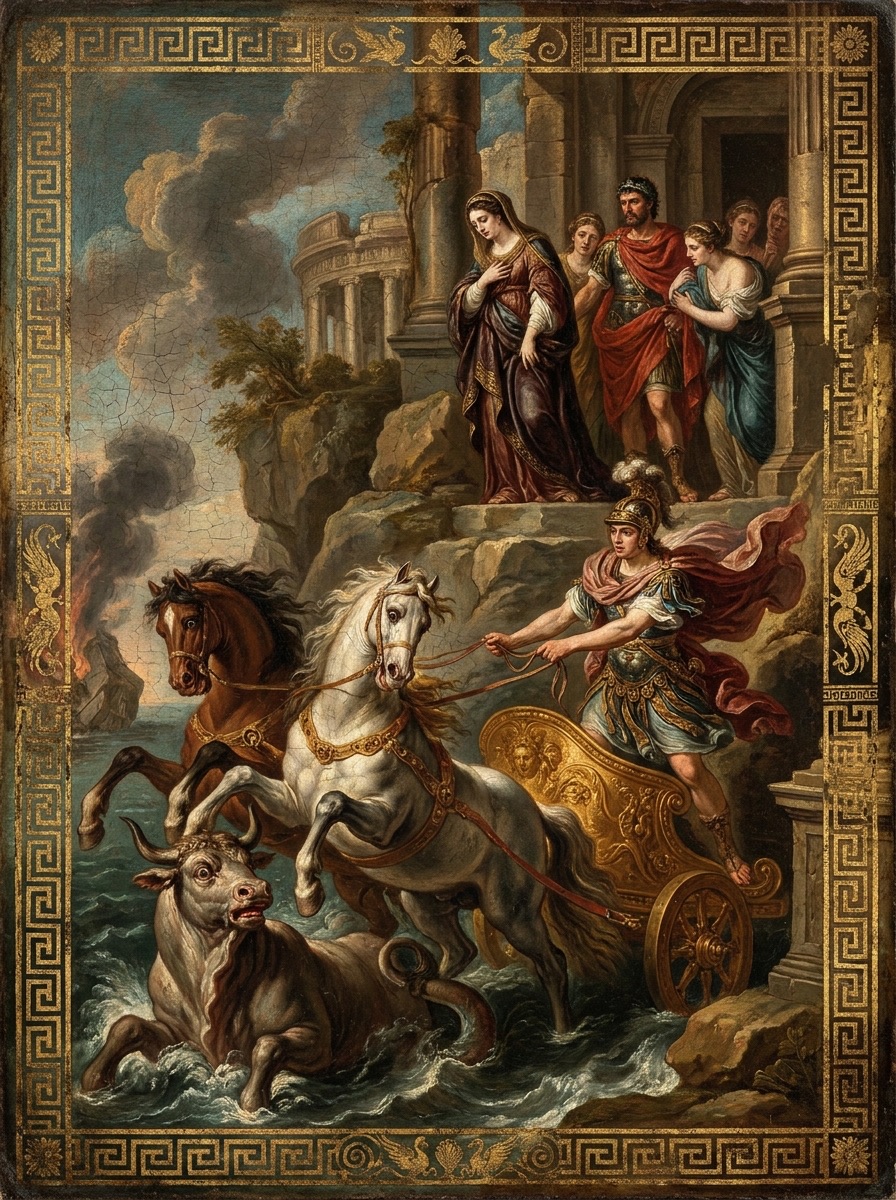
A wave rose high, as if something had pushed up from below. Foam split open, and a terrifying bull burst from the sea. It was no ordinary beast. It was streaked with seawater and a strange gleam, and its bellow, mixed with the roar of the surf, sent the horses rearing in terror.
The animals had never seen such a creature. They screamed and swerved violently from the road. Hippolytus strained at the reins until his hands burned, but the horses were beyond control. The chariot struck stones, lurched, and was dragged onward in ruin. The reins twisted around his body, shattered timbers beat against him, and the wheels bounced over the hard ground again and again.
When the servants caught up, they saw only dust, broken shafts, and Hippolytus battered almost beyond recognition.
He was not yet dead, but he was grievously wounded. The body that had once run after wild beasts could no longer stand. They carried him back, and the news reached Theseus.
Then Artemis appeared.
At last the goddess broke her silence. She told Theseus that Hippolytus was innocent, and that Phaedra had not been born to this wicked desire of her own will, but had been undone by Aphrodite. The nurse had revealed the secret; Phaedra, crushed by shame, had killed herself and left a false accusation; and so, step by step, the whole disaster had come to this end.
Theseus listened as though icy water had been poured over him.
At last he understood that his rage and his curse had killed an innocent son. He hurried to Hippolytus, took him in his arms, and begged him to forgive him. Hippolytus had little strength left, yet he did not answer with hatred. He heard the goddess speak for him, and heard his father’s grief, and before he died he forgave Theseus.
Artemis promised that his name would not vanish so easily. Later people would remember the young man who honored her, and in the region of Troezen they would keep his memory. Before marriage, girls would cut off a lock of hair and dedicate it to Hippolytus, as though bidding farewell to the young man who died through innocence and mistake.
After Hippolytus’s death, the palace was left with nothing but truth that had come too late.
Phaedra’s secret had gone cold with her body, and Theseus’s curse could not be recalled. The tracks of the chariot by the shore would one day be covered over by sand and wind, but the lament of that house would remain in the story for a very long time.