Greek Mythology
Perseus and Medusa — Greek Mythology
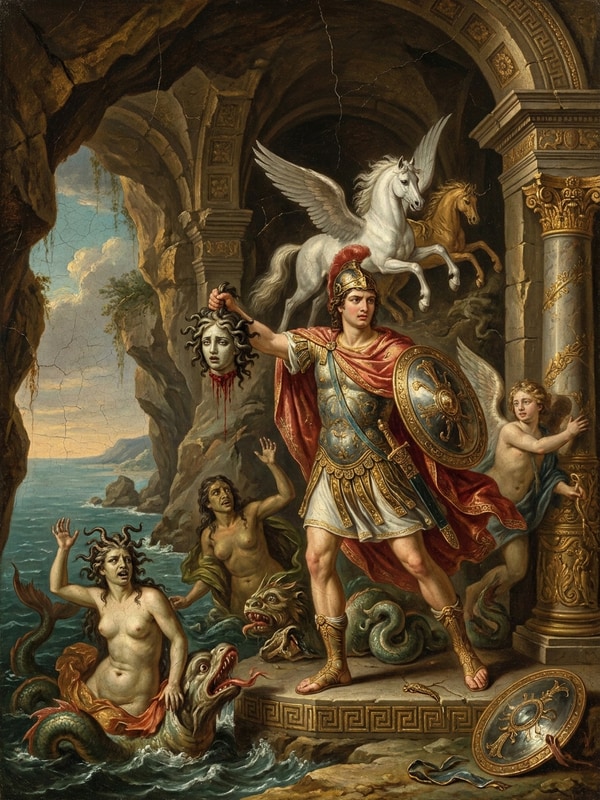
To protect his mother, Perseus is forced to promise that he will bring back the head of Medusa the Gorgon. Aided by the gods, he finds the Graeae and the nymphs, receives the helm of invisibility and winged sandals, cuts off Medusa’s head, and uses it to punish the king who has tried to force his mother into marriage.
Article
Summary
Acrisius, king of Argos, feared the oracle that his grandson would one day kill him. He shut Danaë and the newborn Perseus inside a wooden chest and cast them into the sea, but the chest drifted safely to Seriphos, where the fisherman Dictys rescued them. Perseus grew up on the island, while King Polydectes set his desire on Danaë and began looking for a way to remove the son who protected her. Polydectes laid his trap at a feast, drawing Perseus into a proud promise that he would bring back the head of Medusa the Gorgon. Medusa's gaze turned living creatures to stone, and the errand was meant to be impossible. Perseus knew he had been caught, but withdrawing would leave his mother exposed. Hermes armed him with a curved sword, Athena gave him a mirror-bright shield, and the gods sent him first to the Graeae, who knew the road onward. Perseus seized the single eye shared by the Graeae and forced them to reveal the way to the nymphs. From the nymphs he received winged sandals, a magical pouch, and the helm of invisibility. With these gifts he flew to the desolate land of the Gorgons, looked only at Medusa's reflection in Athena's shield, and, guided by the goddess, cut off her head while she slept. From Medusa's blood sprang Pegasus and Chrysaor, and her deathless sisters woke and gave chase, unable to see the invisible hero. Carrying the head, which still held its petrifying power, Perseus returned to Seriphos and found Danaë and Dictys hiding in a temple from Polydectes. In the palace he opened the pouch and showed Medusa's face to the king and his accomplices, turning them into stone. He then placed Seriphos under the rule of the good Dictys, returned the divine gifts, and gave Medusa's head to Athena, who fixed it on her shield as a lasting sign of Gorgon power.
The Chest on the Sea
Acrisius, king of Argos, once heard a dreadful oracle: his daughter Danaë would bear a son, and when that boy grew to manhood, he would kill his grandfather.
From that day on the king had no peace. He did not dare kill his daughter, yet he would not leave her free. So he shut Danaë in a chamber walled with bronze, thinking he could bar the door against fate. But Zeus came to her in a shower of gold, falling through the cracks of the roof into the hidden room. In time Danaë gave birth to a boy and named him Perseus.
When Acrisius saw the child, he felt no joy, only fear. He ordered a wooden chest to be made, placed Danaë and the baby inside it, nailed down the lid, and had it pushed out to sea. Waves struck the boards; now the chest was lifted to the crest of the water, now it sank into the trough below. Danaë held her swaddled son close in the darkness, listening to the sea beat against the wood, and could only pray to Zeus.
The chest did not sink. For many days it drifted with wind and wave, until at last it came near the shore of Seriphos. On that island lived a fisherman named Dictys, who was hauling in his nets by the sea that day. He saw a dark shape on the water, dragged the chest ashore, and pried open the lid. Inside sat a pale-faced woman, holding a child in her arms.
Dictys took mother and son into his house and gave them food and shelter. Perseus grew up on Seriphos. He learned to fish, to throw the spear, and to run; he also learned to master his anger in his mother’s presence, for Polydectes, the king of the island, often let his eyes linger on Danaë.
The King’s Feast
Polydectes was Dictys’ brother, and he ruled Seriphos. He wanted to marry Danaë, but Danaë refused him. Perseus had grown into a strong young man, and when he stood beside his mother, the king did not dare lay hands on her openly.
So Polydectes devised a scheme. He announced that he meant to court another woman and would need many gifts, and he summoned the men of the island to a feast. At the banquet, one man promised horses, another golden cups, another cattle and sheep. Perseus, young and proud, would not appear poor-spirited before them. He spoke out loudly: “If you need it, I could even bring you the head of Medusa the Gorgon.”
Those words were exactly what the king had been waiting for. Polydectes seized on them at once and demanded that Perseus make good his promise. Medusa was no ordinary enemy. She lived in a far-off place and was one of the three Gorgon sisters. The other two could not die; only Medusa was mortal. But her hair was made of venomous snakes, and anyone who looked directly into her eyes was turned to stone.
Perseus understood that he had been trapped. Yet the words had been spoken, and to shrink back now would leave his mother in even greater danger. He gathered a few simple provisions, left Seriphos, and set out in search of Medusa.
The One Eye of the Graeae
The road was long, and Perseus did not know where the Gorgons lived. As he wandered, Hermes and Athena came to his side. Hermes gave him a sharp, sickle-shaped sword, keen enough to cut through a monster’s neck. Athena gave him a shield polished bright as a mirror, warning him not to look straight at Medusa, but to seek her only in the shield’s reflection.
Yet before he could reach the Gorgons, he had to find those who knew the way. The gods directed Perseus to the Graeae. They were three ancient sisters, gray-haired from birth, dwelling in a dim and lonely place. Between them they shared a single eye and a single tooth, passing them from hand to hand. One would look, then give the eye to another; one would bite, then surrender the tooth in turn.
Perseus hid nearby and waited for the instant when the eye was being passed between them. Then he sprang forward and snatched it away. At once the three old women were plunged into darkness. They stretched their hands through the air, groping wildly, shrieking for him to give it back.
Holding the eye in his hand, Perseus said, “Tell me the road to the nymphs. If you do not, this eye will never return to you.”
Angry and afraid, the Graeae had no choice but to reveal the path. Perseus kept his word, returned the eye, and went on his way.
The Gifts of the Nymphs
When he found the nymphs, the sky was clear and soft grass grew beside the water. They knew he was under the protection of the gods, and they gave him three marvelous gifts.
The first was a pair of winged sandals, which would lift him from the ground and carry him through the air. The second was a magical pouch, small to the eye, yet able to hold a dreadful burden. The third was the helm of Hades, which made its wearer invisible.
Perseus fastened on the winged sandals, slung the pouch over his shoulder, and set the helm upon his head. He touched the sword at his side, raised Athena’s shield, and flew toward the edge of the world.
The farther he went, the colder the air became, and the more desolate the land below. Along the way he saw men and beasts standing rigid as stone. Some still seemed to be fleeing; some stretched out their hands as if begging for help. Perseus knew they were all creatures who had seen the Gorgons and been fixed forever where they stood.
Medusa Asleep
At last he came to the place where the Gorgon sisters lived. It was silent as a dead shore. The rocks were black, and a cold wind blew from the cave mouth. The three Gorgons were sleeping. Their bodies were covered in terrible scales, their hands were hard as bronze, and their teeth were sharp. Medusa lay between her two deathless sisters, her snake-hair coiled about her face, the little serpents still stirring faintly in their sleep.
Perseus did not dare look at her. He raised the shield before his chest and watched only the blurred, bright image reflected in its surface. Athena guided his hand as he moved closer, step by step.
He heard his own breathing, and the faint hiss of the snakes in Medusa’s hair. He found the line of her neck and brought the sword down with all his strength. The blade flashed, and Medusa’s head fell. At once Perseus turned his eyes away, slipped the head into the magical pouch, and tied it tight.
As Medusa’s blood flowed onto the ground, a strange thing happened: Pegasus and the warrior Chrysaor sprang from her body. Pegasus spread his wings and shot upward into the sky like a streak of white light.
The other two Gorgons woke with a terrible cry and flew after the killer. But they could not see Perseus beneath the helm of invisibility; they could only beat through the air in confusion. Perseus rose high on his winged sandals and carried the pouch away from that dark shore.
The King Turned to Stone
Perseus returned to Seriphos with Medusa’s head. All along the way he took care that the pouch did not loosen, for even severed from her body, the head still held its dreadful power.
When he reached the island, his mother Danaë and Dictys were hiding in a temple. Polydectes had cast off his gentle mask. He was forcing Danaë to marry him and mocking Perseus, saying the young man would never come back alive.
Perseus went into the palace. Polydectes was seated among his companions. When he saw Perseus enter, surprise crossed his face; then he began to sneer. He did not believe the young man had truly brought back Medusa’s head.
“The gift you asked for,” said Perseus, “I have brought.”
He first told anyone willing to trust him to turn away. Then he opened the magical pouch and lifted out Medusa’s head. Polydectes and the men who had helped him in his cruelty looked straight into those eyes. Their smiles were still on their faces when their bodies stiffened, the color drained from their skin, and they became cold stone statues.
The palace fell silent. Danaë was free at last from the king’s threats, and Dictys no longer had to hide. Perseus gave Seriphos into the keeping of good Dictys. Then he returned the winged sandals, the pouch, and the helm of invisibility to the nymphs, and gave the sword back to Hermes. As for Medusa’s head, he offered it to Athena. The goddess set it upon her shield, and from then on that shield carried a power that made enemies tremble; whoever saw it remembered the eyes of the Gorgon and the perilous journey of Perseus.