Greek Mythology
Perseus and Andromeda — Greek Mythology
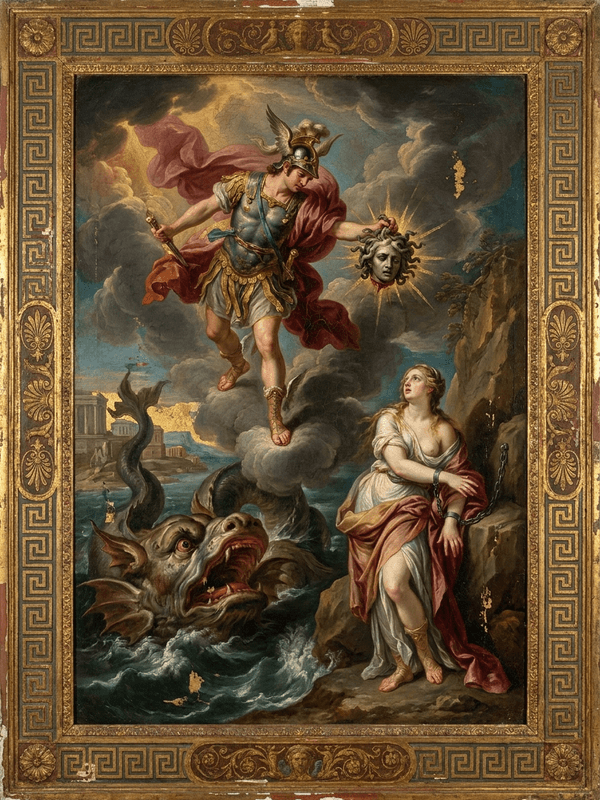
On his way back from the Gorgons with Medusa’s head, Perseus passed above the coast of Ethiopia and saw Princess Andromeda offered to a sea monster because of Queen Cassiopeia’s boast. He won Cepheus’ promise of marriage, killed the monster, freed Andromeda from her chains, and then used the Gorgon’s head at the wedding feast to defeat Phineus and the men who tried to claim her.
Article
Summary
Perseus left the dwelling place of the Gorgons with Medusa’s head hidden in his divine pouch. Winged sandals carried him through the air, the curved blade was in his hand, and he flew back toward the world of men over the open sea. When he passed above Ethiopia, he saw a girl chained to a rock beside the shore, the waves washing over her feet while no one dared come near to save her. The girl was Andromeda, daughter of King Cepheus and Queen Cassiopeia. Cassiopeia had boasted that she—or in another telling, her daughter—was more beautiful than the Nereids, the maidens of the sea. The insult had angered the sea powers. A monster rose from the water and ravaged the land, and an oracle declared that only Andromeda’s sacrifice would end the disaster. Perseus asked Cepheus to promise that, if he saved the princess, she would become his wife. The king swore it at once. As the sea monster surged toward the rock, Perseus rose into the air, attacked from above, and struck again and again until the beast sank bleeding into the waves. Then he freed Andromeda from her chains. A wedding feast was prepared in the palace, but Phineus, Andromeda’s former suitor, burst in with armed men and claimed the bride for himself. Perseus fought back until he was hard-pressed, then warned his friends to turn their faces away. He drew Medusa’s head from the pouch, and Phineus and his followers became stone where they stood. Andromeda left Ethiopia as Perseus’ wife, while the stone figures in the hall remained as a grim memory of the fight.
The Man Who Flew Above the Shore
When Perseus left the far, desolate land where the Gorgons lived, Medusa’s head lay hidden inside the divine pouch. Even severed from her body, that head still held its dreadful power: whoever looked into its eyes would become lifeless stone.
He did not dare loosen the mouth of the pouch. He kept it bound tight and slung over his shoulder. The winged sandals bore him over the sea; the wind tore past his ears, and below him the white waves opened and folded back in long ridges. One hand steadied the pouch, the other gripped the curved blade given to him by Hermes, and the bronze shield at his side flashed with the light of the sky.
He meant to return to Seriphos and bring Medusa’s head to King Polydectes. But as he flew near the coast of Ethiopia, he saw a crowd gathered by the sea. The people stood at a distance. Some lifted their hands and cried aloud; others bowed their heads and beat their breasts. Yet not one of them dared approach the rock at the water’s edge.
Perseus slowed and looked down.
On a black rock lashed by spray, a young woman was chained. Iron fastened her outstretched arms into cracks in the stone. The sea washed up around her feet, then drew back, then came again. She did not flee; she could not flee. She could only lift her face toward the pale gray sky. The wind blew her long hair across her cheeks and shoulders. There were tears in her eyes, but she did not cry out for pity.
Perseus had seen many terrible things, yet this sight made him halt.
He came down beside the shore and asked the weeping people, “Who is this woman? Why is she chained here?”
The people saw that he was a stranger and at first were afraid to answer. At last an old man pointed toward the rock and said through his sobs, “She is our princess, Andromeda, daughter of King Cepheus and Queen Cassiopeia. The sea monster is coming. She has been given to it.”
The Queen’s Boast
Perseus asked again, “Why should an innocent girl be given to a monster?”
King Cepheus and Queen Cassiopeia were on the shore as well. The king wore a dark robe, and his face looked like wood dried by the sea wind. The queen stood beside him with swollen eyes, no longer able to look toward her daughter.
It had all begun with a boast.
Cassiopeia had once bragged before others that she was more beautiful than the maidens of the sea. In another tradition, she boasted that her daughter Andromeda surpassed the Nereids in beauty. The sea nymphs heard it and were deeply insulted, so they carried their grievance to the sea god. After that, the waters no longer lay calm. The waves rose higher than before, ships were overturned, fish fled the coast, and disaster came upon fields and walls alike.
Then a sea monster began to surface from below. It had an enormous body, seaweed hanging from its back, and when it opened its mouth it was like a cave splitting wide. It surged onto the shore, devoured cattle, wrecked villages, and left the people afraid to go near the sea by day. At night they could hear it rolling in the waves.
Cepheus sent messengers to ask an oracle what should be done. The answer they brought back was merciless: only if Andromeda were offered to the sea monster would the land be freed from its ruin.
The king did not wish it. The queen wished it even less. But the monster pressed closer day after day, families lost their dead, and cries filled the city. In the end, the people crowded before the palace and begged the king to save them all. Cepheus, as though his back had been broken beneath the weight, gave the order that Andromeda be taken to the sea.
When the iron closed around her wrists, the queen nearly fainted. Andromeda did not resist. She knew she had not caused this suffering, yet she had seen women in the city weeping over their children and old men kneeling before the altars to beg for life. So she was led to the rock and left there to wait for the thing that would come out of the sea.
When Perseus had heard the tale, he turned and looked again toward the girl on the rock.
Andromeda saw him too. She did not know who this young man was who had descended from the sky. She only saw that he carried a blade, that no dust clung to his feet, and that he looked as if he had just returned from some other danger. Softly she said, “Stranger, do not come too close. When the monster comes, it will swallow you as well.”
Perseus answered, “If I were merely passing by, I should not have asked. But since I have seen you chained here, I cannot pretend I have not seen.”
The Promise on the Rock
Far out at sea, the water suddenly changed.
First a black line moved across the surface. Then the waves were driven apart from below. The people on the shore began to stir in terror, and someone cried, “It is coming! It is coming!”
King Cepheus stumbled toward Perseus as though clutching at the last shred of hope. “If the gods truly help you,” he asked, “can you save her?”
Perseus did not draw his sword at once. He looked at the king, then at Andromeda on the rock, and said, “I will fight this monster. But if I save the princess, you must give her to me in marriage and let me take her as my wife.”
These words were not spoken in a quiet palace, but with the monster bearing down and the roar of the sea in every ear. The king did not hesitate. He raised both hands and swore by heaven and sea: “If you save my daughter, she shall be your wife. I will give you the honor and gifts that are due.”
The queen nodded through her tears. In that moment she wanted only her daughter’s life; nothing else mattered.
Perseus rose into the air. The winged sandals lifted him upward, and sunlight flashed on his bronze shield. The monster drew nearer and nearer to the shore. Its huge head emerged from the water, and foam poured down over its scales. It had caught the scent of living flesh and rushed toward Andromeda on the rock.
Andromeda closed her eyes. The chains made a small sound against her wrists.
Perseus plunged from the sky.
The Blood of the Sea Monster
The monster first saw the girl upon the rock, and then saw another shadow cross the water. It lifted its head and tried to seize Perseus as he flew toward it. But Perseus turned sharply aside, escaping the gaping mouth crowded with teeth, and his curved blade flashed across the creature’s neck. Dark red blood poured out at once and fell into the sea.
Maddened by pain, the monster thrashed in the water, its tail striking up great waves. The surf crashed over the rock and almost reached Andromeda’s knees. The people on the shore screamed and fell back. Only King Cepheus remained where he was, clutching his robe in both hands.
Perseus climbed again. He knew he must not let the monster drag him into the sea, so he used the winged sandals to circle above it, drawing its head upward, then striking from the side. The creature’s scales were hard; more than once his blade scraped across them with a bright flash like sparks. So Perseus looked for places not guarded by armor and drove his weapon near the eye, beneath the throat, and into the belly.
The monster grew more furious. It opened its mouth and spewed a foul mist of seawater, trying to sweep Perseus, blade and all, into the waves. Perseus held his shield before him, let the wind carry him back, then dropped behind the creature and thrust the curved blade deep into the place where shoulder and neck met.
That blow drove the monster under. The sea heaved, then sank, as though a mountain were turning beneath the water. Perseus did not relax. He followed it downward. When the beast’s head surfaced again, he seized his chance and stabbed into its soft throat.
The monster struggled for a long time, but at last it stopped driving forward. A great stain of blood spread across the water, and the waves pushed its vast body toward the shallows. At first the people on shore did not dare make a sound. Only when they saw that the monster was truly dead did they break into cries. Some knelt on the sand and thanked the gods; others ran toward the rock to free the princess.
Perseus reached the rock first. He put away his blade and opened the locks on Andromeda’s wrists with his own hands. When the chains fell loose, her arms were pale from the long binding. Perseus steadied her and helped her down from the slick stone.
Andromeda looked toward the monster’s body in the sea, then back at the young man before her, and said softly, “You saved me.”
Perseus answered, “You are free now.”
The Wedding Feast in the Palace
Cepheus and Cassiopeia came forward to meet them. The king embraced his daughter, and the queen wept too hard to speak. The people stood at a distance, unwilling to crowd too close around Perseus, for they had seen this stranger descend from the sky and kill the monster against which they had been helpless.
According to the oath he had sworn, Cepheus gave Andromeda to Perseus in marriage. A wedding feast was soon prepared in the palace. The people washed away the salt and blood of the shore, lit torches in the hall, spread the couches, and brought out wine and food. When the music began, the city at last felt the disaster that had hung above it begin to lift.
Andromeda changed out of the garments soaked by the sea and put on a bride’s veil. She was still pale, but her eyes no longer held the terror of one waiting to die on the rock. Perseus sat beside her. The divine pouch lay at his feet, its mouth still tied fast.
But the feast did not end in peace.
From the entrance to the hall came the sudden clash of weapons. A man burst in with a band of armed followers. His name was Phineus. He had once been Andromeda’s suitor, and in some tellings he was the brother of Cepheus. He had been promised Andromeda before, yet when the sea monster came, he had not rescued her from the rock. Now that Perseus had slain the monster and the wedding was under way, he arrived to claim the bride.
Phineus stood in the torchlight with a spear in his hand and shouted, “Cepheus, you have given to a stranger the woman who was mine! Perseus, you have only taken another man’s marriage in the confusion.”
Perseus rose and answered, “When the sea monster came, she was chained to the rock. Where were you then? I did not take her from your hands. I saved her from death.”
Phineus would not listen. He lifted his spear and hurled it at Perseus. The spear flew over the feast and drove into the couch behind him. The hall erupted into chaos. Guests overturned tables, wine spilled across the floor, and women cried out as they fled behind the pillars.
Perseus drew his blade and met the attack.
Men Silent as Stone
Phineus had brought many men, while Perseus had few allies near him. Cepheus was old and could not fight for long; the servants and guests in the palace had been thrown into panic by the sudden violence. At first Perseus held them off with strength and swiftness. He leapt over fallen tables, dodged thrusting spears, and cut through enemy shafts with his curved blade.
But the attackers pressed closer.
Some rushed him from the side; others raised shields to block his path. Perseus retreated to a pillar and heard Andromeda calling his name behind him. He knew that if the fight continued this way, even if he carved a path for himself, more innocent people in the palace would die.
So he cried out in warning, “All who are my friends, turn your faces away!”
Some heard and at once closed their eyes or lowered their heads. Others, lost in the tumult, did not understand. Phineus sneered, thinking Perseus had been driven to despair.
Perseus reached down and untied the divine pouch.
As its mouth loosened, a chilling breath seemed to escape from within. He grasped Medusa by her snaky hair and lifted the severed head. That face still wore the terror of its last moment; its eyes were open, as though they could pierce flesh and blood.
The first warrior rushing forward saw it, and his feet stopped where they stood. His mouth was still open, his sword still raised in the air, but the color of human skin had already left him, replaced by the gray surface of stone. Another man was turning to shout to his companions, but before the cry left his throat, tongue and voice hardened with the rest of him. In moments, one stone figure after another filled the hall: some frozen in the act of thrusting spears, some still running, some with anger and fear fixed forever on their faces.
Only then did Phineus grow afraid. He dropped his weapon, turned his face from the head, and stretched out both hands in supplication. “Do not make me look at it! Perseus, spare me!”
Perseus said, “You came armed to seize a woman who had barely escaped death, and you tried to kill the man who saved her. Your plea comes too late.”
He turned Medusa’s head toward Phineus. Phineus tried to hide his face, but the Gorgon’s eyes had already found him. His knees stiffened first; his hands remained lifted in the posture of a beggar. Then his whole body passed from flesh and blood into cold stone. At last the banquet hall fell quiet, with only the sound of the torches burning and the low, frightened sobbing of the living.
Perseus placed Medusa’s head back into the divine pouch and tied it shut.
The Bride Freed from Her Chains
The wedding feast had been broken by bloodshed and stone, but Cepheus’ oath was not undone. Andromeda no longer belonged to Phineus, nor to the rock beside the sea. She had been rescued from the edge of death and became the wife of Perseus.
Later, Perseus left Ethiopia with Andromeda. The people of that coast would remember how, on one day, a sea monster came out of the waves to devour their princess; and how, on that same day, a young hero wearing winged sandals descended from the sky, slew the monster, and unlocked the chains on the rock.
And in the palace of Cepheus, Phineus and his companions still stood like stone. Their arms, their weapons, and their terrified faces remained fixed at the instant of the struggle, reminding those who came after that Andromeda had once been offered to the sea, but the sea had not taken her.