Greek Mythology
Penthesilea at Troy — Greek Mythology
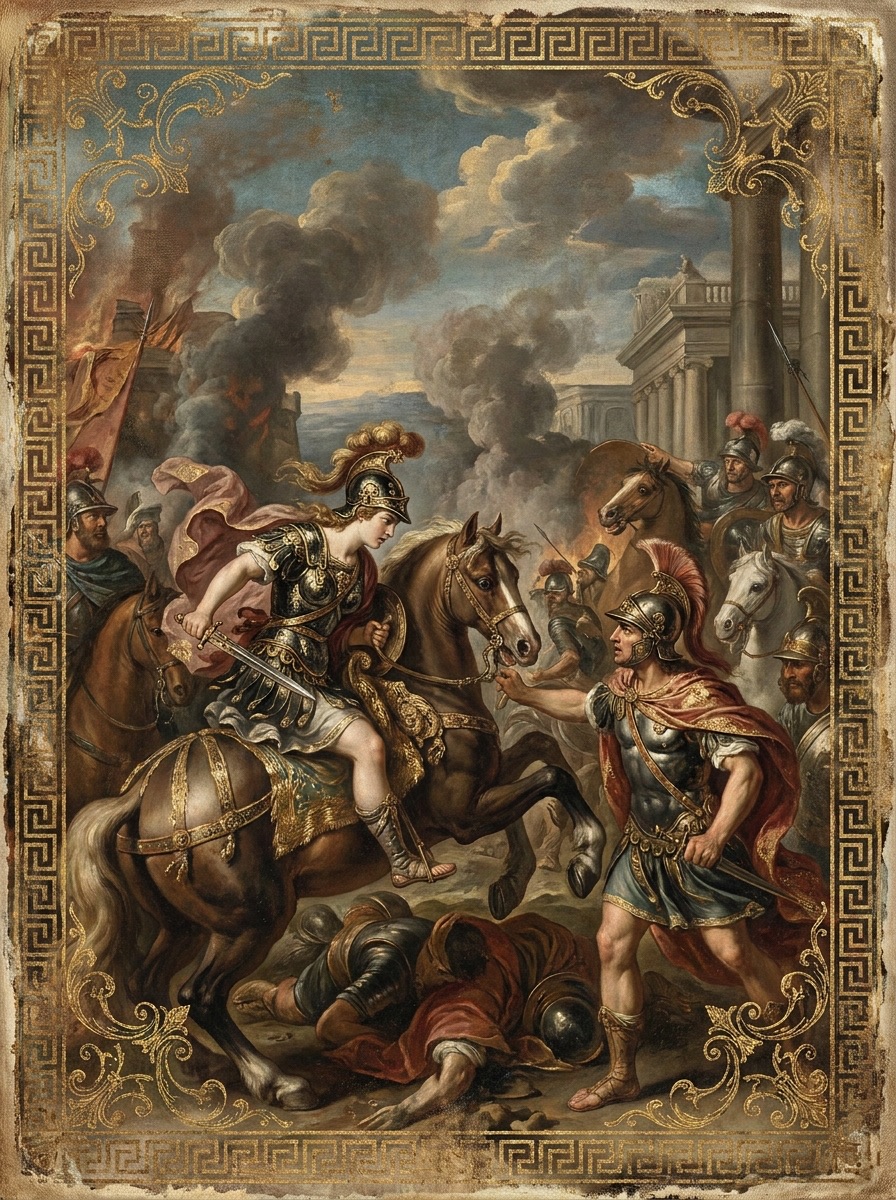
After Hector’s death, Troy has nearly lost heart, until Penthesilea, queen of the Amazons, arrives with her women warriors to aid the city. She scatters the Greeks across the battlefield, but at last she meets Achilles and falls beneath his spear, leaving Troy with a brief and sorrowful hope.
Article
Summary
After Hector’s death, Troy nearly lost the last of its courage. While the city was still heavy with mourning and fear, Penthesilea, queen of the Amazons, arrived with her mounted women warriors and asked Priam to receive her so she might fight for the besieged city. She carried both a hunger for glory and the burden of an old guilt she hoped to cleanse in battle. At daybreak, Penthesilea led the Amazons out through the gates. Their horses and spears broke into the Greek line and stirred the Trojans back to courage. As Penthesilea cut through the plain and drove the Greeks toward the ships, those watching from the walls briefly believed that fate itself might be turning. Achilles heard the clamor and armed himself again. Seeing the queen riding through the dust, he came out from the camp to meet her. The armies gave them space, and Penthesilea fought with speed and force, pressing Achilles more than once, but in the end his spear pierced her armor and she fell at his feet. When her helmet came away, Achilles saw the young and valiant face of the woman he had killed, and pity rose in him too late. Thersites mocked that pity and insulted the dead queen with cruel words. Achilles, already raw with grief and anger, struck him down with a single blow, leaving unease and division among the Greeks as well. Later the Greeks returned Penthesilea’s body to the Trojans. Priam and the Amazon warriors mourned her, and the city held funeral rites for the queen who had brought it a brief hope. She had entered Troy like a bright, sudden wind, but she was extinguished beneath Achilles’ spear, leaving only deeper grief and the sense that the war could no longer be turned aside.
Lamentation Behind the Gates
After Hector’s death, Troy seemed to have lost its backbone.
Once, whenever that prince put on his armor and passed out through the gates, the old men, women, and children on the walls still had something to trust in. Now his body had been brought back into the city, the smoke of his funeral pyre had thinned and vanished, and outside the walls the Greek camp still stood rank upon rank beside the sea, its masts like a dead forest. From the high battlements the Trojans looked down and saw Achilles’ shelter and the shields of the Greeks flashing in the sun.
Priam was old. He sat in his palace among daughters and daughters-in-law whose eyes were red with weeping. Andromache held her little child and often could not speak at all. Whenever Hecuba heard the beat of hooves beyond the walls, it was as if she saw Hector once more being dragged through the dust.
There were still warriors in the city, but at the thought of Achilles their hands tightened helplessly around their spear shafts. If Hector could not withstand him, what could any other man do?
Just when the Trojans were deepest in despair, dust rose along the distant road.
At first the sentries thought the enemy was on the move again and hurried to send word. But as the dust came nearer, they saw that it was not a Greek army approaching, but a company of women on horseback. They wore armor, carried bows on their backs, and held long spears in their hands, while their horses’ manes streamed in the wind. At their head rode a tall woman, young-faced and resolute beneath her helmet. Her shield was polished bright, a short sword hung at her side, and she seemed like a flame that had ridden in from the cold northern wind.
She was Penthesilea, queen of the Amazons.
The Amazon Queen Comes to Troy
Penthesilea had not come for the sake of wandering. She carried a heavy matter in her heart.
Some traditions say that she had once, by mischance, killed one of her own kin while hunting. Blood had been spilled, and remorse could not call the dead back again. She left her homeland and came with her women warriors to war-torn Troy, hoping to cleanse her guilt amid danger and to win renown through victory.
When Priam heard that the Amazons had arrived, he came himself to welcome her into the city. At the sight of the young queen, a little hope kindled again in the old man’s heart. He set food before her, offered wine, and ordered gifts to be brought. The women of Troy, too, gathered around the palace gates to look at them. These were not women accustomed only to weaving and drawing water. Their hands knew reins and spear shafts, and their eyes did not turn away.
Penthesilea told Priam that she would go out to battle the next day. She would not hide behind the walls, nor would she allow the Trojans to send off their dead with nothing but tears. She would drive the Greeks back to their ships and make Achilles know that Troy had not yet fallen.
The old king listened with gratitude and fear. He had lost too many sons already and did not wish to see more young lives cut down beyond the walls. But Penthesilea did not draw back. She seemed like one who had already set life and death behind her and was only waiting for dawn.
That night in Troy, some men polished their shields again, and others gave fresh fodder to the horses. On the walls the guards spoke in low voices, saying that perhaps the Amazon queen truly could hold back the Greeks. The crying did not cease altogether, but among the sounds of grief there came once more the ring of weapons being made ready.
Hooves at Daybreak
The next morning, as the sun had only just risen from the sea, the gates opened.
Penthesilea rode at the front. Beside her the Amazon warriors formed a line, their bronze armor catching the morning light, their spears like a moving bed of reeds. The Trojans followed after them, stirred by that courage, and rushed shouting onto the plain.
The Greeks had thought the Trojans would remain shut inside the city. When they suddenly saw the gates flung open and a band of women warriors charging on horseback, confusion broke out before the camp. Some seized their shields, some searched for helmets, and some had not yet managed to harness their horses. Penthesilea gave them no time to form ranks. She bent her bow and shot down the men who came first against her, then lifted her spear and struck at another Greek warrior. Her horse’s hooves beat through the dust, and her cloak streamed behind her.
The Amazons charged with her into the enemy line. They had not come merely to cheer others on; they killed on the battlefield as fiercely as men. One split the rim of a shield with an axe. Another used a spear to cast a fighter down from his horse. Another pressed close and drove a short sword beneath an enemy’s shield. The Greeks were forced back, and many who had never seen such warriors on the plain of Troy did not know, for a moment, whether to marvel or to defend themselves.
When the Trojans behind them saw the Greek line loosen, their courage returned. They shouted loudly and hurled spears at the enemy. On the walls, women craned their necks to see the plain, and old men leaned against the stonework, hardly able to believe what lay before their eyes.
Penthesilea fought more fiercely with every moment. Her horse swept past a chariot; she struck the warrior in it with her spear, then turned and warded off a flying weapon. Her shield rang beneath blows, and dust clung to her helmet, but she did not slow. It was as though she meant to press all her remorse, shame, and longing for death into this one furious charge.
The Greeks began to fall back toward the ships.
If Achilles had not been there that day, perhaps the Trojans would have driven victory all the way down to the shore. But Achilles was still in the camp.
Achilles Arms Himself
Achilles heard the clamor of battle and came out from his shelter. He saw the Greeks retreating. He saw, amid the dust, a woman warrior riding back and forth through the fight. Her spear fell again and again, and the Trojans around her pushed forward in her wake.
Patroclus was already dead, and Hector had already fallen beneath Achilles’ hand. Achilles had become like a fire after burning, still fierce, yet filled with cold ash. Now, seeing the Greeks driven back, anger rose in his chest again.
He put on his armor, lifted his shield, and took hold of that heavy spear. When the Greeks saw him come forward, it was as though a storm were bearing down from the sea, and they parted to make way for him. Even those who had been retreating halted, turned, and raised their shields again.
Penthesilea saw him too.
There are people on a battlefield whom one can recognize even through dust. Achilles’ armor shone, his stride was swift, and the men near him seemed pushed aside by the force of his presence. Penthesilea did not flee. She reined in her horse, turned toward him, and lifted her spear. She had come to Troy intending to face the most dangerous man of all. Now he had arrived.
The warriors on both sides gradually fell back, as if making an open space for them.
Penthesilea charged first. Her horse sprang forward, and the point of her spear drove straight toward Achilles. Achilles raised his shield and caught the blow; the bronze spear scraped across its face with a shrill sound. He stepped aside and cast his own spear back at her. Penthesilea bent low to avoid it, and the weapon flew over her shoulder and buried itself in the earth behind her.
She drew her short sword and urged her horse closer. Achilles drew his sword as well. Their weapons met in the air with a clear ringing, like hammers in a smithy. Penthesilea was not weak, and she moved swiftly; more than once she forced Achilles half a step backward. The Trojans cried out for her from afar, and the Amazon warriors shouted encouragement to their queen.
But Achilles was still Achilles.
He saw an opening and strode forward hard. Penthesilea was raising her sword again when his spear thrust in past the rim of her shield and pierced her armor. The queen’s body shuddered, and the weapon in her hand dropped. Her horse reared in terror, but Achilles caught the reins so that she did not at once fall into the dust.
Penthesilea slipped down from the horse. She lay at Achilles’ feet. Her helmet rolled aside, her hair came loose, and the spirit of battle had not yet wholly left her face.
Beauty Fallen in the Dust
Achilles looked down at her.
During the fight, he had seen only a strong enemy. Now that her helmet had fallen, he saw the face of the Amazon queen clearly. She was very young. The heat of battle still lingered in her features, but her brow had grown quiet. Death had come too quickly, like a gust of wind snuffing out a torch.
Achilles’ anger suddenly stopped.
He had killed many people and seen many fall. Yet in that moment a belated pity rose in him. This woman might have ruled her own people in a far-off land, but she had come beneath the walls of Troy and given her life to a war that had already swallowed countless lives. Looking at her, he seemed only then to understand that the one he had just killed was not merely an enemy, but someone who had carried courage and pain with her onto the battlefield.
The Greeks gathered around. Some praised her bravery; others stood in silence. From far away the Trojans saw Penthesilea fall, and the hope that had just been kindled in them sank again. The Amazon warriors tried to rush forward and recover their queen’s body, but the Greeks held them off, and they could only retreat through the confusion, crying out as they went.
Then a Greek named Thersites pushed his way forward. He had always had a venomous tongue and liked to mock others where they were most wounded. Seeing Achilles standing beside the dead queen, he spoke cruelly, jeering at him for pitying an enemy, and with a coarse act he insulted the dead.
Achilles’ face changed.
He was already filled with grief and anger over Patroclus’ death, and now, in Penthesilea, he had glimpsed a radiance he could not bear to see mocked. Thersites’ jeer struck like a pebble against a fresh wound. Achilles turned and hit him with one blow. Thersites fell to the ground and did not rise again.
The Greeks fell silent at once. Some feared Achilles; others were secretly displeased. Diomedes in particular was angered, for Thersites was kin to him. But no one could call Penthesilea back from death, and no one could make that day’s blood flow back into living bodies.
A Brief Hope Goes Out
Later, the Greeks returned Penthesilea’s body to the Trojans. The Trojans received her back into the city, not with the cheers they had given when she came as an ally, but with low mourning.
Priam looked upon the young queen and was deeply grieved. She had stood in his palace and said she would fight for Troy. She had made the people of the city believe, for a little while, that fate might yet turn. Now she lay still, with battlefield dust still clinging to her armor. The Amazon warriors gathered around her, cut their hair, and bowed to the ground in grief for their queen.
The Trojans held funeral rites for her. The pyre rose, and smoke drifted toward the sky. Outside the walls, the Greek camp still stood beside the sea; inside the walls, another sorrow after Hector settled on every heart.
Penthesilea did not remain long at Troy. She was like a bright and sudden wind that blew into a besieged city and made its people lift their heads for a moment, thinking victory might still be possible. But when the wind had passed, the plain held only dust churned by horses’ hooves, broken spears, and the name of a queen.
From then on, the Trojans knew that after Hector’s death, even the bravest help to come beneath their walls might not be enough to change the course of the war.