Greek Mythology
Penelope and the Stranger — Greek Mythology
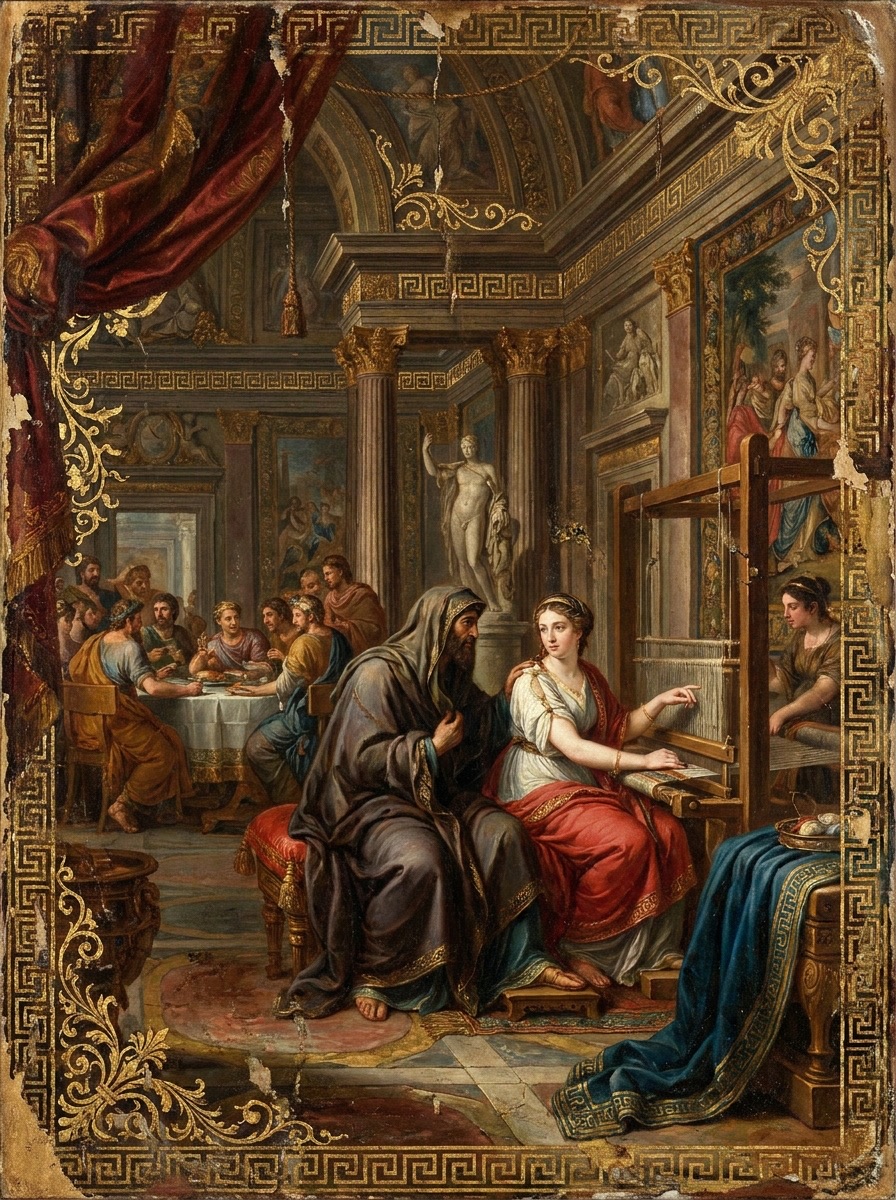
Disguised as a ragged stranger, Odysseus sits by night in his own hall and speaks with Penelope, the wife who has waited for him through long years. Penelope hears him tell how he “once saw Odysseus,” grieves over the signs he gives, doubts even while she hopes, and at last resolves to force the suitors toward their fate with a contest of the bow.
Article
Summary
After Odysseus returns to Ithaca, he still cannot reveal himself. He takes the form of an old beggar and sits in the palace the suitors have overrun, waiting for the right moment to strike. By night, Penelope summons the stranger and asks whether he has heard any news of Odysseus. Odysseus invents a Cretan identity and says that he once welcomed Odysseus into his house. When he describes the cloak and golden brooch Odysseus wore, Penelope is overcome with sorrow. He then tells her that Odysseus is alive and will soon come home. Penelope longs to believe him, but years of disappointment make her wary. She orders the old nurse Eurycleia to wash the guest’s feet. Eurycleia recognizes her master by an old scar and nearly cries out, but Odysseus stops her in time. At last Penelope tells him of her dream, in which an eagle kills her white geese, and says that the next day she will bring out Odysseus’ bow for the suitors to try. Whoever can string it and shoot an arrow through twelve axes, she will marry. Odysseus understands that the hour has come. In the darkness he keeps his secret and waits for dawn.
The Palace at Night
At last the suitors had gone.
By day the great hall looked as though a herd of wild beasts had trampled through it. Cups lay overturned beside the tables, bones and crusts were scattered on the floor, and ash from the braziers had been kicked everywhere. Those young nobles ate the cattle and sheep of Odysseus, drank his wine, and watched Queen Penelope one by one, waiting for her to choose a husband from among them.
Deep in the night, the maidservants cleared away the remains of the feast, and the fire sank lower and lower. Odysseus still sat in the hall, though no one knew him. He wore worn-out clothes and a filthy cloak over his shoulders, like an old man who had come begging from a long road. All day he had endured insults and blows, and he had also endured the harder thing: the urge to reveal himself to his wife and household.
Athena had aged his appearance. She had wrinkled his skin and dimmed his hair. Now he had returned beneath his own roof, yet he could only sit in the shadows like a guest.
When Penelope came down from the upper rooms, her maidservants followed her. She sat beside the fire, her face marked by the weariness of many sleepless years. For a long time she had delayed the suitors by weaving in the daylight and unraveling the cloth at night. Then a maid had betrayed the trick, and she had no excuse left. Now all the island pressed her to marry again, but in her heart she still held a thin thread of hope: perhaps Odysseus was alive; perhaps somewhere he was already on his way home.
She saw the stranger in the hall and told the women to bring him nearer.
“Old stranger,” she said, “I wish to ask you a few things. Where do you come from? Who were your parents? What city is yours?”
Odysseus bowed his head. At the sound of his wife’s voice, his heart felt as though a blade had softly touched it. But he could not reveal himself. The suitors were still in the palace, and among the servants there were traitors. If he showed himself too soon, he and Telemachus would both be in danger.
So he answered only in a rough voice: “Lady, do not ask me about my birth. A man who has suffered too long cannot speak of old things without tears rising of their own accord.”
Hearing this, Penelope wished all the more to know. “I too have suffered much,” she said. “If you have traveled through many lands, perhaps you have heard news of my husband. His name is Odysseus. Long ago he led the men of Ithaca to Troy, and for many years he has not returned.”
The stranger was silent for a while, as if searching through the memory of a very distant road. Then he said that he was from Crete, and that once, in his own house, he had received Odysseus as a guest.
A Purple Cloak
He began to tell a story he had carefully made.
He said that many years before, when Odysseus was sailing to Troy with his ships, he had come to Crete along the way. Storm winds held the fleet back, and the stranger had welcomed the guests into his house, giving them food, wine, and a place to rest. Odysseus wore a purple cloak, fastened with a golden brooch. On the brooch was fashioned a hound gripping a struggling fawn. With Odysseus there was also a herald, a little taller than the rest, darker in skin, with curling hair; his name was Eurybates.
As Penelope listened, tears began to fall.
These were not details anyone could invent by chance. That garment was the very one she had laid in the chest with her own hands, then given to her husband herself. For a moment she seemed to see the old Odysseus standing at the door, the bright cloak around him, ready to board his ship and sail away. He had still been young then, and their son Telemachus had been an infant in swaddling clothes. Who could have imagined that one parting would last twenty years?
She covered her face with the edge of her garment and wept softly for a time. Odysseus sat before her and nearly broke. His eyes grew wet, but he forced the tears not to fall. He was like a stone washed by the sea: cold and hard outside, but within it all scars.
After a long while Penelope lifted her head and asked, “If you saw him, then do you know what became of him afterward? Is he dead?”
The stranger answered at once: “Lady, do not give your whole heart over to grief. The news I heard says he is alive. He has suffered on the sea, delayed by storms and by the gods, and he has lost his possessions. But he is no longer far from home. Soon you will see him return to this palace.”
Penelope wanted to believe him, but many years of disappointment had taught her caution. She looked into the firelight and said quietly, “Many travelers have said the same. To win a cloak or a meal, they bring pleasing tales. Yet Odysseus has never come.”
The stranger spoke more firmly. “I am willing to swear it. He will return, and he will return soon.”
Penelope did not press him further. She ordered clean bedding to be brought for the guest, and she called the old nurse Eurycleia to wash his feet.
The Old Scar
Eurycleia brought a bronze basin and poured warm water into it. She was very old now, and she had cared for Odysseus since he was a child. She bent down, lifted the leg beneath the stranger’s ragged clothing, and as soon as she touched his foot, her hands stopped.
Below his knee was an old scar.
Odysseus had received it when he was young, hunting on Mount Parnassus. A wild boar had burst from the thick woods and gashed his leg with its tusk. The wound had healed long ago, but the mark remained clear. Eurycleia knew that scar too well. Her hands trembled; the foot dropped into the basin, and water splashed out.
She jerked up her head, her eyes filled with shock and joy, and almost cried aloud.
Odysseus instantly reached out, seized her by the throat, drew her close, and whispered, “Old woman, dear as a mother, do not make a sound. If you reveal me, everything will be ruined. This is not yet the hour for recognition.”
Tears sprang into Eurycleia’s eyes. She nodded and held back her cry. The firelight shook in the hall, but Penelope did not see what had happened; Athena, too, had turned her thoughts elsewhere for the moment. The old nurse poured the water away, wiped his feet clean again, and from then on kept the secret hidden in her heart.
Penelope still did not know that the man to whom she had just poured out her grief was the husband she had longed for all these years.
The Dream of the Eagle and the White Geese
After the washing, Penelope spoke to the stranger again, this time about a dream.
She said she had dreamed there were twenty white geese in the courtyard. They fed on grain scattered from the water trough, plump and clean, and she loved to watch them. Suddenly a great eagle came down from the mountain. Its talons struck, and it killed the geese one after another. In the dream she wept bitterly. But then the eagle flew up to the roof beam and spoke with a human voice: “Do not grieve, daughter of Icarius. This is not disaster, but something that will come true. The geese are the suitors, and I am your husband, returned to punish them.”
When she had told this, Penelope looked at the stranger and asked how the dream should be understood.
Odysseus hardly needed to think. “Lady,” he said, “the dream has explained itself. Odysseus will return, and the suitors will not escape death.”
But Penelope sighed. “Dreams have two gates,” she said. “One is of ivory, and dreams that pass through it deceive us. The other is of horn, and dreams that come through that gate are fulfilled. Who can know from which gate my dream came?”
She spoke so not because she had no hope, but because she had hoped for too long and feared to have that hope shattered once again.
Then she told him what she had decided.
“Tomorrow I will bring out the bow of Odysseus,” she said, “and twelve axes with it. Whoever can string that bow and send an arrow through the holes of all twelve axes, I will go with him and leave this house. This is the place where I came as a young bride. Here is my bed, here is my child, here is everything I remember. But I cannot put them off forever.”
When the stranger heard this, he knew that the moment had arrived. “Do not delay it any longer,” he said. “Let them try tomorrow. Before they have strung that bow, the true master may already be standing before them.”
Penelope looked at him. This ragged old man, when he spoke, had a strange steadiness in his voice, as though in the darkness he held a weapon no one else could see. Something stirred faintly in her heart, but still she dared not believe.
Before Dawn
By the time their conversation ended, the night was far advanced. The palace fire had nearly died, and only the red glow of embers lit the walls. The maidservants led Penelope back upstairs. She lay upon her bed but could not sleep for a long time. She thought of the purple cloak, of her husband’s brooch, of the eagle in the dream, and of the bow that no one had strung for many years.
Odysseus remained in the hall. He watched the way his wife had gone, his heart aching and yet steady. She was there before him, but he still could not embrace her. His house was all around him, but his enemies still occupied it. Yet this time he was no longer adrift on the sea, nor trapped on the island of strangers. He had come back inside his own doors.
Outside, the night lay heavy. The suitors slept near the palace walls, still believing that tomorrow would bring only another feast and another struggle for possession. They did not know that the beggar they had mocked had heard the queen’s decision and had found at last the opening for revenge.
Penelope fell asleep with doubt and hope together in her heart. The stranger guarded his secret and waited in the darkness for dawn.