Greek Mythology
Pelops — Greek Mythology
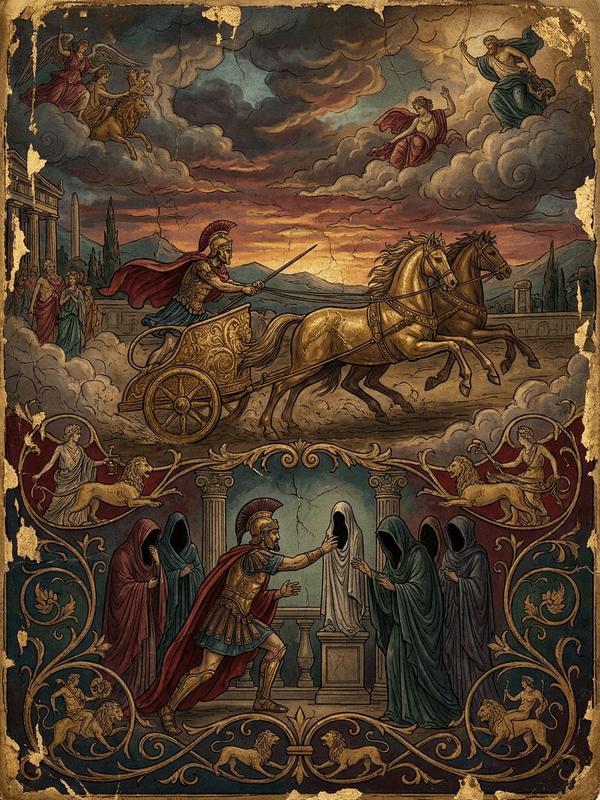
Pelops was the son of Tantalus, once slaughtered by his father and served to the gods, then restored to life by divine power, with a piece of ivory set into his shoulder. When he grew to manhood, he came to Greece and, with god-given horses and a perilous chariot race, won Hippodamia as his wife—yet by betraying the man who helped him, he left a curse behind.
Article
Summary
Tantalus, king of Lydia, had been honored by the gods, but pride rose in him until he dared a monstrous test. At a feast, he killed his son Pelops and served the child’s flesh to the immortals, wanting to see whether they truly knew all things. The gods saw through the crime. They gathered the severed pieces, restored Pelops to life, and replaced the missing part of his shoulder with ivory. Pelops grew into a youth of extraordinary beauty. Poseidon loved him and gave him swift horses and a chariot. Later Pelops left Asia Minor and came to Elis, where he heard of Hippodamia, daughter of King Oenomaus of Pisa, and of the many suitors who had died trying to win her. Oenomaus feared that his daughter’s marriage would bring disaster upon him, so he set a cruel condition: each suitor must take Hippodamia in his chariot and drive ahead, while the king pursued behind. If the suitor reached the goal, he might marry her; if Oenomaus overtook him, the king would spear him to death. Pelops chose to enter the contest. He prayed to Poseidon and also sought the help of Myrtilus, the king’s charioteer. On the day of the race, Pelops’ chariot flew through the dust. When Oenomaus drew near, the king’s wheels failed, and he was hurled to his death. Pelops married Hippodamia and later ruled the land; but Myrtilus did not receive the reward he had been promised. Instead, Pelops cast him into the sea, and as he died Myrtilus called down a curse. Thus Pelops gained a kingdom and great renown, but he also left a shadow over his descendants.
The Child Served at His Father’s Feast
In Sipylus in Asia Minor there lived a wealthy king named Tantalus. He was no ordinary mortal. His mother came of divine blood, and he himself enjoyed the favor of the gods. It was said that he had once been invited to dine among the immortals, sitting at table with Zeus, Hera, and the other gods, hearing words no mortal ought to hear and seeing things no mortal ought to see.
But Tantalus’ heart grew arrogant. He carried heavenly secrets back to earth and stole the food of the gods to boast of it among his mortal friends. The more favor he received, the more he longed to test the immortals: did the gods truly know everything?
One day he invited them to a banquet in his own palace. The braziers burned bright in the hall, bronze cauldrons rolled and steamed over the fire, and servants hurried back and forth, setting out cups, platters, and roasted meat. Tantalus’ son Pelops was still a child, his dark hair falling over his brow, and he knew nothing of the terrible thought hidden in his father’s mind.
Tantalus ordered the boy killed. He had the body cut into pieces, boiled in a pot, and brought before the gods. He wanted to see whether they would be deceived like human guests.
The gods at the table soon sensed that something was wrong. The meat lay on the dishes, and its steam rose with the scent of the feast, but not one of them reached for it. Only Demeter, distraught by the loss of her daughter Persephone, her heart dulled with grief, failed to see clearly what had been set before her. In her sorrow, she tasted a small piece from the shoulder.
At once the gods were filled with anger. They commanded that the scattered limbs of the child be gathered again into a great cauldron. The Fates set the broken body in order, and the gods brought life back into it. Pelops returned from death, opened his eyes, and rose as if he had been lifted from deep water onto shore.
Only one piece of flesh was missing from his shoulder, for Demeter had eaten it. So the gods replaced the shoulder blade with shining white ivory. From that time on, Pelops bore a strange mark on his body: his shoulder gleamed pale as polished tusk beneath the skin.
Tantalus, however, could not escape punishment. He was driven down into the underworld and there tormented by hunger and thirst. Water rose to his chin, but whenever he bent to drink, it slipped away; fruit-laden branches hung before his face, but whenever he stretched out his hand, the wind lifted them beyond his reach. Above him a great stone hung ready to fall, always seeming about to crush him. Tantalus’ crime remained in the house of death, while his son Pelops lived.
The Sea God’s Chariot and Horses
When Pelops grew up, he was handsome and noble in bearing, like a descendant of the gods. Poseidon, lord of the sea, loved him, so the story says, and took him into his favor. He gave Pelops a chariot and a team of tireless divine horses. When the wheels turned, they ran light as wind; when the horses’ manes swept through the dust, they seemed like foam skimming the surface of the sea.
In time Pelops left the old lands of his father and journeyed westward to Greece. He came with wealth, attendants, and the chariot and horses given by the god, and reached the region of Elis. There stood a city called Pisa, ruled by King Oenomaus.
Oenomaus had a daughter named Hippodamia. Her beauty was famous far and wide, and many princes and heroes, hearing her name, drove to Pisa with gifts, hoping to ask for her hand. But the more suitors came, the more graves rose outside the city.
For Oenomaus would not give his daughter in marriage.
Some said an oracle had warned him that his daughter’s husband would bring about his death. Others said the king loved her too fiercely and could not bear to surrender her to any man. Whatever the reason, he made a savage rule: every suitor must race him in a chariot.
In the contest, the suitor would set out first, carrying Hippodamia in his chariot, while Oenomaus followed in pursuit. If the suitor reached the finish, he could marry the princess; if the king overtook him, Oenomaus would thrust a spear into his back and kill him.
The rule sounded as if it offered a chance, but in truth it was nearly a death sentence. Oenomaus had swift horses given by Ares, and his charioteer Myrtilus was skilled with the reins. The young men who came to woo Hippodamia set out one after another, and one after another they fell on the road. Their heads were displayed as warnings to those who came after.
When Pelops arrived in Pisa, he saw those dreadful signs for himself. The wind blew past the city, stirring the relics of dead suitors hanging from the stakes, and the road scored by chariot wheels had been darkened with blood and dust. Yet he did not turn back.
Hippodamia’s Fear
When Hippodamia saw Pelops, her heart was shaken. She had seen too many men die because of her. They had set out in fine cloaks and bright hopes, and returned only as news of death. She did not want Pelops to become the next.
Pelops knew that courage alone would not win this contest. First he prayed to Poseidon, asking the sea god to remember his old favor and make the chariot fly like a wave before the wind. Then he sought out Myrtilus, the charioteer of Oenomaus.
Myrtilus was the son of Hermes, and his hands knew every secret of reins and axles. He knew how the king’s horses gathered their strength, and he knew at what moment a wheel was most likely to loosen. Pelops promised him a rich reward if he won. Some traditions say he offered Myrtilus half the kingdom; others say Myrtilus had long desired Hippodamia himself, and for that reason agreed to act. Whatever he truly wanted in his heart, in the end he took Pelops’ side.
Before the race, Myrtilus secretly tampered with the king’s chariot. He removed the bronze linchpins and replaced them with pins of wax, brittle things that would give way under strain. From the outside, everything seemed in order; the wheels still sat properly upon the axle. When the morning light shone over the chariot, no one saw anything amiss.
On the day of the race, the people of the city gathered along the road. Oenomaus came out in armor, his spear lying in the chariot, his face hard and cold. He had killed many suitors before, and to him this young man from a distant land was only the next in line.
Pelops helped Hippodamia into his chariot. She sat beside him, her fingers clenched tightly around the rail. The horses struck the earth, and dust began to rise lightly around the wheels. At the signal, Pelops’ chariot shot forward like an arrow.
The Race Through the Dust
The road stretched ahead across the plain and through the wind-swept open country. Pelops held the reins tight, and Hippodamia looked back beside him. At first they heard only the sound of their own wheels. Then, from far behind, came the heavier, faster beat of hooves.
Oenomaus was gaining on them.
The king’s horses were indeed swift. Their wheels churned up waves of dust, and the spear in the chariot flashed with a hard light. The distance between the two chariots narrowed little by little. Those watching from the roadside held their breath, as if they already saw Pelops’ fate.
Pelops urged on the horses Poseidon had given him, and the chariot seemed almost to skim the ground. Hippodamia’s hair ribbon was torn back by the wind. She dared not cry out; she could only watch her father’s chariot draw nearer and nearer.
Just as Oenomaus was about to overtake them, his chariot suddenly lurched. First one wheel tilted; then the axle gave a cracking sound. The wax pins could not endure the violence of the race. They split and scattered, and the wheel sprang loose from the axle.
The horses still rushed forward, but the chariot overturned. Oenomaus was hurled into the dust, then dragged by the reins and the wreckage. His spear flew aside, and his armor struck the stones with a dull crash. When the dust settled, the king who had killed so many suitors lay dying.
At the end, Oenomaus knew he had been betrayed and cursed Myrtilus for treachery against his master. But he could no longer mount his chariot or pursue anyone.
Pelops had won the race, and he brought Hippodamia back to Pisa. The law that had terrified so many men fell with the death of the king. Hippodamia became Pelops’ wife, and Pelops gained the throne and the land.
The Helper Cast into the Sea
Yet after the victory, one man remained waiting in the shadows for his reward: Myrtilus.
He had helped Pelops win the race, and in doing so had brought about the death of his old master. Now he came to claim what Pelops had promised him. But Pelops did not wish to keep the bargain. A man who knew such a secret was like a thorn hidden in one’s clothing. If Myrtilus lived, he could reveal the matter of the axle at any time; if he demanded still greater payment, the new king would never feel secure.
Later, either by the seashore or during a crossing, Pelops acted against Myrtilus. He threw the charioteer into the sea. As Myrtilus fell, the waves broke around him, and soon the dark water swallowed his body.
But before he died, he did not go silently. He called down a curse upon Pelops and his descendants, praying that they should never know peace. The sea wind carried the words away, but it did not truly scatter them. In later generations, many disasters would be traced back to that dying curse.
Pelops married Hippodamia and ruled Pisa and the lands around it. The whole peninsula later took its name from him and was called the Peloponnese, “the island of Pelops.” His ivory shoulder remained the sign of his return from death, and his horses and victory were remembered for ages.
Yet behind his glory, two things followed him: the sinful feast that his father Tantalus had set before the gods, and the curse Myrtilus left as he sank beneath the sea. Pelops gained a kingdom, a wife, and renown; but from that time on, his house would never be a house at peace.