Greek Mythology
The Duel of Paris and Menelaus — Greek Mythology
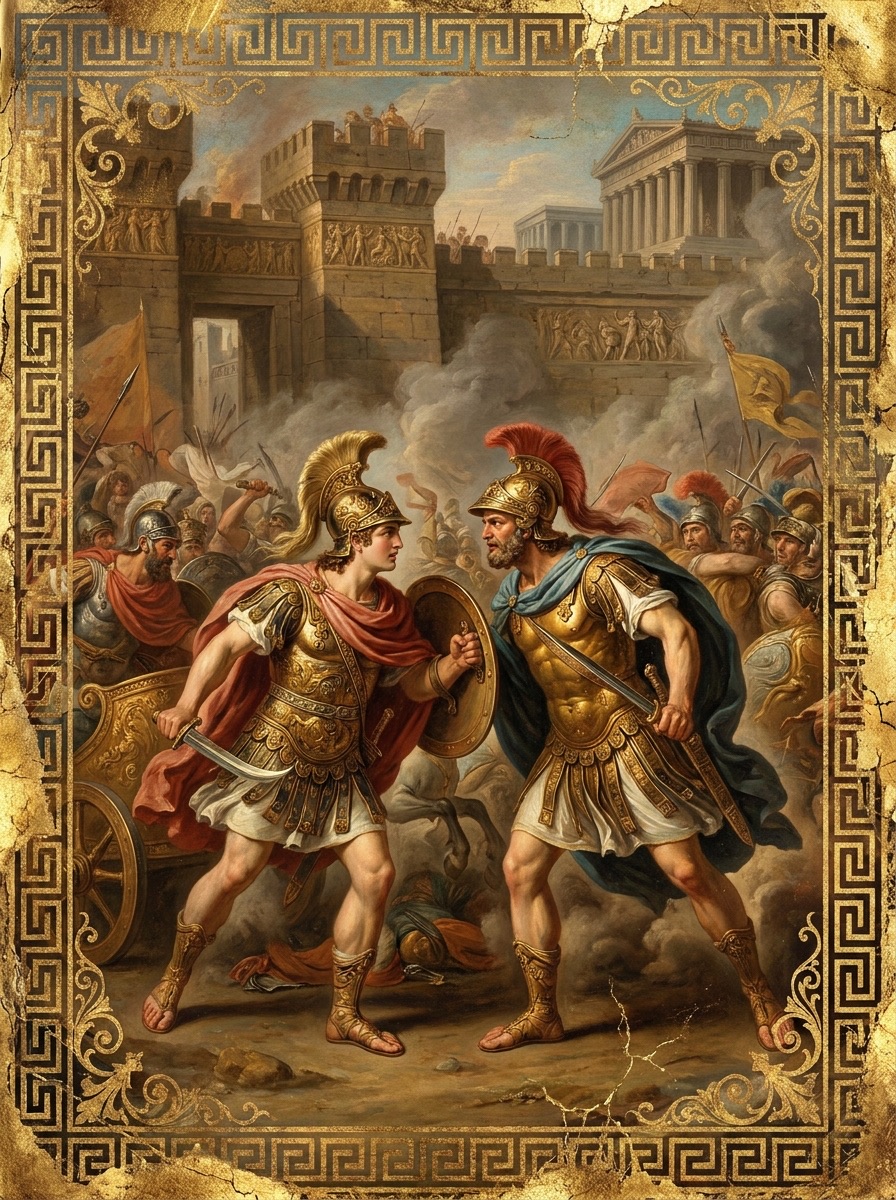
On the battlefield, Paris dared the Greeks to a challenge, only to shrink back when Menelaus advanced. The two armies agreed to settle Helen’s fate by single combat. Menelaus seemed on the verge of victory, but Aphrodite whisked Paris away, and the war was not ended.
Article
Summary
Outside Troy, Greeks and Trojans had already been fighting for a long time. One day Paris stepped out in splendid armor and called the Greeks to challenge him, but when Menelaus came forward, he fled back into the Trojan ranks, drawing Hector’s public rebuke. Ashamed, Paris proposed that he and Menelaus should fight alone. Helen and the treasure she had brought would belong to the winner, and both armies would lay down their arms. Hector and the Greek commander Agamemnon accepted the plan, and Priam himself was brought to the battlefield to witness and swear the oath. Lambs were sacrificed, wine was poured, and Zeus and the other gods were called to bear witness. Then Paris and Menelaus drew lots, armed themselves, and met between the armies. Paris hurled first and missed; Menelaus struck back, piercing Paris’ shield and then shattering his sword in a fierce blow. Menelaus seized Paris by the horsehair crest of his helmet and began dragging him toward the Greek line. Just as Paris was about to be captured alive, Aphrodite snapped the chin-strap of his helmet, wrapped him in mist, and carried him back to his chamber in Troy. Menelaus searched the field for his enemy, and both armies saw him standing there like the victor, but Paris had vanished, and the oath was soon broken.
The Prince Who Stepped Out Before the Army
On the plain outside Troy, dust had been churned pale by wheels and hooves. The Greek ships lay by the shore in dark rows, while the Trojans stood with the high city behind them, some watching from the walls, others carrying orders to the gates. The war had already gone on for a long time, and many men had died by the banks of the Scamander, yet Helen still remained in Troy, and there seemed to be no end in sight.
That day the two armies formed again on the plain. Shields pressed against shields, spearheads pointed forward, and the bronze fittings of the chariots flashed in the sun. At the front of the Trojan ranks came Paris.
He did not look like the rough fighters around him. There was something polished and self-regarding in his bearing. He wore a leopard skin, carried a bow and a sword at his shoulder, and held two long spears in his hands. Many Greeks recognized him at once: this was the man who had carried Helen, queen of Sparta, to Troy and brought all those ships across the sea to this shore.
Paris stood between the armies and shouted his challenge to the Greeks, bidding them send out the bravest among them to fight him single-handed. The Trojans were heartened to hear their prince speak so boldly; the Greeks, too, stirred at once, for Paris had at last come out into the open.
Soon Menelaus saw him from the Greek ranks.
Menelaus was king of Sparta, and Helen’s former husband. He had waited for this day too long. The moment he saw Paris before the line, he sprang down from his chariot like a hungry lion sighting prey, seized his weapons, and rushed forward.
Paris saw him too.
The Trojan prince, who had only moments before been calling out his defiance, changed color at once. He did not meet Menelaus. Instead he turned and slipped back into the Trojan ranks, hiding among his companions. Bronze armor and shields swallowed him up, as though a man on a mountain path had suddenly seen a snake and fled back into the crowd.
And all the army saw his retreat.
Hector’s Rebuke
Hector stood at the head of the Trojans. He was Priam’s eldest son and Troy’s surest defender. When he saw Paris draw back, shame and anger rose in him together, and he stepped up before his brother and rebuked him in front of everyone.
“You are fair to look at, and your body shines with all your fine gear,” Hector said, “but none of that will save Troy. You brought Helen back with you and made the whole city suffer for your sake. Now your enemy stands before you, and you will not face him. If the Trojans were not as patient as they are, stones would already have been thrown at you.”
The words were hard, and Paris could not answer them. He knew Hector spoke truth. If he had never gone to Sparta, if he had never carried Helen away, the Greek kings would never have gathered on the shore, and Troy would not hear mourning songs day after day.
Lowering his voice, Paris admitted that Hector’s reproach was just. He did not deny his guilt, though he would not call himself a coward to his brother’s face. Instead he offered a way out: let the Trojans and Greeks cease fighting, and let he and Menelaus decide the matter alone. The winner would take Helen and all that came with her, and the two sides would swear an oath and kill no more of one another.
Hector was somewhat relieved by this. He went forward and raised his spear to signal a halt. The Trojans stopped where they stood, though some Greeks still had arrows nocked. Hector declared Paris’ proposal aloud: let two men settle the whole quarrel.
From the Greek ranks Menelaus also stepped forward. No one was more willing than he. If he could kill Paris with his own hand, recover Helen, and end the expedition, nothing could please him more.
Still, he demanded that the oath not be left to a mere exchange of words between commanders. Priam, the old king of Troy, should be there too. Young men change their minds too easily; an old man has seen enough fortune and ruin to know the weight of calling the gods to witness. Lambs must be sacrificed, wine poured out, and Zeus and the other gods invoked.
Hector agreed.
Helen on the Wall
When word of the truce reached Troy, Helen was indoors. Hearing that Paris and Menelaus were to fight, she was shaken to the core. One was the husband she now lived with; the other, the husband she had once belonged to. One had brought her to Troy, and the other had brought a Greek army after her.
She went up onto the wall near the Scaean Gate. The old men of Troy sat there, and Priam himself was among them. When they saw Helen approach, they spoke quietly of her beauty, saying it was no wonder Greeks and Trojans had suffered so long for her sake; yet however lovely she was, she ought to be sent home, and not left to drag disaster over the city forever.
Priam did not scold her. He told Helen to sit beside him and name for him the great men she could see among the Greek ranks. So she looked out across the field and told him one by one who they were: Agamemnon, Odysseus, Ajax the Greater, and many others she had known in former days or heard of by reputation.
As she spoke, shame and sorrow came over her together. She remembered the palace in Sparta, her family there, and the fact that she now stood on the walls of Troy while the Greeks who had come for her waited below.
Soon a herald came to the wall and asked Priam to go down and oversee the oath. The old king climbed into his chariot with the lambs and wine and drove out through the gate to the space between the armies.
The Lambs and the Oath
The battlefield suddenly grew still. The men who had been ready to close with one another now stood apart, watching the king’s chariot stop in the middle. Agamemnon, commander of the Greeks, came forward to meet Priam.
Lambs were brought, and bowls of wine. Both sides washed their hands and offered the victims to the gods. Agamemnon raised his hands and prayed to Zeus, to the Sun, to Earth, and to the rivers, asking the gods to hear their oath: if Paris killed Menelaus, Helen and her possessions would remain in Troy and the Greeks would sail home; if Menelaus killed Paris, the Trojans would return Helen and all that came with her, and also pay for the losses the Greeks had suffered.
When the oath had been spoken, the lambs’ throats were cut and their blood ran into the earth. Wine was poured out upon the ground. Many among the armies also lifted their hands and called on the gods to punish any man who should break the truce in the future.
Priam, old and unwilling to watch his son face Menelaus, spoke what he had to say and then drove back to the city. No father, whether victor or loser, could bear to stand and watch such a fight.
The two armies still remained on the plain. Hector and Odysseus measured the ground for the duel and shook lots in a helmet to decide who should throw first. The lot fell to Paris, so he would have the first cast.
Paris began to arm himself. He fastened the greaves around his legs, drew on the cuirass over his body, slung his sword at his side, and lifted a great shield into his hand. His helmet closed over his head, with horsehair swaying above it. Menelaus too put on his bronze armor and gripped his long spear. The two men stood between their armies and faced each other.
The Broken Sword
Paris was first to hurl his spear. The point struck Menelaus’ round shield, but it did not go through. The bronze tip was turned aside, and the force died away.
Menelaus prayed to Zeus, asking the god to let him punish the man who had first wronged his house. Then he hurled his own spear. It flew with anger and struck through Paris’ shield and then through his cuirass. Paris twisted sharply aside and escaped the point, but the missile still drove him back in fear.
Menelaus would not let him go. He drew his sword and rushed in, bringing it down hard upon Paris’ helmet. But the blow met the hard bronze and the blade snapped in his hand, its broken pieces falling to the ground.
Menelaus lifted his face to the sky and cried out that Zeus had failed to give him his revenge at once. Yet he did not stop. Casting away the shattered sword, he seized the horsehair crest and the straps of Paris’ helmet and began dragging him toward the Greek line, as though he were hauling some heavy prize of war.
Paris could hardly breathe. The strap bit into his throat beneath the helmet, and his feet scraped wildly through the dust, his shield trailing at his side. The Greeks saw it and burst into shouts of triumph that seemed ready to break the sky; the Trojans held their breath, watching their prince being taken alive by the enemy.
At that moment Aphrodite intervened.
She had always favored Paris. Had she not once promised him Helen, he would never have carried that beautiful queen away from Sparta. Now, seeing him on the edge of death, she snapped the strap that held his helmet beneath his chin. Menelaus was left gripping only the empty helmet, while Paris slipped free of his grasp.
Before anyone could understand what had happened, Aphrodite wrapped Paris in thick mist and carried him off the battlefield, back to the fragrant chamber in Troy.
Menelaus stood holding the helmet and stared for a moment in confusion. Then he began searching the field for Paris, moving across the open space of the duel like a beast robbed of its prey. He looked toward the Trojan lines, but no one could hand Paris over. And among the Trojans there was no one who would admit to hiding him, for they hated the source of the whole disaster as much as the Greeks did.
Victory that Vanished
After Aphrodite had brought Paris back into the city, she went to Helen as well. Helen had seen the duel from the wall and had seen Menelaus gaining the upper hand. The goddess now urged her to return to Paris.
Helen’s heart was full of shame and anger, and she did not want to go at once to the man who had fled from the battlefield. She spoke bitterly, grieving that Paris had not died under Menelaus’ hand. But Aphrodite showed the majesty of a goddess, and Helen no longer dared resist. She had to return to the house and found Paris already seated there, his armor removed, as though he had never faced any danger at all.
Outside the city, Menelaus still stood on the field. The Greeks could all see it clearly: had the gods not intervened, Paris would have been defeated. Agamemnon therefore cried aloud that Menelaus had won, and that the Trojans must give back Helen and her possessions and make good the losses sworn in the oath.
Yet the duel did not bring peace. The lamb’s blood had already soaked into the earth, and the wine had been poured out, and the gods had heard both sides; but human greed and divine favor were still at work in the shadows. Paris had not died, Helen had not been restored, and the gates of Troy did not open.
What should have ended a long war left only an empty helmet and a silence filled with unease. Both armies knew that the real killing was not over.