Greek Mythology
Pandarus Breaks the Truce — Greek Mythology
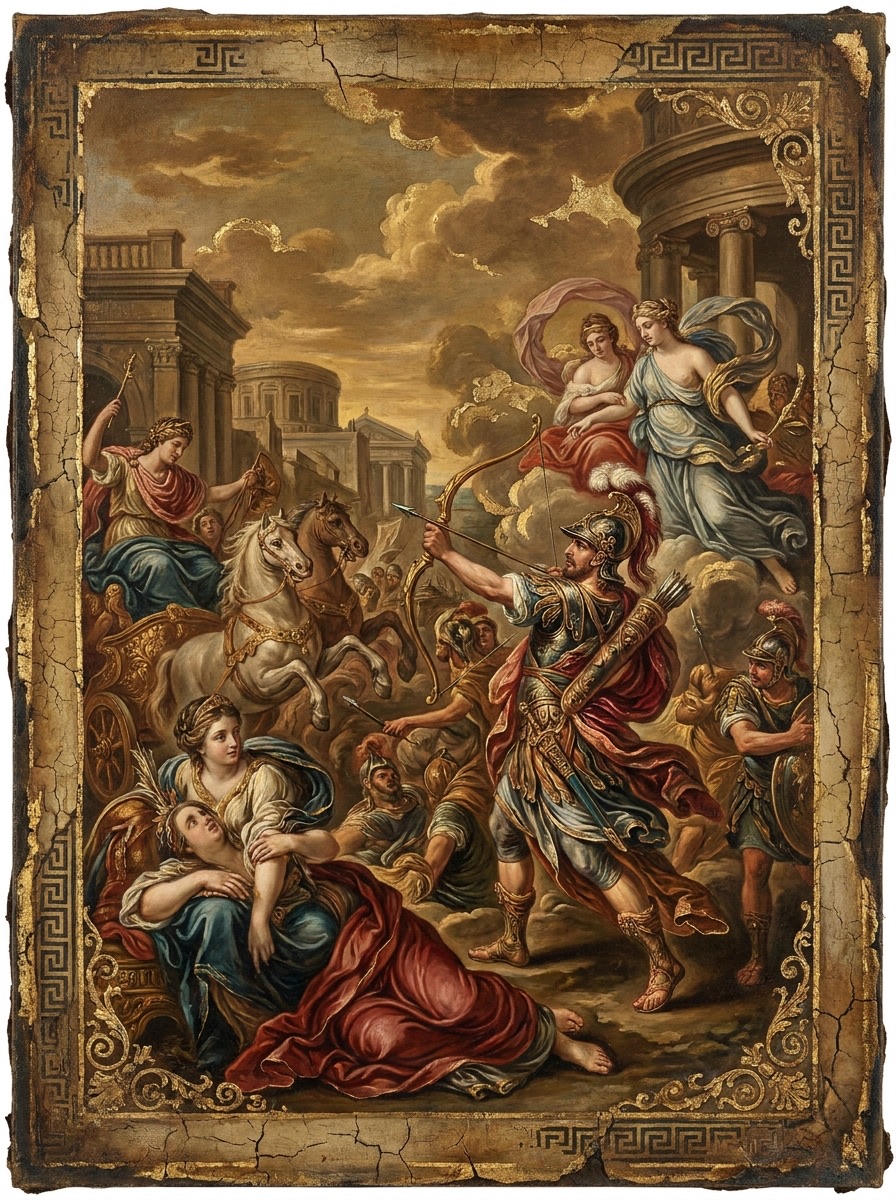
The Greeks and the Trojans swear an oath and prepare to let Menelaus and Paris fight alone, hoping to end the war by single combat. But Pandarus listens to a goddess’s urging and secretly looses an arrow; with that shot, the truce is broken, and the battlefield fills with blood once more.
Article
Summary
The Greeks and Trojans pause on the plain and prepare to let Menelaus and Paris fight alone. If Paris wins, Helen and the treasure she brought will remain in Troy; if Menelaus wins, the Trojans must return Helen and pay compensation. Both armies hope this oath may end the long bloodshed, and the soldiers keep their weapons in hand while watching the open space between the lines. The leaders bring lambs, pour wine upon the ground, and swear by Zeus, the sun, the rivers, the earth, and the powers below who punish oath-breakers. Old Priam cannot bear to watch his son fight and returns to the city after the oath is made. When the duel begins, Menelaus soon has the better of Paris. He seizes the horsehair crest of Paris' helmet and drags him toward the Greek ranks. Had Aphrodite not broken the strap and hidden Paris in mist, the contest might have ended there. After Paris vanishes, Menelaus still stands in the field, and Agamemnon loudly demands that the Trojans honor the oath. But the gods above do not wish the war to end so easily. Athena takes the form of a Trojan warrior and approaches Pandarus the archer, urging him to shoot Menelaus and promising that the Trojans, and Paris most of all, will praise and reward him. Pandarus knows that the oath has only just been sworn and that the gods have witnessed the wine and the blood of the lambs, but the thought of glory and reward shakes his heart. Hidden behind the shields of his companions, he takes out his long bow made from wild goat horns, vows an offering to Apollo, and draws the string. The arrow flies from concealment toward Menelaus. Athena does not let him die at once; she turns the shaft slightly aside so that it strikes where belt and breastplate meet. Blood runs from Menelaus, and Agamemnon is seized by fear and fury, calling the healer Machaon to draw out the arrow and dress the wound. Menelaus lives, but the arrow has pierced the oath just sworn between the armies. The Greeks burn with anger at the broken faith, and the Trojans too are pushed forward by the rising noise of war. Pandarus hoped to win glory with one shot, but instead he shatters the brief peace, and the plain outside Troy fills again with spears, shields, and blood.
Two Armies Paused on the Plain
On the plain outside Troy, the dust had not yet fully settled.
A short while before, Greeks and Trojans had been shouting at one another, shield grinding against shield, spears flashing in the sun. But on this day the two armies suddenly stood still. Chariots drew back. Horses breathed white vapor into the air. Soldiers remained in their ranks, staring toward the open ground between them.
For the two sides had agreed that thousands should no longer bleed for one woman and an old wrong. Paris had brought Helen to Troy, and that deed had drawn the whole war after it. So let Paris fight Helen’s former husband, Menelaus, man against man. Whoever won would have Helen and the treasure she had brought with her. The rest would stop killing and go home.
It sounded as though suffering had at last reached its end. The Greek ships had lain beside the shore for a long time, and the Trojans too were weary of hearing battle cries day after day beyond their gates. Many men still held their spears, but their fingers loosened around the shafts. All of them hoped that this oath, at least, would hold.
Lambs, Wine, and Oaths
The leaders of both sides came forward before the armies. Lambs were brought, wine was carried out, and the offerings were set between dust and grass. Old Priam came from the city of Troy in his chariot, heavy at heart, for the man who must fight was his son Paris.
On the Greek side, Agamemnon lifted his hands to the sky and prayed to Zeus, to the sun, to the rivers, to the earth, and to the powers beneath the earth who punish oath-breakers. They cut wool from the lambs and gave portions to the leaders on both sides, then poured wine upon the ground. The terms of the oath were spoken plainly: if Paris killed Menelaus, Helen and the treasure would remain in Troy; if Menelaus killed Paris, the Trojans would return Helen and make payment for the Greeks’ losses.
The lambs fell beneath the knife, and warm blood sank into the soil. Everyone who watched the sacrifice understood that whoever broke such an oath would draw disaster down upon himself.
Priam could not bear to watch his son fight Menelaus with his own eyes. Once the oath had been entrusted to both sides, he mounted his chariot and returned to the city. From the walls, Trojan elders and women looked out across the plain. Helen was there as well, her heart torn between the past and the sight before her, yet powerless to stop any of it.
Menelaus Seizes Paris
The duel began.
Paris stood in the middle ground wearing shining armor. He was beautiful, and his equipment was splendid; but when he truly faced Menelaus, his earlier pride seemed less secure. The two men cast their spears, then drew swords and struck at one another. Bronze rang against bronze, and the sound carried into both armies, where every man held his breath.
Menelaus fought with growing fury. His anger had been stored up too long: his wife had been taken, his house dishonored, and many Greeks had crossed the sea with him. Now all were waiting for this battle to give its answer. He rushed forward, seized the horsehair crest on Paris’s helmet, and began dragging him toward the Greek ranks.
The helmet strap tightened around Paris’s throat. If Aphrodite had not intervened, Paris might well have been dragged before his enemies that day and killed in full sight of all.
The goddess snapped the strap, wrapped Paris in mist, and carried him away from the battlefield, returning him to his chamber inside Troy. Menelaus was left holding only an empty helmet. He turned and searched the field for his opponent, but Paris was nowhere to be found.
The Greeks saw it, and the Trojans saw it too. Paris had vanished; Menelaus still stood in the open ground. By the terms of the oath, the outcome was clear.
Agamemnon cried out, demanding that the Trojans keep their promise, return Helen and the treasure, and repay the losses caused by the war. For a moment no one in the Trojan ranks could answer boldly. Many lowered their heads, knowing in their hearts that Paris had not won.
The Goddess Comes to Pandarus
But the gods in heaven did not all wish the war to end this way.
Athena came among the Trojan ranks. She did not show herself in her true divine form, but took the shape of a Trojan warrior and quietly approached Pandarus.
Pandarus was an archer from the region of Lycia, famed for his skill with the bow. His bow was not made from ordinary wood, but from the horns of a wild goat. That goat had once leapt across the rocks, its horns broad and strong; craftsmen had fitted the two horns together, joined them at the grip, and adorned the bow with careful workmanship. Pandarus treasured it and usually kept it in its case, not bringing it out lightly.
Athena stood beside him and spoke in the voice of someone he knew. “Pandarus, if you will listen to me, shoot an arrow at Menelaus. If he falls, all the Trojans will praise you, and Paris most of all will richly reward you. First vow to Apollo that when you return home you will offer him splendid sacrifices. Then let the arrow fly.”
The words fell like a spark into dry grass.
Pandarus had been standing in the ranks, watching the leaders of both sides dispute. He knew the oath had only just been sworn. He knew the gods had witnessed the wine and blood. Yet when glory and reward sounded in his ear, a man’s heart was easily shaken. He imagined that if he could bring Menelaus down, he might become overnight a man celebrated by all Troy.
So he bent down and opened his bowcase.
The Bow Drawn in Secret
Pandarus did not step into the open ground. He hid behind the shields of his companions, having several warriors raise their shields to cover him. In that way, the Greeks would not easily see what he was doing.
He took out the long bow, set one end against the ground, and strung it. Then he chose from his quiver an unused arrow. Its shaft was straight, its point sharp, waiting for its first taste of blood.
In a low voice he vowed to Apollo that he would offer sacrifice when he returned to his homeland. Then he set the nock to the string and drew with all his strength.
The horn bow bent little by little into a curve. The string came close to his chest; the arrowhead drew near the bow. Around him, men were still looking toward the center of the field, believing the truce still held. But behind the shadow of the shields, an arrow was already aimed at Menelaus.
The bowstring twanged, and the arrow flew.
It crossed the open space between the armies like a small dark streak and sped straight toward Menelaus. At that instant, if no god had intervened, the point might have struck a mortal place. But Athena did not mean for Menelaus to die at once. She reached out and turned the arrow slightly aside, as a mother brushes a fly from her sleeping child.
The shaft did not enter a fatal spot. It struck where Menelaus’s belt and breastplate met, passed through the layered armor, and tore the flesh beneath.
Blood Beneath the Belt
Menelaus looked down and saw blood running from the wound, staining the belt at his waist and the skin of his legs.
Agamemnon’s face changed first. He came to his brother’s side and took his hand, frightened and enraged at once. He remembered the lambs they had cut, the wine poured upon the ground, and the words both sides had spoken before the gods. If Menelaus died after the oath had been sworn, it would be more than a brother’s grief; it would be a great dishonor to all the Greeks.
He loudly cursed the Trojans for breaking faith, yet he was also afraid for his brother’s wound. Menelaus, though bleeding, could still speak. He reassured Agamemnon, saying the arrowhead had not gone deep into any vital place, for the belt, the plates of armor, and the metal clasp at his waist had stopped it.
Agamemnon did not dare delay. He immediately called for the healer Machaon. Machaon, son of Asclepius, understood the treatment of battle wounds. When he arrived, he examined the injury, carefully drew out the arrowhead, sucked the blood from the wound, and applied medicines to ease pain and stop the bleeding.
Menelaus did not die. But harder to mend than his wound was the oath that the arrow had pierced.
The Oath Is Broken
When the Greeks saw Menelaus wounded, anger passed at once through their ranks. The battlefield, quiet only a moment before, rang again with the sound of weapons. Soldiers tightened their helmets, lifted their shields, and gripped their spears.
The Trojan side too fell into confusion. Some knew this was oath-breaking and felt unease in their hearts; others were already being driven forward by the noise of war. The arrow Pandarus had shot could never be called back. It had not killed Menelaus, but it had killed the brief peace between the armies.
Agamemnon moved through the Greek lines, urging the captains to set their men in order. He reminded them not to forget that the oath had been broken, and not to let the Trojans escape punishment. One hero after another climbed back into his chariot or advanced on foot. Horses pawed the earth, and wheels crushed the dust.
And so the day that might have ended the war became the beginning of new slaughter.
Spears flew again. Shields clashed again. Wounded men fell to the ground, calling out to their comrades. The place where the lambs had just been sacrificed was trampled by feet and chariot wheels. The oath the gods had heard still existed, but the men on the battlefield had been swept away by rage.
Pandarus had hoped to buy glory with one arrow. But what that arrow left behind was not a secure and shining name, but deeper hatred. The truce outside Troy was shattered, and both sides understood that from this moment on, the bloodshed would not soon cease.