Greek Mythology
Pan and Syrinx — Greek Mythology
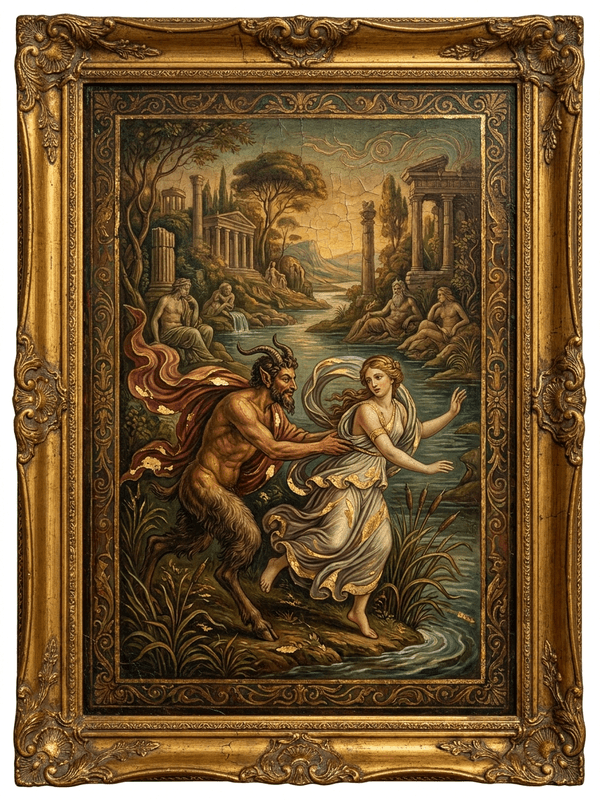
Pan, god of the wild hills, pursued the nymph Syrinx through Arcadia. Unwilling to yield to him, she fled to the riverbank and called upon the water nymphs for help. They changed her into a clump of reeds; when Pan heard the wind singing through the hollow stems, he cut them into pipes of different lengths and made the shepherd’s flute that would bear her name.
Article
Summary
Pan, horned and goat-footed, roamed the mountains, woods, and pastures of Arcadia, where shepherds rested in the shade and nymphs came to the springs. There he saw Syrinx, a nymph devoted to Artemis, who loved hunting and the freedom of the forest more than courtship or marriage. Pan was seized by desire and hurried after her, calling out as he came. Syrinx looked back, saw the wild god rushing toward her, and ran. She fled through trees and brush until she reached the banks of the River Ladon, where the water barred her way. With Pan close behind, Syrinx prayed to the nymphs of the river to hide her. Just as he stretched out his arms to seize her, she vanished from sight. In her place he held only a cluster of cold, wet reeds trembling beside the water. Then the wind passed through the hollow stems, and a thin, sorrowful music rose from them. Pan could not leave that sound behind. He cut the reeds, joined pipes of different lengths with wax, and made a flute. He called it Syrinx, so that the name of the nymph he had lost would remain in its music.
The Wild God in the Valley
Arcadia was a land of mountains. Pines and oaks clung to its slopes, streams slipped down through cracks in the stone, and sheep moved slowly across the grass. In the heat of afternoon, sunlight lay bright on the rocks, shepherds dozed beneath the trees, and the nymphs of the woods came to the clear springs to wash their hands and draw water.
It was in such places that Pan was most at home.
He was not like the stately gods of Olympus, with their ordered robes and shining halls. Pan had horns on his head, a beard on his chin, and the legs and feet of a goat. He could climb the rough hills swiftly and surely. He loved caves, shadows under trees, flocks of sheep, and sudden bursts of laughter. He liked to leap from behind a rock when a shepherd least expected it, making the man clutch his chest in terror. Yet he could also make music. His piping was sometimes quick and wild, sometimes soft enough to quiet a whole valley, so that even the sheep lifted their heads to listen.
But in those days, he did not yet possess the flute for which he would become famous.
One day, as Pan was walking through the woods of Arcadia, treading over dry leaves and startling small birds from the branches, he looked down from a slope and saw a maiden passing at the edge of the trees. She was no mortal girl, but a nymph named Syrinx.
A Nymph Like Artemis
Syrinx lived among the hills and forests. She honored Artemis and followed the maiden goddess’s ways: her tunic was gathered high for running, her step was light, and she often carried a bow and arrows at her side. She cared nothing for noisy wedding feasts and did not linger to hear suitors whisper sweet words by the springs. Many gods and shepherds praised her beauty, but Syrinx wanted only to move through the woods, to hear leaves shiver overhead, and to read the tracks that wild animals left behind.
That day she was returning from the hills, with fine sweat on her brow and bits of grass clinging to the hem of her dress. Pan saw her from a distance, and his heart flared at once. To him she seemed like light among the trees, or a flower suddenly opened beside a spring. He pushed through the shrubs and hurried toward her.
Pan did not know how to wait gently. As he drew nearer, he began calling to her. He wanted to tell her who he was, to ask her to stay, perhaps even to boast of his valleys, his flocks, and the music of his pipes. But Syrinx turned and saw a horned god, thick-bearded and goat-legged, rushing toward her at full speed. She did not stop to hear him out. She turned at once and fled deeper into the wood.
When Pan saw her running, his desire only grew more urgent. He called her name, thrust the branches aside, and followed close behind.
The Flight to the River
Syrinx ran swiftly. She passed through the broken shade of the trees, sprang over low bushes, and bent the grass beneath her feet. Birds startled from the woods beat their wings and rose into the air. Behind her came Pan, his goat hooves striking the earth in quick, hard beats.
At the foot of the slope the trees opened onto a stretch of wet ground, and beyond it flowed the River Ladon. Its water wound among the reeds, and the mud along its bank was soft and slippery. When Syrinx reached the river, there was nowhere farther to run. The bright water flashed before her, blocking her path; behind her, Pan’s breath and footsteps drew nearer and nearer.
She stood at the river’s edge and knew she could not escape by running any longer.
Then she called to the goddesses in the water for help. There was no time to offer garlands, no time to light incense at an altar. In the rush of wind and river sound, she could only pray in haste: hide me; do not let the god who follows take me.
The reeds along the bank stirred lightly, as if someone beneath the water had heard her cry.
Pan reached her then. He threw out both arms, certain that in another heartbeat he would seize Syrinx. But when his arms closed, there was no warm body within them, no fluttering edge of a maiden’s dress. He held only a clump of reeds newly risen beside the water.
Their cold, wet stems pressed against his arms, and their long narrow leaves shivered in the wind. Syrinx, who had been running before his eyes a moment earlier, was gone.
The Wind Through the Reeds
Pan stood stunned on the riverbank.
He looked down at the reeds in his hands, then out over the river. The water went on flowing as if nothing had happened. But the wind passed through the reeds, and from among them came a thin, delicate sound. It was not birdsong, and not the splash of a spring over stones. It was more like a sigh breathed softly from far away.
Pan let go, then took hold of several hollow stems. When the wind blew again, the reeds sounded together, each with its own pitch, gentle and mournful. As Pan listened, the haste and heat in him slowly ebbed. He had not won Syrinx, yet in that sound he seemed to hear the last trace she had left behind.
He could not bear to leave it.
So Pan cut several reeds from the riverbank and trimmed them into pipes of different lengths. The longer pipes gave lower notes, the shorter ones higher notes. He set them side by side, fastened them carefully with wax, and tested them with his fingers, guiding his breath through their hollow bodies.
When the first true note sounded, the valley fell still.
It was no longer the chance sigh of a single reed in the wind, but a real flute. Pan raised it to his lips and played a broken, wandering melody. The music drifted from the banks of the Ladon, crossed the grass, and entered the woods, as though searching for the nymph who had vanished.
The Name of Syrinx
Pan named the flute Syrinx.
From then on, he often carried it with him through the hills and wild places. When shepherds heard piping from the valley, they knew Pan was somewhere nearby. Sheep grazed in the fields, leaves moved in the wind, streams ran over stones, and that shepherd’s flute made from reeds always carried a trace of sorrow after pursuit.
Syrinx was not carried away by Pan. The river and its nymphs hid her among the reeds, saving her from the eager hands that reached for her. Yet her name remained in the music. In later times, whenever people heard a row of reed pipes sounding one note after another, they remembered the story from the riverbank in Arcadia: a nymph fleeing to the water, a breath of wind through the reeds, and Pan, god of the wild hills, making his flute out of loss.