Greek Mythology
Orpheus and Eurydice — Greek Mythology
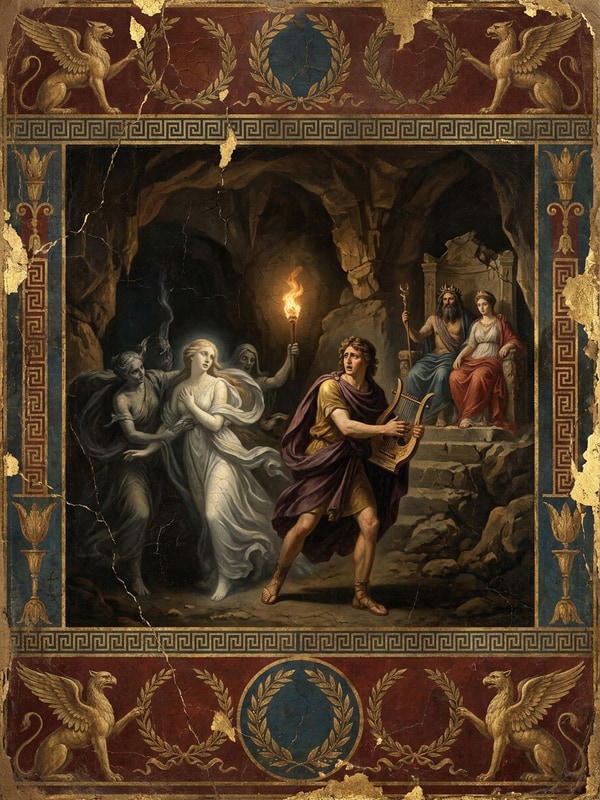
Orpheus could make trees move and wild beasts grow still with his song, yet he could not save his wife Eurydice from the serpent that took her life. He descended into the Underworld to plead for her, nearly led her back to the living world, and then, at the last step, looked behind him—and lost her forever.
Article
Summary
Orpheus was the famed singer of Thrace. His lyre could quiet wild animals and draw trees toward him. He married Eurydice, believing that from then on his songs would carry joy through the hills and among humankind. But not long after the wedding, Eurydice was bitten by a venomous snake in the grass and went down to the realm of the dead. Broken with grief, Orpheus took up his lyre and descended beneath the earth. His song moved the ferryman, the guardian hound, and the suffering shades, until at last he stood before Hades and Persephone and begged them to give Eurydice back to him. The lord and queen of the dead were touched by his music. They agreed that Eurydice might follow him back to the upper world, but on one condition: until they had left the Underworld and seen the sunlight again, Orpheus must not turn to look at her. Orpheus accepted and walked ahead, while Eurydice followed behind. When they were almost at the surface, Orpheus could not hear her footsteps. Fearing she had not followed, he finally turned back. He saw Eurydice—and in that same instant lost her. Darkness drew her back into the Underworld, and this time she could never return. Afterward, Orpheus came back to the world above and sang alone. He refused any new love and was eventually killed by the Maenads of Thrace. It was said that his head and lyre drifted down the water, and that his song did not wholly cease. In death, he met Eurydice again in the Underworld.
The Young Man Who Could Sing
In the wild hills of Thrace, people often heard music drifting from deep within the woods.
The player was called Orpheus. He was not a hero made famous by spear or sword, nor was he like Heracles, who could lift stones and break the necks of monsters. His greatest power lay in the lyre he held against his breast and in the voice that rose with it.
When he sat on a rock and touched the strings, the trees on the slope would slowly draw nearer, like quiet listeners gathering around him. Wild beasts would halt in their tracks; the wolf no longer chased the deer, and birds settled on branches without a cry. Rivers seemed to soften their own voices as they flowed past him. In places where people were used only to the sound of wind and the roar of animals, the song of Orpheus seemed to smooth the world with a gentle hand.
Some said his mother was Calliope, one of the Muses, and that he had been born with the gift of song. Others said Apollo loved the young man and taught him the art of the lyre. Whichever tale was told first, the people of Thrace believed this much: when Orpheus sang, even the coldest and hardest things could be moved.
In time, Orpheus fell in love with Eurydice.
Eurydice was young and beautiful, and often walked with her companions through grass and shadowed groves. When she heard Orpheus playing, she stopped to listen; when Orpheus saw her, he no longer sang only to the hills and trees. They loved one another, and before long they were married. On the wedding day, friends and kin gathered together, garlands hung beside the doors, and music and blessings rose one after another. Orpheus believed that from then on his songs would be full only of light and joy.
But in myth, happiness is often brief.
The Serpent in the Grass
Not long after the wedding, Eurydice went with her companions into a meadow. The grass grew deep, and wildflowers were scattered at their feet. They walked beneath the trees, laughing, while the wind stirred their garments as it might on any bright ordinary day.
Then someone came after her. In the best-known telling, it was Aristaeus. He saw Eurydice and tried to stop her. Frightened, she turned and ran. She looked only ahead and did not see the venomous snake coiled in the grass.
As her foot brushed through the blades, the serpent reared up and struck her ankle.
At first there was only a sharp pain. Then the poison spread through her blood. Eurydice staggered, and the women beside her cried out and caught her, but her face had already gone pale. The meadow, the trees, the far-off sky were still there, yet she could no longer stand. Soon she fell among the grass, and her breath grew fainter and fainter.
When the news reached Orpheus, his lyre was still beside him.
He came running, but what he found was not the laughing face of his new bride. Eurydice lay motionless among the flowers. The wedding garlands had not yet withered, the gladness of the feast had hardly faded, and already death had stepped across his threshold.
Orpheus held her and wept for a long time. He played his lyre and sang her name again and again. This time the trees listened, the stones listened, the beasts listened—but Eurydice could no longer answer him.
After death, the soul must go below to the Underworld. There are dark rivers there, and shadow-like spirits, and the lord and queen of the dead do not easily release what has come into their keeping. For a living person to go there was almost the same as giving himself to death.
But Orpheus did not draw back. He took up his lyre, left the sunlit hills behind, and went in search of the road beneath the earth.
The Road to the Underworld
The road to the Underworld grew darker and darker.
The wind of the upper world faded away. Birdsong vanished. Even the sound of his own footsteps seemed swallowed by the damp black earth. Orpheus went down through the bleak entrance and came at last to the river that the dead must cross. The water ran black and slow, like a wound whose bottom could not be seen.
On the River Styx was Charon the ferryman. Many dead souls stood along the bank, crowded together like shadows, waiting to be carried across. When Charon saw Orpheus, a living man, he would not at first let him aboard. The breath of the living did not belong in that place.
Orpheus did not draw a sword and did not argue. He only sat down, lifted the lyre, and struck the first string.
The music spread over the dark river. It was not a song for a feast, nor a song praising some boastful hero. He sang of Eurydice falling in the meadow. He sang of a newly married husband calling to his wife in an empty house. He sang of his willingness to walk into the deepest darkness, if only he might see her once more.
Charon held his oar and listened. Little by little his movements slowed. The souls on the bank stopped pressing against one another. Even the sound of the water seemed to sink lower. At last Charon let Orpheus climb into the boat and ferried him across the black river.
Farther on stood Cerberus, the three-headed hound that guarded the gate. All three heads growled together, thunder rolling in their throats, claws planted on the ground; no one could force a way past him. Orpheus stood before the beast and played again. The music reached the monster’s ears like a warm hand passing over its mane. The three terrible mouths slowly closed. Six eyes drooped half-shut. The huge body sank to the ground, as if the hound had fallen asleep.
Orpheus went on.
In the Underworld he saw souls undergoing punishment. One man pushed a great stone endlessly up a hill, only for it to roll back down just as it reached the top. Another stood in water, but whenever he bent to drink, the water slipped away. He reached for fruit above his head, and the branches drew back in the wind. Yet when Orpheus sang, the stone paused for a while, the thirsty forgot to chase the water and fruit, and even the eternally suffering dead lifted their heads to listen.
So at last he came before Hades, lord of the dead, and Persephone, queen beside him.
The Song in the Palace of the Dead
Hades sat on his shadowed throne, stern and dark of face. Persephone sat beside him. She herself had once been taken from the upper world to the lower, and she knew the taste of parting.
Orpheus did not boast of his fame, nor did he say that the gods owed him pity. He stood in the palace of the dead, held his lyre, and sang his plea.
He sang that every living thing in the world above must one day come here, and none can escape the gates of the dead forever. He had not come to steal away the law of death, nor to defy the gods for all time. He asked only because Eurydice was too young: her days had hardly begun, the fire of her wedding had not yet gone out, and a serpent had thrust her into darkness. If the lord and queen below would give her back for a while, then when she had lived the years allotted to her, both of them would return here as fate required.
His song echoed through the palace. In that sunless place, it was as if a breath from the living world had entered. The pale shades stood silent as they listened. Even the eyes of the Furies seemed to glisten with tears. Persephone lowered her head, and Hades was silent for a long time.
At last the lord of the dead agreed.
Eurydice might follow Orpheus back to the earth, but there was one condition: until they had left the Underworld and seen the sunlight again, Orpheus must walk ahead and must not turn to look at her. If he turned, Eurydice would at once return below, and he would not be allowed to lead her away again.
When Orpheus heard this, joy and fear rose together in his heart. He gave his promise, gripped his lyre, and turned back toward the road by which he had come.
Eurydice was behind him.
The Road Where He Must Not Turn
The road back was harder than the road down.
On the way there, Orpheus had carried only grief. He knew his wife was below, and so he had gone forward without asking anything else. Now he knew Eurydice was behind him, and yet he could not look at her even once.
The dark path twisted and climbed. Wet stones slipped beneath his feet. Far away the River Styx murmured, like someone sighing in the dark. Orpheus walked ahead and strained to hear any sound behind him. He wanted to hear Eurydice’s footsteps, the brushing of her dress against the rock, the lightest breath from her lips.
But the steps of the dead are very soft.
At times he felt she was there. At other times the space behind him seemed empty. He did not dare call out, fearing his own voice might disturb some hidden power. He did not dare stop, because stopping would be like admitting that doubt had taken hold of him. So he kept walking, step after step, upward.
Little by little the path began to change. The darkness was no longer so thick. Ahead, a gray-white gleam seemed to seep into the passage. It was the light of the upper world. Only a few steps more, only the last cold slope to climb, and they would be free of the Underworld.
Orpheus’s heart beat faster and faster.
He thought: Is she truly there? Has Hades deceived me? Has she fallen behind on the road? Her ankle was bitten by the serpent—does it still pain her? If I reach the outside and she has not followed, what then?
These thoughts coiled around him like snakes. The nearer he came to the light, the more afraid he became of losing her. At last, just as he was about to step into the world of the living, he could bear it no longer and turned his head.
He saw Eurydice.
She was there behind him, pale and silent, and in her eyes too was the longing to return to him. But he had looked back. The condition of Hades had been broken, and death at once reached out its hand.
Eurydice’s form began to drift backward, like mist being drawn into darkness. Orpheus lunged toward her and tried to seize her hand, but touched only cold air. She did not reproach him. She had time only to whisper a farewell, and then she slipped once more into the depths of the Underworld.
This time, she was not permitted to return.
The Empty Sound of the Lyre
Orpheus stood at the threshold, with sunlight falling over him, but it was as if he were still below.
He tried to rush back into the Underworld and plead once more. But the gates of the dead would not open a second time for the same living man. Charon would not ferry him again. Orpheus wandered beside the black river for a long while, weeping and singing, until only echoes remained around him.
At last he had to return to Thrace.
From then on, Orpheus no longer sang at feasts as he once had. He walked alone through the woods and mountains, and his music became more beautiful than before, and more sorrowful. The trees still drew near to him, and the beasts still lay down at his side, but however many listeners gathered, the one he wanted most was not among them.
Many women heard his songs and loved him, hoping to keep him beside them. Orpheus accepted no new love. His heart held only Eurydice. By day he thought of her; by night he thought of her. He sang of the road where no sunlight reached, of the waiting beside the River Styx, and of the single backward glance that cut hope in two.
Later, the Maenads of Thrace, in the frenzy of Dionysus, grew angry with him and said he had scorned them. First they hurled branches and stones at him. But when the branches and stones came near his music, they seemed to lose their force and fell harmlessly to the ground. Only when drums, shouting, and wild pipes drowned out the lyre did the stones truly strike him.
Orpheus fell.
His body was torn apart, and his lyre fell into the river. It was said that his head and lyre drifted away upon the current, still giving out a low song as they went. The water carried them far off, to the sea and beside islands. Later, people treasured his lyre, and some said the gods placed it in the heavens, where it became the constellation Lyra among the stars.
And below the earth, another ending quietly waited for him.
When Orpheus died, he came at last to the Underworld as a shade. This time there was no condition and no command not to look back. In the shadows he saw Eurydice and went toward her. The two were reunited, no longer forced to guess at one another through darkness, no longer afraid that footsteps were too soft to hear.
From then on, the living world no longer heard music played by Orpheus’s own hands. But his story remained: his song had moved rivers, beasts, and stones, and had moved even the lord and queen of the dead. It had almost brought a dead bride back beneath the sun—almost, but for that final glance.