Greek Mythology
Orpheus — Greek Mythology
A poet whose song could move all things descends into the underworld for love, only to lose Eurydice forever with a single backward glance before the light.
Article
Summary
Orpheus is one of the most haunting figures in Greek mythology: a singer, poet, and lyre-player whose music seemed to cross the boundary between nature and the divine. He is usually associated with Thrace and described as the son of Oeagrus and the Muse Calliope, though some traditions connect him with Apollo. Ancient stories say that his song could tame wild animals, draw trees and stones toward him, and even move Hades and Persephone in the underworld. His most famous myth is the story of his descent to the realm of the dead to recover Eurydice, his beloved wife. With his lyre and voice, Orpheus won a chance to bring her back, but he lost her forever when he turned to look at her before they reached the world above. Later traditions tell that he died at the hands of Thracian women or Maenads after refusing ordinary love or the frenzy of Dionysus. Even after death, his head and lyre continued to sing, and his lyre was finally set among the stars as Lyra.
The Divine Singer
Long ago, when the nine Muses still scattered poetry, music, and memory across the earth, and the Graces still made human life gentler and more radiant, a great singer appeared in Thrace. He was no king, no conqueror, no warrior with a spear in his hand; yet if anyone had asked who was most loved and admired, many would have answered: Orpheus.
His birth was noble and mysterious. Ancient tradition often calls him a Thracian singer, the son of Oeagrus and Calliope, the Muse of epic song; other stories link him with Apollo. Either way, the meaning is the same: his gift was not merely human skill, but something like a god speaking through a mortal voice.
Apollo gave him the lyre, and the Muses taught him how to play. With that instrument, Orpheus wandered through palaces and villages, forests and coastlands. He sang of love, of heroes, and of the grief and glory of life. Birds fell silent at his voice; wild beasts gathered peacefully at his feet; trees and stones seemed to wake and move toward the music. Ancient poets returned again and again to this wonder: Orpheus could touch the living and the lifeless alike.
Orpheus and Eurydice
Among all who heard him sing, Eurydice understood his soul most deeply. She became his wife, and also the tenderest, brightest source of his music. Their happiness did not rest on kingdoms, wealth, or the honor of battle, but on the quiet certainty of belonging to one another.
They often walked through valleys, along rivers, and beneath the trees. Orpheus played his lyre while Eurydice sang or danced in the wind. Nature itself seemed willing to pause for them: birds murmured in the branches, streams slowed their course, and flowers opened where she passed. To Orpheus, Eurydice was not merely someone who listened to his song. She was part of the song itself.
Yet in Greek myth, happiness rarely remains untouched for long. Eurydice died young, bitten by a serpent. Ancient versions differ: in Virgil, she is bitten while fleeing Aristaeus; in Ovid, she is bitten while wandering or dancing with the nymphs on her wedding day; in the Bibliotheca, her death is simply recorded as a serpent’s bite.
After Eurydice’s death, Orpheus’ world fell into darkness. He could still play the lyre, but music no longer consoled him. His song no longer praised joy; it carried the pain of loss through forests and valleys. Humans, beasts, trees, and stones heard his grief, as if the whole world had joined him in mourning.
Into the Underworld
After long sorrow, Orpheus conceived a thought almost no mortal would dare to hold: he would enter the underworld and ask Hades to return Eurydice. For ordinary people, the realm of the dead was a road without return. But Orpheus believed that if music had once moved earth and forest, perhaps it might also move death itself.
He set out with only his lyre, crossing desolate places toward the dark road beneath the earth. Rivers of the dead, shadows, ghosts, and the gates of Hades stood before him. Cerberus, the three-headed dog, guarded the realm; Charon did not lightly ferry the living across. Yet when Orpheus touched the strings, even the guardians of the dead were soothed, and the cold ferryman could not refuse his song.
At last he stood before Hades and Persephone. Orpheus carried no weapon and made no threat against the gods. He only sang. He sang of sunlight, of love’s brief season, and of Eurydice taken too soon. Hades was moved, and Persephone wept. In that moment, the power of the underworld seemed to yield, and the law of death briefly opened.
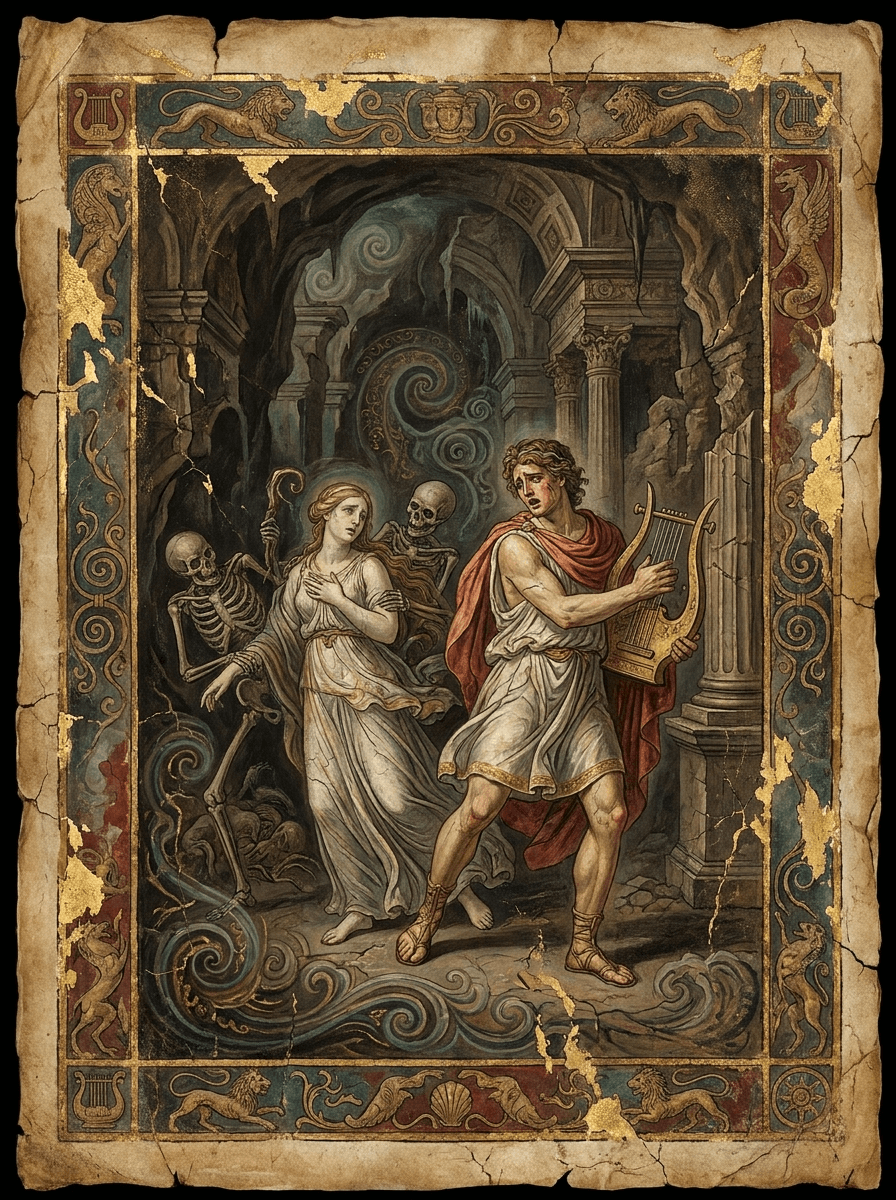
Hades allowed Eurydice to follow him back to the world above, but gave one condition: before they left the underworld and reached the light, Orpheus must not turn to look at her. She would be behind him. He had to trust that she was there.
The Backward Glance
The return was long, dark, and silent. Orpheus walked ahead; Eurydice followed behind. At first he was full of hope, but the nearer they came to the upper world, the stronger his doubt became. He could not hear her footsteps. He could not see her shadow. He began to fear that the gods had deceived him, that Eurydice had been left below, that he was carrying nothing but an empty hope toward the light.
At last, daylight appeared ahead. Only a few steps remained. Orpheus was almost about to regain Eurydice forever. But in those final steps, his faith broke. He turned and saw her; and because he saw her, he lost her. Her shade slipped backward into darkness. Orpheus reached out, but could not hold her. The second separation was crueler than the first, because this time the failure was his own.
He tried to enter the underworld again, but it would not open to him a second time. Death may be moved once; it does not allow mortals to test its borders again and again. Orpheus pleaded beside the dark waters, then returned alone to the world above.
Later Life and Death
Back in Thrace, Orpheus never truly returned to life. Many urged him to marry again, to forget, to begin anew; he answered only with the lyre. His music remained beautiful, but it grew more sorrowful. Eurydice was no longer in the world, and Orpheus’ heart seemed to have remained with her below.
Ancient tradition also differs on his death. The best-known version says that he was killed by Thracian women or the Maenads of Dionysus. Some accounts suggest they hated him because he refused new love, or because he rejected the wild rites of the god. Plato preserves a harsher reading: Orpheus, he says, did not choose to die for love, but tried to enter Hades alive, and so was finally punished by death at the hands of women.
After his death, his head and lyre continued to sing and drifted to Lesbos. The Muses buried his body, and Apollo placed the lyre in the sky, where it became the constellation Lyra. Orpheus’ life ended, but his music did not. It had gone from earth to the underworld, and from the underworld to the stars.
Meaning
The story of Orpheus is not only a tragedy of love. It is also a story about the power of art and the limits of being human. Music can quiet beasts, move stones, and stir the heart of Hades; yet it cannot abolish death entirely. Love can give a person the courage to enter darkness, but not always the strength to trust at the final threshold.
That is why Orpheus is both the greatest of singers and one of the most fragile of human beings. He failed, but his failure made the story eternal. Anyone who has lost someone beloved can understand that backward glance; anyone who believes art can resist death can still hear hope and sorrow in the strings of Orpheus’ lyre.