Greek Mythology
Orestes Avenges Agamemnon — Greek Mythology
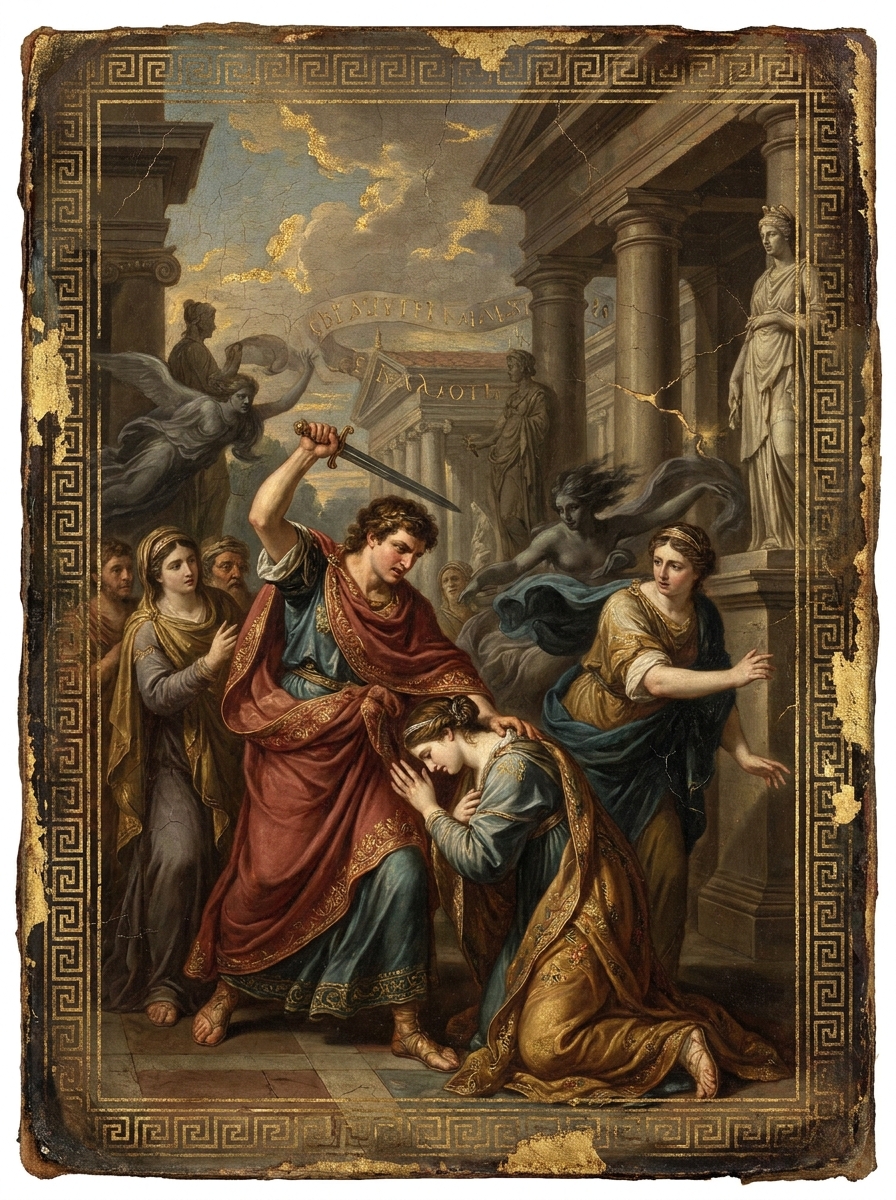
After Agamemnon is murdered by his wife Clytemnestra and Aegisthus, his son Orestes grows up in exile. At last, commanded by Apollo, he returns to Mycenae to avenge his father. He kills the usurper, and he kills his own mother as well; from that day on he carries a heavier guilt and is hunted by the Furies.
Article
Summary
After Agamemnon is murdered, the palace of Mycenae falls to Aegisthus and Clytemnestra. Electra remains trapped inside the house, forced to watch her father’s killer sit upon the throne while her mother shares his power. Unlike the more cautious Chrysothemis, she refuses to make peace with the new order and keeps her hope fixed on Orestes, the brother sent away in childhood. Clytemnestra later dreams that Agamemnon rises from the dead and plants his royal staff beside the hearth, where it grows into a living branch that overshadows the palace. Frightened by the dream, she sends Chrysothemis to make offerings at the tomb; Electra instead urges her sister to pray for Orestes’ return, not for the murderers’ safety. At that same tomb, Orestes arrives with Pylades, carrying Apollo’s command to avenge his father. Orestes leaves a lock of hair on the grave, and Electra recognizes him through the hair, the footprints, and the tokens of their shared past. Brother and sister embrace before Agamemnon’s tomb, but they cannot remain in grief while the usurpers still hold the palace. They decide that Orestes and Pylades will enter as foreign travelers bearing false news that Orestes is dead, hoping the lie will lower their enemies’ guard. Clytemnestra receives the report with a mixture of maternal disturbance and hidden relief, while Aegisthus believes the long-feared danger has finally vanished and comes without proper guards. Orestes kills the usurper first. Then Clytemnestra pleads for her life, pointing to the breast that nursed him and defending herself by recalling Iphigenia’s sacrifice; Orestes hesitates, but Pylades reminds him of Apollo’s order, and he strikes down his mother. The revenge brings no clean triumph. Aegisthus and Clytemnestra lie dead, Electra’s long waiting turns into a heavier silence, and Orestes immediately sees the Furies closing in on him for matricide. Calling on Apollo, he flees Mycenae, while the blood-debt of the house of Atreus continues in a new form: pursuit, guilt, and the need for judgment.
The Daughter in the Palace
After Agamemnon died, the palace of Mycenae did not become still.
Its tall doorposts still stood; the altars remained; servants still passed in and out. Yet the man seated on the throne was no longer the king who had returned from Troy. Aegisthus wore the robes of royalty and enjoyed the wealth Agamemnon had left behind. Clytemnestra stood beside him, as if everything had happened exactly as it should.
Agamemnon’s daughter Electra still lived in the palace too. She had not been killed, but she was like a prisoner in the house of her enemies. Every day she saw her mother come out from splendid rooms; every day she saw Aegisthus receive the greetings of the household. Her heart tightened as though a rough cord had been drawn around it. She could not give her father a proper mourning, nor could she cry out the murderers’ names in public. Only when no one was near could she speak her grief to the dead.
Her sister Chrysothemis was gentler. She too was afraid, and she too was sorrowful, but she did not dare defy their mother. She knew how many eyes watched within the palace—along the corridors, beside the doors, under the shadows of the pillars—eyes that listened on behalf of Aegisthus. She urged Electra to bow her head, at least long enough to stay alive.
Electra could not bear such a life. She remembered the day her brother Orestes had been carried away, still only a child. Fear had spread through the palace then, for many believed Aegisthus would cut down the last root of Agamemnon’s line. So the boy had been smuggled out of Mycenae and raised in a foreign land. At parting, Electra had held him in her arms as if she held the last remnant of their father’s hope. She believed he would one day grow into a man, take up a sword, and return to stand at his father’s tomb.
But year after year passed, and no sign of him appeared on the road. Electra’s hair grew rough with grief, and her clothing no longer looked like the clothing of a princess. She had waited so long that even hope sometimes seemed like a dying fire, with only one red ember left beneath the ash.
The Queen’s Dream
One morning, Chrysothemis came out of the palace carrying offerings. She held wine, garlands, and gifts for the dead, and her face was troubled.
Electra saw her and stopped her at once. “Where are you going? For whom are those things?”
Her sister answered in a low voice, “Mother has ordered me to make offerings at Father’s grave.”
Electra almost laughed bitterly. “She murdered her own husband, and now she offers sacrifice to him? What has made her remember the dead so suddenly?”
Chrysothemis told her that the queen had suffered a terrible dream in the night. In the dream, Agamemnon seemed to rise again from beneath the earth. He held his royal scepter in his hand and planted it beside the hearth of the palace. The dry staff began to grow branches and leaves, and those branches spread thicker and higher until they overshadowed the whole royal house. Clytemnestra woke in terror and ordered her daughter to take offerings to the tomb, hoping to soothe the dead man’s spirit.
When Electra heard this, her eyes flashed. She knew the dream was no good omen—at least not for the guilty. She would not allow her sister to plead for their mother. Instead she told Chrysothemis to pour the offerings at their father’s grave and pray to Agamemnon: if the spirit below still remembered his children, let Orestes come home.
At that moment, two unfamiliar young men were approaching the tomb from a distance. One was calm in bearing, his clothes dusty from travel; the other walked close beside him, watching over him like a brother. They were Orestes and his friend Pylades.
Recognition at the Tomb
Orestes, grown now, was no longer the child who had once been carried away. In exile he had learned the use of weapons, and he had not forgotten how his father died. He had gone to Delphi to ask Apollo what he must do, and the god’s oracle had commanded him to return and avenge his father. If he failed, Agamemnon’s blood would find no rest; if he obeyed, the guilt of killing his mother would pursue him. Both paths were dark, yet he chose the road home.
When he reached Agamemnon’s grave, he cut off a lock of his hair and laid it on the tomb. It was the gift of a son to his father. Then he and Pylades hid for a while, wanting first to learn the state of the palace.
Electra came to the grave and saw the lock of hair. Her heart gave a sudden leap. Its color, its curl, reminded her of her own hair—and of her brother’s curls when he was small. Then she noticed footprints in the earth, left by a young man, and their size and stride made her tremble.
Still, she did not dare believe too quickly. When the stranger stepped out from his hiding place, she first drew back, then fixed her eyes on his face. Orestes told her memories that only brother and sister could have shared, and he showed her a token once kept for him. At last Electra knew him. She threw her arms around her brother and wept until she could barely speak.
All the grief and anger that had been pressed down in her for years broke loose at their father’s tomb. She called on Agamemnon’s name, and on Orestes’ name. Orestes knelt as well, placed his hands upon the earth, and begged the spirit of their father to help them.
But they could not weep for long. Behind the palace doors their enemies still lived. Aegisthus had guards, and Clytemnestra would not surrender power easily. Orestes dried his tears and made his plan with Pylades: he would enter as a traveler from abroad and bring news that Orestes was dead. If the murderers believed it, they would lower their guard.
The News of a False Death
Before long, two strangers arrived at the gates of the palace of Mycenae. Their clothes were dusty from the road, and they said they had come from far away with a message: Orestes, son of Agamemnon, was dead, and his ashes could be brought home.
The news fell into the palace like a stone.
When Clytemnestra heard that her son was dead, her heart did not feel only one thing. She had given birth to this child; yet if that child lived, he was the greatest danger to her. She spoke words of grief, but in her breast she felt relief. She ordered the visitors to be received and sent for Aegisthus.
Electra, standing nearby, heard the words “Orestes is dead” and almost lost her strength. She knew it was a trick, yet the sentence still struck like a blade. She had to keep her face under control, lest her mother see through the disguise.
Aegisthus soon arrived. He believed that the threat which had hung over his head for years had at last been cut away, and his steps were lighter than usual. He wanted to question the messengers himself. He wanted to be certain that the boy who had escaped would never return.
This was the moment Orestes had been waiting for.
Aegisthus entered the room without the full company of guards he usually kept near him. He thought the men before him were only bearers of death-news; he did not know that the death-news itself was a hunter’s net. Orestes drew the sword he had concealed and sprang upon him. Before Aegisthus could cry out, he fell inside the palace. He had sat on Agamemnon’s throne and slept in Agamemnon’s bed; now he died by the hand of Agamemnon’s son.
The Mother’s Plea
After killing Aegisthus, Orestes did not feel release. The harder act still lay before him.
Clytemnestra heard the noise from within and sensed disaster. When she saw the stranger reveal himself, when she saw that the man before her was the son she had believed dead, her face changed at once.
She knew Aegisthus was finished, and she knew the sword would next be turned toward her. She no longer wore the majesty of a queen. Instead she stretched out her hands to her son, opened her robe, and pointed to the breast that had once nourished him. “My child,” she said, “will you kill the mother who bore you? You slept here when you were small. You drank milk here.”
Orestes’ hand trembled.
He hated her because she had murdered his father; yet she was truly his mother. The woman before him had once held him in her arms, and she had also led Agamemnon into the fatal bath. His father’s blood and his mother’s voice pulled against each other inside him, and for a moment he could not strike.
Then Pylades, who had kept silent, spoke and reminded him: do not forget Apollo’s command; do not forget the oath sworn to your father. Orestes seemed to be drawn back out of a mist. He knew he had come to a place from which there was no return.
Clytemnestra spoke again of Agamemnon’s guilt. She reminded him that Agamemnon had sacrificed their daughter Iphigenia for the expedition to Troy, and she said she had not killed her husband without pain. But these words could not save her. Orestes answered that if his father had sinned, the gods and justice should have judged him; she and Aegisthus had murdered a husband who had come home by deceit.
Then he brought his mother beside the body of Aegisthus. When the sword fell, the palace seemed suddenly hollow. Clytemnestra sank down. Agamemnon had been avenged, but the blood of the house of Atreus had gained another stain.
After the Blood Debt
At last Electra saw the enemies dead. The day she had awaited for so many years had truly come, yet no shout of victory rose inside the palace. On the floor lay the blood of Aegisthus and the blood of Clytemnestra: one the usurping enemy, the other the mother who had given them life.
Orestes stood beside the bodies, his sword not yet fully lowered. He should have felt that his father’s spirit had been appeased, but his face grew paler and paler. Suddenly he looked toward the door, as if he saw what no one else could see.
They were coming out of the darkness. They wore shadow like garments; fury burned in their eyes, as if ancient punishment had crawled up from beneath the earth. They were the Furies, pursuers of kindred blood, and above all they did not spare the one who had killed his mother. Others might not see them, but Orestes heard their footsteps and their cries.
Calling on the name of Apollo, he fled the palace and ran toward the god’s sanctuary. Electra remained where she was, watching her brother disappear. For years she had longed for him to come home and avenge their father; now that the vengeance was done, he could not sit peacefully on his father’s throne.
The gates of Mycenae closed again. Within them remained two bodies and a deeper fear. Agamemnon’s blood debt had been paid, but from that day onward Orestes carried the blood of his mother and walked the road of pursuit.