Greek Mythology
The Truth Revealed — Greek Mythology
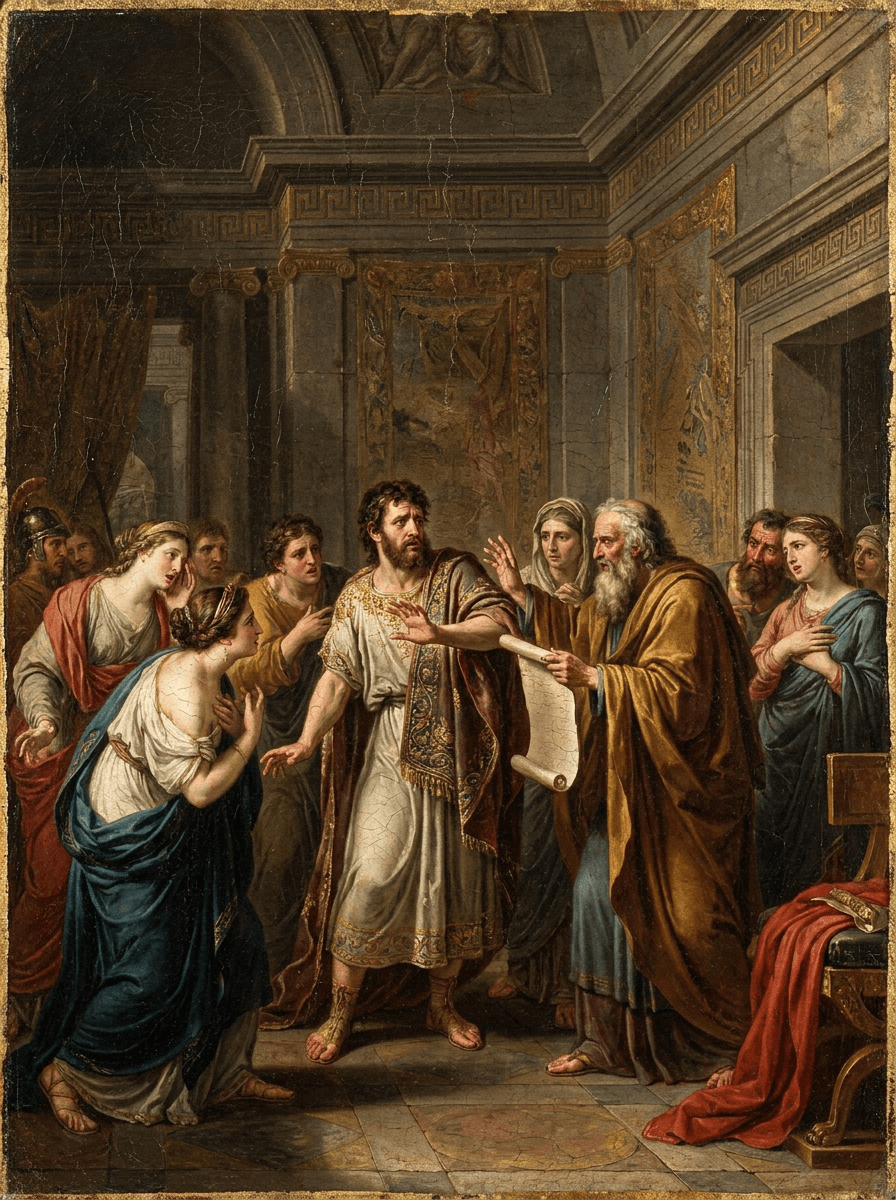
Thebes is struck by plague, and Oedipus resolves to uncover the killer of King Laius. Question by question, the search closes in on the palace until shepherd, messenger, and seer together unveil the dreadful truth: he has slain his father and married his mother.
Article
Summary
The city of Thebes lies under a deadly plague. The fields fail, cattle die, women go into labor only to lose their children, and the altars are crowded with desperate suppliants. Oedipus, who once saved the city from the Sphinx, sends Creon to Delphi to ask Apollo how the ruin may be lifted. The answer comes back at last: Laius was murdered long ago, and the pollution of that unavenged blood still clings to the city. Oedipus at once proclaims that the killer must be found and driven out. He then summons Tiresias, the blind seer, but the prophet will not speak. Oedipus grows angry and begins to suspect a plot, while Tiresias warns him that the man he seeks is nearer than he knows. Jocasta tries to calm him and tells him of an old oracle that said Laius would die at the hands of his own son. But the child had been exposed on Cithaeron, and Laius, she says, was actually killed at a crossroads by strangers. Oedipus, hearing the place described, remembers a violent meeting of his own on that road and begins to fear the answer. A messenger from Corinth arrives with news that Polybus is dead. Oedipus thinks one part of the prophecy has failed, until the messenger reveals that Polybus and Merope were not his true parents at all. The old shepherd is then brought before the king, and under pressure he admits the whole truth: the child from Laius’s house was spared, given to Corinth, and raised there as Oedipus. At last the terrible pattern closes around him. Jocasta kills herself. Oedipus enters the palace, and when he comes out again, he has blinded himself and begs for exile. The plague of Thebes has led him to the one truth he tried to outrun, and the city learns that the pollution it feared was seated on the throne.
The Plague in Thebes
A hidden calamity had settled over Thebes.
The fields outside the gates no longer yielded a proper harvest. Cattle collapsed in the dust. Women in labor cried out in pain, only to lose the children they had carried. Before the temples, smoke rose without ceasing, and old men, youths, mothers, and priests stood with olive branches wound in white wool, kneeling by the altars and begging the gods for help. Yet though the incense climbed toward heaven, the cries in the city did not stop.
Then Oedipus came out of the palace.
He had not been born in Thebes, but he had long since become its king. Years before, a monstrous Sphinx had blocked the road outside the city, devouring all who could not answer her riddle. Oedipus had solved it, and the monster had thrown herself from the rock and died. The Thebans had welcomed him into the city and given him the widowed queen, Jocasta, as his wife. Since then he had worn the crown and been honored as the man who had saved them.
Now the people gathered around him again.
The priest said, “You saved us once. The city is failing again. Find a way to save us.”
Oedipus looked down at the crowd kneeling on the steps, and though he stood firm, fear was not absent from him. He told them that he knew the city was suffering, and that he felt the burden more deeply than any one of them, for each man grieved only for his own household, while he grieved for the whole city. He had already sent Jocasta’s brother Creon to Delphi to ask Apollo why Thebes was being afflicted and how it might be rescued.
As soon as he had spoken, word came that Creon was returning. Laurel was still in his hair, and the dust of the shrine clung to the hem of his cloak.
Oedipus hurried to meet him. “What has the god said?”
Creon did not at once declare it aloud. He glanced at the crowd and seemed inclined to speak in private. Oedipus, however, said, “Speak here, before them all. I fear for them more than for myself.”
So Creon delivered the oracle. There was an old blood-guilt in Thebes that had never been cleared away. King Laius had once been murdered, and the killer still lived in the city. So long as that stain remained, the plague would not leave. Apollo commanded the Thebans to find the murderer and drive him out, or make him pay blood for blood.
At once Oedipus asked, “Where was Laius killed? Who did it? Why was it never cleared up?”
Creon answered that Laius had gone out to seek a prophecy and had been attacked on the road. Nearly all those who accompanied him had died. Only one servant had escaped. He said that they had been set upon by a band of robbers, many in number, and that the king and his attendants had been slain. At the time, the Sphinx was ravaging the outskirts of the city, and Thebes was gasping under the monster’s threat, so the old murder had been put aside.
When Oedipus had heard enough, he stood before the people and issued a stern command: whoever knew the murderer must speak out. Anyone who sheltered him would be barred from the city, barred from its speech, barred from its rites. And if the killer was within the palace itself, Oedipus declared that the same curse should fall on him.
He did not know that the net was already drawing tight beneath his own feet.
The Blind Seer’s Silence
To pursue the old crime, Oedipus sent for Tiresias.
The old man was blind, but people called him the one who understood the will of the gods best. Guided by a child, he came slowly to the palace, his staff tapping the ground step by step. The crowd made room for him, as though he could not see but carried a light no one else could perceive.
Oedipus came forward and said, “Tiresias, you know the things of heaven and the things of earth. Thebes is dying. Apollo says the murderer must be found. If you know anything, save this city.”
The seer lowered his head and was silent for a long time.
At last he said, “Let me go. Do not ask me. You do not know what you are asking.”
Oedipus thought he was refusing to help, and his voice hardened at once. “You know and will not speak? The city is suffering, and you still hide the truth?”
Tiresias would not answer. He said that complete knowledge was not always a blessing. He urged Oedipus to stop and leave the matter alone.
But Oedipus was not a man to retreat. The more he heard, the angrier he became. He suspected the seer of some darker design and even claimed that Tiresias, if not physically blind, must have had a hand in the murder. Then he dragged Creon into the charge as well, saying the two of them had conspired to use the oracle to take his throne.
That finally cut the prophet to the quick.
Tiresias raised his sightless eyes and said, “You call me blind. Yet you are the one who cannot see. The killer you seek is yourself. You live with the ones nearest to you and do not know who you are. You curse me with darkness, while your own house lies in a darkness deeper still.”
The people trembled, but Oedipus only burned hotter. He could not hear the warning for what it was. He took it as slander and declared that Tiresias and Creon had joined hands to overthrow him. Tiresias made no further defense. Instead he spoke words even more terrible: the man they were seeking was king that very day, wise in the eyes of Thebes; by evening he would be blind and exiled. He thought himself a stranger, but would learn that he had been born from that very land. He would discover that he was both father and brother to his children, both husband and son to his wife.
Then the blind seer departed, led away by the child.
Oedipus remained where he was, his anger still unspent, yet those words had already settled into him like cold water seeping through stone. They were absurd enough to resist belief, and yet heavy enough that they could not simply be dismissed.
Jocasta and the Three-Way Road
Creon soon heard that Oedipus suspected him of plotting against the throne, and he came to defend himself.
“Why should I want your power?” he asked. “I already have royal honor without bearing the fear that comes with kingship alone. If I wanted something, would you not give it to me? Why trade safety for danger?”
The two men argued fiercely, until Jocasta came out of the palace and told them not to add more strife to a city already in misery. Creon departed in anger, but Oedipus remained troubled.
Jocasta asked why he was so worked up, and Oedipus told her everything the seer had said.
She listened, then tried to comfort him. “Do not fear prophecies so much. No human being can read the gods clearly. Long ago an oracle said that Laius would be killed by his own son. But our child was born only to have his ankles pierced and be left on the mountain. As for Laius, he did not die at his son’s hands. He was killed by strangers at a place where three roads meet.”
“At a crossroads?” Oedipus asked at once.
His face changed.
Jocasta said that the place lay on the road toward Delphi and Daulis. Laius had been riding in a chariot, with a few attendants beside him.
Oedipus asked what Laius looked like. She answered that he was tall, with some gray already in his hair, and that he resembled Oedipus in more than one way.
Those words reached for his throat like a hand.
Then he began to tell her his own story.
He had always believed himself the son of Polybus, king of Corinth, and Queen Merope. When he was young, a drunken man at a banquet had shouted that he was not truly his parents’ child. He had asked Polybus and Merope about it, and though they rebuked the drunkard, they did not wholly quiet his doubts. So he went in secret to Delphi and asked Apollo.
The god did not tell him who his parents were. Instead he gave him a dreadful prophecy: he would kill his father and marry his mother.
Oedipus was so frightened that the prophecy might fall upon Polybus and Merope that he dared not return to Corinth. He left Delphi and, on the road, came to a three-way junction. There a chariot approached head-on, and the old man in it and his attendants ordered him to step aside. The driver shoved him, and the old man struck him with his staff. Young and hot-blooded, Oedipus struck back. The quarrel quickly turned to bloodshed, and he killed the old man and most of the attendants. Only one man escaped.
As he spoke, his voice dropped.
He asked Jocasta, “Where is the servant who escaped?”
She said that when he later saw Oedipus made king, he begged to be dismissed from the palace and sent into the country to tend the flocks. Oedipus at once ordered him to be brought back. For the moment, the only thing that still allowed him to breathe was the servant’s claim that there had been “a band of robbers.” If several men had truly killed Laius, then Oedipus was not the murderer. If not, then the truth was already closing in.
Jocasta urged him not to keep going. She, too, seemed to grow afraid, as though she wanted to shut the door before the darkness entered.
But Oedipus could no longer stop.
News from Corinth
Before the servant could be brought in, a messenger from Corinth arrived at the palace gates.
He brought what seemed like good news: Polybus was dead, and the people of Corinth wanted Oedipus to come and inherit the throne.
Jocasta heard it and clutched at the news like a rope thrown to the drowning. She called Oedipus over and said, “You see? Prophecies are not reliable. Polybus is dead, not slain by your hand, but taken by age and illness.”
Oedipus also felt some relief. The prophecy of patricide seemed to have failed. Yet he still dared not return to Corinth, because Merope was still alive. He feared the second half of the oracle might yet come true.
When the Corinthian messenger heard this, he laughed and said, “If that is your fear, then you need not fear at all. Merope was not your true mother, nor was Polybus your true father.”
The air before the palace seemed to freeze.
Oedipus asked sharply, “What do you mean? How do you know?”
The messenger said that years before, while tending sheep around Cithaeron, he had received an infant from another shepherd. The child’s ankles had been pierced and badly swollen. He had taken the child to Corinth and given him to Polybus and Merope. The king and queen had no children and raised the boy as their own. They had named him Oedipus, because his swollen feet were part of the name.
Oedipus listened with growing coldness, but still he needed to know everything. He asked who the shepherd had been who handed the child over to the messenger.
The messenger thought for a moment and said that the man had been a servant in Laius’s household.
Jocasta understood at once.
All the color drained from her face. She turned to Oedipus and said, “Do not ask any more. If you still care for your life, stop here.”
But Oedipus believed she was only ashamed of his low birth, that she feared the stain of it would disgrace the royal house. He said he was not afraid of humble origins, so long as he might know the truth of himself.
At last Jocasta looked at him, and in her eyes there was both fear and pleading. “Unhappy man,” she said, “may you never learn who you are.”
Then she turned and went back into the palace, never looking behind her.
The Shepherd’s Tongue
The old shepherd was finally brought in.
He was very old, bent with years in the hills, his face deeply lined by wind and weather. When he saw the Corinthian messenger and then Oedipus, his unease was immediate, as though a sheep had been driven to the edge of a snare.
The messenger recognized him at once and cried out with delight, “This is the man. He gave me the child years ago.”
But the shepherd would not admit it. He said age had clouded his memory and that he did not know what the messenger meant.
Oedipus ordered him pressed harder.
The more the shepherd resisted, the closer the truth came. The messenger reminded him that long ago, on Cithaeron, one of them had tended the sheep of Laius’s house while the other tended the cattle of Corinth, and that they knew one another. The child with the wounded ankles had been handed over by his own hands.
The shepherd trembled, still trying to escape. “Do not ask,” he begged his master.
Oedipus had lost patience. He commanded his servants to bind the old man’s hands behind him. Only then did the shepherd cry out, “If I speak, I am destroyed. If I do not, I am destroyed all the same.”
Oedipus said, “I must know.”
So at last the shepherd told the thing that had been buried for so many years.
The child had indeed come from King Laius’s palace. Someone had given him the infant and ordered him to abandon it in the mountains, so that wild beasts and the cold night might take its life. The oracle had said that the child would one day kill his father. The shepherd’s heart had softened; he could not kill a baby still in swaddling clothes. So he gave the infant to the Corinthian shepherd, thinking the child would be carried far away and Thebes would be forever rid of him.
Oedipus asked, “Who gave the child to you?”
The shepherd said in a low voice, “The queen... Jocasta.”
The last stone fell into place.
Oedipus had no more questions to ask.
He had believed that by fleeing Corinth he could escape the prophecy of killing his father and marrying his mother. Yet the road he took had carried him straight toward Laius. He had believed that by his own wisdom he had saved Thebes and won the queen and the crown. Yet that queen was his mother, and the old man he had killed at the crossroads was his father. He had hunted for Laius’s murderer, and cursed him to be shut out from the city, only to find that the curse had already been laid upon himself.
Darkness in the Palace
Oedipus gave a cry of agony and rushed into the palace.
The people within ran after him in terror. Soon the more dreadful news came out: Jocasta was dead. After entering her chamber, she had shut the door, thrown herself upon the marriage bed, and cried out the name of Laius, and the name of the child who should have died on the mountain. In the end she had ended her own life with a noose.
Oedipus burst into the room and saw her hanging there.
He lowered her body and held it, weeping. But the crying soon turned into something even deeper. He saw the golden pins on her dress, tore them free, and drove them into his own eyes. Blood ran from his sockets down his face. As he stabbed himself, he said that these eyes had seen what they should not have seen and had failed to recognize the people they should have known; let them see no more of parents, wife, or children, and no more of the deeds he had committed.
The servants dared not come near. They only heard him calling out in the dark.
Not long after, the palace doors opened. Oedipus came out, his eyes destroyed, his face drenched in blood. He was no longer the king who had once stood before the city and solved the riddle. He clutched at a pillar like a man made suddenly old and begged the Thebans to cast him out, to send him away where no one would even hear his name.
By then Creon had taken power. He did not drive Oedipus out at once, but said that he must first consult the gods about what should be done. Oedipus asked only to see his daughters. He knew that Antigone and Ismene were still very young, and did not understand what had happened inside the palace, yet already the shadow of his crime had fallen upon them.
The children were brought to him. Oedipus could not see them, only reach out until his hands found their clothes and their small faces. He wept and said that he could no longer protect them. He begged Creon to care for them and not leave them alone in the world.
The plague still waited on the gods’ decision, but the old blood-guilt was no longer hidden. Laius’s death, the infant abandoned on the mountain, the fight at the crossroads, the years of shelter in Corinth, all had been one road leading to the palace gate.
Oedipus had once used his eyes to find the path and his wit to solve the riddle, but in the end he blinded himself before the truth. From that day on, he was no longer the city-saving king the people had hailed. He was the man pursued by the curse he himself had spoken. The Thebans looked at him standing at the palace threshold, blood dripping from his face, and understood at last whose pollution the oracle had meant. They also understood that once some truths come fully to light, a human life can never return to what it was before.