Greek Mythology
Oedipus at Colonus — Greek Mythology
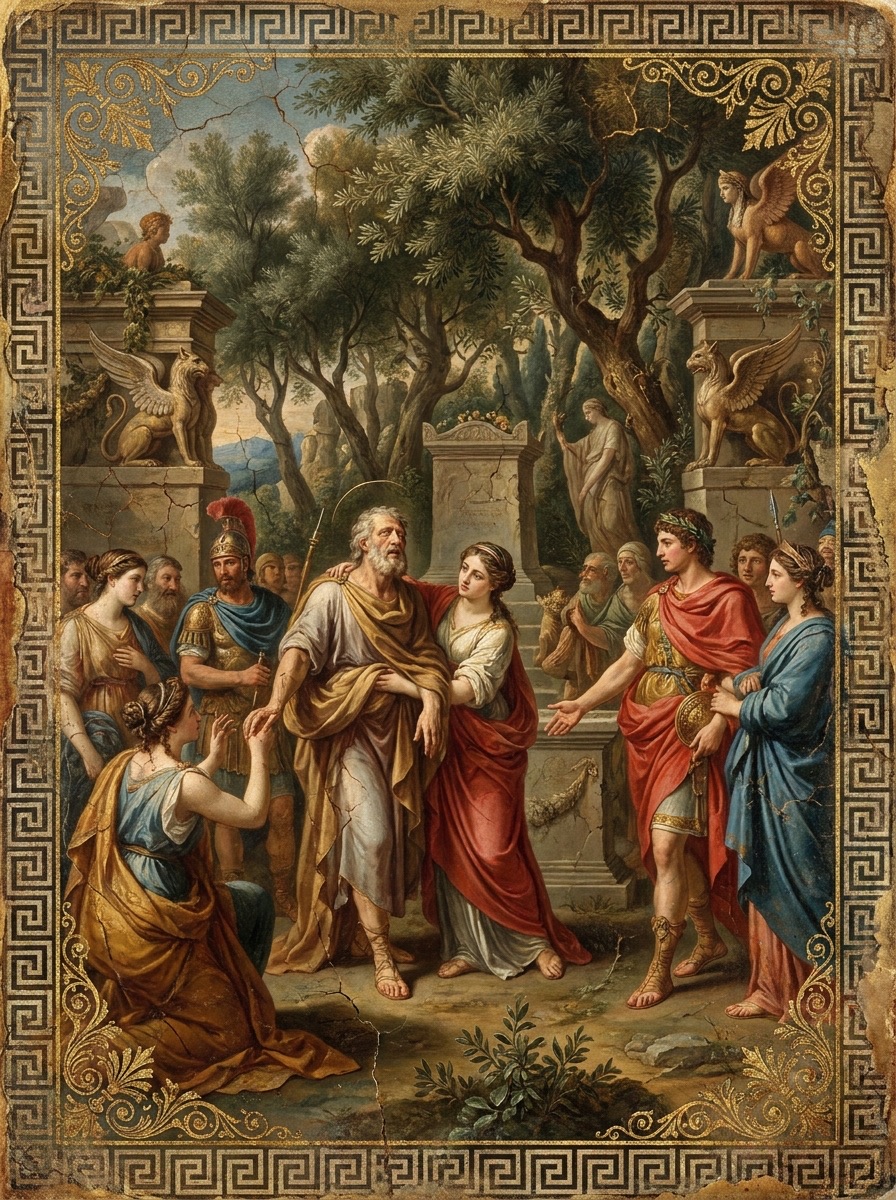
Old and blind, Oedipus wanders to Colonus on the outskirts of Athens, guided by his daughter Antigone. There he finds the place where fate has appointed him to make his final rest. Creon and Polynices come in turn to plead with him and pressure him, but Oedipus entrusts his end to Theseus, and at last departs from the world in a mysterious summons.
Article
Summary
After leaving Thebes, Oedipus is blind and aged, able to walk only with Antigone leading him by the hand. They reach Colonus near Athens and unknowingly enter a sacred grove where no one may tread lightly. The local people tell him that the place belongs to dread goddesses, but Oedipus hears in this the voice of fate, for an oracle once foretold that his life would end in such a place. Oedipus asks the people to summon Theseus, king of Athens. He says he brings neither wealth nor armies, but a gift that will appear only after his death: if Athens receives him, the place of his rest will protect the land. Theseus does not drive him away as a cursed man. He promises that Oedipus will be safe on Athenian soil. Thebans have also heard the oracle and want Oedipus under their control. Creon comes to Colonus, first speaking of kinship and homeland, then using force when Oedipus refuses to return. He has Antigone and Ismene seized, but Theseus pursues the captors and brings the daughters back, proving to Oedipus that the Athenian king can be trusted. Then Polynices comes before his father and asks for a blessing in his war against Thebes. Oedipus remembers that his sons did not help him in his misery and now seek him only because his fate may serve their war. He refuses the blessing and curses the brothers to die by each other’s hands. Antigone begs Polynices to turn back, but he still goes toward battle. When thunder sounds, Oedipus understands that the end has arrived. He purifies himself, says farewell to his daughters, and allows only Theseus to follow him into the sacred grove. What happens there is known only to Theseus; Oedipus does not die in an ordinary way, but is mysteriously taken away. His grave becomes a secret guarded by Athens and a hidden protection for the land that received him.
The Old Man at the Edge of the Sacred Grove
After he left Thebes, Oedipus traveled many roads.
Once he had been a king, seated high on the throne, listening to the complaints of his people and offering sacrifice to the gods. Then everything changed. He learned that he had killed his own father and married his own mother, and shame and pain came down on him together. With the golden pins of the woman who was both his mother and his wife, he struck out his own eyes. After that he was driven from his house and left the city that had once shouted his name in triumph.
By now he was very old. White hair fell over his shoulders, his clothes were worn thin with dust, and the soles of his feet had grown hard from wandering. He could not see the road. He could only rest his hand on his daughter Antigone. Though young, Antigone had learned too early how to guide her father, step by step, past stones, roots, and ditches.
One day they came to Colonus, outside the city of Athens. There were slopes there, and olive trees, and paths marked by horses’ hooves. In the distance the walls of Athens could be seen; nearby all was quiet, and in the deep shade of the trees it seemed as if something hidden did not wish to be disturbed.
Oedipus was weary. Groping with his hands, he sat down upon a stone. Antigone looked around and felt that this was no ordinary place. The grass grew thick, the sound of spring water came from within the grove, and branches bore offerings hung there for the gods.
Before long, local men approached. When they saw a strange old man seated there, they cried out at once:
“Old man, rise quickly! You must not sit there. This is the sacred ground of the dread goddesses. Strangers may not set foot here as they please.”
Antigone hurried to help her father up, but Oedipus did not panic. He asked, “The goddesses you speak of—are they the ones whose true name people fear to utter? Are they also called the Kindly Ones?”
The men were even more astonished. They told him that the grove did indeed belong to them, and that the whole place was sacred also to Poseidon, Prometheus, and the gods of the region.
When Oedipus heard this, he was silent for a long while. Then he said softly to Antigone, “Child, we have come to the place.”
Antigone did not understand. Oedipus told her that long ago an oracle had said that after a life of suffering he would come to rest in a place sacred to the dread goddesses. There he would die, and the land that received him would be blessed; whoever tried to seize him by force would bring disaster on himself.
He was no longer merely an old exile. Fate had circled around him for many years, and now at last it had brought him to the final gate.
The People of Colonus
The people of the place did not dare settle the matter on their own. They kept their distance around Oedipus, afraid that he had polluted the sacred ground, yet unwilling to lay hands on an old man seeking protection.
Oedipus begged them, “Send word to the lord of this land, Theseus, king of Athens. Let him come to me. I do not ask him for help empty-handed. I can leave a blessing for his city.”
When the men of Colonus heard the name of Theseus, their manner softened a little. They said that Athenians honored the gods and also those who came as suppliants, but this was too grave a matter. The king himself must decide.
Just then another figure appeared in the distance. Antigone saw her first: it was her sister Ismene. Ismene had ridden there on horseback, with the dust of the road still on her. The sisters, who had suffered through many years, fell into each other’s arms and wept.
Ismene told their father that Thebes had again fallen into turmoil.
Oedipus’ two sons, Eteocles and Polynices, had been meant to rule Thebes in turn. But once power came within reach, brotherly loyalty grew thin. Eteocles refused to surrender the throne. Polynices was driven out of the city, fled to Argos, married a princess there, and gathered an army to return and attack his own homeland.
More important still, the Thebans had heard another oracle. It said that the place where Oedipus lay after death would bring protection to that land; whoever held him in his power would gain advantage.
At this, Oedipus’ face darkened.
“They drove me away before,” he said. “When I suffered, they did not support me. Now they hear that my grave may be useful, and suddenly they remember me.”
Ismene said that Creon would very likely come. He would not allow Oedipus to be buried inside Thebes, but he wished to place him near the border, so that Thebes might still possess the benefit promised by the oracle.
Oedipus gripped his staff. He had no eyes, but his voice was clear. “I will not go back. Thebes did not want me alive. Let Thebes not think it can claim me dead.”
Theseus Holds Out His Hand
The news soon reached Athens. When Theseus came to Colonus, he did not behave like a man standing far above others. He saw Oedipus in his worn clothes, with empty eyes, and first stood aside to hear the old man speak.
Oedipus told him who he was, concealing none of the dreadful things that had happened. He said that he had committed terrible acts, yet much of it had not been done in full knowledge. At birth he had been cast away by his parents; as a grown man he had walked unknowingly into the dark path laid by the oracle. Now he asked for no throne and no riches. He asked only to die quietly on Athenian soil.
Theseus listened and did not reject him.
He himself had known journeys and danger, and he understood what a stranger most fears when he comes to another land for help. So he said, “Old man, since you have come to me as a suppliant, I will not hand you over to anyone. While I live, no one shall drag you by force from Athenian ground.”
At those words Antigone breathed more easily. Ismene bowed to the king of Athens. Oedipus raised his hands toward the sky he could not see and prayed for Theseus and Athens to be rewarded.
But the calm did not last long.
Creon’s Soft Words and Hard Hands
Creon came.
He was the brother of Jocasta, Oedipus’ wife, and a powerful man in Thebes. In earlier days, when Oedipus still ruled, Creon had been accused and rebuked by him; later, when Oedipus fell, Creon too had seen the blood and tears inside that royal house.
This time he arrived at Colonus with attendants, but his words were gentle. He called Oedipus kinsman. He said Thebes pitied his suffering and begged him to return. He also said that to die away from one’s own city, on another people’s land, was no honorable thing.
Oedipus listened and laughed bitterly.
“Now you call me kin,” he said. “But when I begged to stay, you drove me out; later, when I wished to go, you held me back. You have not come out of pity. You have come to take what the oracle has given me.”
When Creon saw that soft words were useless, his face changed. First he ordered his men to seize Ismene. Then he sent others to take hold of Antigone. The two daughters were dragged away crying out. Oedipus could not see them; he could only stretch his hands wildly through the air. His fingers found no edge of their garments. He heard only their voices growing farther and farther away.
In grief and fury the old man cried out to the sacred place and to the Athenians for help.
The people of Colonus were enraged. They could hardly believe that Creon had dared to seize anyone on Athenian soil. Theseus soon returned as well. When he understood what had happened, he wasted no words. He immediately led men in pursuit, caught Creon’s attendants, and brought Antigone and Ismene back.
When the sisters again embraced their father, Oedipus’ whole body trembled. He touched their hair again and again, making certain that they were still beside him.
Theseus confronted Creon and warned him not to bring Theban arrogance into Athens. Creon had nothing to say. Shamed and angry, he withdrew.
The Son Who Came to Beg His Father
After Creon left, Oedipus thought the danger had passed for a while. But before long another man came to Colonus.
It was Polynices.
He came from Argos, without the army behind him, standing on Athenian land only under the plea of seeing his father. When Antigone saw him, her heart ached. She knew that this brother had once neglected their father in exile, and she knew that he now meant to lead soldiers against Thebes; yet he was still her brother.
Polynices came before Oedipus and lowered his voice. He admitted that he had not cared for his father. He admitted that the struggle between brothers had brought fresh ruin on the family. He said that Eteocles had stolen the kingship that should have come to him in turn, and that he had been forced to seek help from another land. He begged his father to stand on his side and give him a blessing, for the oracle said that Oedipus’ support could sway the war.
Oedipus was silent for a while.
The wind moved through the sacred grove, and the leaves made a light sound. Antigone hoped her father might speak some word of forgiveness, or at least not let still more blood flow between brothers.
But when Oedipus spoke, his voice was as hard and cold as stone.
“Neither of you treated me as a father,” he said. “When I was driven from my home and walked the roads with a staff, you sat in the city fighting over the throne. You have not come now because you love me. You have come because you want to win.”
Polynices knelt on the ground and still pleaded with him.
But Oedipus pronounced a terrible curse upon him: he would not take back Thebes, nor would he return safely to Argos. He and his brother would kill each other, and a brother’s blood would fall by a brother’s hand.
Polynices turned pale when he heard this. He knew that his father’s words were no ordinary burst of anger. They were like fate itself placing a blade before him.
Antigone wept and begged him not to march. “Brother,” she said, “now that you have heard such words, go back. Do not lead an army against your own city.”
Polynices would not agree. He was ashamed and full of pain, yet the throne still pulled him onward. He asked only one thing of Antigone: if he died, let her see that he was buried.
Then he left Colonus and took the road that led toward war.
The Summons in the Thunder
After Polynices departed, the sky changed.
Thunder sounded in the distance. At first it was only one roll, passing behind the clouds; then another came, nearer and deeper. The leaves of Colonus trembled, and the shadows within the sacred grove grew darker.
Oedipus lifted his head. Though he could not see, he seemed to hear a call that no one else understood.
“The time has come,” he said.
He sent for Theseus. When the king of Athens arrived, Oedipus no longer seemed as weary as he had when he first came. He told his daughters to prepare clean water and perform the purifications for him before death. Antigone and Ismene obeyed through their tears, washing the dust from their father’s body and clothing him in fresh garments.
Oedipus felt for his two daughters and drew them into his arms. He knew that once he died, they would be still more alone in the world. He comforted them, saying that he had suffered long and now at last had come to the place where suffering would cease. But his daughters could not bear to release him. They clung to him and would not let go.
Another peal of thunder sounded. Oedipus told them that there could be no more delay.
He asked Theseus to follow him alone, and charged him with this command: he would witness something that must never be revealed to others. The place where Oedipus was hidden in the earth must be passed down in secret from one king of Athens to the next, told only to the one who inherited the rule. In that way the protection Oedipus left for Athens would never be seized by its enemies.
Then Oedipus walked forward without anyone supporting him. A blind old man who had only just been led by his daughter now moved as if he knew every inch of the ground. He entered the depths of the sacred grove, and Theseus followed behind him. Antigone and Ismene were left outside, able only to hear the footsteps fading away.
What happened afterward, only Theseus knew.
Some said there was no sickness and no sword; no funeral pyre and no grave-pit. The gods simply took Oedipus away. When Theseus returned, there was awe upon his face, as if he had seen something that could not be told to human ears.
The Secret Left in Athens
Antigone and Ismene rushed to him, asking where their father was, begging Theseus to let them see his tomb once.
Theseus shook his head. He had promised Oedipus that he would not reveal the place. The sisters broke into sobs, but they knew that their father’s final wish could not be disobeyed.
The life of Oedipus had begun in a royal house and passed through a riddle, a crown, a plague, truth, blood, and exile. At last it came to rest in the sacred grove of Colonus. He did not return to Thebes, nor was he carried off by those who wished to make use of him. He entrusted his final resting place to Athens and to faithful Theseus.
From then on, Athenian soil held a secret no one could point out. People did not know exactly where Oedipus lay at rest. They knew only that Colonus had received a blind old man worn down by suffering, and that before he died, he left his silence and his protection to that land.