Greek Mythology
Oedipus and the Sphinx — Greek Mythology
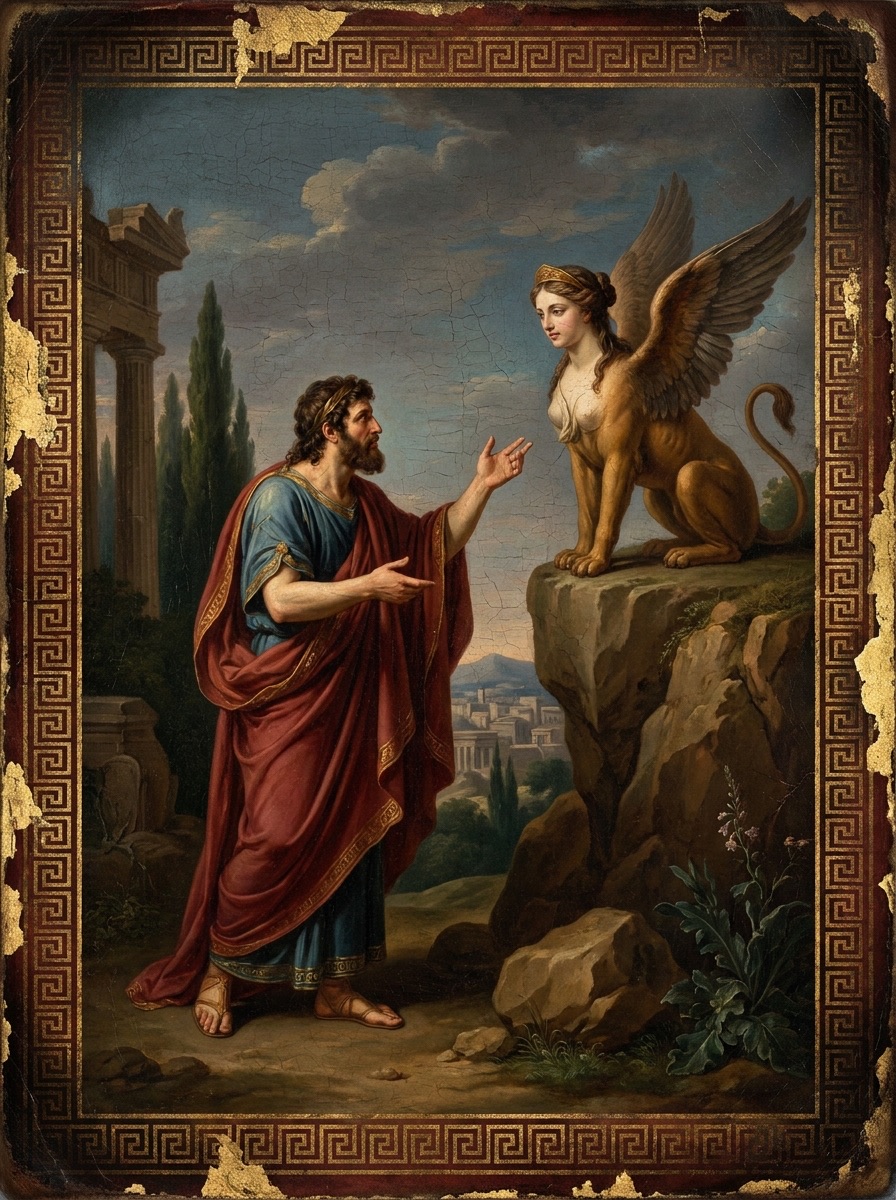
The city of Thebes was cut off by the Sphinx, and many died because they could not answer its riddle. Oedipus, a wanderer newly arrived, solved the puzzle and drove the monster to its death. For this deed he was welcomed into the city and raised to the throne of Thebes.
Article
Summary
After King Laius of Thebes was killed on the road outside the city, Thebes lost its ruler and soon faced a new terror. The Sphinx settled beside the mountain pass, with a woman’s face, a lion’s body, and birdlike wings. It stopped every traveler and demanded an answer to its riddle; those who failed were torn apart, and fear closed the road into the city. At that time Oedipus came near Thebes as a wanderer. He had grown up in Corinth, but after the oracle at Delphi foretold that he would kill his father and marry his mother, he fled the home he believed was his own. On the way he killed an older man in a quarrel at a crossroads, never knowing that the dead man was Laius, king of Thebes. Oedipus did not turn away from the Sphinx. He climbed the road and stood before it as it asked what creature walks on four feet in the morning, two at noon, and three in the evening. Thinking of the whole course of human life, he answered: a human being, crawling as an infant, walking upright in adulthood, and leaning on a staff in old age. With its riddle broken, the Sphinx threw itself from the cliff. When Thebes learned that the monster was dead, the gates opened and Oedipus was welcomed as a savior. Creon honored the city’s promise by giving him the throne, and Queen Jocasta became his wife. To the Thebans, this stranger had restored the road and given the city a moment of relief after fear and death. Yet the riddle on the mountain was not the only riddle in the story. Oedipus believed he had escaped the oracle, but he had already killed his true father and entered the house of his true mother. The fall of the Sphinx brought him glory, but it also carried him straight toward the deeper tragedy hidden inside his own name.
The Shadow on the Mountain Road
Outside Thebes there was a road that led toward the mountain pass. Merchants carried their goods along it, shepherds drove their flocks there, and messengers entered the city by that way. But for a time the sound of human voices grew scarce along the road, until only the wind could be heard rattling stones through the grass.
For a monster had come to the mountainside.
It crouched above the path, its body like a lion’s, its claws hooked into the rock, wings rising from its back, and yet its face was the face of a woman. From a distance it looked almost like someone sitting on the cliff, waiting for travelers. Only when one drew near could one see the cold gleam in its eyes and the blood beneath its paws. The people of Thebes called it the Sphinx.
Whoever tried to pass, the Sphinx stopped. It did not demand gold or silver, nor did it allow anyone to rush forward first with sword or spear. It asked only a riddle. If the traveler answered, he might go on alive. If he failed, the monster tore him apart, and his bones were left among the stones and dry weeds.
News of this spread through Thebes. Near the city gates people spoke in low voices. Some said the creature was a plague sent by the gods; others said it had come to punish some old guilt of the city. But to ordinary families, such words mattered less than the simple terror that someone might leave home and never return.
Thebes was already in turmoil. Its old king, Laius, had been killed on the road beyond the city. Queen Jocasta remained in the palace, but the city had no true master. Creon looked after affairs for the time being, yet he too could not drive away the monster on the mountain road. The Sphinx did not storm the walls or burn the fields. It merely held the road, letting fear creep deeper into the city day after day.
At last the Thebans proclaimed that whoever rid them of the Sphinx would receive the kingship and take Queen Jocasta as his wife.
It sounded like a reward, but in truth it was more like a last hope thrown out by a desperate city. Many young men climbed the mountain full of courage, leaving home with their names still spoken among the living. Not one returned.
A Wanderer Comes to Thebes
It was then that a stranger approached Thebes.
His name was Oedipus. The dust of travel clung to his clothes, and his feet had carried him a long way. He had been raised in Corinth, where people treated him as a prince, yet a question had long troubled his heart: who was he, truly?
Once he heard someone say that he was not the child of the parents who had raised him. The words lodged in him like a thorn. He asked his Corinthian parents, and they tried to comfort him, but his unease did not leave. At last he went to Delphi to ask the oracle of Apollo, hoping to learn his birth.
The oracle did not tell him plainly who his parents were. Instead it spoke something far more dreadful: he would kill his father and marry his mother.
When Oedipus heard this, he was horrified. He did not dare return to Corinth. He believed that King Polybus and Queen Merope were his true parents; if he kept far away from them, perhaps the disaster would never come to pass. So he left the city he knew and set out alone.
On the road he met quarrels and dangers. At a place where three roads crossed, a chariot came toward him. In it sat an older nobleman, and the attendants ordered Oedipus to stand aside. The way was narrow, and neither party would yield. Shoving and angry words soon turned to bloodshed. In the struggle Oedipus killed the nobleman and his servants; only a few escaped.
He did not know that the old man lying dead upon the road was Laius, king of Thebes.
Afterward Oedipus continued his wandering. He did not look back, and no one told him the dead man’s name. Fate, like a net, had already begun to tighten around his feet, but he believed only that he was fleeing the oracle.
In time he came near Thebes. There he heard of the Sphinx on the mountain, and of the city’s promise to the one who could solve its riddle.
People warned him not to go. Some said, “Its riddle has killed so many. Why should a stranger throw his life away?” Others sighed, “Even the warriors of Thebes do not come back.”
But Oedipus did not turn aside. He had left his home behind him, with a terrible oracle at his back; before him stood a city held down by a monster. To him, being alive already felt like walking through danger. He tightened his grip on his staff and climbed the mountain road.
The Riddle of the Sphinx
The higher the road climbed, the colder it grew. Broken wheel ruts crossed the stones; scraps of old clothing and white bones lay beside the path. Eagles circled far off, and the wind moved over the slope like someone sighing under his breath.
When Oedipus reached a jutting rock, the Sphinx spread its wings and descended from above. It blocked the way, lion’s claws planted on the stone, its woman’s face bent toward the stranger.
“Stop,” it said. “All who pass this way must answer my riddle.”
Oedipus looked up at it and did not step back.
The Sphinx asked:
“What creature walks on four feet in the morning, on two feet at noon, and on three feet in the evening? When it has the most feet, it is weakest; when it has the fewest, it is strongest.”
For a moment the mountain road was silent.
That riddle had already swallowed many lives. Some, hearing “four feet,” thought of beasts; hearing “two feet,” they thought of birds or human beings; hearing “three feet,” they could not imagine any living creature that walked so. The more they hurried, the more confused they became, and the more confused they became, the less they could answer. That silence was what the Sphinx waited for.
But Oedipus lowered his head and thought.
He did not seek some strange beast or marvelous bird. He thought of a human life from birth to old age: an infant crawling on the ground, supported by hands and knees; a grown person standing upright and walking on two feet; an old man, weak in the legs, leaning on a staff, as though he had gained a third foot.
So he said, “It is man. As a child he crawls on all fours; in adulthood he walks on two feet; in old age he leans on a staff, and so seems to walk on three.”
When those words were spoken, the face of the Sphinx changed.
It had asked the riddle countless times. It had heard cries, pleading, wild guesses, and terrified silence, but never such a clear answer. Its wings beat violently, sending dust up from the cracks in the rock. The monster gave a piercing shriek, and the sound struck back and forth between the slopes.
Oedipus stood where he was, his staff in his hand. He said nothing more.
The Sphinx knew its riddle had been broken. It could no longer hold the mountain road by that question, nor keep the people of Thebes bowed beneath fear. It turned, sprang back up onto the rocks, spread its wings, and hurled itself from the height into the ravine below.
A heavy sound rose from the valley. Then there was only the wind.
So the disaster that had blocked the way to Thebes came to an end.
The Gates Open
The news soon reached the city.
At first no one dared believe it. Some ran to the walls to look out; others sent brave young men up the road to see for themselves. Only when they found the Sphinx dead and the old road open again did Thebes break into a cry it had not heard for a long time.
The gates were opened, and Oedipus was led inside.
He had not come with an army, nor had he claimed the throne by blood. He had answered a riddle on the mountain road, and by doing so had made the monster vanish from Thebes. To the Thebans of that hour, this was enough. They needed someone who could make the roads passable again, someone who could make fear cease.
Creon honored the city’s promise and gave the kingship to Oedipus. Queen Jocasta became his wife. The people of Thebes called him the savior of the city and shouted for him as though good fortune itself had descended from the sky.
When Oedipus sat upon the throne, perhaps he believed he had at last escaped the shadow of his past. He had left Corinth to flee the oracle; he had come to Thebes and won honor through courage and wit. People remembered the answer he had spoken before the cliff, and the moment when the Sphinx fell.
But no one yet knew that although the riddle on the mountain road had been solved, the riddle of Oedipus’s own birth remained hidden.
For a time Thebes was saved by him. The gates saw travelers again, and the marketplace found its voice once more. The people took him as king and set the crown upon his head. As for the road beyond the city, the wind still blew through the mountain pass, but no monster crouched there any longer, waiting for travelers to answer its riddle.