Greek Mythology
Oedipus and Antigone in Exile — Greek Mythology
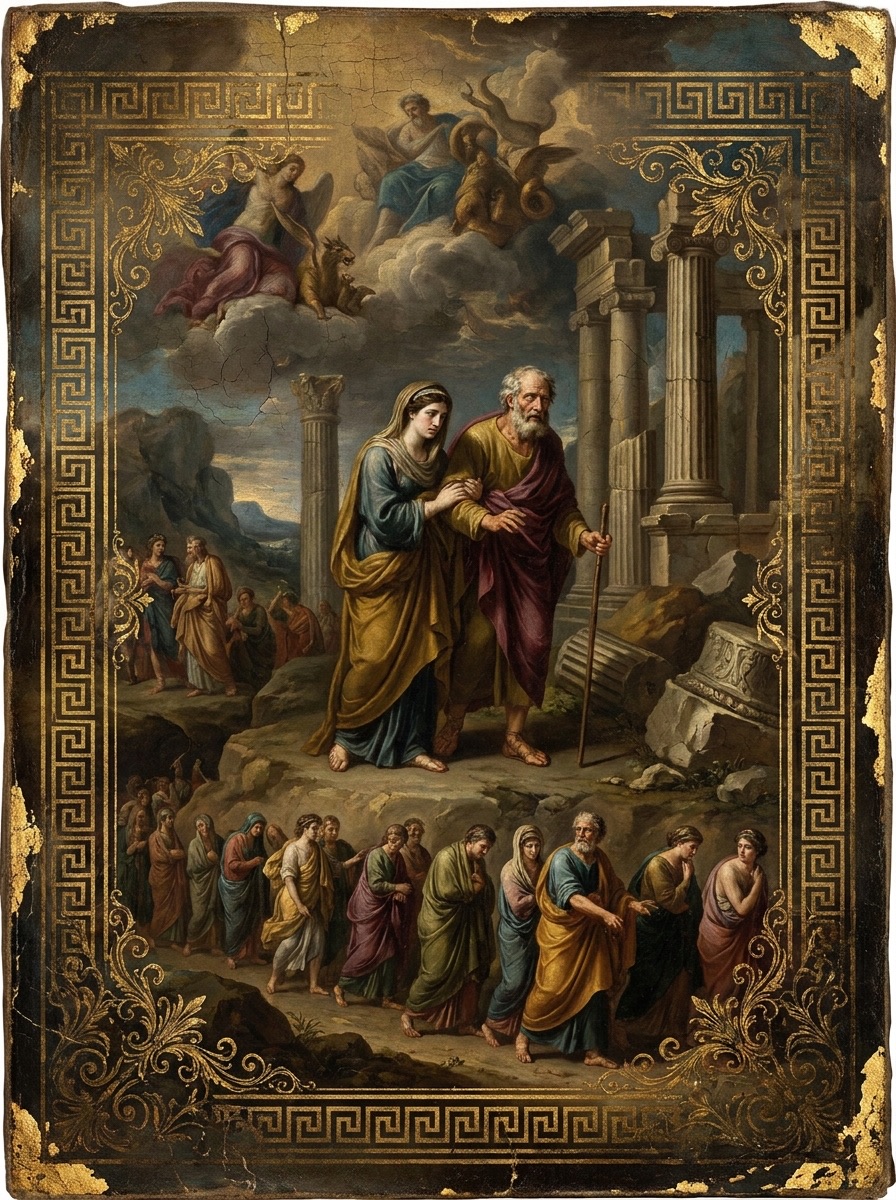
After the truth is revealed, Oedipus leaves Thebes blind and disgraced. Antigone guides him through the harsh first years of exile before the road leads toward Colonus.
Article
Summary
After the hidden truth of Thebes comes to light, Oedipus blinds himself and leaves the city in disgrace. His sons do not truly protect him, but Antigone stays beside him, guiding his steps, finding water, and bearing the shame of exile with him. This story follows their wandering before the final sacred drama at Colonus.
Leaving the City in Darkness
The palace of Thebes had once been full of life. Messengers came and went at the gates, elders approached the king with their questions, and the people laid both the sickness of the city and their hopes for deliverance upon Oedipus. But after that day, only whispers remained before the palace doors.
The truth had been dragged into the light piece by piece. King Laius had died at the place where three roads met, and the man who killed him had not been some foreign robber, but Oedipus himself, who long ago had struck back there with his staff. The infant abandoned on the mountain had not died. He had grown up, fled Corinth to escape an oracle, and still walked straight into the fate the god had foretold. He had killed his own father and married his own mother, Jocasta.
Jocasta ended her life inside the house. Oedipus rushed in and saw her hanging there, and for a moment he stood as if thunder had struck him. Then he took the golden pins from her garments and drove their points into his own eyes. Blood ran down his cheeks. Weeping, he cried that he was no longer worthy to look upon the light, upon Thebes, or upon the people he had harmed without knowing it.
From then on, there was only darkness before him.
He had begged Creon to cast him out of the city, to send him into the wilderness so that Thebes would no longer bear his pollution. Yet the matter did not end at once. Thebes still had to decide who would care for the blind former king, how long he should remain in the city, and how he should depart. Oedipus could no longer command as he once had. He felt his way along the walls, listened for the nearness of other people’s footsteps, and heard the lowered voices outside the doors.
His sons, Eteocles and Polynices, had grown to manhood, but they did not hold up their father as sons should. The throne, the gates, the weapons, and the minds of men gradually mattered more to them than the hand of a blind old man. Oedipus remembered it all. His temper had always been fierce, and now suffering had sharpened his words like stones rubbed smooth and cold.
The one who remained beside him was Antigone.
She was still young, but she no longer lived like a maiden hidden in the women’s rooms of a palace. She took her father’s hand and set it upon her shoulder. She told him where the steps were, where the threshold lay, whether loose stones waited in the road. When people slipped away from them at street corners, she heard it, but did not turn back. When someone whispered, “There goes the cursed man,” she only steadied her father more firmly.
At last Oedipus left Thebes. It was not a king’s procession out of the city. There were no chariots, no trumpets, no armored attendants. There was only an old man, his white hair grown wild, the marks of blood still around his hollowed eyes, and a daughter leading him slowly through the familiar gates.
Antigone Leads Her Father
Once they had left the city, the road grew harder.
By day, the sun beat down overhead. Oedipus could not see the light, but he could feel the heat rising from the stones like the breath of an oven. Antigone wiped the sweat from his face with the edge of her garment and helped him avoid ruts and broken ground. At night they stopped beside the road and searched for some sheltered place to rest. She spread dry grass on the earth, seated her father first, and then went to look for water nearby. Sometimes there was only a little muddy spring water, and even then she brought it to him before she drank.
They crossed the borders of many cities. When people heard the name Oedipus, fear often came into their faces. Once that name had meant wisdom and kingship, for he had solved the riddle of the Sphinx and saved Thebes from being devoured by the monster. Now the same name carried the weight of parricide, incest, and disaster. Some gave them a drink of water but would not let them stay; some let Antigone take a loaf of bread and then hurriedly shut the door; others pointed out the road from a distance, as if they feared even their shadows might fall across the household threshold.
Oedipus could hear these things. At times he was silent for a long while. At other times he flared into anger and cursed those who had abandoned him. Antigone did not argue with him. She knew that his rage held pain, shame, and the loneliness of having no one to depend on. When his breath grew harsh, she only reminded him softly that there was a root ahead, a stone step to the right, and that he must go slowly.
So the years wore away upon the road.
Oedipus’ clothes became ragged, and his staff was polished smooth by use. He had once sat on the throne of Thebes while men came to report to him; now he relied on his daughter to tell him from which side the morning wind was blowing, and whether the mud beneath his feet was dry or wet. Yet one thing still burned within him. He remembered that an oracle had said the place where he finally came to rest would bring benefit to that land, while those who had pushed him away and later sought to use him would not gain what they desired.
Antigone had heard these words too. She did not fully understand where the gods had appointed the end of his journey. She only knew that while her father lived, she would go on leading him.
Toward the Last Resting Place
Stories later bring Oedipus to Colonus, where Athens and the gods receive the end of his life. This entry stops before that final sacred drama. Its concern is the long road itself: the old king without sight, the daughter who does not abandon him, and the bitterness gathering behind them in Thebes.