Greek Mythology
Odysseus’ Revenge — Greek Mythology
After Odysseus returns to Ithaca, he still keeps the disguise of a beggar and sees with his own eyes how the suitors have wasted his house. When Penelope brings out the great bow, he seizes his moment, shuts the palace doors, and demands blood payment from the arrogant men who have wronged him.
Article
Summary
Disguised as a beggar, Odysseus returns to his own palace and sees the suitors occupying his hall and devouring his wealth. He endures insults and blows without revealing himself too soon, while he and the loyal few—Telemachus, Eumaeus, Philoetius, and others—secretly prepare, removing the weapons from the great hall. Pressed to the end of her endurance, Penelope brings out the great bow Odysseus left behind. She declares that whoever can string it and shoot an arrow through twelve axes shall have her hand. One suitor after another tries and fails. At last the beggar asks to test the bow; he strings it easily and sends the arrow clean through the axe-heads. Odysseus casts off his disguise. He shoots Antinous first, then refuses Eurymachus’ plea for mercy and compensation. The doors are locked, the weapons on the walls have been hidden, and the suitors fall into panic. Though the treacherous servant Melanthius manages for a time to smuggle weapons to them, Odysseus, his son, and his loyal servants, with Athena’s help, kill all the wrongdoers. After the revenge, Odysseus cleanses the palace and punishes the servants who betrayed him. Penelope at first cannot believe that he is truly her husband, so she tests him with the secret of their marriage bed. When Odysseus speaks of the bed built around the living olive tree, husband and wife are reunited at last. Later, when the suitors’ kin try to renew the bloodshed, Athena stops both sides, and peace returns to Ithaca.
The Beggar in the Palace
When Odysseus came back to Ithaca, he did not arrive in a king’s robe, nor with a fleet behind him and spoils piled high. He wore ragged clothes, an old pouch hung from his shoulder, and Athena had made his face lean and weathered, like that of a beggar who had spent years wandering along beaches and mountain roads.
First he stayed with the loyal swineherd Eumaeus. Later, when his son Telemachus returned from Sparta, father and son recognized one another in the swineherd’s hut. Outside, the pigs rooted in the mud; inside, a grave decision was made in whispers: the suitors must die. Odysseus warned his son not to betray anything in the palace. When he entered in beggar’s guise, Telemachus must not rush to defend him if he was insulted, nor draw his sword if he was struck. Telemachus listened to his father’s voice with grief and joy struggling in his heart, and only nodded his consent.
The next day they went into the city separately. Telemachus returned to the palace first. Odysseus followed Eumaeus, leaning on a wooden staff, and slowly walked the road he knew so well. He saw his own fields, stone walls, and courtyard gate; he saw the property that should have been under his care fallen into other men’s hands. At the palace entrance, an old dog lay beside a dung heap, ears drooping, his body covered with fleas. This was Argos, the hunting dog Odysseus had once raised with his own hands. Twenty years had passed, and the dog could no longer run; but when he heard his master’s voice, he lifted his head and wagged his tail. Odysseus dared not stop. He hid the tears at the corners of his eyes. Argos had recognized his master, and then he died.
The palace was full of noise. The suitors sat beside the long tables while servants brought in roasted meat and filled cup after cup with wine. Bones of cattle and sheep littered the floor; grease smoked near the hearth. These men ate Odysseus’ livestock and drank Odysseus’ wine, yet behaved as though they were the masters of the house.
When the beggar entered, many of them laughed. Telemachus held down his anger and ordered that food be given to him. Odysseus took his broken bowl and went from table to table, stretching out his hand like a man begging for scraps. He was not doing it for food. He wanted to see every face clearly and hear the tone of every voice.
Some tossed him a piece of meat; others called him a rogue. The most insolent of all was Antinous. He sat at the feast with a cup in his hand, and when he heard the beggar ask for food, he not only refused him but mocked him for still wandering from place to place in old age. Odysseus answered quietly that he, too, had once had a house and wealth, until disaster stripped everything away. Antinous grew angrier at this, snatched up a footstool, and hurled it at him. It struck Odysseus on the shoulder.
Odysseus stood firm and did not fall. Like a stone sunk deep under water, he forced his fury down. Some at the feast thought Antinous had gone too far, fearing that the beggar might even be a god in disguise, come to test the hearts of men. Yet they only said so; they stayed where they were, eating and drinking, and not one of them truly left the table.
Plans in the Night
After evening, the suitors departed and the palace grew quiet. Odysseus and Telemachus set to work, carrying away the shields, spears, and helmets that hung along the walls. The bronze weapons flashed coldly in the firelight. Telemachus took them down one by one, and Odysseus received them beside him. If anyone asked, Telemachus was to say that the smoke would spoil the weapons, and that drunken men might seize them in a quarrel and do harm.
They hid the arms in an inner room, leaving only a few pieces ready for their own use. Then, when the time came to strike, the suitors would not be able to snatch spears from the wall and fight back.
Late that night Penelope came down from her chamber. She still did not know that this beggar was her husband. For twenty years she had waited day and night, hoping Odysseus would return while the suitors pressed her to marry again. Once she had woven a shroud for Laertes, working at it by day and unravelling it by night, using that trick to delay the wedding. But a maid had betrayed the secret, and she could put them off in that way no longer.
She sat by the fire and asked the stranger where he came from and whether he had heard any news of Odysseus. Odysseus invented a tale about a Cretan life and said that he had once seen Odysseus and knew he was still alive and would return. Penelope listened, and tears fell upon her robe. She dared not believe him fully, yet she could not bring herself to reject the hope altogether.
The old nurse Eurycleia was ordered to wash the beggar’s feet. She brought a bronze basin, poured in warm water, and knelt to cleanse him. When her fingers touched his leg, she suddenly felt an old scar. It was the wound Odysseus had received as a young man while hunting, when a wild boar’s tusk tore his flesh. Eurycleia started and nearly cried out. Odysseus at once seized her by the throat and whispered that she must keep silent. The old nurse, with tears in her eyes, nodded her promise.
That night the wind sounded outside the palace, but inside it was as though fire lay buried beneath the floor. Odysseus slept in the entry hall and heard the maidservants slipping away to meet the suitors. Anger surged in him. He wanted to rush out at once and kill them, but he forced himself to endure. The hour had not yet come.
Penelope Brings Out the Great Bow
The next day Penelope entered the hall. She had thought of a way forward. She ordered her maids to bring from the inner chamber Odysseus’ great bow and twelve axes.
No one had strung that bow for many years. Its body was hard, and its cord had been kept in a case. It had belonged to Odysseus, a weapon he left behind before he sailed to war. Penelope stood before them all. Her voice was sorrowful, but clear. Whoever could string the bow and shoot an arrow through the holes of the twelve axes, she said, would be the man she followed from this house.
The suitors stirred with excitement. They had waited so long, and now they thought the queen and the kingship were at last within reach. Telemachus stepped forward first to try. He set the axes upright, one after another, and took up his father’s bow. Three times he strained at it, but could not set the string. The fourth time he nearly had it drawn, when Odysseus, from a distance, gave him a sign with his eyes. Telemachus understood. He stopped at once and, laughing, said he was still young and lacked the strength.
Then the suitors came forward one by one. They held the bow in their hands; some pressed it against their knees, some rubbed it with their palms, some called for fat to soften the horn ends. But the bow remained unyielding, as if it were alive and would not bend. These men, who had boasted loudly day after day of their strength, now flushed red, sweated at the brow, and trembled in the arms.
Antinous refused to admit defeat. He told them to offer sacrifice first and try again the next day. Just then, however, the beggar sitting near the door spoke. Might he also handle the bow? he asked. He did not want to contend for the marriage; he only wished to see how much of his old strength remained.
The hall broke into laughter and abuse. The suitors said wine had muddled his wits if a beggar thought he could touch the king’s bow. But Penelope said that since he only wished to try it, he should not be prevented. At that moment Telemachus stood up, and his voice suddenly carried the authority of a master in his own house. He asked his mother to go upstairs; weaving and the ordering of the maids were hers to oversee, but the bow and the affairs of men were his concern.
Penelope looked at her son in astonishment, but she did not argue further. She went back upstairs with her maids, not knowing what was about to happen below.
The Doors Are Shut
Odysseus had already given quiet orders to the loyal cowherd Philoetius and the swineherd Eumaeus to guard the entrances. The great doors were shut, and the courtyard gate was barred. The maidservants could no longer come and go freely, and the suitors did not notice that danger had closed in around them.
Eumaeus carried the bow to the beggar. Another wave of mockery ran through the hall. Odysseus sat with his head lowered, like an old man turning over some long-kept object. First he examined the bow carefully to see whether worms had eaten into it; then he tested the horn at either end. After that, lightly and calmly, he set the string in place, as naturally as a skilled musician stringing a lyre.
The bowstring rang out, clear and bright.
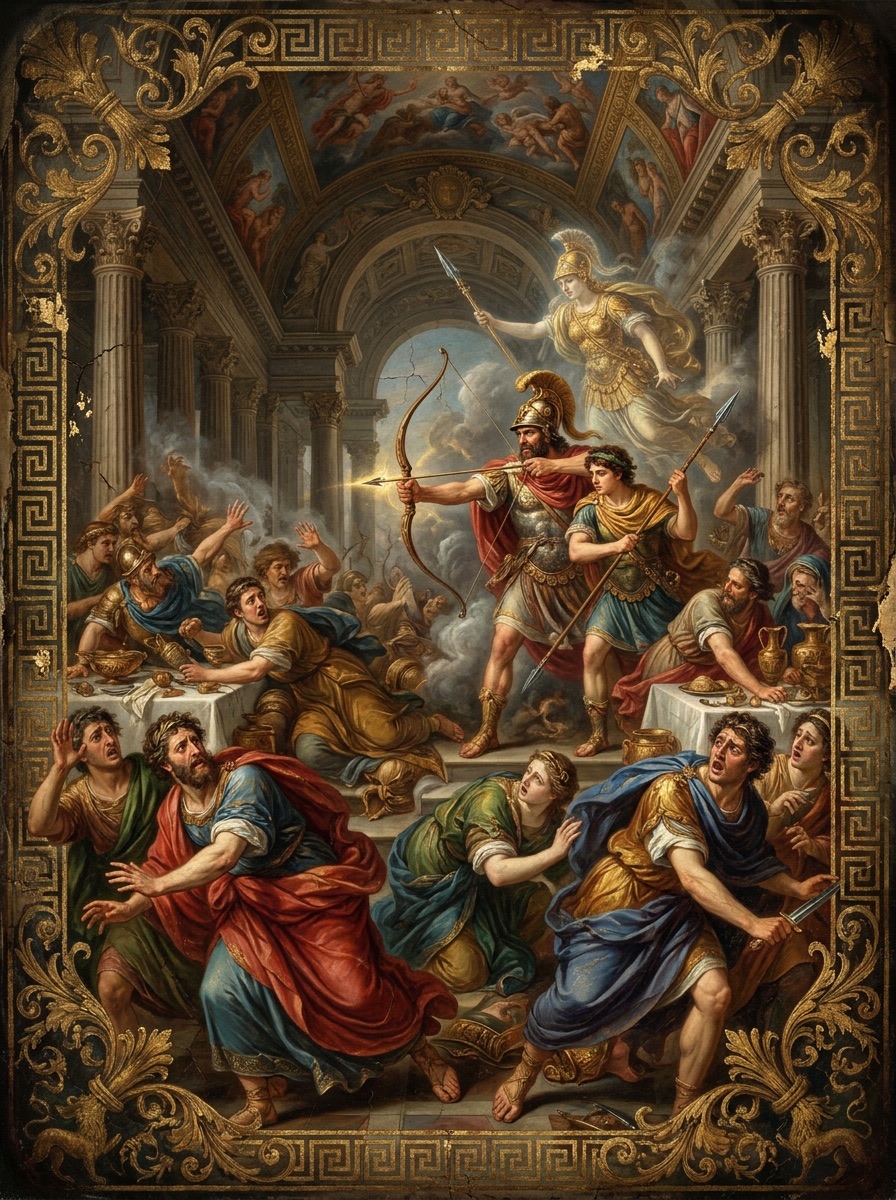
The laughter in the hall ceased. Some faces changed. Outside, thunder suddenly rolled, as though Zeus were answering from on high. Odysseus raised an arrow, aimed along the line of axe-heads, released it, and the shaft flew straight through all twelve holes without swerving.
Telemachus at once girded on his sword and took his place beside his father.
Odysseus no longer bent his back. He stripped off his rags, leapt onto the threshold, and poured the arrows from the quiver at his feet. When the men saw his eyes, they felt that the beggar had changed before them, like a lion long absent returning to his own den.
His first arrow flew at Antinous.
Antinous was lifting a cup, its rim not yet away from his lips. The arrow pierced his throat. Wine and blood gushed out together, and he fell backward beside the table, kicking over the food. At first the suitors thought the beggar had killed a man by accident. They shouted and cursed, demanding his life in payment. But when they turned to look for the weapons on the walls, they found that the shields and spears were gone.
Then Odysseus cried out his own name. He told them that he was Odysseus, the man they had believed dead in a distant land. They had consumed his wealth, forced themselves upon his wife, plotted against his son—and now the price had come due.
Blood in the Hall
Terror broke the suitors’ courage. Eurymachus tried to plead for mercy. He laid the blame on the dead Antinous and said the rest would repay Odysseus with cattle, gold, and bronze if only he would spare their lives.
Odysseus would not accept it. For twenty years he had lost his companions on the sea and suffered hardship in foreign lands, while these men sat in his house day after day doing evil—and now they hoped to buy back their lives with goods. He drew the bow, and his second arrow struck Eurymachus down.
Another suitor, Amphinomus, rushed forward with his sword drawn. Telemachus met him and drove a spear into him. Then Telemachus ran to the inner room and brought out shields, helmets, and spears, arming his father and the two loyal servants. But in his haste he made a mistake: he forgot to shut the door securely again.
The disloyal goatherd Melanthius slipped in and smuggled weapons out to the suitors. At once the danger sharpened. When Odysseus saw shields and spears in his enemies’ hands, he understood that someone had helped them from within. Eumaeus and Philoetius pursued Melanthius, seized him, bound his hands and feet, and hoisted him up against the rafters so that he could do no more.
In the hall the battle burst fully open. The suitors’ spears flew, striking doors and pillars; some glanced off the edges of shields. Athena appeared in the likeness of Mentes and rebuked Odysseus for not yet showing the courage he had shown when he fought at Troy. Then, like a swallow, she flew up to the rafters and watched from the darkness.
Odysseus and Telemachus stood shoulder to shoulder, with the two faithful servants guarding their flanks. They waited until their enemies’ spears had missed, then hurled their own together. One suitor after another fell in blood. Tables overturned, platters of meat rolled across the floor, wine jars shattered, and the firelight flashed on bronze and on men’s faces.
The suitors fled in confusion, but there was nowhere to go. The doors were shut, the weapons were few, and fear had eaten away their courage. Some hid behind pillars; others tried to clasp Odysseus’ knees and beg for mercy. The bard Phemius and the herald Medon had not joined in the crimes, and Telemachus pleaded for them; Odysseus spared their lives. The rest fell one by one.
When the last shout died away, only heavy breathing remained in the hall, with the smell of blood and the slick ground underfoot. Odysseus looked over the room full of bodies and did not laugh. He merely ordered the old nurse to summon the maidservants who had betrayed their master.
Cleansing the Palace
Eurycleia entered the hall and saw the suitors lying in heaps. Astonishment and joy rose in her, and she was about to cry out in triumph. Odysseus stopped her. One should not boast over the dead, he said; the gods and the men’s own wicked deeds had brought them down.
The unfaithful maids were called in. When they saw the blood on the floor, their knees weakened with fear. Odysseus ordered them first to carry the bodies out beneath the portico, then to wash the tables, chairs, and floor. They rinsed with water and scrubbed with sponges, wiping the blood from the stone. When everything had been set in order, Telemachus led them out and punished them according to their guilt.
Melanthius did not escape punishment either. The goatherd who had insulted Odysseus and helped the suitors was dragged out to pay for his betrayal.
Afterward Odysseus ordered the hall purified with sulfur and fire. Smoke wound among the rafters and covered the smell of blood. The maidservants rekindled the hearth and set the chairs in order. The palace was still the same palace, but it had been wrested back from the riotous noise of the suitors.
Penelope’s Test
Upstairs, Penelope heard the news: Odysseus had returned and had killed the suitors. She could not believe it at once. For twenty years there had been too many false reports and too many dreams. Slowly she came down and saw a man sitting by the fire, washed clean of the beggar’s grime but still marked by storm and hardship. She looked at him, her heart surging, yet she stood still.
Telemachus grew impatient and reproached his mother for being so cold. Penelope did not answer at once. She wanted a sign that only she and Odysseus could know. So she ordered a maid to move their marriage bed outside, so the guest could rest.
At those words Odysseus’ face changed. How could that bed be moved? he demanded. Long ago, with his own hands, he had made one bedpost from a living olive tree, whose roots still grew in the earth. He had built the bedroom around the trunk and joined the bed frame to it. Unless someone had cut the roots, no one could carry that bed away.
When Penelope heard this, she could hold back no longer. No outsider could know that secret. She ran to him and threw her arms around her husband, her tears falling on his neck. Odysseus held her too, like a castaway at last grasping land.
That night they spoke for a long time. Penelope told how she had delayed the suitors and feared for her son’s life. Odysseus told how he had left Troy, how he had met giants, goddesses, storms, and waves, and how he had come alone to his own threshold. The night should have been short, but Athena lengthened it, so that the long-parted husband and wife could slowly tell out the sorrows of twenty years.
After the Revenge
When dawn came, Odysseus knew the matter was not entirely finished. The suitors all had fathers and brothers, and their kin would not easily swallow the deaths. First he went into the countryside to see his aged father, Laertes. The old man, dressed in worn clothes, was working in the orchard, his face full of grief. Odysseus tested him with a few words; when he saw that his father’s sorrow was too heavy to bear, he revealed himself and named the fruit trees Laertes had given him when he was a child. Only then did Laertes believe that his son had truly returned.
Before long, the suitors’ relatives gathered, took up weapons, and came to the place where Odysseus and his family were, seeking revenge for the dead. Though Laertes was old, he put on armor and stood beside his son and grandson. Battle was about to begin again.
Athena did not wish Ithaca to go on bleeding. With Zeus’ will behind her, she stopped both sides and made the men lay down their hatred. Odysseus at last regained command of his house and land. The suitors who had lorded it for years in his hall were dead; Penelope no longer had to endure forced marriage; Telemachus was no longer merely the boy men despised.
After fire and water had cleansed it, the palace of Ithaca grew quiet again. Greedy guests no longer crowded the threshold; wine cups were no longer filled for them. After his long wandering, Odysseus had come home, and in this revenge he recovered the name and honor that had been taken from him for so many years.