Greek Mythology
Father and Son Reunited — Greek Mythology
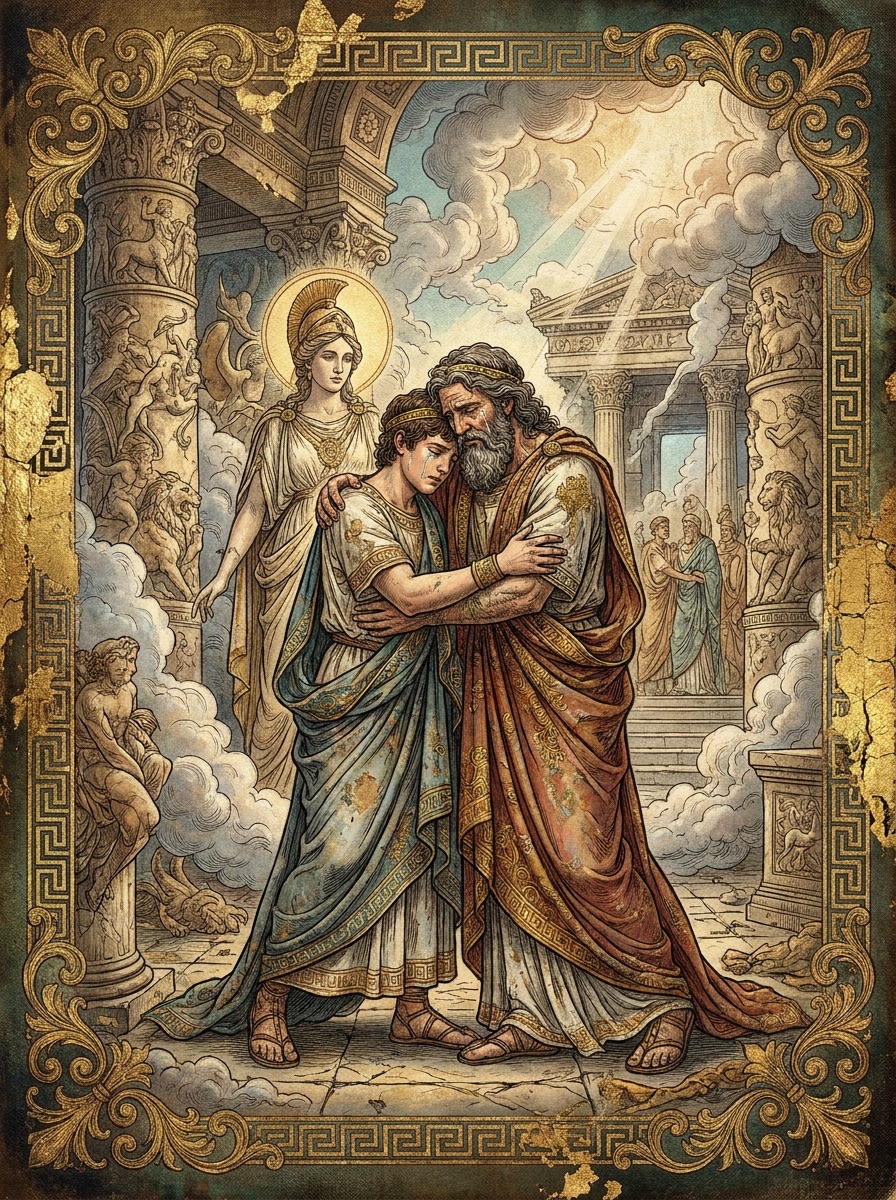
Telemachus returns from Sparta and slips into the hut of the swineherd Eumaeus, not knowing that the ragged beggar by the hearth is his father, Odysseus, long thought lost. Athena works a marvel, restores Odysseus to his true form, and father and son finally recognize each other. In that poor hut, they begin to plan their return to the palace and the punishment of the suitors.
Article
Summary
While Eumaeus is away at the palace, Athena calls Odysseus outside and touches him with her staff. At once the shabby cloak falls away, his bent back straightens, and he stands there in the full majesty of a king. Telemachus first thinks he must be facing a god, but Odysseus tells him the truth: he is his father returned at last. The two throw themselves into one another’s arms and weep for the years they have lost. Odysseus soon masters his grief, for the suitors still feast in the palace and the hour of vengeance has not yet come. Father and son speak quietly of what must be done next, and Odysseus makes clear that disguise is still necessary. Their first task is to hide the weapons in the hall. The spears, shields, and helmets must be taken down and put away in an inner room, so the suitors cannot seize them in a drunken quarrel. Telemachus must make up a reasonable excuse and keep the matter secret. By dawn, the larger plan is fixed. Odysseus will enter the palace as a beggar, endure the insults of the suitors, and wait for the right moment. Telemachus will return home as though nothing has changed, keep his counsel, and trust Athena while he watches the house. What looked like a chance meeting in a swineherd’s hut becomes the first sure step toward the fall of the men who have devoured Odysseus’s home.
The Swineherd’s Hut
A cold mist often clung to the coast of Ithaca at dawn. On the hillside, the shadows of the oaks and pear trees had not yet fully lifted, and from the pigsty came the first grunting of the herd. The faithful swineherd Eumaeus lived here, in a small hut with wood stacked against the wall, dogs at the doorway, and the pigs that Odysseus had left behind in the pen.
That day, a visitor sat inside in torn clothes. He wore an old cloak and carried the look of a man weathered by hardship, a beggar who had wandered through many cities and endured much suffering. Eumaeus spread a hide for him by the fire and set before him some meat he could ill afford to spare.
Yet this beggar was none other than Odysseus, lord of Ithaca.
He had been gone for twenty years: ten at the walls of Troy, and ten more tossed about by the sea. At last he had set foot on his own land, only to find that home was no longer what it had been. A band of suitors now filled his palace, gorging themselves on his cattle and sheep and wine, pressing Penelope to marry again. His son Telemachus had grown into manhood, but they mocked him, slighted him, and had even plotted in secret to kill him.
Athena would not let Odysseus rush straight to the palace. She had disguised him as a beggar and sent him first to Eumaeus, to test who still remained loyal in Ithaca and to wait until Telemachus was safely home again.
Eumaeus did not know who his guest truly was. Sitting by the fire and tending the meat in the pot, he spoke of his absent master with a sorrowful heart. If Odysseus still lived, he said, he should have returned long ago; if he had died at sea, then Ithaca had lost the one man who could hold those insolent suitors in check.
Odysseus listened in silence. His heart tightened, but he held back his tears and answered only in the rough voice of a beggar, saying that perhaps the master would yet come home.
The Son’s Return
Then, suddenly, the dogs outside fell quiet. They did not bark, but wagged their tails and ran to greet someone. Eumaeus looked up and saw a young man standing at the threshold, his travel cloak still over his shoulders and dust on his feet from the road.
It was Telemachus.
He had just come back from Pylos and Sparta. In search of news of his father, he had left Ithaca to visit Nestor and Menelaus. While he was away, the suitors had laid an ambush at sea, planning to kill him when his ship returned. By Athena’s protection he escaped the trap, landed first on a lonely stretch of the Ithacan shore, and then, as the goddess directed, came at once to Eumaeus’s hut.
When Eumaeus saw him, he was as overwhelmed as a man who has lost his son for years and suddenly sees him returned alive. He dropped what was in his hands, rushed forward, and clasped Telemachus, kissing his forehead, eyes, and hands, the tears streaming down his face.
“You are back, my dear child!” the swineherd cried. “I had thought I should never see you again. Those men in the city are wicked enough; they would not have spared you even on the sea.”
Telemachus was deeply moved as well. He steadied the old man and told him not to be so overcome, then asked after his mother and whether the suitors were still behaving as they pleased. Eumaeus led him inside and set him on a fleece.
Odysseus watched his son enter and felt the sea rise in his chest. When he left home, Telemachus had still been only a child in swaddling clothes; now he stood before him, a straight-backed young man. He longed to throw his arms around him, to speak his name aloud, but he could not. He remained seated apart, like a stranger with nowhere to go.
Telemachus noticed the guest and asked Eumaeus, “Who is this man? From what land has he come, and what ship brought him to Ithaca?”
So Eumaeus told him the story he had heard from the beggar himself and asked Telemachus to take the man in. Telemachus sighed when he heard it. It was not that he lacked pity, but his own house had already been seized by the suitors, and even the son of the master could hardly protect another man there.
“I would gladly give him clothing and food,” he said, “and I could send him somewhere else if need be. But if he goes to the palace, those men will mock him and may even strike him. I have not strength enough to keep them back.”
Hearing this, Odysseus, still speaking like a beggar, asked about the number of the suitors and whether Telemachus had no kinsmen or friends to stand with him. His words were probing, but beneath them lay anger held hard in check.
Telemachus answered that the suitors came from Ithaca and the neighboring islands, that they were many, and that each man had his own followers. He was young and alone, and his mother was caught in a cruel bind. He did not weep as he spoke, but folded his pain deep within himself.
Odysseus listened and saw at once that his son was no coward. He had only been waiting for the hour when he could strike.
The Goddess Summons Him Outside
Soon after, Telemachus asked Eumaeus to go into the city and tell Penelope that he had returned safely, but not to spread the news among the suitors. Eumaeus agreed at once, tied on his sandals, took up his staff, and set out along the road to town.
The two of them were left alone in the hut.
Then Athena came to the doorway. She did not let Telemachus see her, but revealed herself only to Odysseus. Standing outside, bright-eyed and radiant, she signaled for him to come out.
Odysseus rose and stepped into the open. Athena said to him, “The time has come. Tell your son the truth. The two of you must now take counsel together against the men who have taken over your house.”
When she had spoken, she touched Odysseus lightly with her golden staff. At once the ragged cloak vanished, and the stooped back of the old beggar straightened. His skin regained its color, his shoulders broadened, his gaze deepened, and his hair fell dark and shining at his temples. In an instant, the man worn down by shipwreck and hunger stood before her in the full bearing of a king.
Then Odysseus turned and went back into the hut.
Telemachus looked up and nearly dared not stare. The man before him was no longer the tired old stranger he had just seen; he stood now as tall and splendid as a god. Telemachus quickly averted his eyes and said, “Stranger, you were not like this a moment ago. Your clothing has changed, and your body as well. You must be one of the gods from Olympus. Have mercy on us. We will gladly offer you sacrifice.”
Odysseus came close, and his voice was no longer disguised.
“I am no god,” he said. “I am your father. For my sake, you have suffered much; for my sake, you have watched those men waste our house. Now I have returned.”
Telemachus stood frozen. He looked at the man before him as though hearing the one thing he had most longed to hear and most feared to believe.
“You cannot be my father,” he said in a trembling voice. “No mortal man can turn old and young in the space of an instant. Some god must be mocking me.”
Odysseus answered, “It is no mockery. Athena has changed my shape. When she wishes me to look like a beggar, I am a beggar; when she wishes me restored, I stand before you as I am. My child, I am Odysseus. After twenty years, I have come home to my own land.”
Tears Held Back for Twenty Years
When those words fell, the hut was silent for a moment. The fire gave a soft crackle in the ash; outside, the pigs moved restlessly; and wind slid over the hillside.
Telemachus could bear it no longer. He sprang toward Odysseus and threw his arms around the father he had known only through stories and longing. Odysseus held him just as tightly. This man who had faced giants, witches, monsters, and storms at sea, this king who had endured so many trials, now broke into tears at last.
Father and son wept in each other’s arms, like two eagles crying over an empty nest after hunters have stolen away their chicks. For years one had been driven by waves across the world, and the other had endured insult and loneliness at home. Now they had met at last in a humble swineherd’s hut, with no palace, no feast, only smoke, hide mats, and a rough wooden door between them and the world.
After a long while, Odysseus was the first to master himself. He knew that grief and joy alike must wait; the suitors were still drinking in the palace, still thinking him dead.
Telemachus wiped his eyes as well. He looked at his father with delight and dread together, and asked, “Father, there are too many of them. How can the two of us stand against such a crowd? If they once seize spear and shield, blood will run across the threshold.”
Odysseus did not rebuke his caution. He asked, “Would it still seem too little if Zeus and Athena were on our side?”
At the mention of the goddess, Telemachus’s heart steadied. Then Odysseus laid out the plan.
Hiding the Weapons
He said that when Eumaeus returned, he himself must be disguised again as a beggar. On the next day, Telemachus was to go back to the palace and sit among the suitors as though nothing had happened. Later, Eumaeus would bring the “beggar” into town. Then the suitors would surely sneer at him, hurl insults at him, perhaps even kick him or strike him with stools.
As he spoke, his eyes were calm, but beneath that calm his purpose was sharp as a blade in its sheath.
“When you see them humiliating me, do not lose your temper,” Odysseus told his son. “Even if they drag me by the feet, still you must keep yourself in hand. Say only what is gentle and try to stop them. If they will not listen, let them go on with their wickedness. When the hour comes, they will pay for it.”
Telemachus nodded, though he knew how hard that would be. To watch his father be abused and not spring forward was harder than bearing insult himself.
Odysseus then told him that once he was back in the palace, he must find a way to hide the weapons from the hall. Spears, shields, and helmets hung there within easy reach, and if the suitors could seize them in a moment, the danger would be great. Telemachus should say that the smoke of the hearth had blackened the arms, or that he feared drunken quarrels might turn to murder, and so had them carried into the inner rooms, leaving only the few pieces father and son would need.
“And if they ask why you did it,” Odysseus said, “tell them that weapons should be kept in order and not left for drunken hands to grasp. Remember this above all: tell no one. Not even Penelope for now. As for the servants and handmaids, I must first test their hearts myself.”
Telemachus listened and began to understand. His father had not survived by force alone. He was like a seasoned hunter, already setting his net strand by strand.
The two of them then went over many smaller points: whom they could trust and whom they must watch; how to speak once inside the palace and when to keep silent; how to endure insults; how to act when Athena gave the signal. Outside the hut, evening slowly gathered, and the sea wind carried the smell of salt across the hillside.
Still in the Guise of a Beggar
When they had finished speaking, Athena changed Odysseus back into his former appearance. The broad shoulders disappeared beneath the ragged clothing, the shining hair went gray, and the lines returned to his face. Once more he was the old beggar warming himself by the fire.
Not long after, Eumaeus came back from the city. He noticed nothing of what had passed in the hut, and merely brought Telemachus the news from the palace: Penelope had learned that her son was safe and had been comforted; the suitors, hearing that their ambush had failed, were burning with anger.
Telemachus sat beside his father, yet could not call him father. Odysseus kept his head lowered as well, still every inch the poor guest. Only the two of them knew that Ithaca’s fate had already begun to change within that plain little hut.
Night fell. The swineherd’s fire kept burning. Outside, the pigs grew quiet, and below the hill the sea moved darkly in the night. The tears of recognition had dried, leaving behind something heavier and harder: a silent promise to endure until the right moment, and then take back the palace from the suitors’ grasp.