Greek Mythology
Odysseus Returns to Ithaca — Greek Mythology
Odysseus falls into deep sleep aboard the ship of the Phaeacians and is at last brought back to Ithaca. Yet his homeland has been overrun by Penelope’s suitors, and Athena changes him into the likeness of a beggar, sending him first to hide in the hut of the swineherd Eumaeus while he waits for his son Telemachus to return.
Article
Summary
The Phaeacians keep their promise and carry Odysseus back to Ithaca by night. He sleeps deeply on the ship, and before he wakes they set him down near a cave with the bronze, clothing, gold, and gifts they have given him. As the sailors return home, Poseidon is angered that they helped Odysseus. He turns their ship to stone just as it nears Scheria, making the Phaeacians understand that divine anger has reached them. When Odysseus wakes on the shore, Athena has wrapped Ithaca in mist, so he does not recognize his own land. He first counts the Phaeacian gifts and sees that nothing has been stolen, then fears he has been set down in yet another strange country. Athena comes to him in the form of a young herdsman and listens while he carefully invents a Cretan exile's story, testing his cunning and keeping him from revealing himself too soon. Athena then shows her true form. She tells Odysseus that this is indeed Ithaca, that the suitors are devouring his house, and that Penelope still resists them. Together they hide the treasure in the cave of the nymphs and plan the recovery of the palace. The goddess then changes Odysseus into an old, poor beggar so that he can approach loyal servants and enemies without being recognized. Following Athena's direction, Odysseus goes to the hut of Eumaeus the swineherd. Eumaeus does not know that the old stranger is his master, yet he gives him food, a cloak, and a place to sleep according to the law of hospitality. He condemns the suitors for wasting the house and mourns the missing Odysseus, even while doubting every wanderer who claims to bring news of him. Odysseus sees that this poor servant is more faithful than many people inside the palace. Meanwhile Telemachus, urged by Athena, returns from Sparta, avoids the suitors' ambush at sea, and comes first to Eumaeus' hut. The swineherd welcomes the young master with joy and is then sent to the palace to reassure Penelope. When father and son are alone, Athena restores Odysseus to his true appearance, and he reveals who he is to Telemachus. The return to Ithaca does not begin with a king entering openly through his doors, but with recognition and a revenge plan in a swineherd's hut.
The Sleeping Man Is Carried Ashore
The ship of the Phaeacians left Scheria in the night. Long and dark, it skimmed the sea like a bird flying close over the water. The sailors sat along both sides of the vessel, and the oar-blades dipped and rose, parting the sea, which closed again behind the stern. Odysseus lay on board with soft blankets beneath him. For so long he had not known safe and untroubled sleep; scarcely had he shut his eyes before a deep darkness of rest overcame him.
He did not know how many sea-roads the ship crossed, nor how the starlight shifted above his head. The Phaeacian sailors knew the winds and hidden currents well. They did not wake him, but bent steadily to their oars. Before full daylight, the ship had drawn near Ithaca. By the shore lay a quiet harbor, its waters sheltered as if held in two arms. At the head of the harbor stood an olive tree, and beneath it a cave where nymphs were often honored. Stone jars and stone basins stood inside, and bees drifted through the cool shade.
The sailors brought the ship to land and first lifted Odysseus out. Still he slept heavily. They laid him carefully on the sand, then carried down the gifts that Alcinous and the Phaeacian nobles had given him: bronze vessels, clothing, gold, and finely made chests. So that no passerby would see them, they piled the treasure beside the olive tree and covered it with branches and leaves. When this was done, the sailors went back aboard, turned the prow, and prepared to return to their own country.
But Poseidon, lord of the sea, had not forgotten Odysseus. He was angry that the Phaeacians had brought this wanderer home, and he complained of it to Zeus. When the ship was almost back at Scheria, so close that the people on shore could already see it, Poseidon lifted his hand and fixed the vessel fast upon the sea. It still held the shape of a ship in motion, but it could move no farther. Slowly it became a great stone, standing in the water. The Phaeacians looked on from afar in terror, and from that day they no longer dared so readily to escort strangers on their way.
A Homeland He Could Not Recognize
When Odysseus woke on the shore, the sun had already lit the hillsides. He sat up and saw before him an unfamiliar bay, unfamiliar trees, unfamiliar rocks. To protect him, Athena had wrapped Ithaca in a thin mist, so that for a time he could not tell that this was his own land.
First he touched the garments beside him, then counted the bronze and the gold and silver. When he saw that nothing was missing, his heart grew a little steadier. Yet the more he looked around, the more uncertain he became. Striking his breast, he sighed and said, “What people’s country have I come to now? Do wild men live here, or men who fear the gods? Have the Phaeacians set me down in the wrong place?”
He dared not call out loudly, nor did he dare wander far. Years of hardship had taught him one thing: the first person seen on a shore is not always a friend.
Then Athena came. She did not at once show herself in divine form, but appeared as a young herdsman, wearing a cloak and carrying a slender spear, like a noble youth ranging through the hills to watch the flocks. When Odysseus saw someone there, he went to meet him. His heart was eager, but he did not let that eagerness show. He only asked respectfully, “Friend, tell me, what place is this? Whose city is here, and whose land?”
The young herdsman looked at him and smiled. “Stranger, you must have come from very far away if you do not know Ithaca. It is not broad, but it is famous. It has hills and rocky ground, good for raising goats; its valleys are few, but they can bear wheat and vines. Many ships have passed over the sea and heard its name.”
When Odysseus heard the word “Ithaca,” his heart seemed to catch fire. He longed to fall to his knees and kiss the earth, but still he restrained himself. He did not yet know who this youth before him might be. So he did not speak his true name, but instead wove a winding tale: he claimed to have come from Crete, to have killed a man, to have fled aboard a ship with his goods, and finally to have been put ashore in this place.
He spoke calmly, and every detail sounded true: how the ship had come to land, how the sailors had gone away, how he feared his enemies might pursue him. Athena listened with a smile in her eyes. She loved this wariness and cleverness in Odysseus, for among all heroes he knew best when to tell the truth and when to hide it.
The Goddess Lifts the Mist
Suddenly the young herdsman reached out and touched Odysseus on the shoulder, and his form changed. Beneath the cloak there was no longer a mortal youth, but gray-eyed Athena. Her gaze was bright, and her voice was like wind passing over a bronze shield.
“You never change your ways,” the goddess said. “Even in your own homeland, you must first invent a story. Yet I do not blame you. Among mortals you are famed for prudence and cunning, and among the gods I too know how to shape a plan. Now you need test no further. This is Ithaca.”
With that, she scattered the mist. The hillside, the harbor, the cave, and the olive tree all stood clear before him. Odysseus saw the familiar land, and tears rushed into his eyes. He knelt down, caught up a handful of earth, and kissed his homeland. When he had left this place, he had been a king sailing to war with his ships; now he had returned like a wanderer cast up by the waves. Twenty years had passed, and at last he stood again on the stony ground of Ithaca.
Athena did not let him remain long in joy. She told him that his palace had fallen into disorder. Many young nobles were living in his halls, slaughtering his cattle and sheep every day, drinking his wine, and courting his wife Penelope. Believing Odysseus dead at sea, they pressed the queen to marry one of them so that they might divide his household and his kingship.
When Odysseus heard this, his face grew cold. He did not rush at once toward the palace. He knew that if he burst in on a wave of anger, he would die on his own threshold. The suitors were young and many; they had swords in their hands and servants around them. He had only just reached the shore, and he did not yet know who remained loyal and who had betrayed him.
Athena thought the same. She helped him carry the Phaeacian gifts into the cave of the nymphs, then blocked the entrance with a great stone. The gold, bronze, and clothing would be hidden there until the matter was settled. Then the goddess lifted her wand and lightly touched Odysseus.
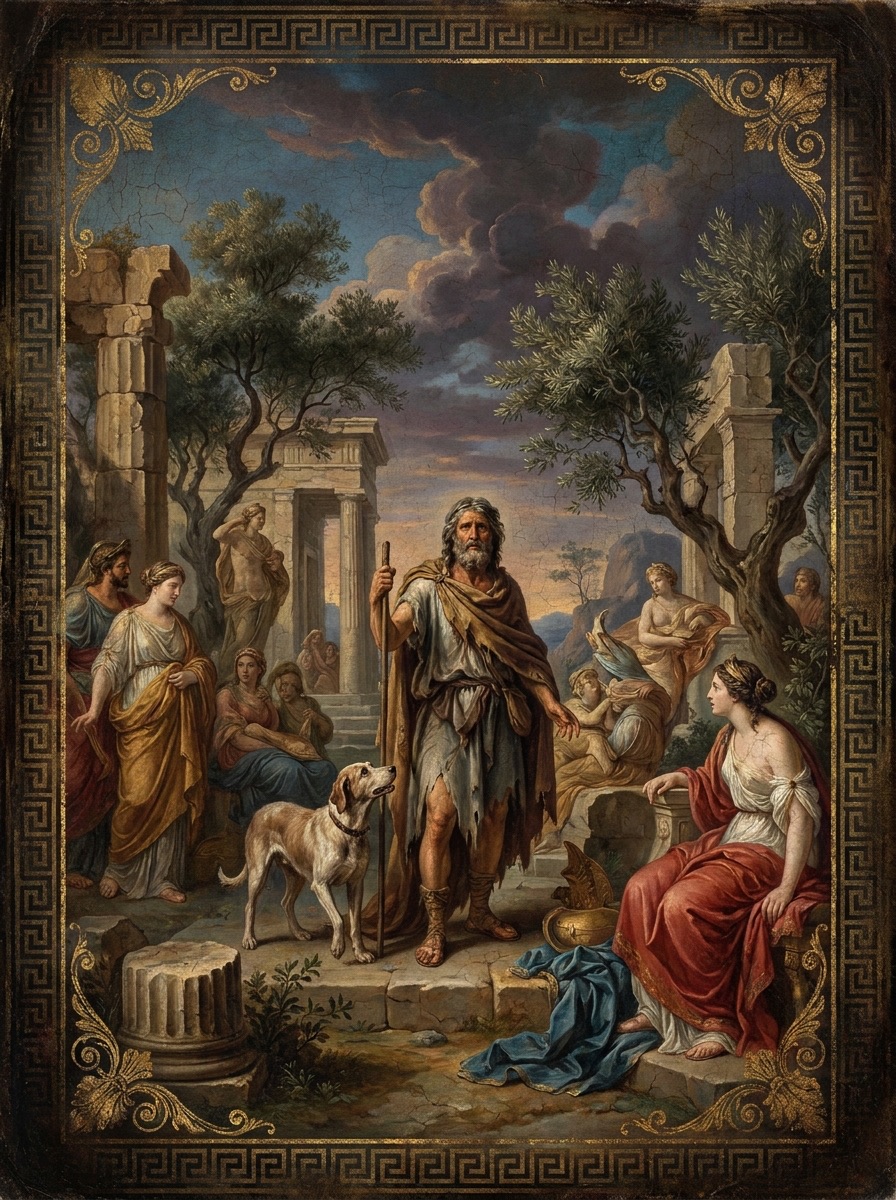
At once his skin shriveled; his shoulders stooped; his hair grew thin and gray. Around his eyes appeared the marks of long hunger and weather. His fine clothing turned into filthy rags, and over them hung a dirty animal skin. In his hand there was now a wooden staff for the road. The king who had stood there vanished; in his place stood an old beggar whom no one would care to look at twice.
“Go first to the swineherd Eumaeus,” Athena said. “He still remembers you. He tends your swine and has pity for your son. Telemachus is still abroad seeking news of you, but I will bring him back. Once father and son have met, you can decide how to deal with those men.”
Odysseus nodded. He held down the anger in his heart and went into the hills by the road the goddess had shown him.
The Loyal Swineherd
The paths of Ithaca were rough, the stones hard and sharp. Leaning on his staff, Odysseus walked step by step toward the swine-pens of Eumaeus, like an old man worn down by suffering. The place lay far from the palace, enclosed with stones and thorns, and within the pens were many well-fed swine. A few watchdogs heard his steps and rushed out, barking fiercely and showing their teeth.
Odysseus did not retreat. He crouched down and lowered his staff. Just then Eumaeus came out of the hut, shouted at the dogs, and drove them off with stones. He went to the unknown old man, saw his torn clothes and dust-covered body, and led him inside.
The hut was not large, but it was solidly kept. Branches and hides lay on the floor, and embers glowed in the hearth. Eumaeus cut a piece of pork, sprinkled it with barley meal, roasted it, and gave it to his guest; then he poured wine. Odysseus sat by the fire and smelled the meat, and grief stirred in his heart. His palace was occupied by insolent men, while the one who treated him as a human being was this servant dwelling among the hills.
As Eumaeus entertained him, he spoke of his master. If Odysseus were still alive, he said, he would never let the suitors behave so outrageously; but after so many years without word, he feared his lord had died far away. As he said this, his voice fell. He did not know that the old beggar before him was his master. He was simply following the sacred custom of hospitality, giving food and a place to sleep to a stranger in need.
Odysseus listened, but did not reveal himself. He still said that he was a wandering foreigner, and even claimed to have heard news of Odysseus—that the hero might soon return. Eumaeus shook his head. He had heard too many vagrants invent such tidings in exchange for a meal or a cloak. Yet he did not drive the old man away. He only said, “Guest, I am willing to feed and shelter you not because you bring good news, but because Zeus watches over wanderers.”
Late in the night, the mountain wind blew over the swine-pens. Eumaeus gave his own cloak to the guest and went out himself to guard the best of the pigs, lest anyone steal them in the dark. Odysseus lay inside the hut, listening to the wind and to the restless movements of the swine outside, and understood more clearly than before: in this household, thrown into disorder by the suitors, there were still those who had not forgotten their old lord.
The Son Returns
Meanwhile, under Athena’s urging, Telemachus left Sparta and sailed back to Ithaca. The suitors had already set an ambush at sea, hoping to kill him on his return. But the goddess protected him, and his ship avoided the hidden danger and came safely to shore.
Telemachus did not go first to the palace. As Athena had arranged, he came to the hut of Eumaeus. When the swineherd saw his young master, he rejoiced like a father seeing a child restored after being lost; he embraced him, weeping and laughing at once. Odysseus still sat inside, wrapped in rags, like a silent old man. Telemachus was courteous to him as well and told Eumaeus to take good care of the guest.
Then Eumaeus was sent to the palace to carry word to Penelope that her son had returned safely. Only father and son remained in the hut. Athena came to the doorway, visible to Odysseus alone. The goddess beckoned him outside and touched him once more with her wand. The rags and shriveled skin disappeared; his body stood straight again, his shoulders broad, his eyes bright, like a battle-tested hero clothed once more in his own radiance.
When Odysseus came back into the hut, Telemachus started in fear. He thought the figure before him could not be a mortal man, but some god. He turned his eyes away and begged him not to bring harm. Odysseus spoke: “I am no god. I am your father. You have searched for news of me and endured the insults of those men for my sake. Now I have come home.”
Telemachus could not believe it at once. For years he had heard his father’s name only from his mother and the old men; he had never truly seen him. How could the old beggar who had just been sitting by the fire suddenly become Odysseus? He feared that a god was mocking him.
Odysseus told him that Athena had changed his appearance. Then he opened his arms. At last Telemachus rushed forward and embraced his father. The two wept together in the hut, like young eagles stolen from the nest by hunters and then returned. Outside were the swine-pens and the mountain wind; inside was the recognition for which twenty years of separation had waited.
When they had wept, Odysseus was the first to recover his calm. He asked his son how many suitors were in the palace, which servants could be trusted, and which had already gone over to them. Telemachus said that the men came from Ithaca and the neighboring islands, and that they were many. Day after day they sat feasting in the hall. He feared that father and son were too few to fight them.
But Odysseus said that if Athena and Zeus were willing to help, numbers alone would not decide the outcome. He ordered Telemachus to return first to the palace and show no sign that anything had changed. When Odysseus himself came into the hall still disguised as a beggar, Telemachus must not be quick to act, even if the suitors insulted him, shoved him, or struck him. At the proper time, Telemachus was to quietly remove the weapons from the walls, leaving only those that father and son could use.
Telemachus listened and agreed. He knew that from this moment he could no longer be merely the insulted boy. His father had returned to Ithaca, but he could not enter his own house in the likeness of a king. He must first draw near his enemies like a shadow, look into every face, and wait for the right time to let them know who had truly come home.
Odysseus put on the rags again, bent his back, and resumed the form of the old beggar. The ashes in the hearth glowed faintly red, and outside in the wild hills the light was fading. The soil of Ithaca was already beneath his feet; loyal men had been found; the son long parted from him stood at his side. Yet the palace doors had not opened, and the suitors still laughed noisily in his hall. Odysseus tightened his grip on the wooden staff and hid his anger beneath lowered eyes, waiting for the final step of his return.