Greek Mythology
Odysseus Leaves the Phaeacians — Greek Mythology
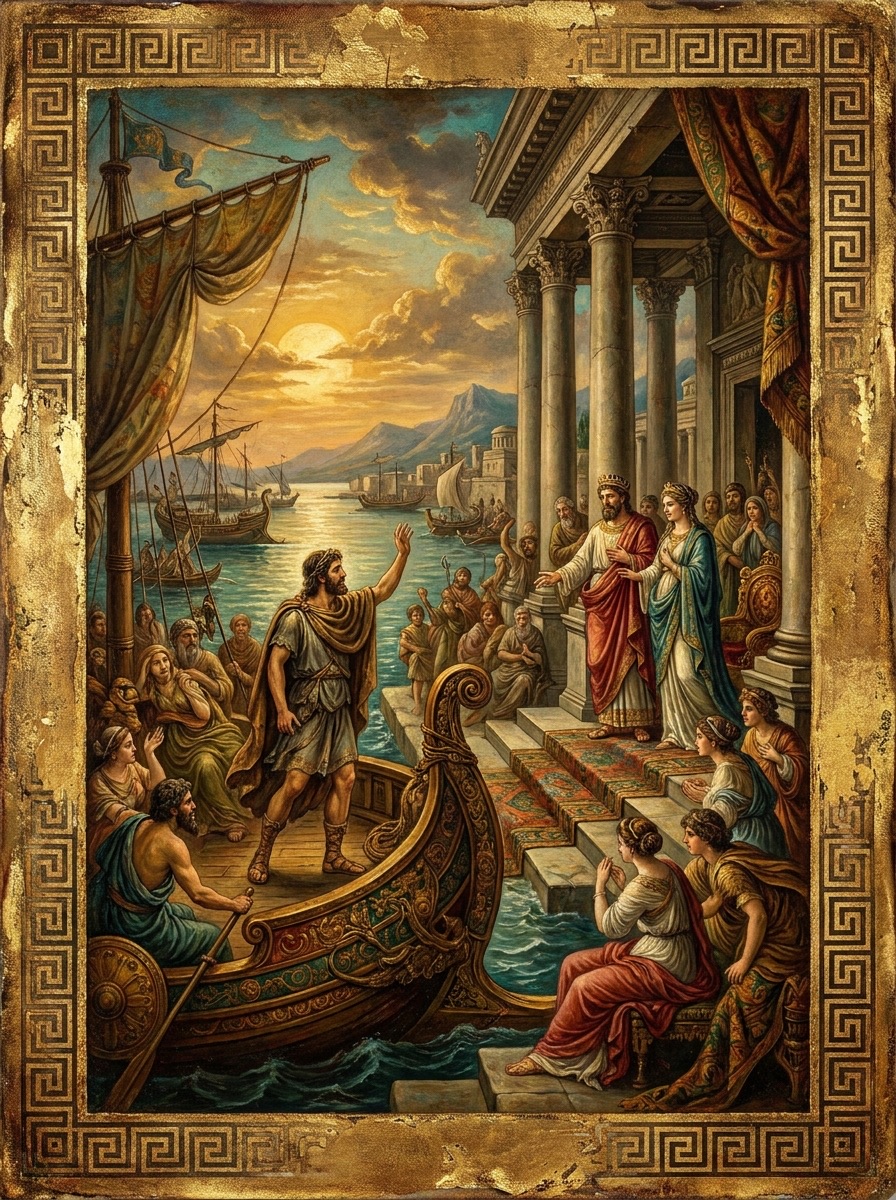
After Odysseus finishes telling the Phaeacians the story of his wanderings, Alcinous resolves to send him home to Ithaca by ship. By night Odysseus boards with his gifts and falls into a deep sleep. The Phaeacian sailors lay him on his native shore, but as their own vessel returns, Poseidon’s anger turns it into a stone ship beside the harbor.
Article
Summary
The next day, Queen Arete herself prepares his gifts, fastening the chest tightly so that no one can open it on the voyage. Odysseus bathes, changes his clothes, prays to Zeus, and takes leave of Nausicaa, the princess who once saved him by the river. He promises that, once home, he will remember her kindness forever. When night falls, the Phaeacian sailors bring him aboard their swift ship. He lies down on soft blankets in the stern and soon sinks into heavy sleep. Through the darkness the ship cuts across the sea, the rowers never resting, until at dawn they enter the harbor of Ithaca. Odysseus is still asleep. The sailors do not wake him, but lift him gently onto the shore and set his gifts beside an olive tree. As they sail homeward, Poseidon, angered that the Phaeacians have helped Odysseus, turns the ship just as it nears harbor into stone. When Odysseus wakes, he cannot at first recognize his homeland, hidden under a mist. His first thought is to count his possessions and make sure the Phaeacians have not deceived him. His long wandering by sea has ended at last: he has set foot on Ithacan soil, though danger still waits for him in his own house.
The Last Night in the Palace
When Odysseus finished speaking, a long silence settled over the hall of the Phaeacians.
The fire still burned at the center of the room. Cups stood upon the tables. The singer’s lyre had fallen quiet. These Phaeacians, lovers of song and masters of the sea, had only a little while before been drinking and talking around the long tables; now they sat with their eyes fixed on the stranger among them. Only that day had they learned that the man at their feast was no ordinary castaway, but Odysseus, king of Ithaca.
He had fought beneath the walls of Troy and then drifted for ten years over the sea. He had seen the cave of the Cyclops, escaped the witch’s drugged cup, heard the song of the Sirens, passed through straits guarded by monsters, and lost every one of his companions. Now he sat alone in the hall, clothed in garments the Phaeacians had given him, with clean ground beneath his feet; yet when his tale was done, the weather of the sea still seemed to cling to his face.
King Alcinous was the first to speak. He was not a man who took pleasure in pressing a guest’s wounds with questions, but even he was deeply moved. He told the nobles gathered there that Odysseus had suffered enough. Since he had come to the land of the Phaeacians, they must not let him risk the sea again alone.
“We are a people of ships,” the king said. “Our vessels need no pilot to point out every way; they know the thoughts of men. Tomorrow choose the best rowers, and send this guest back to his own country.”
The others agreed. Alcinous then commanded that each lord bring another gift, to make up, as best they could, for all that Odysseus had lost through the years. The Phaeacians were not poor. In the palace were bronze vessels, golden cups, finely woven robes, chests, and costly furnishings. Servants passed to and fro, setting gleaming objects aside and folding soft cloth with care.
Odysseus looked on these gifts with gratitude, yet he could not wholly let down his guard. He had lived through too many tricks and disasters; he knew that a single day at sea could ruin a man’s life. Still, Alcinous spoke plainly, and Queen Arete had treated him with true kindness. At last he raised his cup and blessed them all. He wished peace upon the king, the queen, and the Phaeacian people, and prayed that he himself might live to set foot upon the soil of Ithaca.
Arete Fastens the Chest
At dawn the palace was astir again.
Servants carried a strong chest before Odysseus and filled it with the treasures given by the Phaeacians. Queen Arete herself inspected the robes, the gold, and the bronze. She knew how much Odysseus had lost along the way, and she knew what a man returning home alone most feared: that even now, on the last stretch of the journey, thieves might rob him again. So she ordered the lid shut, took a stout cord in her own hands, and bound the chest fast.
The cord passed around the body of the chest, was drawn tight, and secured. Unless the owner himself untied it, no one could easily open it. Odysseus watched and silently noted what she did. Caution had kept him alive through all his wandering; he would not overlook even the binding of a chest.
Afterward, servants prepared water for his bath. Warm water poured over his shoulders and back, washing away the salt and dust of travel. Since he had left the island of the goddess Calypso, storms had tormented him until he had crawled almost naked onto the Phaeacian shore. Now, dressed in clean garments, he seemed to rise once more out of misery.
A feast was made ready in the palace. The company sat down again, poured wine, and offered sacrifice. Alcinous had the cup passed to the guest, and Odysseus prayed to Zeus, asking the great god to bear witness that the Phaeacians had honored him with the courtesy owed to a stranger, and asking that this voyage home be safe.
Hardly had the prayer ended when thunder sounded in the sky. It was not the broken roar that runs before a storm, but seemed rather an answer from on high. Odysseus heard it, and his heart grew steadier. If the gods would give a homeward-bound man even one sign, that was enough to help him endure the night.
Then Princess Nausicaa came before him.
She had been the one who found Odysseus by the river. On that day he was soaked with seawater and so weary he could barely stand; she had not fled from him, but gave him clothing and told him how to enter the city and supplicate the queen. Now she stood in the palace, bright-robed and attended by her maidservants, no longer startled as she had been when she first saw him.
She said softly, “Stranger, may you reach your own land in safety. When you are home, remember that I was the first to save you.”
Odysseus looked at her and answered solemnly, “Princess, if I reach the roof of my own house, if I live to offer sacrifice to the gods again, I will remember you as one remembers a goddess. It was you who gave me life.”
It was not a loud farewell, but it was a true one. Nausicaa said no more, and Odysseus did not cover the moment with empty words. Both knew that once a wanderer stepped aboard ship, the sea would soon carry the days of meeting far away.
The Night Ship Leaves Shore
After sunset, the Phaeacian sailors hauled the ship down to the sea.
It was long and light, its dark hull gleaming like some sea creature crouched beside the waves. The oars were set in order along both sides, the sail was furled, and the cables were made ready. The sailors kept Alcinous’ command in mind: let the guest suffer no further hardship, but carry him steadily to Ithaca.
Odysseus’ gifts were brought aboard. The chest, the bronze vessels, and the woven cloth were carefully stowed so they would not be damaged in the voyage. Then the sailors spread thick, soft blankets and linen sheets in the stern, making a place for the guest to sleep.
By the time Odysseus came down to the shore, night had deepened. Behind him the walls of the Phaeacian city, the palace lights, and the figures standing along the beach were fading into darkness. He turned back and took leave of Alcinous, Arete, and the people. He spoke no long speech, but once more wished them peace, and wished their land forever blessed with wine, grain, and song.
Then he boarded the ship and lay down in the place prepared for him at the stern. For many years he had rarely slept in safety. Each time he closed his eyes, some storm, enemy, monster, hunger, or god’s anger might be waiting ahead. But that night, not long after the Phaeacian ship left the shore, he fell into a deep sleep.
It was heavy as death, though it was not death. The sea wind passed along the ship’s side, and the waves softly struck the hull. The rowers sat on their benches; their blades entered the water together and rose together. The ship sped through the night as if it had a mind of its own, as if it knew the road before it.
Phaeacian ships were unlike those of other men. They did not need someone to mark every hidden reef and every bay; they could carry a guest to the place he longed to reach. The rowers bent to their work, the prow split the sea, and black water flared white on either side. Starlight shone on the wave-tips. No island rose in the distance, and no storm pursued them.
Odysseus slept. He did not know how much water the ship crossed, or when the dark hills of Ithaca first showed themselves in the dawn. For him, that night was as though the gods had lifted him gently out of suffering and set him down on the shore of home.
Morning in Ithaca
At first light, the ship reached Ithaca.
The Phaeacians brought it into a quiet harbor. It was the harbor of Phorcys, where jutting headlands on either side keep off the outer winds and waves, and the water within lies calm, so that a ship entering there has no need to cast a heavy anchor. On the shore stood a thick-leaved olive tree, and near it a deep cave sacred to the nymphs. Inside were stone bowls and jars, and stone formations fine as woven cloth; the tale was told that bees also made their dwelling there.
Odysseus still slept, like a man so worn with travel that he would not wake even at his own door.
The sailors did not rouse him. They knew that for a man who had wandered so long, the thing he needed most might be these few undisturbed moments of sleep. So they made the ship fast, went carefully to the stern, lifted Odysseus with the blankets beneath him, and laid him on the sand. Then they carried down his gifts and piled them beside the olive tree, away from the road, so that no passerby would see them and be tempted.
When all was done, the sailors boarded again. They did not wait for Odysseus to wake, nor did they call out loudly from the shore. The Phaeacians were quick and careful in sending guests on their way. Having fulfilled the king’s charge, they turned the ship’s head and sailed back toward their own island.
As they departed, Odysseus was still deep in sleep. The waves withdrew softly beside him, and morning light touched the rough land of Ithaca. In his dreams he may still have been at sea, or at the mouth of some monster’s cave, or gripping an old oar in his hands. But his body had already come home.
Poseidon’s Anger
The Phaeacian ship left Ithaca and sailed homeward.
The sailors thought the voyage had ended well. But Poseidon, lord of the sea, had long been storing up anger. Odysseus had blinded his son, the Cyclops Polyphemus, and for years Poseidon had hindered his return. Now the Phaeacians had not only received Odysseus kindly, but had carried him safely back to Ithaca in one of their swift ships. To the sea god, this was a boldness mortals ought not to possess.
Poseidon went before Zeus and complained that the Phaeacians carried travelers too freely, even bringing home a man he hated. Zeus did not bid him go on tormenting Odysseus, for the hour of return had already come; yet he did not wholly restrain Poseidon’s wrath. So the sea god went back over the water. When the Phaeacian ship was just about to enter its own harbor, he raised his mighty hand and struck the vessel.
The ship that had only moments before been racing over the sea suddenly stopped.
The oars stood motionless in the water, the prow still pointed toward the harbor, and foam still clung to the stern, but the whole vessel had become stone. It stood there by the shore like a ship that would never again make land. The men aboard were seized with terror, and the Phaeacians on shore saw the strange thing happen. Everyone understood that this was a punishment from a god.
Alcinous remembered an ancient prophecy: one day, if the Phaeacians carried a stranger home, they would anger Poseidon; the sea god would turn their ship to stone, and might even cover their city with a great mountain. The king at once ordered the glad cries of welcome to cease and commanded sacrifices to Poseidon. Bulls were brought to the altar, and the people prayed that the sea god would put away his anger and not press further disaster upon their city.
From that time on, the Phaeacians could no longer ferry distant guests across the sea as carelessly as before. The stone ship remained outside the harbor, reminding them that they had once brought home a hero who had suffered for many years, and that by doing so they had angered the god who ruled the waves.
The Man Asleep in His Own Country
On the shore of Ithaca, Odysseus at last awoke from his deep sleep.
He opened his eyes and saw unfamiliar slopes, damp sand, shadows of trees, and the mouth of a cave. The goddess Athena had spread a mist over the land so that he could not at once recognize his own country. The man who had longed for twenty years to see his doorway sat on the shore of home and thought he had been carried somewhere else.
He stood up, startled and angry, and his first thought was for his gifts. He went to the olive tree and examined the chest and the treasures the Phaeacians had given him, counting them one by one. The gold was there, the bronze was there, and the robes were there. The Phaeacians had not deceived him. They had set him ashore and left his possessions whole.
Only he did not yet know that this mist-veiled land was Ithaca.
The sea wind moved through the leaves of the olive tree. The cave lay cool and quiet. Far off, the road into the hills led toward his fields, his pastures, and the palace now overrun by the suitors. Odysseus’ wandering had at last come to land, but his house was not yet truly his again.
That night the Phaeacians kept their promise and brought a weary hero home; Poseidon, too, left the mark of his anger, turning their returning ship to stone. The story of the sea came to rest on the shore of Ithaca. Odysseus, awake now and standing in the mist, with gifts beside him and old wounds within him, stepped once more upon his own land.