Greek Mythology
Odysseus Leaves Calypso — Greek Mythology
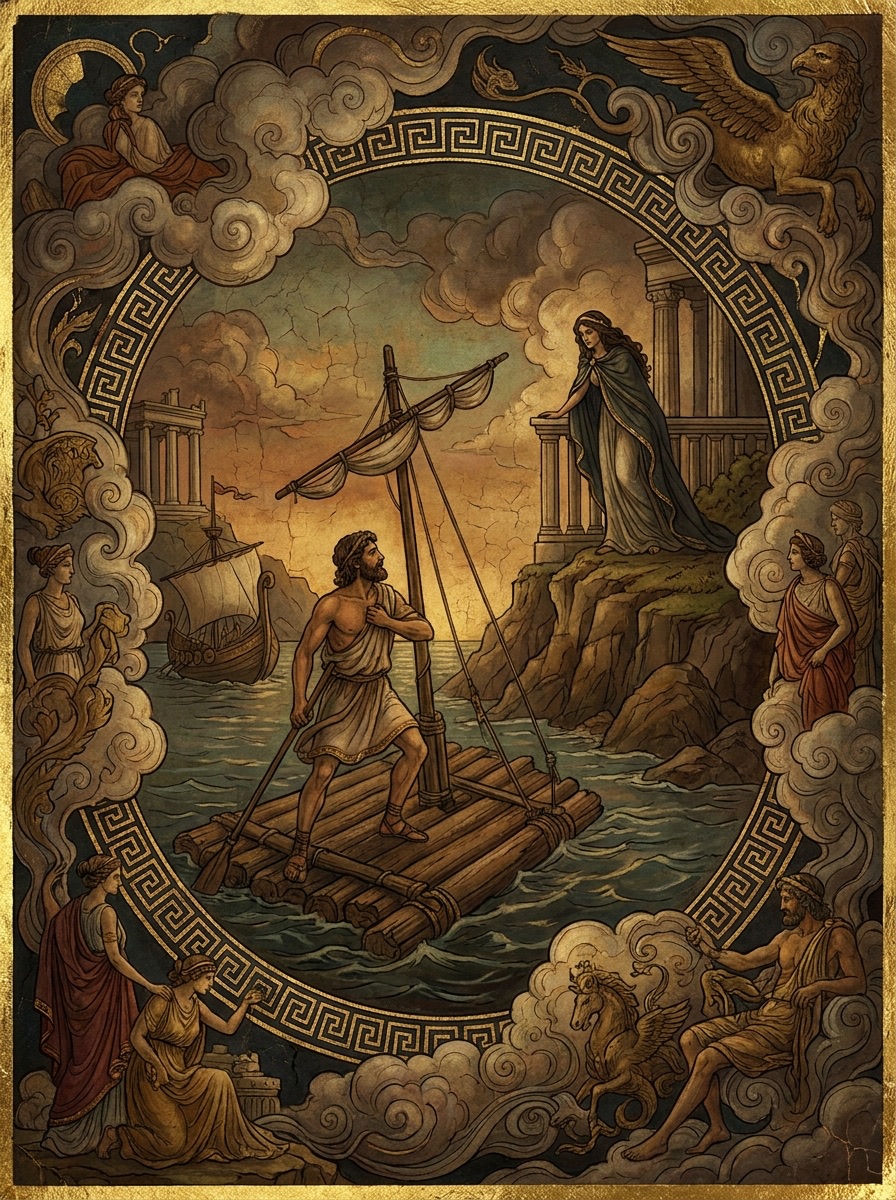
Odysseus is kept for years on Ogygia by the goddess Calypso, gazing day after day across the sea and longing for home. At last the gods send Hermes with the command that he be released. Though unwilling, Calypso helps him build a raft and leave the island, setting him once more upon the sea-road home.
Article
Summary
The Trojan War has long been over, but Odysseus has still not returned to Ithaca. After his ship and companions are lost, he drifts alone to Ogygia, where the goddess Calypso shelters him in her cave. She gives him food, clothing, tenderness, and the promise of ageless immortality, yet Odysseus spends his days weeping by the sea and thinking of Penelope, Telemachus, and his poor but beloved homeland. On Olympus, Athena speaks for him before Zeus, reminding the gods that Odysseus is trapped on Calypso’s island while suitors devour his household and press Penelope to remarry. Poseidon still hates him for the blinding of Polyphemus, but the sea god is away from the divine assembly. Zeus therefore sends Hermes across the sea to Ogygia with an order: Calypso must let Odysseus go. Hermes reaches the goddess’s cave and delivers the king of the gods’ command. Odysseus is not fated to die on that island; he must be released to seek his home. Calypso protests that the gods resent goddesses who love mortal men, and she grieves that the man she saved and cared for must depart, but she cannot defy Zeus. When she tells Odysseus he may leave, he cautiously asks her to swear that she is not setting another trap at sea. Calypso makes the oath and urges him one last time to stay, warning that the road home will still be full of storms and suffering, while she can offer safety and immortality. Odysseus admits that no mortal woman can rival a goddess, but he chooses Ithaca all the same, with its aging, danger, and mortal limits. Calypso finally ceases to resist and gives him tools, timber, and guidance so he can build a broad raft. When the raft is ready, Calypso supplies water, food, wine, clothing, and sailcloth, and teaches Odysseus how to steer by the stars. On the morning of departure, the wind fills the sail and carries him out from shore. Ogygia fades behind him, and Poseidon’s anger still waits ahead, but Odysseus is no longer enclosed in Calypso’s island: he has chosen the uncertain sea because it leads toward home.
The Man Weeping by the Sea
The walls of Troy had long since fallen, and the ships of the Greeks had long since scattered toward their homes. Yet Odysseus, king of Ithaca, had still not returned.
One by one his companions had perished on the sea, and his ship had been destroyed. At last, clinging to broken timbers, he was driven by wind and waves to an island far from the world of men. The island was called Ogygia. Deep-blue water surrounded it on every side, and the surf beat night and day against its rocks. Yet inland the trees grew thick, springs ran out from clefts in the stone, vines tangled over the mouth of a cave, and the air was often fragrant with flowers, herbs, and woodsmoke.
The one who lived there was the beautiful goddess Calypso.
She took in the man whom the sea had cast ashore. She gave him food and clothing and let him rest in her cave. Grapevines grew outside its entrance; within, a fire burned, and fragrant wood smoldered slowly in the flames. Calypso would sit at her loom, weaving with a golden shuttle, and speak softly to Odysseus. She had fallen in love with him, and she did not wish to let him go.
But Odysseus’ heart was not on that island.
By day he often went alone to the shore and sat on a wave-wet rock, staring out over the endless sea. He could not see the hills of Ithaca or the earth before his own doorway. He heard only the cry of seabirds and the waves rolling in, one after another. At night, though he lay in the goddess’s cave, his thoughts were with his wife Penelope, his son Telemachus, and that poor, stony, beloved homeland.
Calypso had told him that she could keep him forever young, untouched by old age and death. To a mortal, such a promise might seem greater than a kingdom. But Odysseus would rather return to his own house, even if hardship waited there, even if one day he must grow old and die.
He had remained on the island for many years. Year after year the sea rose and fell; year after year the woods put on new leaves. But Odysseus’ longing for home did not change.
The Decision on Olympus
At that time the gods were gathered in council on Olympus.
Poseidon, lord of the sea, was still far away and did not sit among them. Odysseus had once blinded his son, the Cyclops Polyphemus, and for that Poseidon hated him and had made him suffer terribly upon the sea. But Athena had never forgotten Odysseus. She knew his cunning mind, and she knew he had suffered too long, so she spoke for him before Zeus.
Athena said that Odysseus was trapped on Calypso’s island and could not go home. In his palace, the suitors were harassing his wife day after day, eating his cattle and sheep, drinking his wine, and pressing Penelope to marry again. If the matter dragged on much longer, the household of Ithaca would be swallowed up by those men.
Zeus listened and made his decision. He ordered Hermes to go to Ogygia and carry the king of the gods’ command to Calypso: she must no longer keep Odysseus there. She had to let him leave.
Hermes at once put on his winged golden sandals, took up the divine wand that can lull men to sleep and wake them again, and flew down from the summit of Olympus. He skimmed over the earth and crossed the sea, darting like a gull close above the wave-crests. Foam whitened beneath his feet, and the wide water stretched all the way to the edge of the sky. At last he reached the hidden island.
Calypso’s cave lay deep among the trees. Thick vines grew about its entrance, and poplars, cypresses, and fragrant woods stood all around, with birds resting in the branches. Several clear springs ran nearby with a bright sound of water. When Hermes drew near, he saw warm firelight inside the cave, and Calypso sitting at her loom, singing as she wove.
But Odysseus was not within.
As always, he was sitting by the sea, looking toward the direction of home, with tears in his eyes.
The Command Brought by the Messenger
When Calypso saw Hermes, she knew the divine messenger at once. She invited him in, set ambrosial food and nectar before him, and asked why he had come to an island so far from the paths of the gods.
Hermes did not speak in riddles. He said that he had not come idly, but by command of Zeus. Odysseus must not be kept on the island any longer. Fate had not appointed that he should die there; he still had to return to his own land. Calypso must let him go.
At these words, Calypso felt both anger and pain.
She said the gods were always harsh toward goddesses. Male gods might love mortal women as they pleased, yet if a goddess took pity on a mortal man, she was blamed. Odysseus, she said, had come to her after his ship was shattered by the thunderbolt, drifting alone to her shore; she had saved him and kept him alive. She had meant to make him deathless and let him live with her on the island forever. But since Zeus had given the order, she could not defy him. Still, she had no ship and no sailors, and she could not escort him across the sea herself.
Hermes had only come to deliver the command. He warned Calypso not to anger Zeus, and then he left the island, flying once more over the sea.
Silence returned outside the cave, and the loom no longer sounded. Calypso stood for a while, then at last walked down toward the shore.
Odysseus was still sitting there. The sea wind stirred his clothing, and long grief had worn his face thin. Calypso came to his side and told him he need not weep anymore: she was willing to let him go. She would give him timber and tools to build a great raft, and she would prepare water, wine, and food for his departure.
When Odysseus heard this, he did not rejoice at once. He had endured too much suffering and had seen too many tricks of the gods. He looked at Calypso and answered cautiously that if she truly meant to release him, she should swear an oath that she would not contrive some new disaster against him on the sea.
Calypso smiled faintly. She knew he was suspicious, but she also knew why. She swore an oath before the gods that she would do him no harm. She said only that he should understand how dangerous the road ahead would be, and how much suffering still waited on the sea. If he stayed on the island, he could live in peace and even receive immortal life.
To Stay or to Go Home
That evening, Calypso led Odysseus back to the cave. The fire was kindled again, and food was set upon the table. The goddess ate the food of the immortals; Odysseus ate mortal fare. Outside the cave, night deepened, and the sea wind passed through the trees, carrying the damp scent of the shore.
Calypso urged him one last time.
She told him that if he knew how much suffering still lay on the road home, he would choose to remain. She also said that Penelope, though a mortal woman, could not be compared with a goddess. Calypso herself was beautiful and would never age, while mortal youth always fades.
Odysseus did not deny her beauty. He knew that no mortal woman could rival an undying goddess. Yet he still answered that day and night he longed to go home and to see the day of his return. Even if storms rose again upon the sea, even if he had to endure more suffering, he would bear it all if only he could set foot on the soil of Ithaca.
When Calypso heard this, she pressed him no further.
At dawn the next day, as the first light appeared, she brought Odysseus a great axe and a sharp adze, and led him to a place on the island where the trees grew tall and thick. There stood poplars, pines, and firs, their trunks straight and already seasoned by the wind, fit to float upon the water.
Odysseus tucked up his clothing and took the axe to the trees. Stroke after stroke the blade fell; chips flew, and the trunks gave deep cracking groans. Before long, the trees lay on the ground. He cut away the branches, smoothed the trunks, and dragged the timber together. Calypso stood nearby, showing him where to find wood and where the tools were kept.
He shaped the timbers cleanly, fastened them with pegs and ropes, and built a broad raft. Then he raised a mast, fitted crosspieces and a sail, and made a steering oar so he could guide his course amid wind and waves. For several days the shore rang with cutting, scraping, and hammering. Odysseus’ hands were sore from the wood, and his body was stained with resin and sweat, but there was more light in his eyes than before.
When the raft was finished, Calypso prepared his supplies. She bathed him, gave him clean clothing, and loaded bread, wine, and fresh water onto the raft. She also gave him sailcloth and taught him how to steer by the stars. Some stars, she said, kept their places in the night sky; he must remember which side to keep upon his course if he wished to sail toward home.
The Raft Leaves Shore
On the morning of his departure, the sea was calmer than usual. The wind blew from the island out toward the open water, as though at last it were willing to carry him on.
Odysseus stood upon the raft, his hand on the steering oar, and looked back at the island that had held him for so many years. The cave still lay among the shadows of the trees; the springs still ran; the vines still hung at the entrance. Calypso stood on the shore. She did not stop him now, nor did she follow. She only watched as the mortal man raised his sail.
The wind caught the sail, and it slowly swelled. At first the raft rocked gently; then it left the shallows and slipped toward deeper water. Waves slapped between the timbers with small, broken sounds. Odysseus steadied himself and looked, as the goddess had taught him, toward the stars and the rim of the sky. In his heart there was only one direction.
Behind him, Ogygia grew smaller and smaller. The trees became a dark green blur; the cave mouth vanished; the figure on the shore could no longer be seen. Ahead still lay the long sea. Poseidon’s anger had not wholly passed, and new storms might rise at any moment.
Yet in that hour, Odysseus was no longer trapped upon the island.
With fresh water, food, clothing, and a raft he had built with his own hands, he left Calypso behind and set out once more upon the road home.