Greek Mythology
Odysseus in the Underworld — Greek Mythology
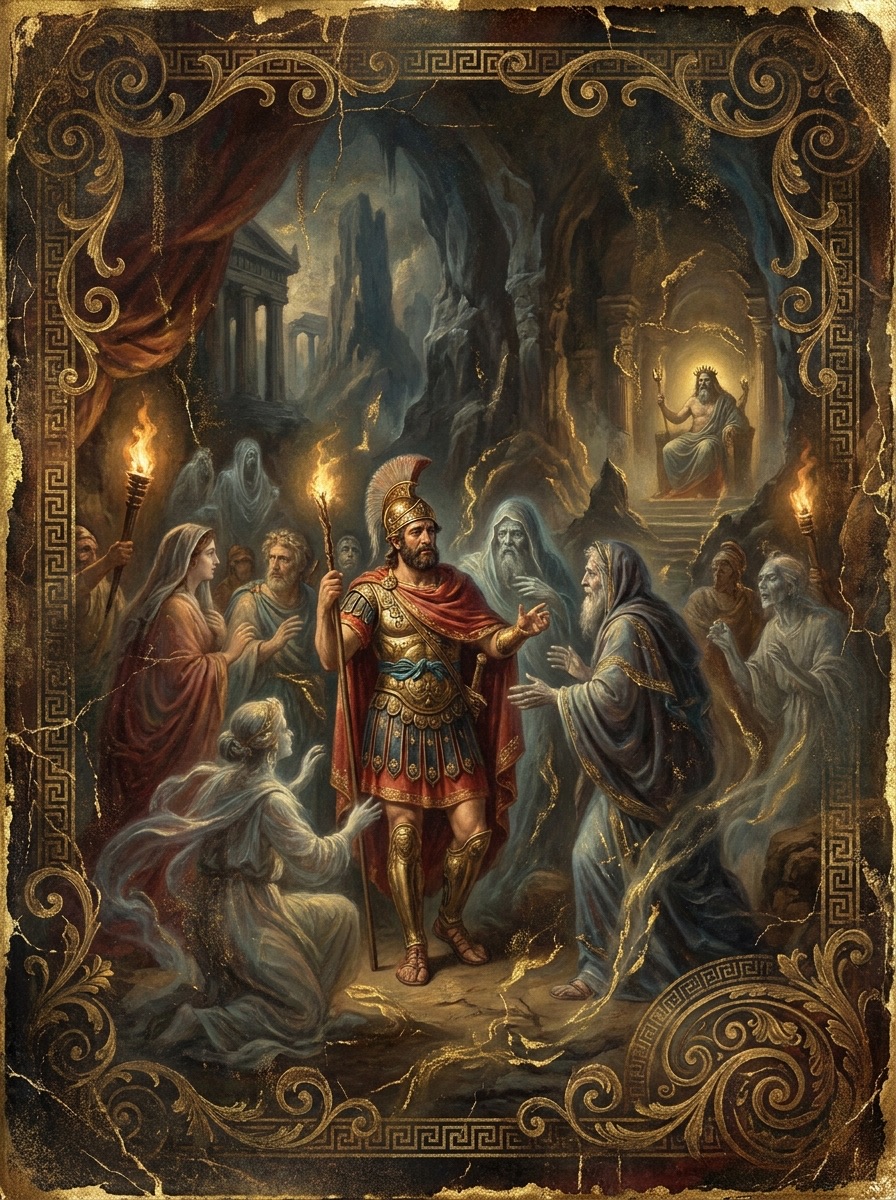
After leaving Circe’s island, Odysseus follows the goddess’s directions and sails to the edge of Ocean, where he offers sacrifice at the dark threshold of the Underworld and summons the dead. There he meets the seer Tiresias, his dead mother Anticleia, and many heroes of former days, before returning to his ship with grave warnings about the road home.
Article
Summary
Odysseus had lived for a year on Circe’s island when at last he remembered Ithaca, his house, and the wife and son who were waiting for him. Circe did not try to keep him, but she told him that sails and oars alone would not bring him home. First he had to go down to the realm of the dead and question the blind seer Tiresias, who alone could tell him how to face the journey still ahead. He and his men sailed to the farthest edge of Ocean. On a cold, shadowed shore, Odysseus dug a pit and made the sacrifice. The blood of black sheep flowed into the trench, and the spirits of the dead came crowding near. Sword in hand, Odysseus guarded the blood. First he promised burial to his dead companion Elpenor; then he let Tiresias drink and heard the prophecy of Poseidon’s anger, Helios’ cattle, and the vengeance waiting in his own hall. After that, Odysseus saw his mother, Anticleia, and learned that she had died of longing for him. He tried to clasp her in his arms, but embraced only a drifting shadow. She told him that Penelope still waited, Telemachus still guarded the house, and old Laertes was wasting away in grief. Many other shades came in the Underworld: heroes from the war and names from ancient tales. Agamemnon told how he had been murdered after reaching home; Achilles said he would rather be a poor laborer among the living than king among the dead; Ajax the Greater, still nursing his old anger, refused to speak to Odysseus at all. When the spirits gathered in greater and greater numbers, Odysseus grew afraid to linger and hurried his men back to the ship. Back on Circe’s island, Odysseus kept his promise to Elpenor. He buried him by the sea and set an oar upon his mound. From the Underworld he had brought back no treasure, only heavy warnings and a sharper longing for his kin; with these in his heart, he prepared once more to sail into the dangers of the homeward road.
Circe’s Instructions
Odysseus and his companions had stayed a long while on Circe’s island. There were warm rooms there, wine and meat in plenty, and the goddess’s hospitality, gentle and perilous at once. At first, men worn down by storms and salt water thought only of sleeping safely at last. But as the days passed, the slopes of Ithaca, the ground before his own doors, and the sound of Penelope’s loom began to return to Odysseus’ heart.
One day, while the men sat at the feast and the wine still stood in their cups, some of them began to weep. “We have been too long away from home,” they said. “If you still remember Ithaca, take us back.”
Their words struck Odysseus painfully. That night he went to Circe and begged her to let them depart. The goddess was not angry. She looked at him and said, “You may go. But your road home does not yet run straight to Ithaca. First you must go to the Underworld and question Tiresias. Only he can tell you how to avoid the disasters still before you.”
At the word Underworld, Odysseus’ face darkened. What living man would not fear to seek the dead? Yet Circe described the way with exact care. The ship must cross the streams and sail to the end of Ocean. There lay a gloomy shore, and the groves of Persephone, where poplars and fruitless willows stirred in the wind. When he reached that place, he was to dig a pit, pour into it honeyed milk, sweet wine, clear water, and barley meal, then slaughter black sheep so that their blood ran down into the trench. The dead would come at the smell of blood; but until Tiresias had spoken, none of them was to drink.
At dawn the next day, the men pushed the ship into the sea. Before they sailed, another grief came upon them, though they did not yet know it. Young Elpenor had fallen asleep drunk on the roof the night before; waking in confusion, he had tumbled from the height and broken his neck. In their haste the others boarded the ship, unaware that he lay dead behind them. The wind filled the sail, and Circe stood on the shore as they set out toward the place no living man willingly visits.
The Dark Shore at the Edge of Ocean
The ship sailed all day over the sea. After the sun went down, the world did not darken in the ordinary way; it seemed instead to be covered slowly by a cold gray ash. The water was so black that no depth could be seen beneath it, and even the wind dropped low. The men no longer laughed or spoke. They heard only the slap of oars and the sound of the prow cutting through the waves.
At last they reached the place Circe had described. There were no houses there, no smoke of cooking fires. Tall poplars grew by the shore, and willows trailed their branches over the damp, cold ground. Odysseus ordered his men to bring the black ram and the black ewe. Then he drew his sword and dug a pit in the earth. As the goddess had commanded, he poured in the honeyed drink, the wine, and the water, scattered fine barley meal over them, and prayed to the dead and to the powers of the queen below.
Then he cut the throats of the sheep. Warm blood streamed into the trench, spreading red through the shadowed soil. As soon as its smell rose, shapes began to gather from every side.
They were not people of flesh and bone, but dreams driven in by wind. Shadows of old men, shadows of young men, shadows of warriors slain in battle, shadows of unmarried girls, all pressed toward the pit of blood. Odysseus’ companions turned pale with fear. Odysseus himself was afraid, yet he drew his long sword and stood beside the trench, holding the shades back and allowing none to come near.
Then a familiar, sorrowful voice reached him first. It was Elpenor.
The Unburied Companion
Elpenor’s shade stood near the pit, his voice sounding as if it came from a great distance. “Do not leave me beside Circe’s house,” he said to Odysseus. “You went away too quickly and raised no mound for me. When you return, burn my body, and burn my weapons with me. Heap up a grave for me by the sea, and set my oar upon it, so that those who come after may know I was once a comrade in your ship.”
Odysseus listened with a heavy heart. He had not expected that before he met the seer, he would first be met by such a plea. He promised Elpenor that as soon as he returned to Circe’s island, he would bury him with the proper rites. Only then did the shade grow calm and withdraw to one side.
But more of the dead pressed forward. Odysseus held them off with his sword until the shade of blind Tiresias appeared. The seer still carried a golden staff, as he had in life. Even among the dead, he bore a deeper portion of divine knowledge than the others.
Odysseus stepped aside from the blood. Tiresias bent down and drank. Once he had drunk, his voice came clear.
The Prophecy of Tiresias
“You seek your home,” said the seer, “but Poseidon, lord of the sea, will not let you go easily. You blinded his son, the Cyclops, and his anger is still waiting for you on the water. If you can master yourself and your men, you may yet reach Ithaca. If you cannot, disaster will fall.”
He told Odysseus that they would come to the island of Thrinacia, where Helios kept his cattle and his flocks. Those animals were sacred. Not one was to be touched, not one slaughtered. If the men endured their hunger, the ship could still go on; but if anyone killed the god’s cattle, ship and companions alike would be destroyed. Even if Odysseus survived and came home, he would come alone, in another man’s vessel, and late to his own land.
The seer did not stop there. He said that when Odysseus returned to Ithaca, he would find his house filled with insolent suitors. They would be eating his livestock, drinking his wine, and pressing his wife to marry. Odysseus would have to find a way to punish them. After that was done, he must take an oar and walk inland until he reached people who had never seen the sea. In that place, someone would mistake the oar for a winnowing shovel. There he was to sacrifice to Poseidon, and only then would the sea god’s anger begin to be appeased.
Odysseus listened, his hand closed around the hilt of his sword, not daring to miss a word. When the seer had finished, he withdrew into the shadow. But Odysseus did not leave at once, for he saw one shade standing among the dead whose face was so familiar that his heart ached.
It was his mother, Anticleia.
The Man Who Tried to Embrace His Mother
When Odysseus had left Ithaca for Troy, his mother was still alive. He did not know that she had died. A little earlier, he had held back all the spirits from the blood, even her, with the edge of his sword. Now that the seer had spoken, he let his mother come near the trench.
Anticleia drank the blood and knew her son. “My child,” she asked, “how have you come alive into this darkness? Have you still not reached home?”
Odysseus’ eyes filled with tears. He told her that he had been wandering over the sea, suffering hardship after hardship, and had not yet seen Ithaca again. Then he hurried to ask about his house. Was his father Laertes still alive? Was his son Telemachus holding the estate? Was Penelope still waiting for him?
His mother told him that Penelope remained in the palace, grieving night after night, yet faithful to her husband; that Telemachus still guarded the household; and that old Laertes had left the city and no longer lived as he once had. He wore rough clothing, slept on the ground, and thought only of his absent son. As for Anticleia herself, neither sickness nor arrows nor the sword had taken her. Longing for Odysseus had consumed her. Day after day she waited for him to return, until life itself wore away.
When Odysseus heard this, he stretched out both arms to clasp his mother. But his hands passed through the shade and held nothing. The first time, he embraced only a breath of cold air; the second time, again emptiness; the third time, in anguish, he cried, “Mother, why will you not let me hold you?”
Anticleia answered softly, “My child, this is the way of the dead. Once flesh and bone have been given to the fire, the soul flies away like a dream. Remember what I have told you. Return to the sunlight, and tell these things to your wife.”
Odysseus bowed his head. The Underworld was filled with countless spirits, but in that moment the one thing he most wished to carry away was a single embrace from his mother.
Shadows of Heroes
Afterward, many women of old tales and many heroes drew near the pit. Odysseus saw people famed in ancient stories and heard them speak of their houses and their sufferings. The Underworld seemed like a fathomless country of memory, where names the living thought lost still murmured in the dark.
Then his comrades from the Trojan War came. The shade of Agamemnon approached, and after drinking the blood he told Odysseus of his dreadful death after reaching home. He had not died on the battlefield, but in his own palace, caught in the plot of his wife Clytemnestra and her lover. He warned Odysseus to be cautious when he returned, not to trust too quickly in bright halls or warm welcomes.
Achilles came as well. The greatest warrior of his life had no gleam of armor in the Underworld, no sound of chariot wheels around him. Odysseus praised him, saying that he had been honored by multitudes while alive and was still powerful among the dead. But Achilles answered that he would rather be a hired laborer for a poor man on earth than rule as king among the dead. At this Odysseus fell silent. However bitter life may be, it has sun, wind, and soil; however exalted the Underworld may seem, it is only a kingdom of cold shadows.
Odysseus also wished to speak with Ajax the Greater. Ajax had once quarreled with him over the arms of Achilles and had died with anger in his heart. Odysseus addressed him, ready to set the old hatred aside, but the shade of Ajax said nothing. He merely turned away and passed into the darkness. His silence was heavier than reproach.
Flight Back to the Ship
The dead came in greater and greater numbers, like autumn leaves swept up by the wind, or like a soundless tide rising in the night. Standing beside the blood pit, Odysseus suddenly feared that Persephone might send up some terrible monster from the depths of the Underworld and trap the living there forever. He dared not remain. He called urgently to his men to return to the ship.
They burned the bodies of the sheep as offerings to the dead and to the gods below, then loosened the mooring ropes. The men gripped their oars, and the ship drew away from the gloomy shore. The waters of Ocean closed behind the stern as if no living man had ever come there. After a while, the wind rose again, the sail filled, and the ship bore them back toward Circe’s island.
Odysseus did not forget Elpenor. As soon as they landed, they found the young man’s body, cut wood for the pyre, and burned him with his weapons. Then they built a mound by the sea and planted an oar upon it. The wind moved over the grave, and the oar trembled slightly, as though it were still listening to the sea.
Thus the road to the Underworld ended. Odysseus brought back no gold, no silver, no shout of victory, but a few heavy prophecies: do not touch the cattle of Helios; beware the enemies in your own house; and while a person still lives beneath the sun, let him cherish the light. After that, he boarded his ship once more, understanding more clearly than before that the road home was still long, and more dangerous than ever.