Greek Mythology
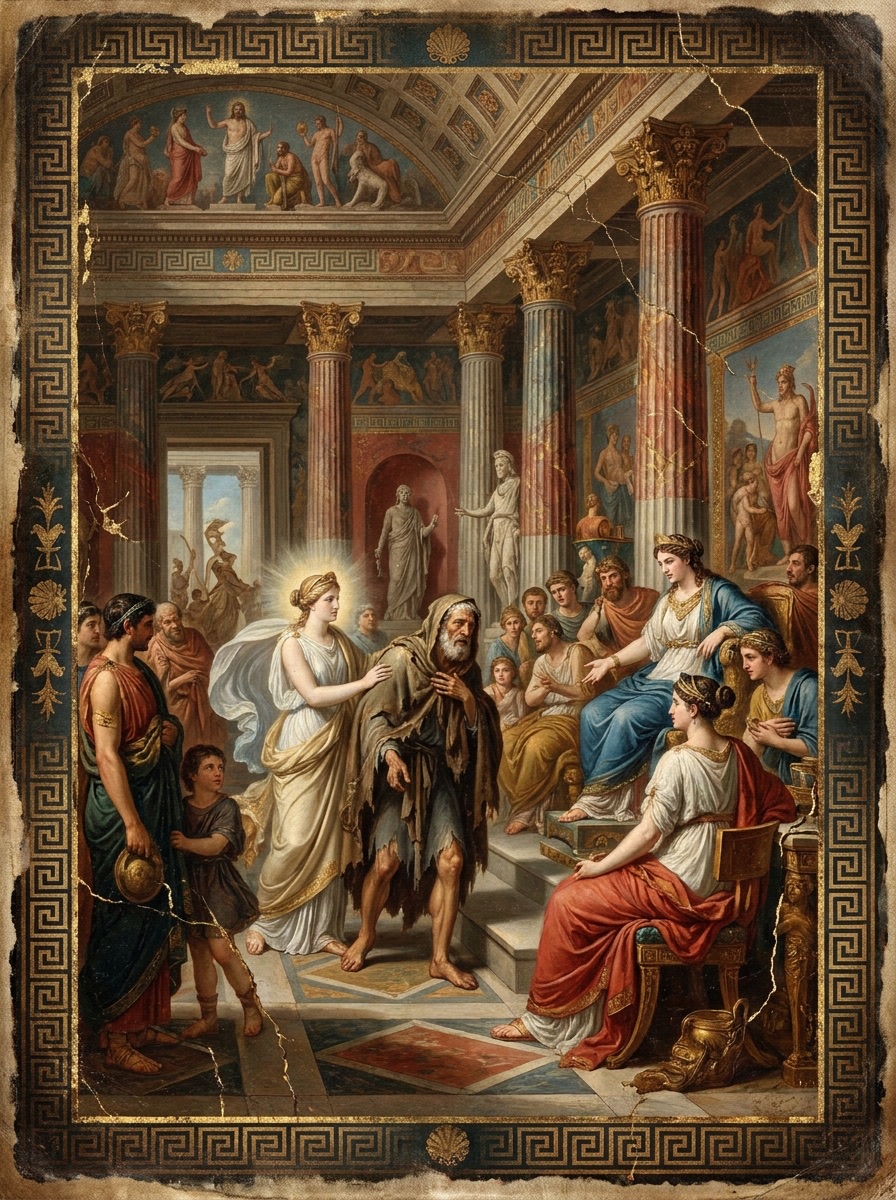
The Beggar Enters the Palace — Greek Mythology
Disguised as a ragged beggar, Odysseus returns to his own palace with the swineherd Eumaeus. He endures insult and anger in silence, sees how the suitors are ruining his house, and is recognized before death by his faithful old dog, Argos.
Article
Summary
At daybreak, Telemachus returns first to the palace and quietly warns his mother not to question him too closely. He also brings her word that Odysseus may yet come home. Meanwhile Athena has transformed Odysseus into an aged beggar, so that he can enter the city beside the swineherd Eumaeus. Back in the palace, Telemachus faces the suitors’ questions and their false concern. They are angry that their ambush failed, yet they continue feasting in the hall as though the house already belongs to them. Telemachus keeps his composure and hides the hope of his father’s return beneath a careful silence. As Odysseus walks to the city with Eumaeus, they meet Melanthius, a shepherd who has sided with the suitors. He insults and kicks the beggar, but Odysseus only clenches his teeth and endures it. At the palace gate he sees the old dog Argos lying in a heap of dung. Though the dog is only skin and bones, it still recognizes its master, lifts its head, and then quietly dies after seeing Odysseus at last. Odysseus enters the hall and begins going from table to table with his hand out. He deliberately tests the men around him and sees who is shameless and who still has a little restraint. Antinous finds him disgusting and hurls a stool at his shoulder, but Odysseus endures the blow and sits back down at the threshold. Some of the suitors think the attack is too much, yet none of them truly stop it. When Penelope hears that a beggar has been struck, she grows angry upstairs and wants to question him. Odysseus refuses to meet her before the others and tells Eumaeus to say he will come at night. So he remains on the threshold in his rags, absorbing the insults and studying the disorder of his own house until the moment comes when he can finally reveal who he is.
The Plans at Dawn
At first light, before the mist had lifted from Ithaca, Telemachus rose from the hut of Eumaeus the swineherd. The night before, he had seen his father. He knew now that the old man in rags was truly Odysseus, returned after twenty years of wandering. But this secret could not yet be revealed. Not even his beloved mother could be told at once.
Odysseus sat by the hearth, still dressed in a beggar’s torn clothing. Athena had hidden his broad shoulders, strong limbs, and bright eyes, making him look like an old man worn down by years. Telemachus looked at him with a heart full of joy and fear. He knew that one mistake would give the suitors their chance to strike first.
Odysseus said to his son, “Go back before me. If those men insult you in the hall, endure it. If they lay hands on me, do not draw your sword at once. Only take the weapons from the hall and carry them into the inner storeroom. If anyone asks, say the smoke has spoiled the bronze, and that you are putting the arms away to clean them.”
Telemachus nodded and fixed every word in his mind. He told Eumaeus to bring the “foreign beggar” into town after him, and then he set out for the palace alone.
The Son Returns to His Mother
When Telemachus reached the palace, the voices of the suitors were already ringing through the hall. One man ordered servants to slaughter sheep, another called for wine, another lifted meat from the fire as casually as if he were in his own house. When Penelope heard that her son had returned, she hurried down from the upper rooms. She embraced him, touching his face and shoulders as though to make sure the sea and storms had not taken him from her.
“My child,” she said, “why did you sail away in secret? I thought I would never see you again.”
Telemachus comforted his mother, telling her only that he had gone to Pylos and Sparta to seek news. He told her that Odysseus was not dead, but still held far away. At this Penelope’s tears fell again. Over the years she had heard too many false reports to believe at once, yet she could not keep herself from hoping.
The suitors, too, crowded around Telemachus and asked about his journey. They smiled outwardly, but inwardly they were furious, for they had set an ambush at sea to kill him, and now he had come home unharmed. Antinous and Eurymachus exchanged a glance, but for the moment they held back their murderous intent.
Insults on the Road
By then Odysseus was preparing to enter the city. Eumaeus handed him a rough wooden staff and arranged the ragged cloak over his shoulders. Together they went down the hill road, passing a spring and stone-built watering troughs where the townspeople often came for water.
Near the spring they met Melanthius the goatherd. He was a servant in the house of Odysseus, but he had long since gone over to the suitors. When he saw Eumaeus leading a filthy beggar, he burst into a sneer.
“Well, well,” he said, “one scoundrel leading another! Is there not already enough food and drink being wasted in the palace? Must you bring this beggar too, to stand by the doors and stretch out his hand?”
As he spoke, he lifted his foot and kicked Odysseus. Odysseus tightened his hand around the staff, and anger flared through him. If he had wished, he could have struck the insolent servant down against the roadside stones. But he remembered Athena’s plan, and remembered that the time for action had not yet come. He clenched his teeth, mastered himself, and only bowed his head as he kept his balance.
Eumaeus trembled with rage and prayed to the gods that Odysseus might one day return and punish such treachery toward his master. Melanthius paid no attention. He strode on ahead toward the palace.
The Old Dog Lifts His Head
Before the palace gates lay a heap of dung from cattle and mules, waiting for the servants to carry it out to the fields. Beside that filth lay an old dog. His body was covered with ticks, his ears drooped, and he had grown so thin that he seemed little more than bones.
At the sight of him, Odysseus felt his heart tighten.
The dog’s name was Argos, and Odysseus himself had raised him long ago. In those days Argos had been young and swift as the wind. Hunters had taken him into the hills, and wild goats, deer, and hares had rarely escaped his nose. But after Odysseus sailed for Troy, no one cared for him properly. The young hunting dog became an old dog, and the paws that once raced over the ground now lay sunk in dust.
Argos heard the footsteps and lifted his head with effort. His eyes were clouded, yet he still knew his master. He wagged his tail, moved his ears faintly, and tried to rise in greeting, but his body no longer had the strength.
Odysseus could not go to him and embrace him. He was a beggar now; if he showed too much feeling for an old dog at the palace gate, someone might grow suspicious. So he turned his face aside and secretly wiped the tears from his eyes.
He asked Eumaeus, “That dog seems well bred. Was he once a swift runner?”
Eumaeus sighed. “He was the dog of my master, Odysseus. If his master were still here, you would see how quick he was. But the master may have died far away, and the women of the house will not care for the dog. When servants no longer have a master over them, half their diligence is gone.”
As they spoke, they passed through the gate. Argos watched Odysseus go. Then at last he lowered his head. He had waited twenty years only to see his master once more. Having seen him, he died.
The Beggar Enters the Hall
Eumaeus led Odysseus into the great hall. Inside, the smoke, the smell of wine, and the scent of roasting meat mingled together. The suitors sat at the tables like crows that had taken over another bird’s nest. Telemachus saw his father enter, but showed nothing on his face. He merely ordered Eumaeus to give the beggar some food.
He brought bread and meat to Odysseus and said, “Stranger, take these. You may also go from table to table and ask. A beggar who is shy will find it hard to fill his belly.”
Odysseus accepted the food and understood his son’s meaning. With his ragged bag and wooden staff, he went from one suitor to another, holding out his hand for a little bread, a piece of meat. He said deliberately that he too had once been rich, with a house, servants, and a full table; but the gods had changed his fortune, and after wandering into foreign lands, he had come to this.
Some of the suitors tossed him scraps. They did not do it out of pity; they only thought that a few leftover mouthfuls given to a beggar meant nothing. But Antinous sat watching with a darker and darker face. He was the most arrogant of the suitors, and when he saw this beggar daring to move from table to table through the hall, he began to abuse him.
Eumaeus spoke up for Odysseus, saying that even a beggar was a guest sent by Zeus and should not be driven away. But Antinous insulted the swineherd as well, saying he should never have brought such a man into the palace.
Odysseus came before Antinous and said calmly, “You sit at the table of wealthy men, with plenty of food at your hand, yet you will not spare even a little bread. You look like a lord, but your heart is not lordly.”
The words struck Antinous hard. He seized the footstool beside him and hurled it at Odysseus. It struck Odysseus heavily on the shoulder and back. The sound rang through the hall, and everyone turned to look.
Odysseus did not fall. Like a solid rock, he endured the pain, walked silently to the threshold, and sat down there, setting the food he had begged beside his feet. Then he said, “If a man is wounded fighting for his cattle, his silver, or his fields, that is no strange thing. But I asked only for a bite to fill my belly, and for that I have been struck. May the gods remember it.”
Some among the suitors heard him and thought Antinous had gone too far. A beggar who entered a house seeking food should have been under the protection of the household; no one could know whether he might be a god in altered shape, testing mortal hearts. Yet they only muttered among themselves. No one truly rose to stop Antinous.
The Queen Upstairs
Word of the insult soon reached the upper rooms. When Penelope heard that a foreign beggar had been struck by Antinous, anger filled her. “May Apollo strike him in the same way,” she said.
Then she heard from the servants that this beggar seemed to know something of Odysseus, and she wished to call him upstairs and question him. For years she had sat at her loom, weaving by day and unweaving by night, using every device she could to delay marriage. Whenever anyone claimed to have seen Odysseus, she had to ask; and after every question, she feared that hope would fail her again.
Eumaeus brought the queen’s message to Odysseus. Odysseus was willing to meet her, but not by daylight, not under the eyes of the suitors. He told Eumaeus to answer that when night had fallen, he would tell the queen what he knew. Now there were too many watching eyes, and the smallest misstep could ruin everything.
Penelope heard this and thought the stranger spoke carefully, unlike an ordinary beggar. She agreed to wait until night.
The Man Who Endured
Eumaeus still had to return to the swinefold and tend the animals. Before he left, he looked at the insulted beggar with pity in his heart, not knowing that the master he had faithfully guarded all these years stood before him. Odysseus took leave of him in an ordinary voice and told him to go back without worry.
In the hall, the suitors went on feasting. Cups clattered, knives cut through meat, and fat dripped into the fire with a hiss. Antinous remained in his place as if nothing had happened. Telemachus watched it all, his anger surging inside him, yet he obeyed his father’s command and held himself still.
Odysseus sat by the threshold, his back still aching, the beggar’s bread in his hand. He saw who was most brutal, who was most reckless, who still had some trace of shame. He saw how his own house had been occupied, how his wife was being pressed, and how his son had grown up among enemies.
He did not yet speak his name. He did not reach for the weapons on the wall. For the moment, he was only a beggar whom no one honored. Yet because of that, every face in the hall revealed itself to him. Night slowly descended. The palace was still loud with feasting, but Odysseus had fixed all he had seen firmly in his heart.