Greek Mythology
Odysseus and Penelope — Greek Mythology
After wandering for twenty years, Odysseus finally returns to Ithaca. First he must rid his palace of the suitors who have devoured his house, and then he must face the most cautious — and the most painful — of all trials: his wife, Penelope. She will not trust the man before her until an immovable bed reveals the truth at last.
Article
Summary
After the Trojan War, Odysseus drifts at sea for years, and the people of Ithaca come to believe he is dead. His palace fills with suitors who eat his cattle, drink his wine, and pressure Queen Penelope to remarry so they can seize his throne. Penelope delays them as long as she can, holding the house together while waiting for a husband almost no one expects to see again. She first buys time by claiming she must weave a burial shroud for Laertes, working by day and secretly unraveling the cloth by night. The lie is eventually exposed, and the suitors force her to a final choice. At that moment Odysseus returns in disguise with Athena's help, visits the faithful swineherd Eumaeus, reunites with Telemachus in a poor hut, and begins a plan to hide the weapons and draw the enemy into the palace. Penelope has the great bow and the twelve axes brought into the hall and declares that the man who can string the bow and shoot through the axe-holes will win her hand. The suitors fail one after another, and even Telemachus backs away after secretly taking his father's warning. At last the beggar-disguised Odysseus takes the bow, strings it with ease, sends one arrow clean through the twelve holes, and kills Antinous with the next shot, turning the feast into a massacre. Even after the bloodshed, Penelope does not yield to joy too quickly. She hears that her husband has returned, but fears the news may be a god's illusion or a stranger's lie, so she tests the man before her with the secret of their bed. Odysseus answers by describing the olive tree around which he built the marriage bed, a detail no impostor could know, and Penelope finally realizes the truth. She embraces her husband at last, and the twenty years apart end in tears. At dawn Odysseus goes to meet old Laertes and proves to his father that he has truly come home. Athena restrains the revenge of the suitors' kin, Ithaca settles for the moment, and the olive-wood bed stands again as the sign that the house itself has been preserved.
The Long Night in the Palace
When Odysseus left Ithaca, his son Telemachus was still an infant. He put on his armor, boarded the black ships, and sailed away with the kings of Greece to attack Troy. No one imagined that the journey would last twenty years.
Ten years of war passed. Troy’s walls fell, and many heroes returned home with wounds and spoils. But the king of Ithaca did not come back. Some said his ships had been scattered by the wind; some said he had died at sea; others claimed that some distant island had held him fast. Year by year the news grew thinner, until only rumor remained.
Yet the palace in Ithaca did not grow quiet. Noble youths swarmed through its halls, calling themselves suitors of Queen Penelope. At first they came bearing gifts and speaking with some courtesy. As time wore on, they began to treat the house as their own. They slaughtered Odysseus’ cattle, drank the wine from his cellars, and spent their days and nights in the hall with dice, songs, and quarrels filling the air.
Penelope lived in the upper chambers. She was no longer young, but she remained composed and dignified. She knew very well that these men wanted more than her hand in marriage. They wanted the throne Odysseus had left behind, and the wealth that went with it. If she chose one of them, Ithaca would change masters, and Telemachus would stand in danger.
The suitors pressed harder with every passing day. Penelope had no army, and she could not drive them from the gates by force. So she chose cunning over strength.
She told them, “I cannot marry again at once. Laertes, the father of Odysseus, is old now, and I must first weave a burial shroud for him. When the cloth is finished, I shall make my decision.”
The suitors found this reasonable and agreed.
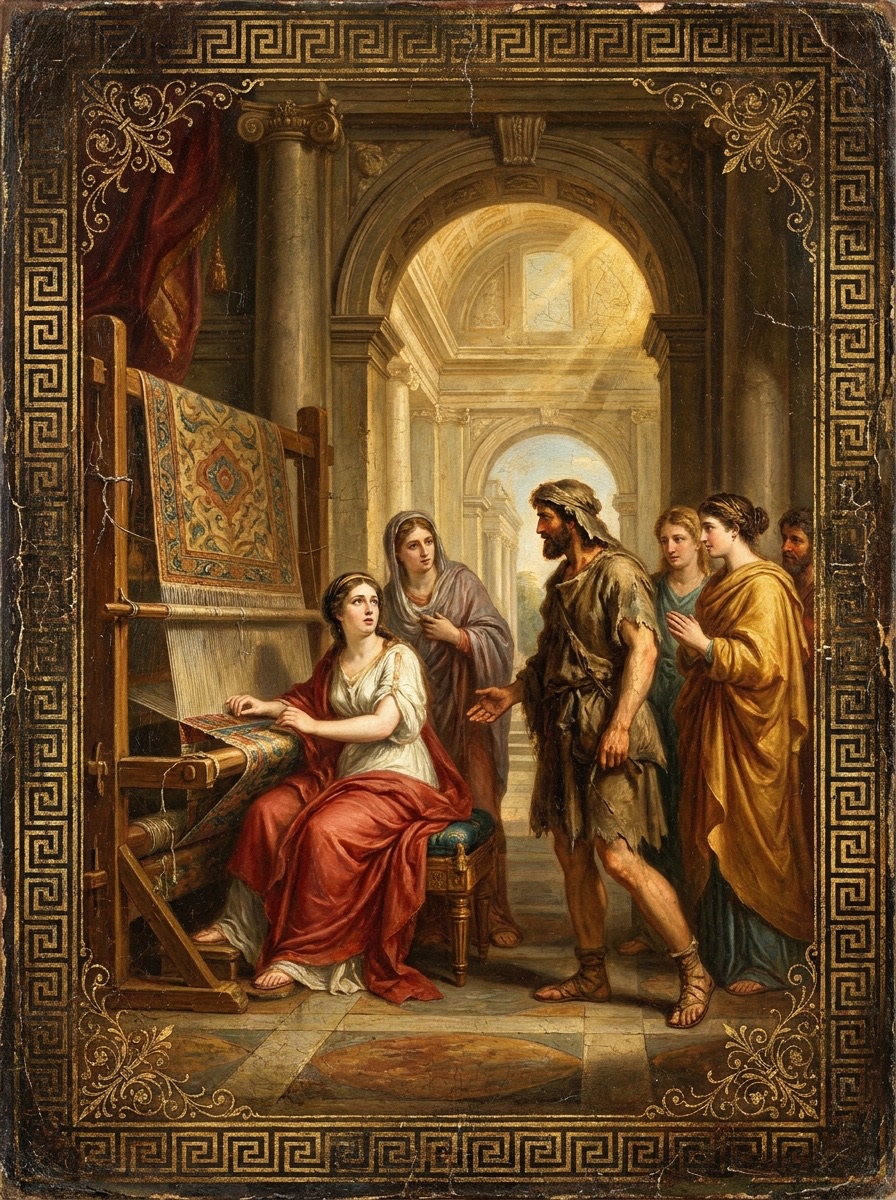
So Penelope sat by the loom in daylight, the shuttle passing back and forth through the threads as the cloth slowly grew. The suitors watched the work advance and thought the wedding drew nearer. But each night, once the lamps were lit and the doors shut, she secretly undid what she had woven by day.
Thus she deceived them for three years. For three years, she guarded her husband’s house with a piece of cloth that could never be finished. At last, however, one of the servants betrayed her secret. Furious, the suitors closed in and demanded that she delay no longer. Her escape narrowed day by day, and she had no choice but to carry her grief in silence.
The Beggar at the Door
Just when the suitors believed victory was almost theirs, Odysseus returned to Ithaca.
He did not come back in a king’s chariot or in shining armor. Athena disguised him as an old man in rags, with a staff in his hand and a battered bag over his shoulder, like a wandering beggar entering the land that was his own. In this way his enemies would fail to recognize him, and even friends would not know him at once.
First Odysseus went to see the swineherd Eumaeus. This faithful servant lived among the hills, tending the royal pigs. Though he did not know the stranger before him, he still welcomed the old man into his hut, spread reeds for him to rest on, and set meat before him. As Odysseus listened, he heard of the disorder in the palace, of Penelope’s suffering, and of the young Telemachus’ patient struggle.
Not long after, Telemachus returned from abroad. With Athena’s help, Odysseus revealed himself to his son. At first the young man could hardly believe his eyes, until the old beggar suddenly took on the shape of his father — broad-shouldered, bright-eyed, and unmistakable. Then he wept and threw himself into Odysseus’ arms.
Father and son quickly made their plan. Telemachus would go back to the palace first and secretly remove the weapons from the hall, leaving only a few close at hand. Odysseus would remain in the guise of a beggar and enter later, so that he might see with his own eyes how those men behaved.
When Odysseus stepped into his own hall, the suitors were at table, eating and drinking. Cups clinked, and the smell of roast meat filled the room. No one offered a seat to the ragged old man. Some mocked him; others threw things at him. Odysseus swallowed his rage, kept his head low, and walked slowly through the columns and thresholds that had once been his own.
Only one old creature knew him.
It was Argos, the hunting dog Odysseus had raised in his youth. Now the hound was too old to rise, lying by the dung heap outside the door, covered with flies. When it heard its master’s step, it pricked up its ears and wagged its tail, but it had not the strength to crawl forward. Odysseus saw it and nearly wept, but he turned his face away so no one would notice. Argos had waited long enough to see its master once more; then it died quietly.
The Queen’s Night Questions
After dark, the hall grew still at last. When Penelope heard that a wandering old man had arrived in the palace, she ordered him brought before her. She hoped to learn something of her husband from a traveler who had crossed many lands, even if it was only a rumor.
Odysseus sat by the fire, still in his torn clothes, and looked at the woman before him. Twenty years had passed. Grief had deepened the lines on her face, yet her eyes still held the same mixture of gentleness and caution. He longed to say at once, “I have come back.” But the hour was not yet right. Enemies filled the palace, and even among the servants some had sided with the suitors. If the truth escaped too soon, all would be lost.
So he invented a tale that sounded true. He said he had met Odysseus in Crete and that the hero was still alive, on the road home.
Penelope listened, tears running down her cheeks. She asked carefully about everything: what clothing the man had worn, what companions were with him, what marks he bore. Odysseus answered by speaking of the purple cloak he had once worn when he left home and of the golden brooch on his chest. He told her these things with perfect detail. The more she heard, the more her grief deepened, for only someone who had truly known Odysseus could have spoken so.
Then she called for the old nurse Eurycleia to wash the guest’s feet. Eurycleia had looked after Odysseus since he was a boy. She brought a bronze basin, poured in warm water, and knelt to wash the old man’s feet. The moment the water touched his legs, her hand stopped.
She had found a scar.
It was the mark Odysseus had earned in his youth while hunting. A wild boar had burst from the trees and torn his thigh with its tusk. Eurycleia remembered the wound, and she remembered the child who had bled and been carried home. She looked up at once, almost crying out.
Odysseus clamped a hand over her throat and whispered, “Motherly old woman, do not ruin me, and do not ruin yourself. Not yet.”
Eurycleia held back her tears and nodded. The water in the basin trembled lightly as she finished washing his feet, but she kept the secret locked inside her heart.
Penelope did not know what had happened in that brief moment. Her own heart still wavered between hope and doubt. She told the stranger that she would set a contest: the one who could string Odysseus’ great bow and send an arrow through twelve axe heads would be the man she married.
The bow hung in the palace. It was heavy and unyielding, and almost no one but Odysseus had ever been able to draw it. When Penelope spoke the condition aloud, she did not feel at ease. It was as though she had opened the last closed door, not knowing whether behind it she would find her husband or be forced into another marriage.
The Great Bow and the Twelve Axes
The next day Penelope brought the great bow from its storeroom. She held it herself, and tears fell onto the wood. It had been Odysseus’ before he left, darkened by years, the string still unfastened, and yet it called up the memory of his hands.
She carried it into the hall, set it before the suitors, and had twelve axeheads arranged in a line, each with a hole in the haft. Then she said, “Whoever can draw this bow and send an arrow through the twelve holes shall leave this house with me.”
The suitors grew eager at once. They liked to boast of their strength, and now at last they had a chance to win the queen. But when the first man took up the bow and tried to bend it, the string would not move. The second strained until his face reddened and his palms burned, but he too failed. One man held it near the fire, hoping to soften the wood; another rubbed it with oil; another planted his knee against the bow and gritted his teeth. Gradually the laughter in the hall faded, giving way to embarrassment and anger.
Telemachus tried as well. He nearly succeeded, but Odysseus signaled him silently to stop. The young man understood and set the bow down, saying his strength was not yet enough.
Then the beggar seated by the door spoke up. “Let me try too.”
The suitors burst out laughing. Some called him greedy; others said he had gone mad from wine. That a ragged old man should even touch Odysseus’ bow seemed absurd to them.
But Penelope did not mock him. She thought that since the guest had spoken, he ought not be humiliated in violation of custom. Yet Telemachus stood up and asked his mother to return to the upper rooms and remain there with the women. Penelope looked at her son in surprise, for the child she had once protected now spoke like a true master of the house. She made no further protest, but withdrew with her attendants.
When the door closed behind her, everything changed.
Odysseus took the bow. He did not wrestle with it as the suitors had done. He merely turned it in his hands and inspected it, as a lyre-player might test the strings of his instrument. Then he drew it lightly, and the string snapped back into place as though it had been waiting for him all along. He set an arrow to the string, sat where he was, and aimed. The bow sang, the arrow flew, and it passed cleanly through the twelve axeheads with a sharp ringing sound at the far end.
The hall fell silent.
Odysseus rose. His rags could no longer hide the majesty of a king. He turned and loosed the first arrow, striking Antinous full in the throat as the suitor lifted his cup and still had not understood what was happening. Wine and blood spilled together onto the floor.
The suitors cried out and reached for weapons, only to discover that the spears and shields had already been removed from the walls. Telemachus, Eumaeus, and the cattleman took their places beside Odysseus. The doors were shut; there was no escape. Odysseus proclaimed himself aloud and rebuked them for taking his house, abusing his wife and son, and wasting his wealth.
Some begged for mercy. Some offered to repay him. Some tried to rush the door. Odysseus spared none of them. Arrow after arrow flew, and when the arrows were gone, he seized a spear. Tables were overturned; cups rolled away; roast meat dropped into the dust. Those who had once laughed here fell one after another.
At last the hall that had echoed with noise for so many years grew still. Odysseus stood amid the blood, breathing hard like a lion that had finally reclaimed its den.
Penelope’s Test
News of the massacre reached the upper chamber, and Eurycleia hurried to Penelope in great excitement. “Wake up, child!” she cried. “The man you have waited for has returned. Odysseus is in the hall, and he has killed those insolent men.”
Penelope dared not believe her at once.
Twenty years of waiting had been too long. She had heard too many false reports and dreamed too many times of her husband’s return. Each time she woke, there had only been an empty room and tears beside her. Now an old woman came to tell her that Odysseus had come back and slain the suitors, and her heart tightened instead of opening.
“Do not deceive me with a god’s illusion,” she said. “Perhaps some god has taken pity on us and destroyed those wicked men. Odysseus may already be dead in some far-off place.”
Eurycleia was so agitated she nearly stamped her foot. Then she mentioned the scar, saying she had touched it herself. Penelope still said nothing. She was not cold, nor was she heartless. She knew Odysseus too well. There are clever heroes, and there are strangers who can lie well; the gods can change a man’s face, and they can also throw the mind into confusion with illusions. She had endured for twenty years through caution and patience. At the very last step, she could not simply fling the door open.
She went down into the hall. Firelight touched the walls. The floor had been cleaned, yet the smell of blood still lingered. Odysseus sat by a pillar, now clothed again, his face and shoulders made even stronger by Athena’s aid. When he saw Penelope approaching, his heart surged, but he did not force her into his arms.
She sat opposite him and looked at him for a long time. Her eyes held suspicion, sorrow, and a hope she could scarcely bear to name. Telemachus watched impatiently and could not help blaming her for her coldness.
But Penelope said softly, “Child, my mind is in turmoil. If he is truly Odysseus, then there is a sign known only to us two.”
Odysseus heard this and still held back. He knew she was testing him.
Then Penelope turned to the servants and said, “Move his bed outside and make it ready, so he may sleep there.”
At those words, Odysseus changed at once.
The Bed That Could Not Be Moved
He sprang up, anger and hurt in his voice. “Who has moved my bed? Unless a god himself has done it, no mortal could shift it. That bed was not made from ordinary wood.”
Then he told the story.
When he and Penelope married, there had been an olive tree in the palace, deep-rooted and full of leaves. Odysseus had not cut it down and carried it away. Instead, he built their chamber around the trunk. He had shaped the living tree into a bedpost, inlaid it with gold, silver, and ivory, and stretched the frame with straps of leather. When the room was finished, the living olive tree became part of the marriage bed itself. Its roots remained in the ground, and the bed stood fast with them. Unless someone first cut the tree down to the root, the bed could never be moved.
Only two people knew this.
As soon as Penelope heard it, her knees gave way, and tears burst from her eyes. There could be no more doubt. This man knew the bed, knew the olive tree, knew the secret they had guarded together. He was no phantom, no trickster, no likeness shaped by a god. He was Odysseus.
She ran to him, flung her arms around his neck, and wept as she told him she had not meant to be cold. For so many years she had feared being deceived by a lie, the way Helen once brought ruin upon a household when she was led away by an outsider. She had guarded herself too long and feared too much, and so she had needed proof.
Odysseus held her, and his anger melted away. He too began to weep. The sea-waves, the giant’s cave, the island of a goddess, the shadow of the underworld, the mast in the storm — all those hardships seemed to recede like water pulling back from the shore. At last he had come home beneath his own roof and embraced his wife.
Athena lengthened the night so that dawn would not come too soon. Thus the husband and wife, separated for twenty years, had time to sit together and tell each other their suffering, little by little. Odysseus spoke of leaving Troy, of losing his companions on the sea, and of the times he had nearly failed to return at all. Penelope spoke of the days in the palace, of the suitors’ pressure, and of the cloth she had woven by day and unraveled by night.
They spoke for a long time, as though they meant to mend the gap of twenty years thread by thread.
After Dawn
Odysseus’ return was not only a reunion. The relatives of the slain suitors would not accept their deaths lightly. Their sons and brothers had fallen in the palace, and vengeance would soon spread across Ithaca. Odysseus knew that new danger still awaited him.
At daybreak he went to see his aged father, Laertes. The old man had been living on his farm, dressed in rough clothes, tending his fruit trees with his own hands. Grief over his lost son had long bent his heart. Odysseus first tested him, and only then revealed himself, proving his identity with the old signs between father and son. When Laertes heard that his child had returned, light came back into his eyes.
As expected, the kin of the suitors gathered to avenge the dead. Bloodshed almost broke out again. At that point Athena stepped in and halted the fighting. Ithaca could not remain trapped forever in revenge. The goddess made both sides lay down their weapons and bind themselves to peace.
So Odysseus finally returned to his palace for good. The marriage bed, built around the olive tree, still stood in the inner chamber, its roots sunk deep into the earth like the house they had once guarded together. Penelope’s waiting had not been in vain, and Odysseus’ wandering ended there at last. After so many storms, the roof of Ithaca once again knew the calm of night.