Greek Mythology
Odysseus and Laertes — Greek Mythology
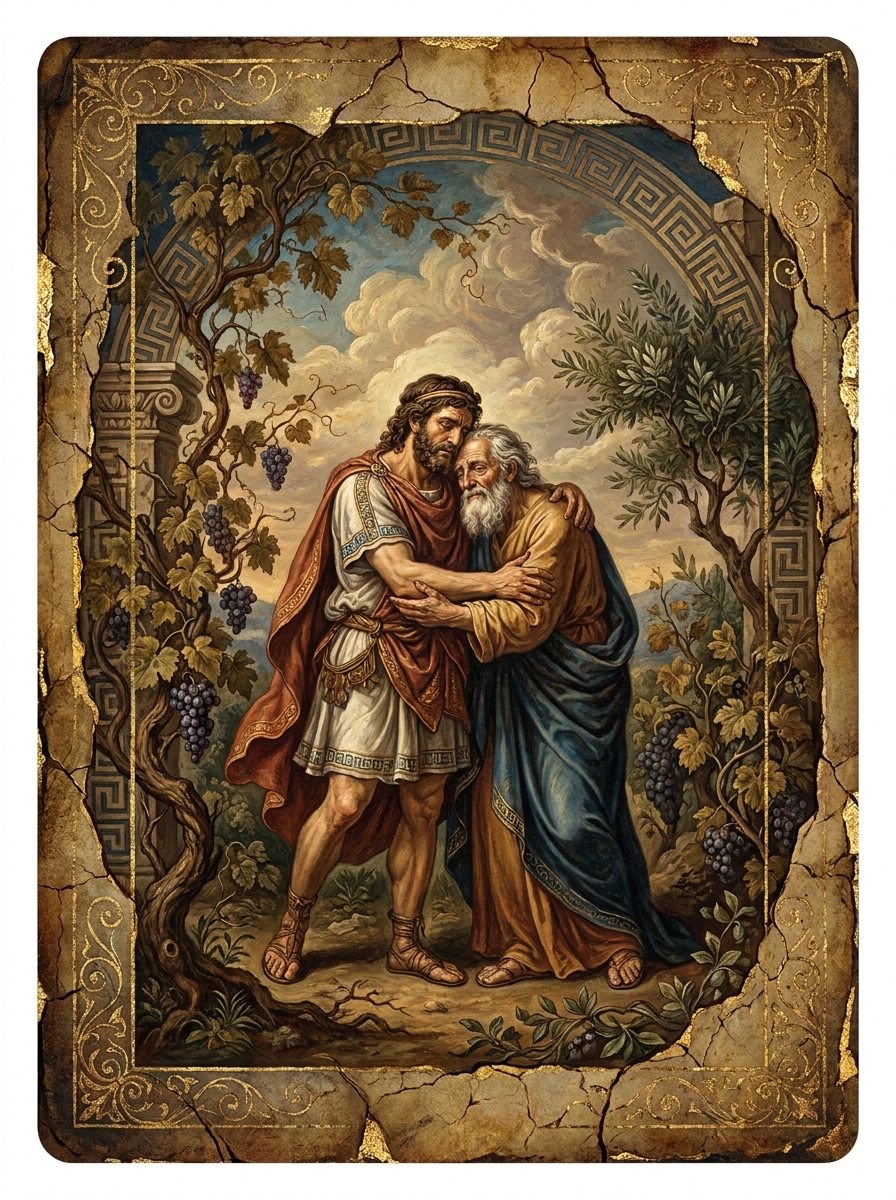
After Odysseus kills the suitors, he goes into the countryside to seek his aged father, Laertes. First he tests him with a false tale; then, by the scar on his leg and the fruit trees his father once gave him in childhood, he makes himself known. At the end of long sorrow, father and son at last cling to one another and weep.
Article
Summary
Odysseus has returned to Ithaca and slain the suitors who occupied his halls and oppressed his household. Yet peace has not fully come. The kin of the dead men will soon seek vengeance, and Odysseus has not yet seen his old father Laertes, who lives in loneliness out in the fields. Laertes has long since left the palace and dwells in a rough hut among the orchards. He wears coarse, patched clothing and tends the fruit trees and vines with his own hands, all the while believing that his son has died far away. When Odysseus comes into the garden and sees how worn and aged his father has become, grief rises in him; still, he first invents the identity of a stranger, testing whether Laertes still keeps him in his heart. When the old man hears that this stranger once entertained Odysseus, he is overcome with sorrow and pours dust over his white hair. Odysseus can bear it no longer and reveals his true name. Laertes is afraid to believe him too quickly, so Odysseus shows him the old scar on his leg and recalls the pear trees, apple trees, fig trees, and vines that his father promised him one by one when he was a child. Then the old man knows his son, and almost faints in his arms. Afterward, the relatives of the slain suitors gather to take revenge on Odysseus and his house. Laertes arms himself once more, and in the fighting he casts a spear that brings down Eupeithes, the father of Antinous. At last Athena intervenes and stops the bloodshed, making the people of Ithaca swear peace, so that Odysseus, with his father, wife, and son, may return to his own household.
The Old Man in the Fields
After the suitors had fallen in the hall of Odysseus, the night on Ithaca did not at once grow quiet.
The smell of blood still lingered in the palace. Firelight shone on pillars and thresholds; the serving women had washed the floors, yet what had just happened still lay heavy on every heart, like a shadow that could not be swept away. Odysseus had at last seen Penelope. At last, beside his own bed, he had spoken the secret known only to husband and wife. But he understood well that the island’s troubles were not yet over.
The suitors had not fallen from the sky. They had fathers, brothers, and kinsmen. By morning the news would spread, and cries of grief would rise from house after house; anger would rise with them. Odysseus knew that he had come home, but he had not yet gained peace.
The next day he did not remain in the palace to rest in the joy of reunion. He took his son Telemachus with him, and called also the faithful swineherd Eumaeus and the cowherd Philoetius. Together they went out toward the countryside.
There lived his father, Laertes.
Laertes had once been king of Ithaca, but after his son had been gone so many years, he no longer wished to live in the palace. He left its noise and bustle to others and withdrew into the fields, beside a humble dwelling. Around it were orchards, vines, and rows of garden beds. The old man wore no soft robes, only patched and weathered clothes; leather gaiters were bound around his legs, and his hands were often stained with earth. He no longer looked like a king. He looked like an old farmer.
His life was bitter, and not merely because it was poor. The bitterest thing was what he carried in his heart: his son Odysseus, the son who had once sailed with the fleet to Troy, had been away too long. Others might still hope for his return, but Laertes often felt that his son had died at sea, his bones perhaps scattered by the waves, without even a grave.
Odysseus came to the edge of the orchard and saw his father.
The old man was bending beside a tree, a tool in his hand, clearing the soil around its roots. His hair had gone white, and his shoulders had sunk. His clothes were covered with dust, as though they had not been changed for any joyful occasion in many years. Odysseus stood a little way off and watched him, and pain went through his heart.
Many times on the sea he had longed for home, longed to see his wife, his son, and his father. Yet now that he truly saw his father in this state, he could not at once speak.
Telemachus and the two loyal servants went on ahead into the house to prepare food. Odysseus stayed alone in the garden and walked toward the old man.
The Stranger’s Tale
Laertes heard footsteps and lifted his eyes. Before him stood a man in clean clothing, like a guest from far away, or like a stranger who had traveled through many lands. The old man did not recognize him.
In his heart Odysseus wanted to embrace his father at once and call him “Father.” But he had passed through too many dangers and had learned the habit of testing first and telling the truth afterward. Besides, he wanted to know whether, after all these years, his father still remembered him with love.
So he mastered his voice and, pretending not to know Laertes, said:
“Old man, I see that this orchard of yours is well tended. The trees are neatly pruned, and the vines have not been neglected. But you yourself live hard. At your age, dressed as you are, you do not seem to belong to a prosperous household. Tell me, whose land is this? And whose servant are you?”
Laertes did not grow angry. He only looked at the stranger and asked where he came from and whom he sought on Ithaca.
Odysseus began another invented tale. He said that he came from a distant land, that he was of no low birth, and that he had once received a man named Odysseus as a guest. That man, returning from Troy, had come to his country; he had given him gifts and had heard him speak of his homeland, Ithaca, and of his father, Laertes.
When the old man heard the name “Odysseus,” it was as though he had been struck. He stood there, and the look on his face changed all at once. Only after a long silence did he ask in a trembling voice:
“Stranger, you say you saw him? How long ago was that? Ah, my poor son! If he were still alive, if he truly could return to this land, you would receive rich hospitality here. But now, most likely, the fish of the sea have eaten him, or he has died in some stranger’s country, with no father or mother to close his eyes and no wife to mourn over him.”
At this, Laertes could bear no more. He took dust from the ground and poured it over his white hair. The dust fell on his shoulders and his clothing, and he bowed his head like a man who had lost his last hope.
Odysseus watched his father’s grief, and his chest tightened. Before enemies he could hold back tears. Before the Cyclops he could give a false name. Before the suitors he could endure in silence under a beggar’s rags. But the man before him now was not an enemy. He was his own old father.
He could not continue the test.
The Scar and the Fruit Trees
Odysseus stepped closer, reached out both hands, and held the old man.
“Father,” he said, “do not weep any longer. The man you seek is here. I am Odysseus. I have come back to Ithaca, and yesterday I killed the suitors who were doing evil in my house.”
Laertes raised his head. In his eyes were astonishment and doubt. He had longed so deeply for his son’s return that he was afraid to believe too easily. Through many years he had heard too many false rumors and had dreamed too many dreams that broke when he woke.
The old man said, “If you are truly my son, give me some certain proof. Do not comfort me with words alone.”
Odysseus nodded. He loosened his clothing and showed his father the old scar on his leg.
That scar had been left from his youth. When he was a boy, he had gone to visit his mother’s father and had joined a boar hunt in the hills. The boar burst out from the thicket, and its tusk tore his leg. Later he grew to manhood, sailed to Troy, and wandered for many years, but the mark remained on his body. It was by that same scar that the old nurse Eurycleia had recognized him while washing his feet.
Laertes looked at the scar, and his heart began to yield. But Odysseus spoke again:
“Do you remember this orchard? When I was a child, I walked here with you and asked you for this tree, then that one. You promised them to me one by one. You gave me thirteen pear trees, ten apple trees, and forty fig trees. You also told me that fifty rows of vines would one day be mine. When the grapes ripened, the fruit in the different rows would turn color at different times.”
These were not things a stranger could know. They were words spoken when a father held the hand of his little son and walked slowly through the orchard. The child looked up at the leaves on the branches, and the father promised him the trees as gifts. No one then could have imagined that twenty years of war and wandering would come between them, setting father and son on opposite sides of the sea.
When Laertes heard this, all doubt left him. His knees weakened, and he nearly fell. Odysseus quickly caught him and held him in his arms. The old man leaned against his son’s breast, and tears came down, like a spring long held back suddenly breaking free.
As he wept, he said, “Father Zeus, then the gods in heaven still watch over mankind! Those insolent men have received their punishment at last. Yet I am afraid their kinsmen will gather and come against us in revenge.”
Odysseus held his father and comforted him. “Father, do not grieve ahead of troubles that have not yet come. Let us go into the house first. Telemachus is waiting there, and the loyal servants are preparing food.”
The Old King Stands Again
When father and son entered the house, Telemachus was already there. Three generations met beneath that roof, and the room was filled at once with joy and sorrow. The old man looked at his grandson, then at his son, as if he wished to make up with his eyes for all the years that had been lost.
The servants washed the dust from Laertes and brought him clean clothes. Athena helped unseen, making the old man appear stronger than before, his shoulders straighter and his bearing firmer. When he had put on the robe and came out again, even Odysseus looked at him with wonder: the man who had just been scattering dust over his head and weeping in the orchard now showed something of the king he once had been.
They sat down to eat. Bread and meat were set on the table, and wine was poured into cups. Yet they had hardly begun to take comfort in the meal when a new danger could already be felt in the wind outside.
Among the slain suitors, Antinous had been the most arrogant, and he had been the first whom Odysseus shot down. His father, Eupeithes, could not endure his son’s death, and he called on the relatives of the dead to take up arms. They gathered together, and grief became anger; anger became the thought of revenge. Some urged them to consider carefully: for years these suitors had devoured Odysseus’ wealth, pressed his wife, plotted against his son, and were themselves far from innocent. But a father who has lost his son does not easily hear such words.
Before long, armed men were advancing toward the countryside.
Odysseus heard the news and did not panic. He put on his armor, and Telemachus took up his weapons. The two faithful servants stood beside them. When Laertes saw his son and grandson preparing to meet the attack, the courage that had long slept in his breast awoke again. He did not wish to be an old man who merely sat indoors waiting for the outcome.
He said, “Today I am truly glad. My son and my grandson are both striving to prove their courage.”
Odysseus heard him, and his own heart warmed. He gave weapons to his father. Laertes gripped the spear. His hand may not have been as steady as it was in youth, but his eyes were no longer empty. He stood at the doorway as though he had returned to the place where he belonged.
Athena Stops the Bloodshed
The two sides soon met.
The kinsmen of the suitors came on in anger, with Eupeithes at their head. He wanted vengeance for Antinous, as though he had forgotten how his son had behaved in another man’s house. Odysseus’ party was small, but they did not retreat. Telemachus stood beside his father, the two loyal servants guarded the flanks, and Laertes lifted his spear.
Then Athena gave her aid. Following the goddess’s will, the old man hurled the spear with all his strength. It flew through the air and struck Eupeithes. The father of Antinous fell to the ground, and the avenging crowd faltered.
Odysseus and Telemachus rushed forward, and sword and spear flashed in the daylight. If the battle had continued in that way, Ithaca would soon have been drenched in more blood. One family would kill another, fathers would avenge sons, sons would avenge fathers, and hatred would spread like wildfire through the villages and fields of the island.
Zeus did not wish the slaughter to go on. Thunder sounded from on high, and Athena revealed her majesty, commanding both sides to stop fighting.
Her voice rose above the cries of the battlefield:
“Men of Ithaca, stop! Shed no more of your own people’s blood.”
The avengers grew cold with fear, and the weapons in their hands sank down. Odysseus still wished to press the attack, but Athena restrained him. The goddess had spoken, and mortals could no longer let anger lead them on.
So the two sides made a pact of peace. The deaths of the suitors ended there, and no further chain of vengeance was to be pursued. After years of waiting, plunder, and bloodshed, Ithaca at last had a chance to be settled again.
Odysseus stood on his own land. Beside him were his son, his loyal servants, and the father he had only just regained. Laertes no longer kept watch alone in the orchard, pouring dust over his white hair. The son who had been missing for so many years had come back; scarred, worn by storm and war, yet truly standing before him.
From that day onward, the royal house of Ithaca was no longer a place of waiting and lamentation alone. Father, son, and grandson were gathered together again, and the blood feud at their door was stopped. The long homeward road of Odysseus came at last to rest in his father’s embrace and on the soil of his native land.