Greek Mythology
Odysseus and Eumaeus the Swineherd — Greek Mythology
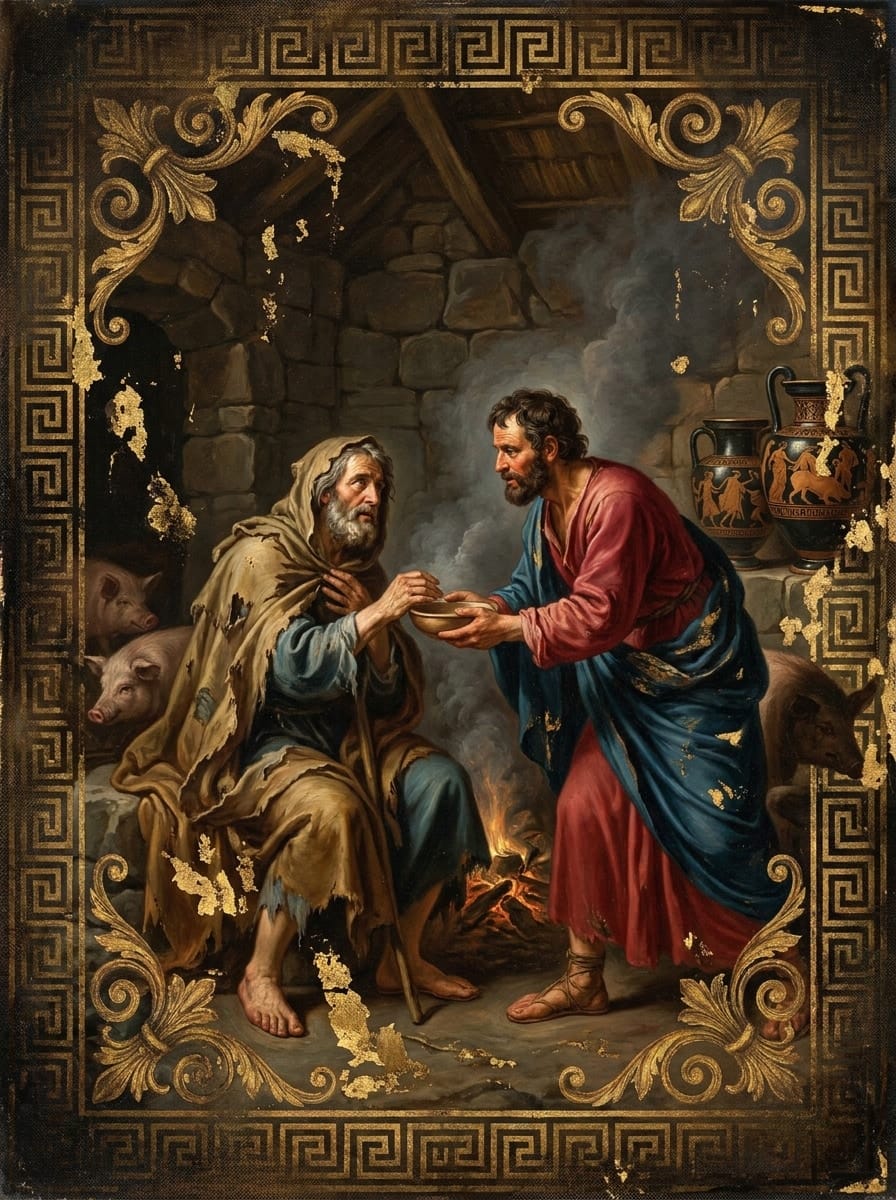
After Odysseus returns to Ithaca, he dares not enter his palace at once. Disguised as a poor old man, he seeks shelter with Eumaeus, the faithful swineherd. Eumaeus does not recognize his master, but he receives him with the plainest food and kindness, and Odysseus sees that, after twenty years away, someone in his household still keeps faith with the old loyalty.
Article
Summary
When Odysseus is brought back to Ithaca, Athena warns him not to hurry to the palace. The suitors crowd his halls, wasting his wealth and threatening Telemachus’ life. The goddess changes him into the shape of a poor old man and tells him first to seek out Eumaeus the swineherd. Eumaeus lives beside the distant pigsties, guarding Odysseus’ herds. He drives away the fierce dogs, welcomes the unknown old man, spreads skins for him, roasts pork, and pours wine. Odysseus cannot reveal himself, so he invents a tale of wandering and misfortune, testing what the swineherd still feels for his absent lord. Eumaeus speaks of Odysseus with grief and of the suitors with bitter hatred. He does not readily trust news brought by strangers, yet he still cares for the old man according to the sacred custom of hospitality. At night he finds him a cloak, while he himself sleeps outside in a hide, keeping watch beside the swine. Telemachus returns safely from abroad and also comes first to Eumaeus’ hut. Eumaeus receives him like a father welcoming a son, then goes into town as instructed to carry word to Penelope. While he is away, Athena restores Odysseus to his true appearance, and father and son at last recognize one another. After Odysseus and Telemachus have wept together in the swineherd’s hut, they begin to plan how they will deal with the suitors. When Eumaeus comes back, Odysseus has been changed once more into the seeming beggar. The faithful swineherd still knows nothing of the truth, yet without realizing it, he has guarded the first safe doorway of his master’s return.
A Strange Old Man Comes to the Pigsties
Odysseus had come home to Ithaca at last.
Yet he did not enter the city like a victorious king, nor did he hurry straight to his own palace. Morning mist still clung to the slopes, the rocks by the sea were wet with spray, and the island paths wound away toward fields, woods, and the lonely enclosures of the swine. Athena stood beside him and held back the urgency that had gathered in him through all his years of wandering.
She told him that his house was not at peace. The suitors sat day after day in his hall, slaughtering his sheep, drinking his wine, pressing Penelope to marry again, and plotting how to kill Telemachus. If Odysseus appeared now in his own form, before his hand was ready on the sword, word would reach them at once.
So the goddess stretched out her hand and changed his appearance. She wrinkled his skin, bent his shoulders, turned his hair gray, and covered him in ragged clothing, until he looked like an old wanderer worn down by hunger and sea winds. She gave him a rough staff and a shabby bag. Now even a familiar friend, passing close beside him, would see only a pitiful beggar.
“Go first to Eumaeus,” Athena said. “He keeps your swine, and he still bears goodwill toward you and your son.”
Odysseus obeyed and climbed the hill road toward the swineherd’s dwelling.
The place lay far from the town, surrounded by pens built of stone. Eumaeus himself had raised the wall with heavy rocks, set thorns along the top, and placed stakes outside to keep out wild beasts and thieves. Within were many well-fed pigs, divided among their pens. Watchdogs lay at the entrance; as soon as they heard a stranger’s step, they lifted their ears, bared their teeth, and rushed forward.
Odysseus did not draw a weapon, nor did he shout. He knew that for now he was only an old man. Quick-witted, he sat down on the ground and held his staff across his body. The dogs were about to spring when a sharp cry came from inside the hut.
Eumaeus ran out, holding a freshly cut piece of oxhide. He stooped, snatched up stones, and hurled them at the dogs, scolding them for forgetting how guests should be treated. When he had driven them away, he hurried to help the old man up and led him into the house.
“Old father, my dogs nearly tore you apart,” Eumaeus said. “If that had happened, the guilt would have fallen on me. Come in. My house is not rich, but when a guest comes to the door, he should at least have food.”
Odysseus lowered his head and followed him inside.
The Swineherd’s Meal
Eumaeus’ hut was small, but sturdily kept. Branches and hides lay on the floor, embers glowed in the hearth, and tools and straps hung along the wall. The swineherd seated his guest, spread a thick wild-goat skin on the ground for him, and brought out a piece of pork to roast over the fire.
He had no golden cups or silver dishes from the palace. He cut the meat, sprinkled it with barley meal, and poured wine. It was not a treasured vintage kept for noble guests, but it was clean and warm. Odysseus took the food, and his heart stirred within him.
He had seen countless warriors beneath the walls of Troy. He had reached the islands of giants and witches. He had known royal feasts and dangerous sweet words. Now he sat in a poor hut on his own island, while a servant called him stranger and set rough food before him. He could not speak his name. He could only eat slowly, like a beggar.
Eumaeus sat opposite him and sighed.
“These swine ought to be for my master’s use,” he said. “But my poor lord is dead somewhere, or lost, who knows where. Now lawless men occupy his house. Every day they feast and drink and slaughter his stock. They honor neither gods nor men. They are only waiting for the queen to yield, so they can divide this household among themselves.”
At the word “master,” Odysseus felt a movement in his heart, but he kept his voice under control and asked, “Who is this master of yours? In my wanderings, perhaps I have heard news of him.”
Eumaeus shook his head.
“Many men have come here claiming they saw him, all of them hoping for a cloak or a meal. My mistress hears such tales, weeps over them, and at last learns they were empty words. I will not believe so easily again. If Odysseus lives, he should have come home long ago. If he is dead, may the gods grant him rest.”
As he spoke, the sturdy swineherd’s eyes reddened. He did not live in comfort inside the palace, but kept watch over the herds in the hills; yet when he spoke of his master, he spoke as if of kin.
Odysseus looked at him with hidden joy and hidden pain. Joy, because after twenty years away someone still remembered him; pain, because he was near enough to touch this loyal servant and yet could not embrace him.
The Name He Would Not Reveal
Eumaeus asked the old man where he came from, what disaster had overtaken him, and why he had reached this place alone.
Odysseus had long since learned how to weave words in danger. He did not say that he was the king of Ithaca. Instead he said that he was from Crete, that in youth he had loved war and sea voyages, and that he had followed an army to Troy. Afterward, he said, he had suffered bitterly at sea: ships broken, companions dead, himself driven from one land to another by storms and evil men.
He told the story as if it were true, filling it with a father, ships, spoils of war, betrayal, and escape. He even mentioned Odysseus, saying that in a distant place he had heard the hero was still alive.
At this Eumaeus’ face changed. It was not that he had no hope, but hope had lasted so long that he feared being deceived again.
“Old man,” he said, “I will feed you and shelter you, for Zeus watches over wanderers too. But if you say my master is alive, I cannot simply believe you. Beggars know that if they say Odysseus is coming home, the people in this house will give them more. I do not like such lies.”
Odysseus was not angry. He looked into the fire and answered slowly, “I ask you for no reward. If my words prove false, you may throw me from a cliff. If they prove true, all I ask is a cloak.”
Still Eumaeus would not yield; he said that all things rested with the gods. Then he spoke of Telemachus. The boy, he said, had grown into a young man, yet suffered under the pressure of the suitors in the palace. Now he had gone abroad to seek news of his father, and even on that journey he might not be safe.
When Odysseus heard his son’s name, it was as if fire touched him. Telemachus had still been an infant when he left home; now he was old enough to sail in search of his father. Father and son had been divided for twenty years, and still the same violent men hemmed them both in.
Night gradually fell. Outside, the swine grunted and crowded together in their pens, and a cold wind blew down from the hills. Eumaeus secured the pigs and told his men to keep special watch over the best boars, since the suitors would send for meat again the next day. When he came back inside, he noticed the old man’s thin clothing and looked at him more closely.
Odysseus deliberately told a tale from an old battlefield: once, during a night ambush, the cold had been cruel, and a clever warrior had spoken in such a way that a comrade lent him his cloak. Eumaeus understood the meaning. He did not laugh. He told one of the herdsmen to bring a cloak and a thick hide so the old man could sleep warm.
“A guest must not freeze to death in my house,” he said.
Odysseus wrapped the cloak around himself and lay beside the fire. Eumaeus, however, did not remain in the warmth. He put on a heavy hide, took up his sharp spear, and went outside to sleep among the swine, guarding them from wild beasts and thieves. Odysseus watched him go and understood: this man was not loyal in words only. He kept watch for his master even through the cold of night.
Telemachus Comes Home
At daybreak Eumaeus was already busy again. He ordered the herdsmen to tend the swine, gave his guest more food, and spoke of going into town to learn news of Penelope. Just then Athena, guiding Telemachus from the shore, brought him safely back to Ithaca.
Young Telemachus had escaped the suitors’ ambush. He did not go first to the palace, but, as the goddess had arranged, came to Eumaeus’ pigsties. When Eumaeus saw him, he was like a father seeing his son return from a far journey. He dropped his work, ran to him, kissed his head and eyes, and could not hold back his tears.
“You have come back!” he cried. “I thought I would never see you again. Come inside quickly. Your mother grieves for you every day.”
Telemachus steadied him, then noticed the ragged old man sitting in the hut. He did not despise him, but asked Eumaeus who the guest was and where he came from. Eumaeus described him as a poor wanderer and asked Telemachus to take him into town and give him some chance of life.
Telemachus answered with difficulty, “I am not safe in my own house. The suitors fill the hall, and at any moment they may try to kill me. If I bring the old man there, they may insult him, even strike him. Let him stay here for now. I will send clothing and food.”
Odysseus sat nearby and listened to his son speak. He saw that the young man was cautious, able to endure, and still mindful of pity toward the poor; his heart ached and rejoiced at once.
Before long, Telemachus sent Eumaeus into town to tell Penelope that he had returned safely, but to spread the news no further, lest the suitors hear of it. Eumaeus agreed at once, put on his cloak, and set out along the road toward the city.
Only father and son were left in the hut.
Before Father and Son Are Known to Each Other
As soon as Eumaeus had gone far enough, Athena came to the doorway. She did not let Telemachus see her, but she made a sign to Odysseus. Odysseus stepped outside, and the goddess touched him with her golden wand. His bent back straightened, the wrinkles left his face, his torn clothing became clean and fine, and he was once more the broad-shouldered, steadfast-eyed hero.
When he returned inside, Telemachus sprang up in astonishment. He thought the one before him could not be mortal, but must be some god, and he dared not look straight at him.
Then Odysseus spoke: “I am no god. I am the father for whom you have longed all these years.”
Telemachus could not believe him at once. For twenty years he had heard too many reports about his father: some said he was dead, others that he still lived. The man before him had been a beggar only a moment ago and now looked like a hero. How could he trust so sudden a change?
Odysseus told him that Athena had altered his appearance. He said he had endured countless disasters at sea and had at last returned home, but could not reveal himself openly yet. There were too many enemies in the palace. First they must learn who was loyal and who was false; only then could they strike and take back the house.
As Telemachus listened, belief overcame him at last. He threw himself into his father’s arms. Father and son clung to each other and wept. One had left home in the strength of his manhood and had been worn by hardship; the other had lost his father almost at birth and had now grown into a young man. Outside, the swine cried in their pens, and the wind passed over the stone wall, but in that remote herdsman’s hut lay the greatest secret in Ithaca.
When their weeping was done, Odysseus quickly mastered himself. He asked how many suitors were in the palace, which were the most violent, and which servants in the household might still be trusted. Telemachus told him all he knew: they came from Ithaca and the neighboring islands, they were many, and they spent their days eating, drinking, and behaving with shameless arrogance.
Father and son then settled their plan. Telemachus would return first to the palace and betray nothing. Odysseus would remain disguised as a beggar and later be brought into town by Eumaeus. Whatever insults or blows he suffered in the hall, Telemachus must endure it and not reveal too soon that father and son were acting together. When the right moment came, they would take down the weapons and turn upon the suitors.
When this was decided, Athena changed Odysseus back into the old beggar. Wrinkles climbed over his face again, and the ragged cloak returned to his shoulders. When Eumaeus came back from town, the man he saw was still the same pitiable stranger.
Eumaeus suspected nothing. He brought news from the palace and was relieved that Telemachus had come home safely. The three sat in the herdsman’s hut and ate their simple meal. The loyal swineherd did not know that the wanderer he had sheltered was his long-lost master. Still less did he know that, in this very hut, father and son had already planned their return to the palace.
Night fell once more over the hills of Ithaca. Outside the pens, dogs kept watch; inside the hut, firelight flickered. Odysseus sat quietly beside Eumaeus, wrapped in the beggar’s rags. He had seen now that although wicked men occupied his house, it had not been wholly ruined. At least here, beside the distant pigsties, one man still remembered his master, honored the guest, and guarded what ought to be guarded. Because such loyalty remained, Odysseus’ road home was no longer one he had to walk alone.