Greek Mythology
The Oath of Tyndareus — Greek Mythology
When Helen, princess of Sparta, came of age, her beauty was spoken of throughout Greece, and heroes from many lands came to seek her hand. Tyndareus feared that choosing one man would make enemies of all the rest, until he followed Odysseus’ counsel and made every suitor swear in advance: whoever married Helen, they would all defend that marriage.
Article
Summary
When Helen came of age, the fame of her beauty drew suitors from across Greece, and the wheels of their chariots sounded before the palace of Sparta. Princes, heroes, and noblemen arrived with gifts: gold cups, woven robes, horses, and weapons. Tyndareus saw them all looking toward the same woman, and his unease grew with every guest. He feared that choosing one husband would turn the rejected men from disappointment to insult and hatred. These suitors were backed by lands, ships, and warriors, so a marriage quarrel could easily become a struggle between houses and cities. What should have been a joyful match for Helen became, in Tyndareus' eyes, a danger that might bring war. Odysseus of Ithaca understood the problem and offered a plan. Before any choice was announced, every suitor should swear before the gods to accept whoever became Helen's husband. If anyone later carried Helen away or harmed that husband, all who had once sought her hand would come to his aid. Tyndareus saw the wisdom of it: while each man still hoped to be chosen, none would dare refuse such an oath. So the heroes were summoned before the altar, and one by one they spoke words they could not take back. As the fire and sacrificial smoke rose, they accepted the same promise under the eyes of the gods. Only afterward did Helen choose Menelaus, son of Atreus. The disappointed men had just sworn, and so they gathered up their gifts and attendants and left Sparta without drawing swords. The marriage seemed safely settled: Helen became Menelaus' wife, and Tyndareus later entrusted him with the rule of Sparta. Yet the words spoken at the altar did not fade. Years later, when Paris carried Helen away, Menelaus could summon the old suitors to keep their promise. Tyndareus had meant the oath to prevent strife, but it helped gather the Greek kings at Aulis and set their ships on the road to Troy.
Wheels Before the Palace of Sparta
In Sparta, the palace of Tyndareus slowly lost its quiet.
At first there was only dust on the far road and a few chariots stopping outside the gates. Then more came. Attendants led horses by the reins, servants carried gifts, and bronze armor flashed in the sun. One man brought golden cups, another finely woven robes; others arrived with swift horses or splendid weapons. Day and night people passed through the palace doors, and in the halls one could often hear unfamiliar footsteps and lowered voices.
They had all come for Helen.
Helen was the daughter of Leda and had grown up in Sparta. Word of her beauty had already traveled across Greece, swifter than any messenger. Some said that when she crossed the courtyard, her companions stopped their spinning to look at her. Others said that young men in distant lands needed only to hear her name before they longed to see Sparta for themselves. Such rumors spread farther and farther, until they drew many famous heroes to her father’s house.
Noblemen came from Mycenae and Argos; men came from Pylos and Aetolia; princes arrived from Crete, Ithaca, Salamis, and many other cities. These were no ordinary young men. Many had behind them their fathers’ lands, ships, and warriors. They sat in Tyndareus’ hall, speaking politely, yet their eyes kept measuring one another. Each understood that he desired not a gift, not an honor casually bestowed, but the same woman.
Tyndareus watched it all, and his heart grew heavier.
The Father Who Dared Not Choose
If only two or three suitors had come, the matter might have been settled easily. But now seated before him were some of the most honored young men in Greece. Their gifts lay piled indoors, their attendants waited outside, their horses stood tied beneath the trees. The moment Tyndareus named Helen’s husband, every other man would know he had been rejected.
And what would the rejected men do?
Some might swallow the insult, gather up their gifts, and go home. But others might feel dishonored. Greek heroes cared deeply for reputation, for oaths, and for the glory that marriage could bring. For the sake of a woman, or a single resentful word, swords might be drawn. Tyndareus had seen enough of the world to know this. Anger carried from a feast into the open could become a quarrel; a quarrel, once families and allies took part, could become a war.
By day he entertained his guests; by night he could not sleep. When the lamps in the palace had gone out, he still lay awake, turning the matter over in his mind. If he chose this man, would another raise an army? If he chose that one, would others unite against Sparta? Helen’s marriage should have been a joyous affair, yet now it pressed on him like a stone on the chest.
It was then that one man saw his difficulty.
That man was Odysseus of Ithaca.
Odysseus too was among the suitors. He was not one of those who spoke only with the strength of their arms or the fame of their houses. Often he sat aside and listened while others argued, yet his eyes missed no one in the hall. He knew that Helen might not choose him. He also knew that what Tyndareus feared most was not the size of the bridal gifts, but the resentment that would remain after the marriage.
So Odysseus found a chance to speak with Tyndareus.
The Counsel of Odysseus
Odysseus did not begin by pressing his own suit. Instead, he told Tyndareus that he knew a way to spare Sparta from future disaster.
The plan was not complicated, but it had to be carried out before the bridegroom was announced.
First, all the suitors should be gathered together and made to swear before the gods: whoever Helen chose in the end, or whoever Tyndareus gave her to, the others must accept the marriage. If anyone ever harmed Helen’s husband, or carried Helen away from his side, every man who had once sought her hand must help the injured husband and join in punishing the wrongdoer.
When Tyndareus heard this, he understood.
If he chose a son-in-law first and only afterward demanded an oath, the rejected men would already be embittered and might refuse. But if they swore before the choice was made, each would still believe he had hope, and none would wish to appear cowardly or dishonorable. No man would want to admit before the others that, if he failed to win Helen, he would turn against another man’s marriage. In this way the oath would bind them first; once the decision was made, they could not easily take it back.
Tyndareus was grateful to Odysseus, and promised to help him find another suitable marriage. In time, Odysseus did indeed marry Penelope, the daughter of Icarius. But that belonged to a later part of the story. For the moment, the urgent matter was Helen’s choice.
The Oath Before the Altar
Tyndareus followed Odysseus’ advice and summoned the suitors.
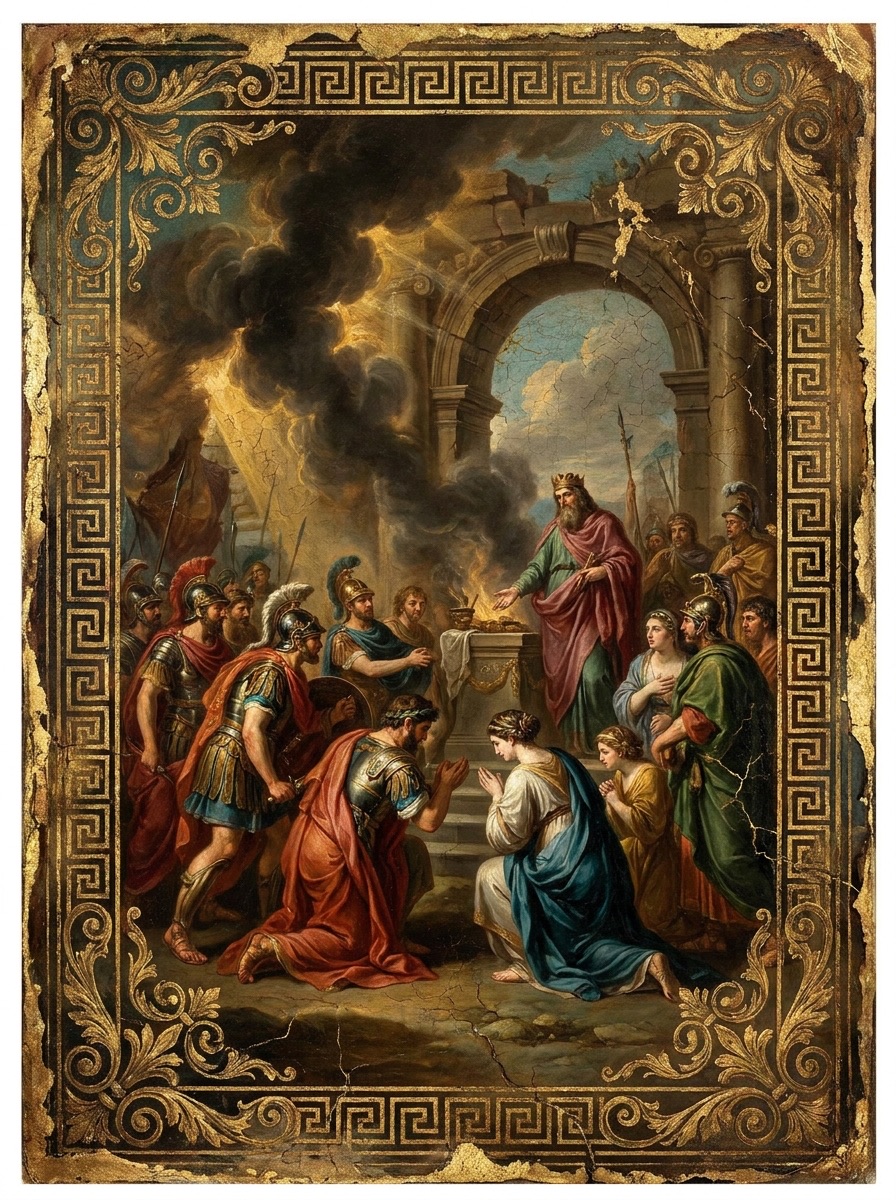
On that day the sacrifice was prepared before the altar. Flames rose, and smoke carrying the smell of fat drifted upward. The heroes stood around it; their chariots waited at a distance; their attendants did not dare speak loudly. Everyone knew this was no ordinary feast and no contest of strength. Tyndareus was asking them first to speak words before the gods that could not be withdrawn.
One by one they came forward. Some laid a hand beside the altar; some lifted a hand toward the sky. All acknowledged the same oath: whoever became Helen’s husband, they would defend the marriage; if anyone took Helen away by deceit or force, they would aid the wronged husband and seek justice against the offender.
Perhaps, as they spoke, some of them did not think very far ahead. They were still wondering whether Helen would look toward them, whether their gifts were rich enough, which house Tyndareus favored in his heart. Perhaps some thought this was only a custom before a wedding: if they were chosen, the oath would protect them; if they were rejected, they would depart with dignity.
But the gods heard the oath. Words spoken before an altar are not like wine in a cup, swallowed and forgotten. They remain upon those who speak them, like unseen cords.
Helen Chooses Menelaus
Once the oath had been sworn, Tyndareus could at last make his decision.
Helen’s husband would be Menelaus, son of Atreus and brother of Agamemnon. Agamemnon was already powerful, holding authority in the region of Mycenae. Menelaus was not as commanding as his elder brother, but he was nobly born and came with a name worthy of the royal house of Sparta.
When that name was spoken, there must have been a brief stillness in the hall. Many eyes turned toward Menelaus, and then toward Tyndareus. Some men were disappointed; some quietly resented the choice; some perhaps had already clenched their hands. Yet they had just sworn before the altar, and could not at once turn hostile.
So the gifts were gathered up, and the chariots began to leave. The rejected suitors returned with their attendants to their own cities. Dust rose on the roads again, only now it marked their departure from Sparta, not their arrival as bride-seekers. The palace slowly grew quiet once more. Helen married Menelaus. Later, Tyndareus handed the kingship over to him as well, and Menelaus became lord of Sparta.
The marriage seemed to have ended the matter peacefully.
Feasts come to an end, songs fall silent, and wedding gifts are stored away in treasure rooms. People may have thought that the suitors had gone back to their separate lives, and that the oath was only an old memory. But the words spoken that day before the altar had not scattered on the wind.
Words That Did Not Disappear
Many years later, Paris, prince of Troy, came to Sparta. Menelaus received him as a guest, but Paris carried Helen away. Different traditions tell the matter differently: that Helen was deceived, that she was abducted, or that she followed willingly. Yet for the Greeks, the result was plain: Menelaus had lost his wife, and Sparta had been shamed.
Then the oath once devised by Tyndareus was raised again.
Menelaus was not merely an offended husband. Behind him stood the men who had sworn before the Spartan altar. By now those men had returned to their own kingdoms. Some had become kings; some commanded fleets; some possessed warriors and cities. Years had passed, and perhaps many no longer thought of the crowded days when they came to court Helen. But the oath was still waiting for them.
So the message traveled from city to city. The old suitors were called upon to keep their promise and help Menelaus recover Helen. Some agreed readily, some hesitated, and some tried to find a way out; but all knew that this was no idle word spoken in passing. It had been uttered before an altar, with the gods as witnesses.
Helen’s marriage had begun as a choice within the palace of Sparta. Tyndareus had meant the oath to prevent strife. He could not have known that one day it would gather the ships of so many Greek heroes in the bay of Aulis, and carry their spears and shields toward Troy.
Afterward, when people spoke of Helen’s suitors, they remembered not only how they came to Sparta with gifts, but how they stood before the altar and spoke the same promise. That promise saved a wedding in its own hour; later, it became one of the beginnings of the expedition to Troy.